
What Is Direct Lithium Extraction and How Does It Help EVs?

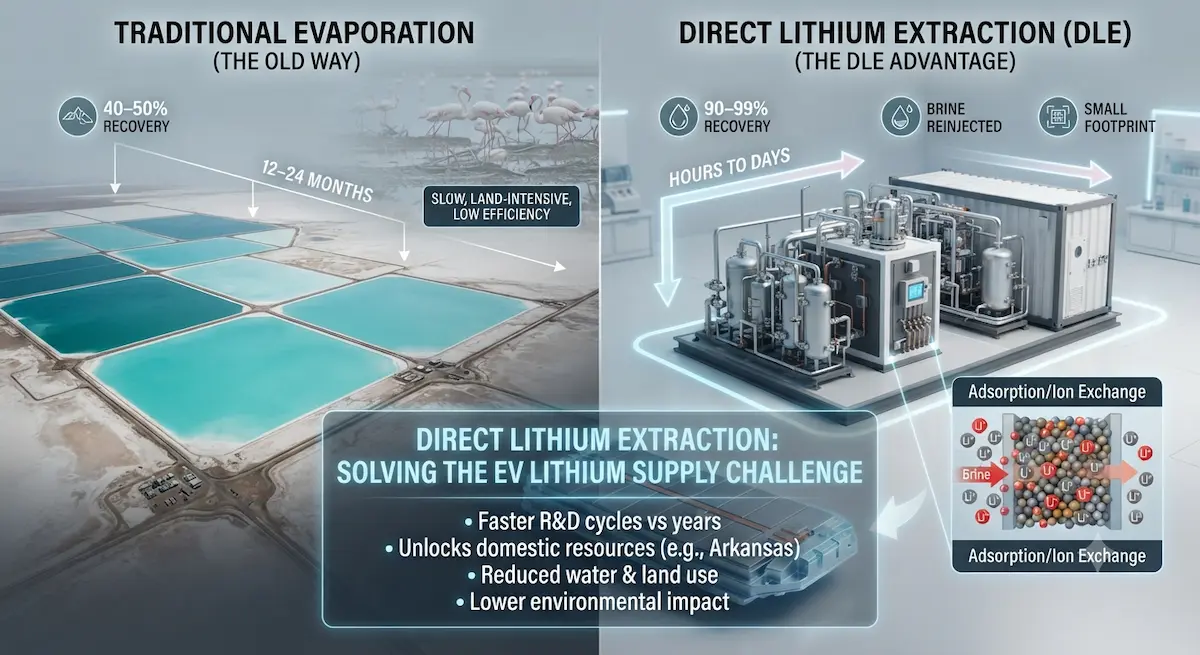
As electric vehicle demand continues to grow, the world needs more lithium than ever before. Traditional lithium extraction is slow and uses large amounts of land and water. Direct Lithium Extraction (DLE) offers a faster and more efficient way to produce lithium, helping manufacturers build more EV batteries while reducing environmental impact.
Lithium is only one part of the sustainability picture — see our guide on how nickel mining affects EV battery sustainability.
Direct Lithium Extraction
Direct Lithium Extraction (DLE) is a group of advanced technologies that recover lithium directly from lithium-rich brine in hours or days instead of 12 to 24 months. Unlike traditional evaporation ponds, DLE separates lithium from brine without waiting for water to evaporate naturally.
DLE can recover 90–99% of the available lithium, while traditional evaporation methods usually recover only 40–50%. It also requires much less land and water and can extract lithium from geothermal brines, oilfield-produced water, and other low-concentration sources that are not economical with evaporation ponds.
For the EV industry, DLE helps improve lithium supply security. Since 2021, lithium shortages and price spikes have disrupted battery manufacturing worldwide. DLE provides a faster and more sustainable way to increase lithium production, supporting the 3–6× growth expected between 2030 and 2050.
How Traditional Brine Lithium Extraction Works
Around 59% of the world’s lithium comes from underground brine reservoirs. These saltwater deposits are found mainly beneath the South American Lithium Triangle, which includes Chile, Argentina, and Bolivia.
Traditional extraction begins by pumping lithium-rich brine into large evaporation ponds. These ponds can cover thousands of hectares. Sunlight and wind slowly evaporate the water over 12 to 24 months, leaving behind a more concentrated brine. After that, chemical processing converts the concentrated solution into lithium carbonate or lithium hydroxide, both of which are used to manufacture EV batteries.
Although the process has been used for decades, it has several major drawbacks.
Slow Production
The biggest limitation is time. It takes 12 to 24 months to produce lithium after pumping the brine. This makes it difficult for producers to respond quickly when EV demand increases.
Low Lithium Recovery
Traditional evaporation ponds recover only 40–50% of the lithium available in the brine. The remaining lithium is lost in waste streams, discarded with tailings, or left behind in the depleted brine.
Large Land Requirements
Evaporation ponds require thousands of hectares of flat land. Building these facilities changes natural landscapes and damages high-altitude salar ecosystems, which support wildlife such as flamingos, unique algae, and native plants.
High Water Consumption
Many evaporation projects operate in extremely dry regions, including the Atacama Desert. Large amounts of water are lost through evaporation, reducing water availability for nearby communities and sensitive ecosystems.
How Direct Lithium Extraction Works
Instead of waiting months for water to evaporate, Direct Lithium Extraction removes lithium directly from the brine using selective chemical or physical processes.
The process is much faster. Brine is pumped from underground and passed through a DLE system that captures lithium while allowing the remaining brine to be reinjected into the aquifer or reused. The extracted lithium is then processed into lithium carbonate or lithium hydroxide for battery production.
Several DLE technologies are currently under commercial development.
Adsorption
Adsorption uses a solid sorbent material that attracts lithium ions while allowing sodium, magnesium, potassium, and other minerals to pass through.
After the sorbent becomes full, it is washed to release a concentrated lithium solution for further processing.
Companies including EnergyX, Lithium Harvest, and Standard Lithium are developing adsorption-based DLE systems. Depending on the brine, recovery rates typically range from 70–90%.
Ion Exchange
Ion exchange works similarly but uses specialized polymer resins instead of solid sorbents.
These resins selectively capture lithium ions while rejecting competing minerals such as sodium and magnesium. This technology performs best when high lithium selectivity can be maintained despite the complex chemistry of natural brines.
Several companies, including Li-Industries, are developing ion exchange systems for different types of lithium resources.
Solvent Extraction
In solvent extraction, the brine is mixed with a special organic solvent that selectively absorbs lithium.
The lithium is then transferred into a purified water-based solution before final refining.
Summit Nanotech reports lithium recovery rates between 90% and 99.9% using advanced nanomaterial-enhanced solvent extraction technology.
Membrane Separation
Membrane-based DLE uses ion-selective membranes that allow lithium ions to pass through while blocking larger competing ions.
Although membrane systems generally require more energy than adsorption, they may provide higher lithium selectivity for certain brine compositions.
Companies such as Evove are actively developing this technology.
Electrochemical Extraction
Electrochemical DLE uses electrical current to move lithium ions through selective membranes into a concentrated product stream.
This method offers excellent lithium selectivity and could integrate well with renewable energy sources, although it currently consumes more energy than some other DLE technologies.
Lilac Solutions is one of the leading companies developing electrochemical lithium extraction systems.
DLE vs Traditional Evaporation: Full Comparison
| Factor | Evaporation Ponds (Traditional) | Direct Lithium Extraction |
|---|---|---|
| Recovery rate | 40–50% of available lithium | 70–99% (technology-dependent) |
| Time to production | 12–24 months | Hours to days |
| Land footprint | Thousands of hectares of evaporation ponds | Industrial plant on a fraction of the land |
| Water consumption | High — evaporation water lost | Low — brine reinjected or reused |
| Brine sources | High-Li, low-Mg continental brines only | Geothermal, oilfield, low-Li, high-Mg brines also viable |
| Carbon emissions | Relatively low (mainly solar evaporation) | 50% lower claimed by some DLE providers (Summit Nanotech) |
| Ecosystem impact | Salar ecosystem destruction; flamingo habitat loss | Dramatically reduced footprint |
| Response to demand | Slow — 2–5 years to new production | Faster — months to scale vs years for pond development |
| Commercial maturity | Fully mature; decades of production | Commercial pilots scaling; no purely DLE plant at full commercial scale yet (2026) |
The Arkansas Opportunity for U.S. Lithium Production
The United States currently relies heavily on imported battery-grade lithium. Direct Lithium Extraction offers a practical way to increase domestic production without building large evaporation ponds.
One of the most promising locations is the Smackover Formation in southern Arkansas. This underground formation contains lithium-rich geothermal brines that have been produced for decades during oil and gas operations.
Instead of drilling entirely new wells, companies can use much of the existing infrastructure to deliver lithium-rich brine to DLE facilities. This could reduce development costs while increasing domestic lithium production.
Several major companies have announced projects in Arkansas, including:
- Standard Lithium
- Albemarle
- EconoLithium
These projects represent billions of dollars in planned investment and could help build a more secure U.S. battery supply chain.
Lithium produced in the United States may also qualify as a domestic critical mineral under U.S. policies such as the Inflation Reduction Act (IRA). Using domestic lithium can help automakers meet battery sourcing requirements for EV tax incentives.
Interest from automakers continues to grow. GM Ventures invested $50 million in EnergyX to help secure future domestic lithium supplies for electric vehicle production.
According to BloombergNEF, DLE could supply approximately 17% of global lithium demand by 2030, compared with about 11% in 2024.
DLE’s Role in the EV Battery Supply Chain
Lithium is one of the most important raw materials used in modern EV batteries. A stable lithium supply helps manufacturers control battery costs and meet growing demand.
In recent years, lithium prices have changed rapidly because traditional production cannot increase output quickly. Since evaporation ponds require two to five years to reach production, they cannot respond fast enough when demand suddenly rises.
Direct Lithium Extraction changes that situation.
Because DLE can begin producing lithium much sooner, companies can expand production more quickly when market demand increases. Faster production may help reduce extreme price swings and improve long-term supply stability.
This is especially important for automakers that sign five- to ten-year battery supply agreements. More predictable lithium prices make it easier to plan future EV production and control manufacturing costs.
Supporting Battery Recycling
Direct Lithium Extraction is not limited to natural brine resources.
Researchers are also applying similar technologies to recover lithium from spent EV batteries during the recycling process.
Instead of losing valuable lithium during conventional chemical treatment, DLE methods can recover much more of the metal from battery black mass.
Research published through ScienceDirect suggests lithium recovery could improve from roughly 70–80% with conventional hydrometallurgical processes to 90–95% using advanced DLE-based methods.
Recovering more lithium from used batteries helps build a circular battery economy, reducing the need for newly mined lithium while supporting long-term EV sustainability.
See the full picture of which chemistries recycle best in our guide on which EV battery chemistry is most recyclable.
Advantages of Direct Lithium Extraction
Direct Lithium Extraction offers several benefits over traditional evaporation ponds. It produces lithium faster, recovers more lithium from the same brine, and reduces the environmental footprint of lithium production. These advantages make DLE one of the most promising technologies for supporting the growing EV battery industry.
- Higher lithium recovery: Most DLE technologies recover 70–99% of available lithium, compared with 40–50% for traditional evaporation ponds.
- Faster production: Lithium can be extracted in hours or days instead of waiting 12–24 months for water to evaporate.
- Lower land use: DLE facilities require only a small industrial site instead of thousands of hectares of evaporation ponds.
- Reduced water loss: Many DLE systems reinject or reuse brine, helping conserve water in arid regions.
- More resource flexibility: DLE can process geothermal brines, oilfield-produced water, and low-concentration brines that are not practical for evaporation methods.
- Supports domestic lithium production: Countries like the United States can develop lithium resources using existing geothermal and oilfield infrastructure.
- Improves battery recycling: Similar technologies can recover more lithium from spent EV batteries, supporting a circular battery economy.
Disadvantages of Direct Lithium Extraction
Although Direct Lithium Extraction has significant potential, it also faces several technical and economic challenges. Most DLE technologies are still moving from pilot projects to full commercial production, and some issues must be solved before widespread adoption.
- Limited commercial experience: As of mid-2026, no purely DLE-based lithium plant has reached full commercial-scale operation.
- High initial investment: Building DLE facilities requires advanced equipment and significant upfront capital.
- Sorbent and resin degradation: Materials used to capture lithium gradually lose efficiency and must be replaced, increasing operating costs.
- Complex brine chemistry: Brines with high magnesium or other competing minerals often require additional treatment before lithium can be extracted efficiently.
- Scale-up challenges: Achieving laboratory performance at industrial production levels remains technically difficult and expensive.
- Energy requirements: Some DLE methods, particularly electrochemical systems, consume more energy than traditional evaporation processes.
- Water management requirements: Extracted brine must be properly treated before reinjection or reuse to protect underground aquifers and maintain environmental safety.
Current Challenges and Commercial Status
Direct Lithium Extraction has shown great potential, but it is still an emerging technology. While many pilot projects have produced encouraging results, no purely DLE-based lithium plant has reached full commercial-scale production as of mid-2026.
Before DLE becomes widely adopted, several technical and economic challenges must be addressed.
Sorbent and Resin Degradation
Many DLE systems rely on specialized sorbents or ion-exchange resins to capture lithium.
Over time, these materials gradually lose their performance after repeated use. Replacing them increases operating costs and adds maintenance requirements for commercial plants.
High-Magnesium Brines
Not all lithium brines have the same chemical composition.
Many geothermal and oilfield brines contain high levels of magnesium, making it more difficult to separate lithium efficiently. Additional treatment is often needed before extraction, increasing both cost and process complexity.
Scaling Up Production
Producing lithium in a laboratory is much easier than operating a facility that processes thousands of tonnes of lithium each year.
Many companies have found that scaling up DLE systems requires larger investments, new engineering solutions, and extensive testing before reaching commercial production.
Water Management
Although DLE uses much less water than evaporation ponds, proper water management is still essential.
After lithium is removed, the remaining brine must often be treated before it can be reused or safely reinjected into underground aquifers. Managing water quality, temperature, and dissolved minerals is an important part of every DLE project.
Conclusion
Direct Lithium Extraction (DLE) changes how we get lithium for electric vehicles. This technology makes lithium production faster, cleaner, and more widespread. It turns a slow and controversial process into a better resource for the future.
DLE unlocks domestic U.S. lithium from Arkansas geothermal brines. It also uses less land and water than older methods. Major automakers and battery makers are investing billions of dollars into this technology for the coming years.
Cheaper, faster lithium supply also flows directly into cell pricing — see our guide on how battery chemistry affects manufacturing cost.
Frequently Asked Questions
What is Direct Lithium Extraction (DLE)?
Direct Lithium Extraction (DLE) is a group of technologies that remove lithium directly from underground brine using selective chemical or physical processes. Unlike evaporation ponds that take 12 to 24 months, DLE can recover lithium in hours or days while achieving 70–99% recovery rates, depending on the technology used.
Is Direct Lithium Extraction commercially available?
Yes, but it is still in the commercial demonstration and early deployment stage.
Several companies are building larger DLE facilities in Arkansas, Chile, Argentina, and Canada, but no fully commercial plant using only DLE technology has operated at large scale as of mid-2026.
Industry analysts expect DLE to become a much larger part of global lithium production during the next decade.
How does DLE help electric vehicles?
Compared with traditional evaporation ponds, DLE generally has a smaller environmental footprint.
It uses less land, reduces water loss, and can recover significantly more lithium from the same amount of brine. Many DLE systems also allow depleted brine to be reinjected underground, helping protect local water resources.
