
Hyundai Ioniq 7 Battery: Complete Guide

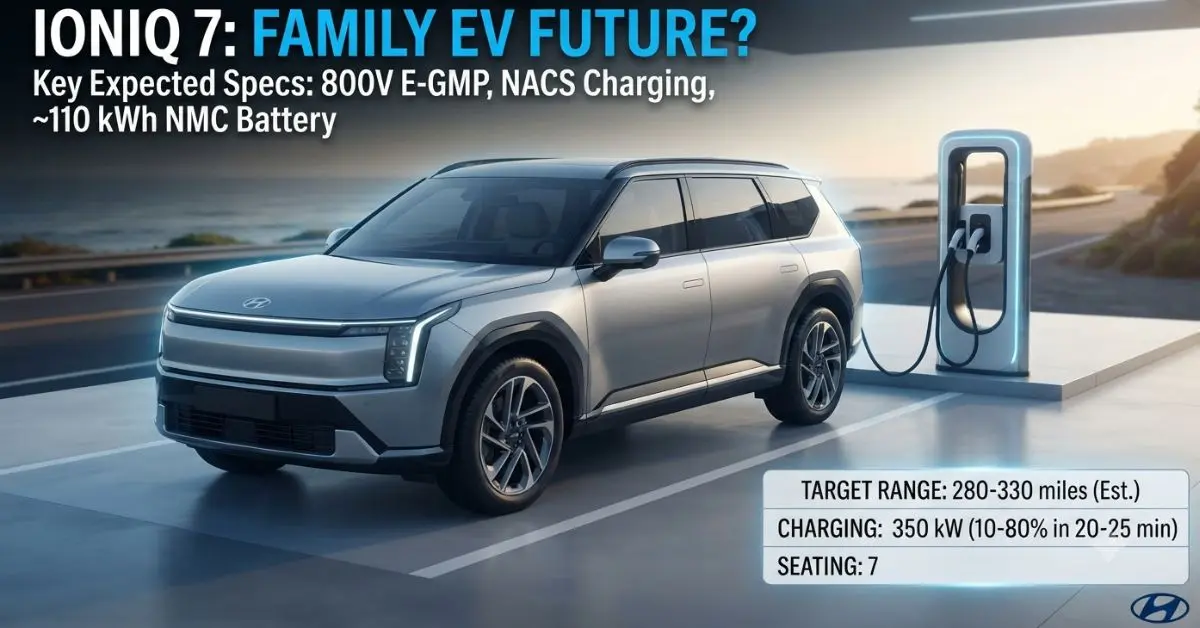
The Hyundai Ioniq 7 is an upcoming electric SUV with three rows of seats. It uses Hyundai’s special 800-volt E-GMP platform. It will be smaller than the new Hyundai Ioniq 9. While Hyundai has not shared official details yet, experts expect the car to use a large 100–110 kWh battery. This battery will likely allow the SUV to travel between 280 and 330 miles on a single charge.
The Ioniq 7 will feature 350 kW DC fast charging. This technology charges the battery from 10% to 80% in about 20 to 25 minutes. Hyundai will include a NACS charging port, which lets drivers use Tesla Superchargers. The car will also have V2L, or “Vehicle-to-Load,” technology. This lets you use the car’s battery to power electronic devices like laptops or camping gear.
This SUV will compete against the Tesla Model X, Rivian R1S, and the Kia EV9 GT-Line. Hyundai designed the Ioniq 7 to be a premium choice for families who want a fully electric vehicle with plenty of space.
Hyundai Ioniq 7: What We Know and Expect
| Specification | Expected (Based on E-GMP Platform) | Source / Confidence |
|---|---|---|
| Platform | 800V E-GMP | Confirmed (all Ioniq EVs) |
| Battery size | ~100–110 kWh NMC | Industry analyst estimate |
| EPA range estimate | 280–330 miles | Recharged.com analysis |
| DC fast charging | 350 kW (similar to Ioniq 9) | Based on platform capability |
| 10–80% DC time | ~20–25 minutes | Based on 110.3 kWh Ioniq 9 at 350 kW: 24 min |
| Charging port (US) | Native NACS | All 2025+ Hyundai EVs standard |
| V2L / V2H | Standard (V2L confirmed on E-GMP) | All E-GMP models carry V2L |
| Seating | 6 or 7 seats | Three-row configuration expected |
| Expected launch | 2026–2027 | Unofficial/unconfirmed |
| Starting price (est.) | $55,000–$70,000 (US) | Analyst estimate |
Ioniq 7 vs Ioniq 9: How Will They Differ?
Hyundai confirms the Ioniq 9. It features an 110.3 kWh NMC battery. It offers 311–335 miles of EPA range. You can charge it at 350 kW in 24 minutes. Prices start near $61,450.
The Ioniq 7 will likely be smaller and lighter than the Ioniq 9. It sits below the Ioniq 9 in size and price. Recharged.com suggests the Ioniq 7 targets families who need more space than a two-row EV but want less luxury than the Ioniq 9.
Hyundai may position the Ioniq 7 as a value-oriented, three-row SUV. It might use a rear-only motor to increase range from a smaller battery. This strategy mirrors the single-motor efficiency found in the Genesis GV60.
Why the Ioniq 7 Matters: The Market Gap
The most accessible three-row electric SUVs in the U.S. in 2026 are the Kia EV9 (from ~$56,395), the Rivian R1S (from ~$78,000), and the Tesla Model X (from ~$79,990). A Hyundai-branded three-row EV positioned between $55,000–$70,000 with Hyundai’s class-leading battery warranty would address a real pricing gap. The Ioniq 7 could bring the E-GMP’s proven 800V fast charging and V2L to buyers who want three rows at a more accessible price point than the Ioniq 9 or Rivian R1S.
E-GMP Platform: What the Ioniq 7 Will Inherit
All Hyundai E-GMP vehicles share core features. The 800V architecture allows for ultra-fast DC charging across the platform, like in the high-performance Kia EV6 GT. Drivers use V2L (Vehicle-to-Load) technology to power external appliances and devices directly from the traction battery.
Navigation systems automatically activate battery preconditioning when routing to a DC charger. All new Hyundai EVs now include the NACS (North American Charging Standard) port as a standard feature. These E-GMP batteries also carry a 10-year, 100,000-mile warranty in the U.S.
Important: No Official Specs Confirmed
All specifications above are industry estimates and analyst projections — Hyundai has not officially confirmed any Ioniq 7 specifications, pricing, or launch timeline as of June 2026. Hyundai has focused its three-row announcements on the Ioniq 9. The Ioniq 7 name and positioning are widely discussed in automotive media but remain unconfirmed. Buyers considering a three-row EV who are interested in the Ioniq 7 should monitor Hyundai’s official announcements through 2026–2027 for confirmed details. For immediate three-row needs in 2026, the Ioniq 9, Kia EV9, and Rivian R1S are confirmed production alternatives.
Three-Row Electric SUV Comparison: Current Options vs Expected Ioniq 7
| Model | Battery | Range (EPA) | DC Rate | Starting Price (US) | Status |
|---|---|---|---|---|---|
| Hyundai Ioniq 9 (confirmed) | 110.3 kWh NMC | 311–335 miles | 350 kW | ~$61,450 | On sale 2026 |
| Kia EV9 GT-Line | 99.8 kWh NMC | ~280 miles | 239 kW | ~$65,000 | On sale 2026 |
| Rivian R1S (Large Pack) | 108.5 kWh NMC | ~321 miles | 220 kW | ~$78,000 | On sale 2026 |
| Hyundai Ioniq 7 (expected) | ~100–110 kWh NMC | 280–330 miles (est.) | 350 kW (est.) | $55,000–$70,000 (est.) | Expected 2026–2027 |
Conclusion
In mid-2026, details about the Hyundai Ioniq 7 battery remain unconfirmed. Experts expect the car will use a 100–110 kWh NMC battery. This type of battery stores energy efficiently. The vehicle will likely feature 800V fast charging for quick power boosts and a NACS plug for easy charging. Hyundai will likely include its standard 10-year warranty with this model.
Hyundai built this car on its E-GMP platform. This technology helps the car sit between the smaller Ioniq 5 and the larger Ioniq 9. The company aims to fill a market gap for a premium three-row electric family car priced between $55,000 and $70,000. If Hyundai uses its proven technology, this SUV will be a strong choice for families.
Hyundai plans to share official details, prices, and the global debut date sometime between 2026 and 2027. You should watch Hyundai’s official channels for the latest updates.
