
Rivian R2 Battery: Complete Guide

Researched from Rivian’s own releases and R2 warranty guide, fueleconomy.gov, LG Energy Solution and independent charge and range tests by State of Charge and Car and Driver, checked November 2026.
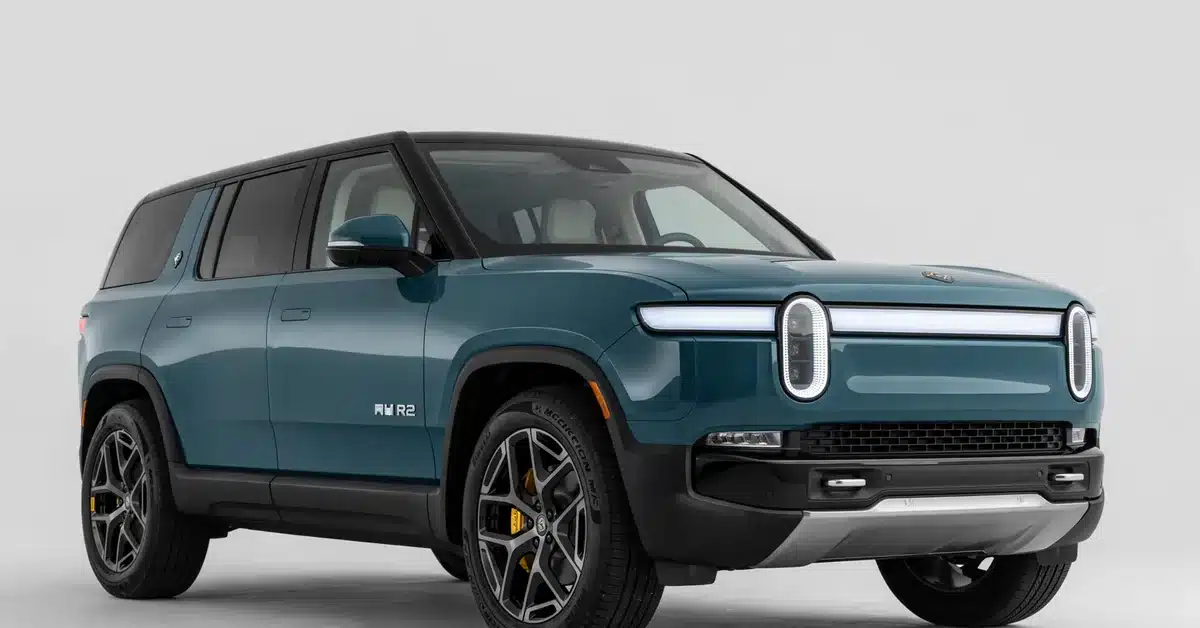
The Rivian R2’s battery holds 87.9 kWh of usable capacity — one pack for the Performance, Premium and Standard Long Range versions. The EPA rates the shipping car at 330 miles (307 on all-terrain tyres), charging runs 10–80% in 29 minutes by Rivian’s claim (an independent test beat it), and the battery warranty is 8 years / 120,000 miles. Deliveries began in June 2026 — but so far only the $57,990 Performance is shipping.
• Battery: 87.9 kWh usable (~94 kWh gross, estimated) — LG 4695 cells, high-nickel
• Range: 330 miles EPA (Performance, 21″ wheels) · 307 miles on all-terrains
• Charging: 10–80% in 29 min claimed, 26 min 52 s tested · native NACS port
• Warranty: 8 years / 120,000 miles, 70% capacity floor
Rivian R2 Battery: Full Specs
One battery size does nearly all the work in the R2 range — and the figures arguing about it online (87.4, 88, 94, 100 kWh) are mostly the same pack wearing different labels.
How big is the R2’s battery?
Rivian’s published figure is 87.9 kWh usable, and it applies to every version with a stated capacity: Performance, Premium and Standard Long Range. There are not three battery sizes to choose between today — there is one pack, three motors-and-trim packages around it.
Two other numbers orbit that figure. Engineering databases working from Rivian’s EPA declarations put the pack’s gross capacity at about 94 kWh (an estimate — Rivian does not publish gross), and the EPA certification itself recorded 86.8 kWh of certified usable energy in testing. Neither contradicts 87.9; they are the same pack measured at different points for different purposes.
Where do “87.4 kWh” and “100 kWh” come from?
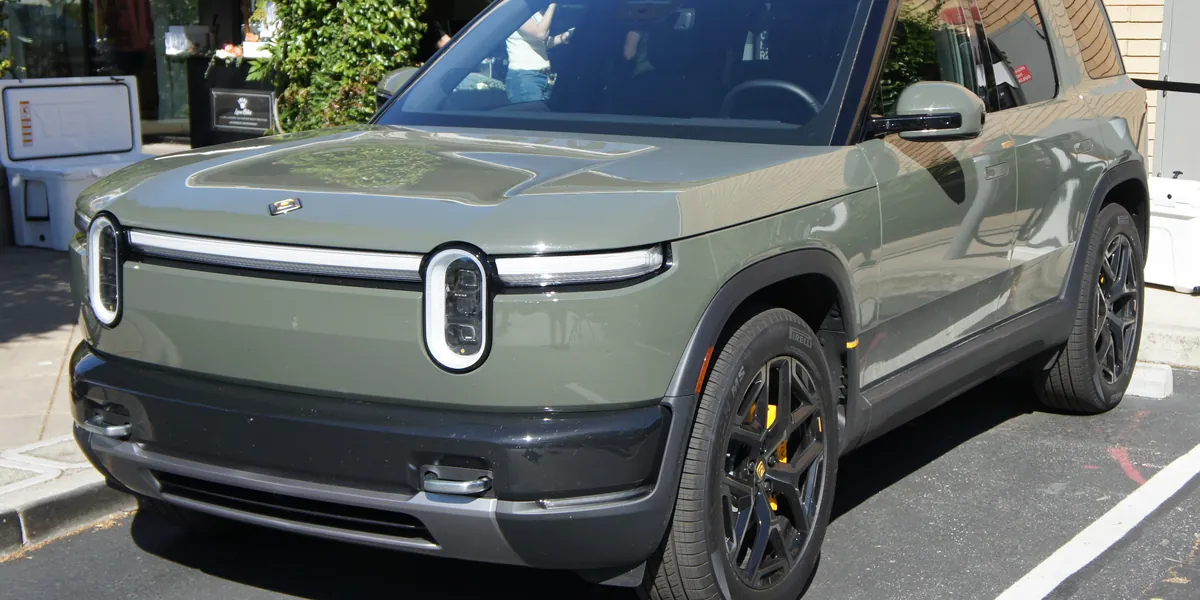
Both are worth burying properly. The 87.4 kWh figure comes from a battery information label photographed on a pre-production car in February 2026 — weeks before Rivian published its specifications. It was never a Rivian spec; the official figure released in March 2026 is 87.9.
The ~100 kWh figure has even less behind it: it appears in pre-launch speculation and on low-quality spec-scraper pages, and no Rivian source has ever published it. If a listing or video quotes a 100 kWh R2, it is quoting a guess.
Which R2 can you actually buy today?
This is where most coverage misleads by omission. The R2 is on sale — production began at Rivian’s Normal, Illinois plant on 22 April 2026 and the first customer deliveries followed on 9 June 2026 — but four years of “$45,000 Rivian” headlines describe a version that does not arrive until 2027.
| Version | Price | Status | Range |
|---|---|---|---|
| Performance (Launch Package) | $57,990 | Delivering since June 2026 | 330 mi EPA (21″) / 307 mi (20″ AT) |
| Premium | $53,990 | Late 2026 | 330 mi (Rivian estimate) |
| Standard Long Range (RWD) | $48,490 | Early 2027 | 345 mi (Rivian estimate) |
| Standard (base) | $44,990 | 2027 | 275+ mi (Rivian estimate) |
Prices exclude the $1,495 destination charge. The shipping Performance is a dual-motor car with 656 hp — early reports of a tri-motor flagship were wrong; no tri-motor R2 is on sale. With the Tow Package the R2 is rated to tow 4,400 lb. The base Standard’s battery is smaller, and Rivian has not published its capacity — anyone quoting a figure for it (75 kWh is the common guess) is estimating.
The Cells: LG 4695s, and No LFP
The R2’s pack is built from a new generation of cylindrical cells made by LG Energy Solution in Arizona — and despite persistent rumours, no version of it is LFP.
Who makes the R2’s cells?
The cells are 4695 cylindricals — 46 mm across, 95 mm tall — supplied by LG Energy Solution under a 67 GWh, five-year agreement, and made at LG’s Arizona plant. LG’s own announcement says each 4695 holds about six times the energy of the smaller 2170 cells in Rivian’s R1, which is how the R2 gets a competitive pack into a smaller, cheaper car.
The chemistry is high-nickel: Rivian confirmed to Green Car Reports that the LG deal covers high-nickel cells, and analysis of Rivian’s EPA filings identifies the cathode as NCMA. The pack is structural — the cells are integrated into a pack that forms part of the car’s floor — and engineering analysis of the EPA data puts it at 541 kg, or 167 Wh/kg at pack level.
Is the R2 battery LFP?
No. No LFP R2 has been announced, let alone sold. The LFP assumption travels over from the R1, whose entry pack was LFP — and even Rivian has since dropped that pack from the R1 range (June 2026). Our explainer on what battery chemistry Rivian uses covers how the two line-ups differ.
What is genuinely unknown is the base Standard’s chemistry: Rivian has disclosed neither its size nor its chemistry, so any page stating either is guessing. When Rivian publishes it, this page will say so.
Charging: A 400-Volt Car That Charges Like a Bigger One
Rivian deliberately kept the R2 on a 400-volt architecture to hit its price — then tuned the charging curve hard enough that it hardly matters.
How fast does the R2 charge?
Rivian’s claim is 10–80% in 29 minutes, with up to 150 miles added in about 15 minutes under optimal conditions. Rivian’s EPA filing lists a peak of 217 kW. Those are the official numbers, and for once the independent test came back better:
What does the charging curve look like?
Unusually flat for this price class. In State of Charge’s test the car held high power to about 30% charge, then tapered in a near-straight line to 68 kW at 80%. That shape — not the peak — is what sets the strong ~150 kW average, and it compares well with cars costing far more. Rivian also confirmed to the tester that the car can accept up to 630 amps, which is why it needs a genuinely high-power charger to show its best.
NACS, Superchargers and home charging
The R2 has a native NACS port (rear-left), so it plugs straight into Tesla Superchargers with no adapter; older CCS1 fast chargers need a CCS-to-NACS adapter. At home, the onboard charger is 11.5 kW (48-amp), which refills the pack overnight with hours to spare. Note what the 400-volt choice costs you: nothing at Tesla’s ~400-volt-class V3 Superchargers, and the peak-rate bragging rights against 800-volt Korean rivals — which still finish 10–80% about seven minutes sooner.
Real-World Range: EPA 330, Tested 260
The R2’s official range is strong; its tested highway range is merely good — and the gap between the two is the honest story of this car’s efficiency.
What does the EPA say?
Only the Performance has official ratings so far, and they split by wheel: 330 miles on 21-inch all-season tyres (105 MPGe) and 307 miles on 20-inch all-terrains (99 MPGe). Ignore the 335- and 328-mile figures in spring coverage — those were unadjusted dynamometer numbers from the certification filing, not the rating.
What did independent testers get?
Car and Driver’s 75-mph highway test returned 260 miles on the 21-inch wheels and 220 miles on all-terrains. A 70-mph test by Out of Spec on all-terrains, in cool weather, managed about 213 miles. Highway running at speed is simply where this tall, boxy SUV pays for its shape.
What about winter — and the versions still to come?
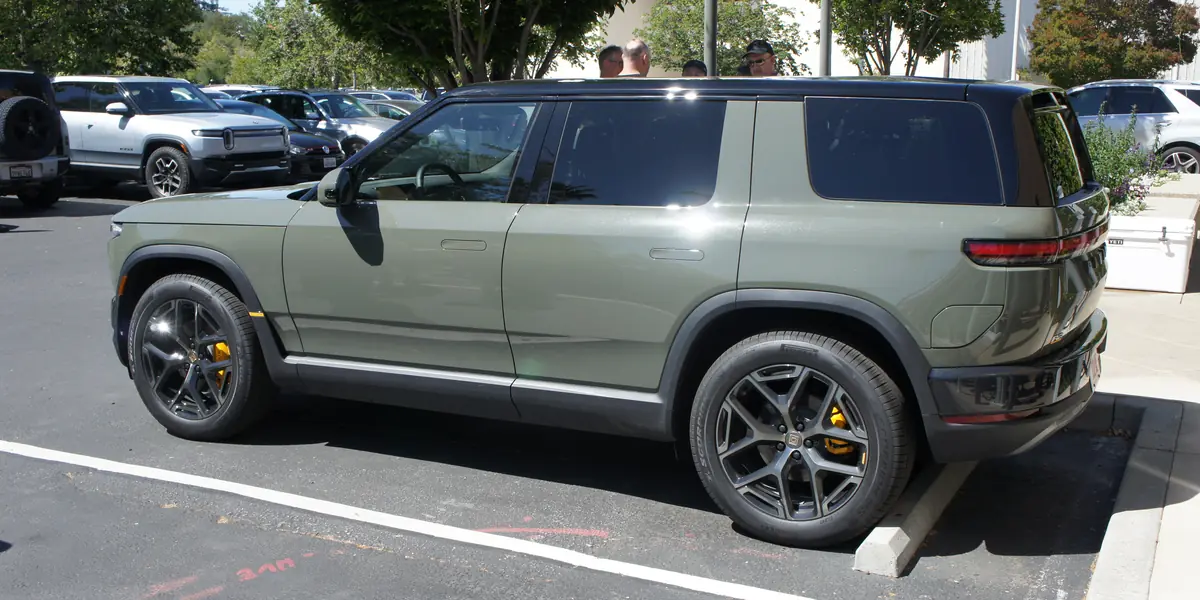
No dedicated instrumented winter test exists yet; the cool-weather Out of Spec run above is the closest evidence. One equipment note from the EPA certification data: a heat pump is standard, which is the single most effective defence against winter range loss. For the untested versions, Rivian estimates 330 miles for the Premium and 345 for the rear-drive Standard Long Range — plausible on the same pack with less weight and one motor, but estimates until the EPA rates them.
Power Outlets, V2L and Home Backup: What Actually Works
Search interest in the R2’s outlets is high and the honest answer is narrower than the reveal suggested: today, one outlet works; the clever accessories are still to come.
What works today
The production R2 has one 120-volt outlet, rated up to 1,900 watts (per InsideEVs’ outlet guide) — enough for tools, a fridge, camping kit or a slow cooker at a tailgate, from the car itself, no accessory needed. That is the whole of the car’s shipping vehicle-to-load capability.
The Field Outlet — announced, not on sale
Rivian has showcased a Field Outlet accessory that plugs into the NACS charge port and offers two 120-volt outlets at up to 2,400 watts. It appears in Rivian’s own imagery — but as of November 2026 it is not on sale, with no price or date announced. Do not budget for it, and treat any listing claiming to sell one with suspicion.
Can an R2 power your house?
Not yet. The hardware story is real: the car’s energy module contains a bidirectional charger, and Rivian’s chief software officer has confirmed the V2H hardware is built in. But home backup needs Rivian’s bidirectional home charger, which is likewise not on sale, unpriced and undated — so today an R2 cannot power a home. Rivian joined the ChargeScape vehicle-to-grid programme in June 2026, pointing to V2G arriving via a future software update: an intention, not a feature. And ignore “11 kW V2L/V2H” figures on spec sites — the guide that popularised the number has retracted it; no Rivian source supports it.
Battery Life, Warranty and Replacement Cost
For a car five months old, the only honest lifespan evidence is Rivian’s track record and its warranty — both of which are better than most buyers expect.
What warranty does the R2 battery carry?
8 years / 120,000 miles, with capacity guaranteed not to fall below 70% — per Rivian’s own R2 warranty guide, and uniform across all R2 versions. One warning: some third-party warranty tables list the R2 at 150,000 miles. That is the term for the big R1 packs, carried across by mistake; the R2’s own guide says 120,000.
How long will the battery last?
There is no R2 degradation data — there cannot be yet. What exists is brand evidence: Recurrent’s real-world dataset (over a billion miles) found Rivian among the brands showing about 100% range retention at three years and no significant range loss at five. Read that precisely: it is range retention — makers hold back buffer capacity that can mask cell-level wear — not proof of zero degradation. For scale, Geotab’s 2026 fleet study puts average EV battery loss at about 2.3% per year across all brands. The R2’s own story will take years to tell; its warranty floor (70% at 8 years/120,000 miles) is the hard promise underneath.
What would a replacement battery cost?
No price exists. Rivian publishes no pack price for any model, and no R2 pack has ever been replaced — the oldest cars are five months old and every one is deep inside its warranty. Any site quoting an R2 replacement figure has invented it.
For scale only, the larger R1 packs: one owner was quoted $18,000 for a replacement (reported by TopSpeed in June 2025), and independent modelling puts out-of-warranty R1 pack replacement at $15,000–$30,000+. Those are 109–140 kWh packs; they are context, not an R2 estimate. Rivian also sells an extended plan, Rivian Care: owner-reported terms describe battery coverage extending to 200,000 miles for eligible cars — worth asking about before the standard warranty runs down, not a number to plan a purchase around today.
The 12-volt trap — and one recall to know
Searches for “Rivian battery replacement” mostly surface the 12-volt auxiliary battery — the small battery that wakes the car. Dealer quotes and forum threads about a few hundred dollars are about that part, not the traction pack under the floor. Know which battery a price refers to before it frightens or reassures you.
The one battery-adjacent recall so far: in October 2026 Rivian recalled a small number of R2s (about 14 cars, per TechCrunch’s report of the NHTSA filing) for high-voltage battery pack fasteners that may not have been tightened properly, with free inspection and repair at service centres. It is a torque-and-inspection fix, not a cell defect — but it is exactly the kind of thing worth checking on an early car.
R2 vs R1: A Different Battery Philosophy
The R2 is not a small R1 — its battery differs from its big sibling’s in supplier, cell size, structure and strategy.
Rivian’s R1 (R1S SUV and R1T truck) currently offers two packs: Large at 108.5 kWh usable and Max at 140 kWh, built from Samsung SDI 2170 cells; the 92.5 kWh LFP Standard pack was dropped in June 2026, so new R1s are nickel-only too. Our R1S battery guide covers that range in full. The R2 instead runs one 87.9 kWh pack of LG 4695 cells in a structural housing, at roughly half the R1’s entry price.
| Rivian R2 | Rivian R1 (R1S/R1T) | |
|---|---|---|
| Pack sizes (usable) | 87.9 kWh (one size) | 108.5 / 140 kWh |
| Cells | LG Energy Solution 4695 | Samsung SDI 2170 |
| Chemistry | High-nickel NCMA | High-nickel (nickel-based) |
| Battery warranty | 8 yr / 120,000 mi | 8 yr / 150,000 mi (Large/Max) |
| Price from | $44,990 (2027) / $57,990 shipping | ~$71,700 |
Rivian R2 vs Its Real Rivals
The R2’s battery is mid-sized for its class — its advantage is charging speed at its price, not capacity.
| Model | Battery (usable) | EPA range | DC peak | Price from |
|---|---|---|---|---|
| Rivian R2 | 87.9 kWh | 330 mi | ~217 kW (EPA filing) | $57,990 (shipping) |
| Tesla Model Y | ~78 kWh (est.) | Up to 320 mi | ~250 kW | $44,990 |
| Hyundai Ioniq 5 | 84 kWh | Up to 318 mi | ~240 kW | ~$36,600 |
| Kia EV6 | 84 kWh | Up to 319 mi | 240 kW | ~$37,900 |
| Ford Mustang Mach-E | 88 kWh (Extended Range) | Up to 320 mi | 150 kW | $37,795 |
| Chevrolet Equinox EV | 85 kWh | 319 mi | 150 kW | $34,995 |
Tesla does not publish the Model Y’s battery capacity — the figure shown is a third-party estimate. Read the table with the R2’s rollout in mind: its $44,990 base version closes much of the price gap in 2027, while the Korean pair still charge faster (10–80% in about 20 minutes) and the Mach-E and Equinox EV charge slower, as our Mustang Mach-E battery guide shows in its charging section. On range per charge, the whole class sits within about 12 miles of each other — the R2’s real edges are its charging curve and its outlets story, not a bigger battery.
Frequently Asked Questions
How big is the Rivian R2 battery?
87.9 kWh usable, per Rivian — the same pack in the Performance, Premium and Standard Long Range. Gross capacity is estimated at about 94 kWh by engineering databases; Rivian does not publish it. The base Standard arriving in 2027 has a smaller pack whose size Rivian has not disclosed.
Is the Rivian R2 on sale yet?
Yes. Production began in April 2026 and customer deliveries started on 9 June 2026. Only the Performance with Launch Package ($57,990) is shipping so far, by invitation to reservation holders; the Premium follows in late 2026 and cheaper versions through 2027.
How long does the R2 take to charge?
Rivian claims 10–80% in 29 minutes on a DC fast charger; State of Charge tested a production car at 26 minutes 52 seconds, peaking at ~226 kW. At home, the 11.5 kW onboard charger refills the pack overnight.
Does the Rivian R2 have vehicle-to-load (V2L)?
Partly. It has one built-in 120-volt outlet rated up to 1,900 W. Rivian’s 2,400 W Field Outlet accessory for the charge port has been showcased but is not yet on sale, and home backup (V2H) does not work yet because Rivian’s bidirectional home charger is not on sale either.
What is the R2’s battery warranty?
8 years / 120,000 miles with a 70% capacity floor, per Rivian’s R2 warranty guide — the same for every version. Tables listing 150,000 miles are showing the R1’s term by mistake.
How much does an R2 battery replacement cost?
Nobody knows — no price has been published and no R2 pack has ever been replaced; the car is months old and fully warrantied. For scale, an R1 owner was quoted $18,000 for that car’s much larger pack, and modelling puts R1 replacements at $15,000–$30,000+.
Is the Rivian R2 battery LFP?
No. The shipping pack uses high-nickel NCMA cells from LG Energy Solution. No LFP R2 exists or has been announced; the future base version’s chemistry has not been disclosed.
How far does the R2 go on a charge?
The EPA rates the Performance at 330 miles on 21-inch wheels and 307 on all-terrains. Independent 75-mph highway testing returned 260 and 220 miles respectively. Rivian estimates 345 miles for the rear-drive Standard Long Range due in 2027.
Conclusion
The R2’s battery story is simpler than the internet makes it: one 87.9 kWh LG pack, honestly rated, charging faster than promised — wrapped in a rollout that has not reached the affordable versions yet.
Buy the story as it stands today and you are buying a $57,990 Performance with a 330-mile EPA rating, a 29-minute charge and an 8-year/120,000-mile battery warranty. Wait, and the same pack arrives in a $48,490 rear-drive car Rivian estimates at 345 miles. Either way, the numbers worth trusting are the verified ones above — not the 87.4 label photo, not the 100 kWh that never existed, and not replacement prices for a battery nobody has had to buy.
