
What Is a Blade Battery? BYD’s EV Battery Explained

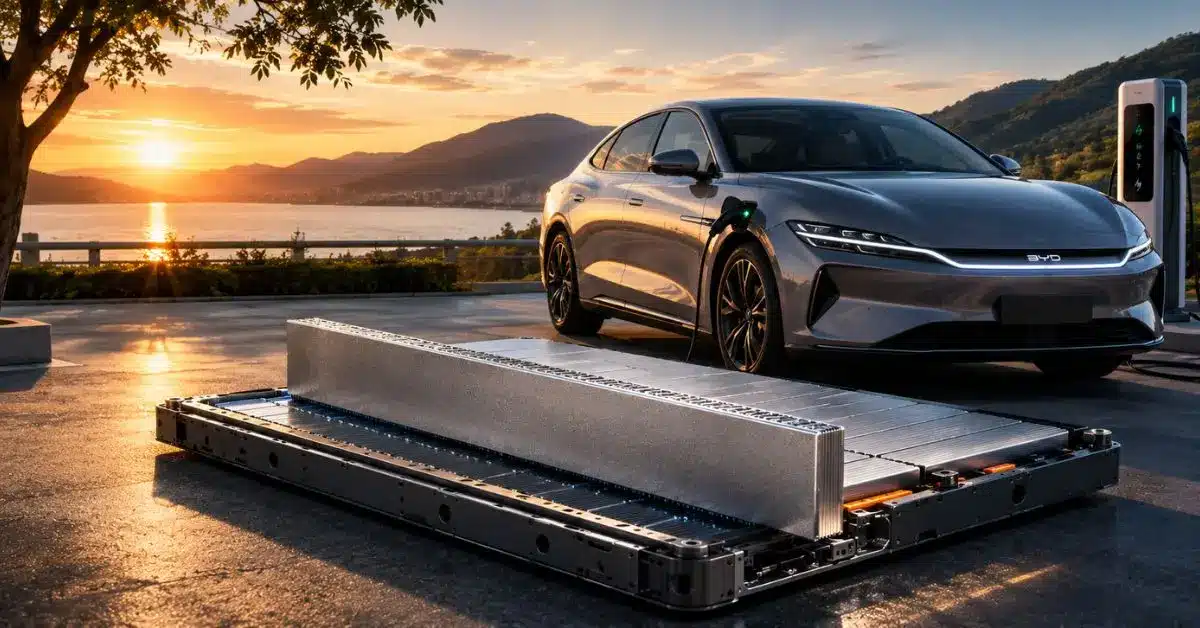
The BYD Blade Battery is a lithium iron phosphate (LFP) battery with a unique long, flat, blade-shaped cell design. Publicly launched in 2020, it uses Cell-to-Pack (CTP) technology — long prismatic cells slot directly into the pack without modules. The result is a battery that passed a nail penetration test without fire, lasts over 5,000 charge cycles, and has become a global safety benchmark. In March 2026, BYD launched a second-generation Blade Battery that charges from 10% to 70% in just 5 minutes.
What Makes the Blade Battery Different?
Traditional EV batteries use compact prismatic, cylindrical, or pouch cells grouped into modules inside a pack. The Blade Battery does something fundamentally different: each cell is long, flat, and thin — resembling a blade — and spans nearly the full width of the battery pack, which can be up to 2.5 meters in length.
These blade cells are arranged side by side in a honeycomb aluminum structure, then inserted directly into the pack. No modules. No module housings. Just cells, structural material, and a pack enclosure. This is CTP — Cell-to-Pack design.
The blade arrangement increases battery pack space utilization by over 50% compared to conventional LFP block batteries. More active cell material fits in the same physical space, improving energy density at the pack level.
The Chemistry: Why LFP Makes Blade Cells Safe
The Blade Battery uses lithium iron phosphate (LFP) chemistry. The iron-phosphate olivine crystal structure is extremely thermally stable. It does not release oxygen under heat or mechanical stress — the key trigger for battery fires in NMC chemistry.
LFP’s thermal runaway temperature is approximately 270°C, compared to ~210°C for NMC. But the blade cell’s shape provides an additional safety advantage: the long, thin geometry maximizes surface area relative to volume, allowing heat to dissipate uniformly. Even in extreme conditions, heat spreads across the cell’s length rather than concentrating in a hot spot.
The Nail Penetration Test: BYD’s Safety Benchmark
The nail penetration test is considered the most extreme battery safety test — it simulates a metal object (like crash debris) piercing through the battery. Most NMC batteries fail dramatically.
BYD’s results during the test:
| Battery Type | Surface Temperature After Nail Test | Fire or Smoke? |
|---|---|---|
| BYD Blade Battery (LFP) | 30–60°C | None |
| Conventional LFP block battery | 200–400°C | No flames, but dangerously hot |
| NMC ternary lithium battery | 500°C+ | Yes — violent fire |
The Blade Battery also passed extreme conditions: bent, crushed, heated to 300°C in a furnace, and overcharged by 260% — none resulted in fire or explosion.
Blade Battery Generations: From 1.0 to 2.0
Generation 1 (2020–2025)
- LFP chemistry with graphite anode
- Space utilization improved by 50%+ vs conventional LFP
- 5,000+ cycle life
- 10–80% charge time: ~33 minutes
- Used in all BYD pure-electric models: Han, Tang, Atto 3, Seal, Sea Lion
- Toyota bZ3 also adopted blade battery cells
Generation 2 (Launched March 2026)
BYD unveiled the second-generation Blade Battery alongside its Flash Charging infrastructure in March 2026. Key upgrades:
- New cathode: Lithium manganese iron phosphate (LMFP) instead of standard LFP — higher energy density
- New anode: Silicon-carbon composite instead of graphite — faster lithium insertion
- Flash-flow electrolyte: AI-optimized for faster ion mobility
- Internal resistance reduced by 50%
- Heat generation reduced by 50%
- Energy density improved by ~5% vs Gen 1
- 10% to 70% charge time: 5 minutes (using 1,500 kW Flash chargers)
- 10% to 97% charge time: 9 minutes
- Works in -30°C conditions: 10% to 97% in 12 minutes
The Gen 2 Blade Battery comes in two cell formats: a Short Blade format supporting an 8C peak charge rate and a Long Blade format optimized for energy density.
Blade Battery vs Traditional NMC: Comparison
| Feature | Blade Battery (LFP) | NMC Battery (Conventional) |
|---|---|---|
| Chemistry | LFP (Gen 1) / LMFP (Gen 2) | NMC / NCA |
| Cycle life | 5,000+ cycles | 500–2,000 cycles |
| Thermal runaway temp | ~270°C | ~210°C |
| Nail test result | No fire, surface 30–60°C | Fire/explosion |
| Energy density (pack level) | Competitive (CTP boosts pack efficiency) | Higher at the cell level |
| Cost | Lower (no cobalt) | Higher |
| Cold weather | Weaker (improved in Gen 2) | Better |
| Charge speed (Gen 2) | 10–70% in 5 min (Flash charger) | Typically 20–30 min |
Which Cars Use the Blade Battery?
BYD committed in April 2021 to equip all its pure-electric models with the Blade Battery. Current models include:
- BYD Han (flagship sedan)
- BYD Tang (SUV)
- BYD Atto 3 (compact SUV)
- BYD Seal
- BYD Sea Lion 07 EV
- BYD Dolphin and Seagull (smaller models)
External adoptions:
- Toyota bZ3 — first non-BYD model to use the Blade Battery
- Hongqi E-QM5 and Bestune NAT — FAW Group EVs with blade cells
- BorgWarner signed an exclusive supply agreement with FinDreams Battery (BYD’s battery subsidiary) in 2024
Conclusion
The blade battery in electric cars represents one of the most important battery engineering advances of the 2020s. Its long, flat cell design, combined with Cell-to-Pack integration, solves two problems simultaneously: it improves energy density without sacrificing safety, and it eliminates costly module hardware.
With 5,000+ cycle life, proven nail-penetration safety, and a Gen 2 that charges from 10% to 70% in 5 minutes, the blade battery has set a new global benchmark for what LFP chemistry can deliver.
As BYD expands internationally, the blade battery will play a central role in making EVs more affordable, safer, and longer-lasting for drivers worldwide.