
XPeng P7 and P7+ Battery: Sizes, Types, Range and Charging

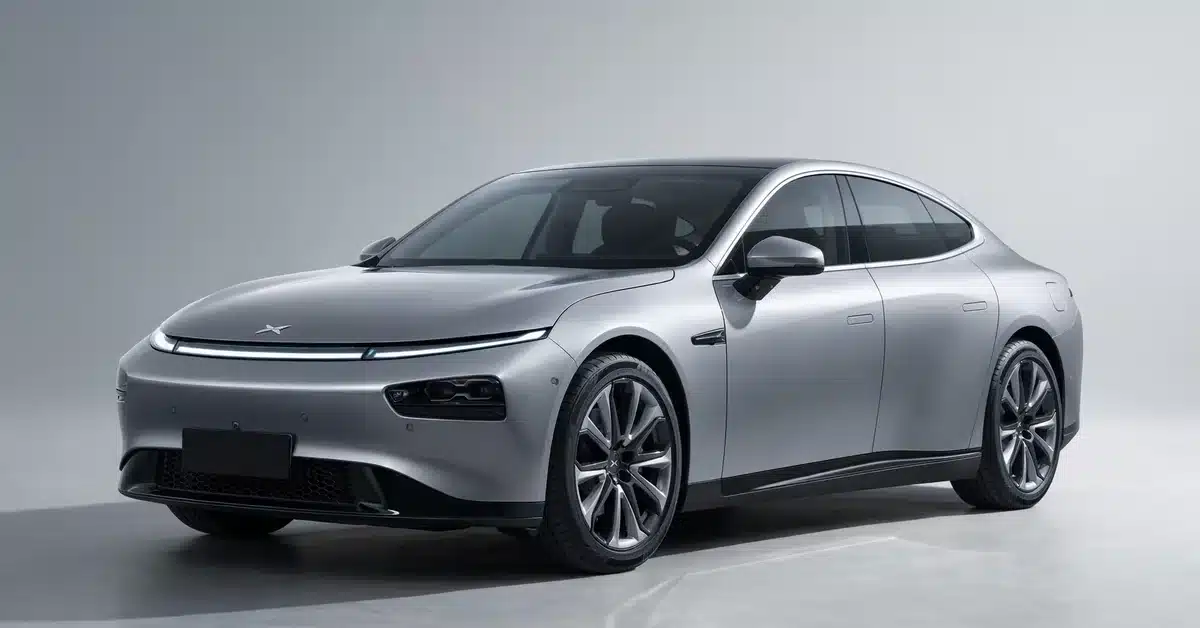
Sources for this guide: EV Database (including its Fastned charge-curve data), XPeng’s 2025 annual report and official releases, CnEVPost and CarNewsChina (including MIIT filing reports), EVKX, Wikipedia’s P7 and P7+ model histories, and independent charging tests — each figure is labelled with the test cycle and market it belongs to.
Three different cars now answer to the name “P7”, and they do not share a single battery between them. The original P7 is an NCM sports sedan, the P7+ is a bigger LFP family fastback sold alongside it, and the 2025 “new P7” is a second-generation car that mixes both chemistries. Most pages on this topic quietly pick one of the three and answer for that car alone — which is how the same search produces three contradictory “P7 battery sizes”. This guide separates them. None of the three is sold in the US, so every figure here is a European or Chinese-market figure, labelled as such.
“XPeng P7 battery” can mean three cars. The original P7 (2020–2023) and its P7i facelift use 60.2–86.2 kWh packs — NCM on most cars, LFP on later base versions; European P7s carry one 86.2 kWh pack (82.7 kWh usable). The P7+ (2024– ) is a separate, larger model and is all-LFP: 61.7 or 74.9 kWh in Europe, 455–530 km WLTP. The new P7 (2025, China only so far) offers a 74.9 kWh LFP pack or a 92.2 kWh NCM pack.
XPeng P7, P7+ and New P7: Three Different Cars Behind One Search
The P7 name covers three separate models, and the battery depends entirely on which one you mean.
The P7+ is not a trim or a facelift of the P7 — it is a separate, larger and cheaper model sold alongside the P7i. The 2025 new P7 is a second-generation replacement for the original car, launched in China while the P7+ was still expanding into Europe.
Timeline: the original P7 reached Chinese buyers in June 2020; the P7+ was revealed in October 2024 (Paris Motor Show debut, Chinese sales from November); the second-generation P7 followed in August 2025 — a faster, more technical car, while the P7+ is positioned for interior space and family use.
| Car | On sale | Battery sizes | Chemistry |
|---|---|---|---|
| Original P7 | 2020–2023 (P7i facelift 2023) | 60.2–86.2 kWh | NCM, plus LFP base versions |
| XPeng P7+ | 2024– | 60.7–76.3 kWh (China launch cars); 61.7 / 74.9 kWh (Europe) | LFP only |
| New P7 | 2025– (China) | 74.9 / 92.2 kWh | LFP / NCM |
Match your car against that table first, then go to its own section — the three share nothing under the floor.
Original XPeng P7 Battery (2020–2023): Sizes, Chemistry and Range
The first P7 launched in China with 70.8 and 80.9 kWh NCM packs; the cars Europe received carry a single 86.2 kWh pack, of which 82.7 kWh is usable.
This is the car the head search term originally meant, and still the one most used-car listings describe.
The China launch cars
China’s launch range, priced ¥229,900–349,900 in April 2020, paired a 70.8 kWh pack with 568 km of NEDC range (RWD Long Range). The 80.9 kWh pack delivered 656 km NEDC, up to 706 km in the Super Long Range version; the AWD Performance car was rated at 552 km NEDC. XPeng’s launch fast-charge claim was 30–80% in 31 minutes, and the launch cells are CATL prismatic NCM811 — high-nickel chemistry, chosen for range.
China later added a cheaper LFP version, the “480” cars, with a pack of roughly 60.2 kWh and a 480 km NEDC rating — the first LFP P7s, and a trap for used buyers, because the badge does not say which chemistry is underneath.
The European cars
European and export P7s are simpler: one pack across all trims (RWD Long Range, AWD Performance, Wing Edition), all now discontinued — 86.2 kWh nominal, 82.7 kWh usable, on a 400V architecture.
| Original P7 | Pack | Usable | Range | DC charging |
|---|---|---|---|---|
| China RWD Long Range | 70.8 kWh NCM | — | 568 km NEDC | 30–80% in 31 min (launch claim) |
| China Super Long Range | 80.9 kWh NCM | — | 656–706 km NEDC | as above |
| China “480” | ~60.2 kWh LFP | — | 480 km NEDC | — |
| Europe (all trims) | 86.2 kWh NCM | 82.7 kWh | up to 576 km WLTP (RWD); 505 km WLTP (Performance) | 182 kW peak, ~27 min 10–80% |
Charging is where the European car quietly beats its brochure: XPeng claimed 175 kW and 10–80% in about 29 minutes, but the charge-curve data EV Database publishes from Fastned’s network shows a 182 kW peak and a 135 kW average — roughly 27 minutes. AC charging is 11 kW, and EV Database’s real-range estimates (495 km RWD Long Range; 455–460 km Performance/Wing) are the honest planning numbers.
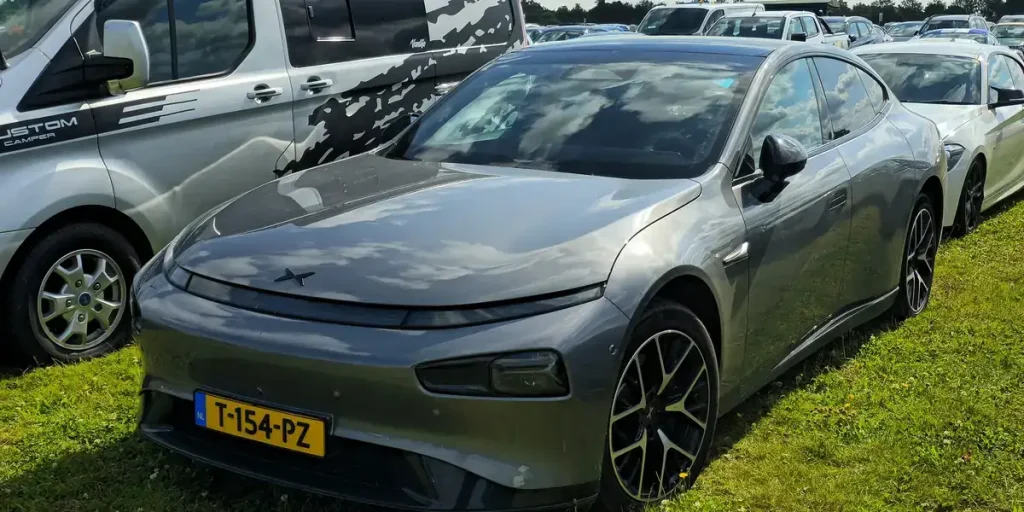
XPeng P7i (2023): The Facelift and the First LFP P7
The P7i facelift kept the 86.2 kWh NCM pack for its long-range cars and added the first factory LFP P7 sold in volume.
It entered production in March 2023, replacing the original car in China.
The NCM P7i versions (702 Pro/Max, 610 Performance) use an 86.2 kWh ternary (NCM) pack rated at 702 km CLTC, with CALB named as one of the suppliers — a change from the launch car’s CATL supply.
In November 2023 XPeng added the P7i 550 Pro and 550 Max with a 64.4 kWh LFP pack supplied by Eve Energy, per the regulatory filing reported at launch: 550 km CLTC, 10–80% in 29 minutes, from ¥223,900. The P7i badge therefore hides the same split as the original car — check the version, not the badge.
XPeng P7+ Battery: Sizes, Chemistry and Range
Every P7+ ever built runs an LFP battery from Eve Energy — there is no NCM P7+.
In Europe today that means 61.7 or 74.9 kWh; the launch-era Chinese cars used 60.7 and 76.3 kWh packs that no longer describe what a European dealer sells you.
The China launch cars (2024)
The P7+ went on sale in China in November 2024 at ¥186,800 (Long Range Max), ¥198,800 (Ultra Long Range Max) and ¥218,800 (Limited Edition Max). The launch packs were 60.7 kWh (602 km CLTC, later raised to 615 km by an over-the-air update) and 76.3 kWh (710 km CLTC; 685 km in the Limited Edition), charging on an 800V silicon-carbide platform at up to 3C with a claimed 30–80% in 16 minutes. During 2025 the Chinese flagship moved to a 74.9 kWh LFP pack with 5C charging (10–80% in 12 minutes claimed, 685 km CLTC) — the pack that crossed over to Europe.
The cars Europe actually buys (model year 2026)
| P7+ (Europe, MY26) | Pack | Usable | WLTP range | DC peak | 10–80% |
|---|---|---|---|---|---|
| RWD Standard Range | 61.7 kWh LFP | 59.6 kWh* | 455 km (283 miles) | 350 kW | ~12 min (220 kW average) |
| RWD Long Range | 74.9 kWh LFP | 74.9 kWh* | 530 km (329 miles) | 446 kW | ~13 min (260 kW average) |
| AWD Performance | 74.9 kWh LFP | 74.9 kWh* | 500 km (311 miles) | 446 kW | ~13 min |
*Usable figures are EV Database’s estimates — XPeng does not publish net capacity for these cars.
Read that table carefully, because an older version of this page got it wrong: the “341–382 miles of WLTP range” quoted for the P7+ in places is a CLTC conversion wearing a WLTP label — the real WLTP figures are the 283, 329 and 311 miles above. Prices start at €46,600 in Germany (Standard Range), and EV Database’s real-range estimates — 375 km Standard Range, 460 km Long Range — are the numbers to plan a winter motorway trip around.
If the shape of this car appeals but you want a smaller XPeng, our XPeng G6 battery guide covers the SUV that shares this all-LFP approach in a higher-riding body.
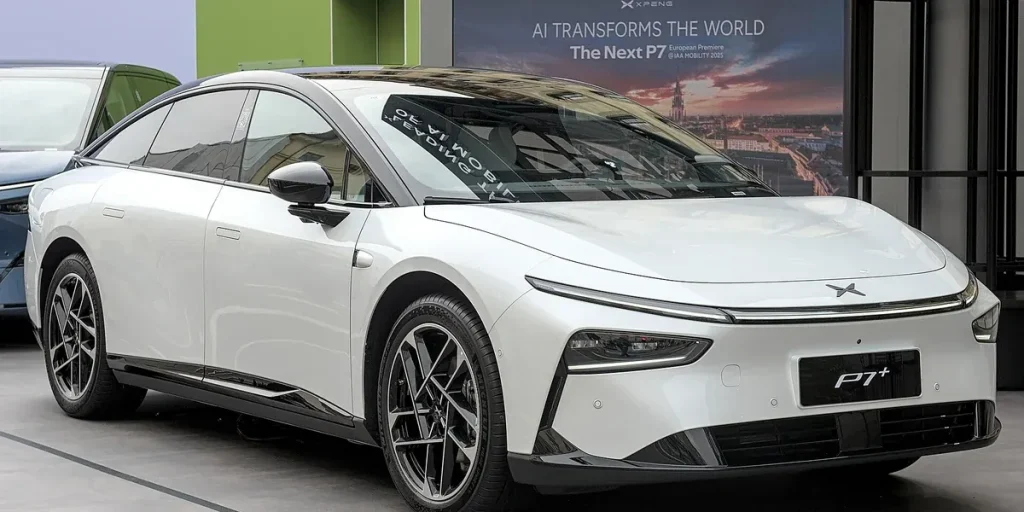
The 2026 facelift — and the range-extender
The facelift was announced at the end of December 2025 and launched in January 2026 — China on January 8, Brussels a day later — as a global model headed for 36 markets. The smaller pack grows to 61.7 kWh and becomes a 5C pack, keeping its 615 km CLTC rating in Chinese spec. The bigger news is a range-extender variant: a 49.2 kWh LFP pack with a petrol generator, rated at 430 km of electric range and 1,550 km combined, both CLTC. If a listing advertises a P7+ with a 1,550 km range, that is this REV car — check which version you are looking at before comparing batteries.
The New XPeng P7 (2025): Bigger Packs, China Only for Now
The second-generation P7 is a different car again: a 74.9 kWh LFP base pack or a 92.2 kWh NCM flagship pack, on sale in China since August 2025 and not yet confirmed for Europe.
It debuted on August 6, 2025 and reached showrooms on August 27 at ¥219,800–301,800 (entry price cut to ¥203,800 in March 2026).
The 74.9 kWh LFP car (702 Max) is rated at 702 km CLTC; the 92.2 kWh NCM car stretches to 820 km CLTC in rear-drive form and 750 km as the all-wheel-drive 750, with 90.0 kWh usable per EVKX. Per the MIIT regulatory filings, Eve Energy supplies the LFP pack and CALB the NCM pack — the same two suppliers as the P7i, split by chemistry.
Charging claims are extreme: a 480 kW peak and up to 525 km of range added in 10 minutes. Treat both as claims — no independent measured curve existed when this guide was researched, and EVKX’s modelled 10–80% time of about 10 minutes is a model, not a test. China-spec cars charge at 7 kW AC (11 kW optional). The car was shown at the Munich IAA in September 2025, but no European sales launch has been confirmed, and range-extender versions added in China later in 2025 are a China-only story for now.
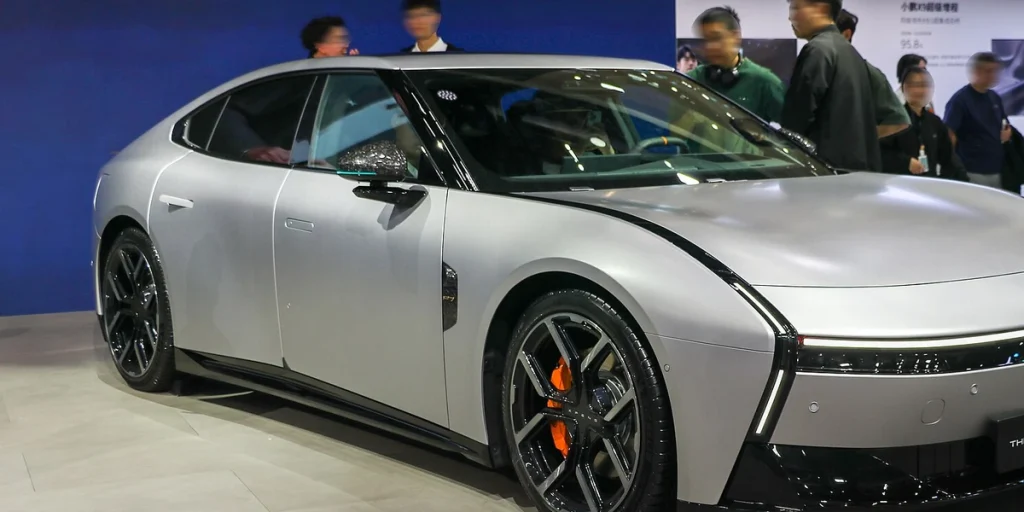
What Battery Type Do They Use? Cells and Suppliers, Car by Car
There is no single “P7 battery type” — the honest answer is a table, not a word.
NCM cars came first, LFP spread from the base versions upward, and the P7+ went all-LFP; the sourcing comes from regulatory filings and launch reporting, not XPeng marketing.
| Car | Pack(s) | Chemistry | Cell supplier |
|---|---|---|---|
| P7 launch (2020, China) | 70.8 / 80.9 kWh | NCM811 | CATL |
| P7 “480” (China, later) | ~60.2 kWh | LFP | not confirmed |
| P7 (Europe) | 86.2 kWh | NCM | not named by the databases |
| P7i (2023) | 86.2 kWh | NCM | CALB (named as one supplier) |
| P7i 550 (2023) | 64.4 kWh | LFP | Eve Energy |
| P7+ (2024– ) | 60.7–76.3 kWh; 61.7 / 74.9 kWh (EU) | LFP | Eve Energy |
| New P7 (2025) | 74.9 / 92.2 kWh | LFP / NCM | Eve Energy / CALB |
Two patterns stand out. XPeng moved its volume cars to LFP early and completely — the P7+ has never offered anything else — and NCM survives only where maximum range is the selling point: the P7i’s long-range cars and the new P7’s 820 km flagship. If a seller tells you a P7+ has an NMC battery, they are describing a car that does not exist.
The 109 mm Pack: Design and Modules
The P7+ battery pack is 109 mm thick — a figure XPeng itself calls the world’s thinnest in its own press material, so read it as XPeng’s claim rather than an audited record.
It comes from XPeng’s official Goodwood release (July 2025), which also confirms the hardware underneath: an LFP-based 800V pack built for 10–80% charges in as little as 12 minutes.
Why chase thinness? A fastback’s enemy is rear headroom, and a thinner floor pack buys it back — XPeng cites 973 mm of rear headroom in the P7+. It is a packaging decision, not an energy one: capacity comes from the car’s long footprint.
Charging: The Claims vs the Measured Numbers
The P7+ is one of the few cars whose measured charging beats its brochure — an independent test recorded 10–80% in under 12 minutes at a 266 kW average.
The average across the session is what decides how long you actually stand at the charger, and it matters more than any peak figure.
The original P7 and P7i
The European P7’s Fastned-measured curve — a 182 kW peak holding a 135 kW average — gives roughly 27 minutes for 10–80%, slightly better than XPeng’s own 175 kW, 29-minute claim. The P7i’s LFP 550 cars claim the same 29 minutes. Respectable, but a generation behind what followed.
The P7+
XPeng quotes a 446 kW peak for the European Long Range car (one Chinese launch report puts the equivalent car at 451 kW; 446 is the European figure). EV Database gives the Long Range a 260 kW average and about 13 minutes for 10–80%; the Standard Range, 220 kW and about 12 minutes.
— the average charging power an independent Italian HPC test measured across a full 10–80% charge in a P7+. Most EVs advertise a peak they hold for a minute or two; this is the average for the whole session.
That test was conducted in Italy and published in October 2026. Two caveats apply to every P7+ charge time here: you need a charger that can actually deliver 350–450 kW — ruling out most of Europe’s older DC network — and a warm, preconditioned battery. On a 150 kW charger, a P7+ is simply a car charging at 150 kW.
The new P7
For the 2025 car there are only claims: a 480 kW peak, up to 525 km of CLTC range added in 10 minutes, a modelled 10–80% of around 10 minutes. Until an independent curve exists, file those with every other launch-day number — promising, unproven.
Real-World Range and Efficiency
Efficiency is the P7 family’s quiet strength: the European P7+ Long Range is rated at 141 Wh/km, and EV Database’s real-range estimates run from 375 km (P7+ Standard Range) to 495 km (the original P7 Long Range).
This is the figure that decides running costs and real range, and the one most P7 pages never print.
The Standard Range P7+ is rated at 152 Wh/km (WLTP, including charging losses) against the Long Range car’s 141 Wh/km vehicle consumption — strong numbers for a large fastback, and the reason a 74.9 kWh pack reaches 530 km WLTP while heavier rivals need more battery to go the same distance. EV Database’s real-range estimates are the sober version: 460 km (P7+ Long Range), 375 km (Standard Range), 495 km (original P7 Long Range). Chinese CLTC consumption claims — around 11.4 kWh/100 km for launch P7+ cars, 11.0 for the new P7’s 820 version — come from a gentler cycle and are not comparable with the WLTP figures.
Winter Range: What Cold Weather Does to These Cars
Expect the LFP cars to lose more range in winter than the NCM cars — XPeng’s own Australian used-EV guide calls cold sensitivity LFP’s “one real weakness”.
That covers the whole P7+ range, the P7i 550 and the new P7’s base car; the NCM cars are the steadier winter choice.
The only sourced cold-weather numbers are EV Database’s estimates — read them as estimates, not tests. Its city cold-weather estimate for the original P7 RWD Long Range is 470 km against a 495 km mild-weather real range, a modest NCM penalty. The P7+ Standard Range’s band widens sharply in the cold: 270 km pessimistic, 540 km ideal, around a 375 km central estimate. No instrumented winter test of the P7+ was found in this research, so this page will not invent one.
The practical advice stands on the chemistry: if your winters are Scandinavian rather than Mediterranean, budget a bigger penalty into an LFP P7+ than into an NCM P7 — and precondition before fast charging, because a cold LFP pack also charges slowly.
Lifespan and Degradation: What Is Actually Known
No published fleet degradation dataset exists for the P7 or the P7+ — anyone quoting you a measured “P7 degradation rate” is inventing it.
There is no Recurrent- or Geotab-style study of these cars and no owner-fleet data in the public record, and this page will not dress a guess up as a figure. What can honestly be said: within the warranty term, XPeng guarantees the battery to at least 70% of its original capacity, with repair or replacement below that line (see the warranty section). That 70% floor is the only hard lifespan number attached to these cars.
The chemistry picture is context, not P7 data: LFP packs of the P7+ type are typically rated for far more charge cycles than NCM packs — broadly around 2,000–5,000+ cycles against roughly 1,000–2,500 for NMC — but those are laboratory figures, and nobody has published how a five-year-old P7+ fleet actually measures.
Battery Warranty by Market
In Europe the battery warranty is 8 years or 160,000 km with a 70% capacity guarantee; in the UK it is 8 years or 100,000 miles.
The guarantee works as a floor: if capacity drops below 70% inside the term, XPeng repairs the pack to return it to at least 70%.
- European Union: battery 8 years / 160,000 km, 70% capacity floor. The vehicle warranty starts at 2 years and can be renewed with scheduled servicing up to 7 years / 160,000 km.
- United Kingdom: battery 8 years / 100,000 miles; the vehicle itself is covered for 7 years / 100,000 miles.
- China: published secondary sources conflict on the exact battery term by model year, so this page prints no Chinese figure — check the warranty booklet of the specific car.
- United States: none of these cars is sold there, so no US warranty exists.
One caution: the guarantee belongs to the market the car was sold in — a Chinese-market P7+ in Europe is not covered by the European warranty, whatever the badge says.
Replacement Cost: The Honest Answer
XPeng has published no price for a replacement P7 or P7+ battery pack — not in Europe, not in China.
An out-of-warranty pack is a dealer-quote item, priced by pack, market and repair route (module-level or full exchange), and no official or dealer figure was found in this research.
That makes the figures circulating on Q&A sites unusable — estimates without a source, some implausibly round. The honest planning position: inside 8 years, degradation below 70% is XPeng’s problem under warranty, not yours; outside it, get a written quote from an XPeng service centre before buying a high-mileage car whose price assumes the worst.
XPeng’s Own Charging Network: S4, S5 and the Europe Plan
XPeng ran 3,159 self-operated charging stations in China at the end of 2025 — and runs no established network in Europe at all.
Its 2025 annual report counts 2,654 supercharging and 505 destination stations, with S4/S5 hardware across 222 Chinese cities.
The hardware numbers need untangling from the cars. The S4 station (2022) peaks at 480 kW; the S5 (China, Q3 2024) is rated at up to 800 kW as a station figure (800 A at 1,000 V). No XPeng car accepts 800 kW — the fastest car here peaks at 480 kW claimed — so any page saying a P7+ charges “at up to 800 kW on XPeng’s network” is quoting the plug, not the car. XPeng’s talk of 10,000 stations is likewise a company target, not a count.
Europe is, for now, a plan rather than a network: in July 2026 XPeng announced an intention to build more than 1,000 self-operated superchargers across 13 European countries. Until those exist, European owners charge on public networks — which, given the P7+’s 446 kW appetite, means hunting for the newest high-power chargers.
P7 and P7+ vs Rivals: Tesla Model 3, BYD Seal, BYD Han
The P7+ gives up battery size to every rival here and out-charges all of them by two to three times.
That is the whole competitive story in one line — XPeng chose charging speed and efficiency over raw capacity.
| Car (Europe) | Usable capacity | Chemistry | WLTP range | DC peak |
|---|---|---|---|---|
| XPeng P7+ Long Range | 74.9 kWh* | LFP | 530 km | 446 kW (~13 min 10–80%) |
| Tesla Model 3 RWD | ~60 kWh | LFP (CATL) | 534 km | 170 kW |
| Tesla Model 3 Long Range | ~75–79 kWh | NMC (LG) | up to 750 km | 250 kW |
| BYD Seal (RWD) | 82.5 kWh | Blade LFP | 570 km | 150 kW (~36 min 10–80%) |
| BYD Han | 85.4 kWh | Blade LFP | 521 km | 120 kW |
*EV Database estimate for the P7+; Tesla does not publish its capacities at all, so the Model 3 figures are database compilations, not Tesla figures.
Read the table as a trade-off, not a league table: the Seal and Han carry 8–11 kWh more battery and the Long Range Model 3 out-ranges everything here, but on a high-power charger the P7+ finishes its stop before the Seal reaches halfway through its own. BYD’s smaller 61.4 kWh Seal Comfort (460 km WLTP, 110 kW, new for model year 2026) narrows the price gap without changing that story. For long motorway days with short stops, the P7+’s formula wins; for maximum range between home charges, the bigger packs do.
Charging Tips for P7 and P7+ Owners
Charge an LFP car to 100% regularly — XPeng builds a reminder into the car for exactly this — and keep NCM cars at 80–90% for daily use.
The two chemistries on this page want opposite habits, so the first tip is knowing which car you have.
- LFP cars (P7+, P7i 550, P7 “480”, new P7 74.9): XPeng’s XOS software triggers a full-charge reminder after 14 days or 1,000 km without one, because the battery management system needs a full charge to calibrate its state-of-charge estimate. Follow it — a full charge every couple of weeks keeps the range reading honest. But not daily; the car itself never asks for that.
- NCM cars (original P7, P7i long-range, new P7 92.2): 80–90% daily, 100% only when you need the range, and don’t leave the car sitting full.
- Before a fast charge: navigate to the charger so the car preconditions the battery. A cold pack will not take 350 kW however good the charger is — double true for LFP in winter.
- At the charger: check the charger’s own rating first. Anything under 200 kW caps a P7+ well below what it can accept.
Frequently Asked Questions
Is the XPeng P7+ the same car as the P7?
No. The P7+ is a separate, larger and cheaper model sold alongside the P7i (launched November 2024). The original P7 is a 2020 sports sedan, and a second-generation “new P7” followed in 2025. They share a name and nothing under the floor.
What battery type does the XPeng P7 use?
It depends on the version. Launch and European P7s use NCM packs — the European car is 86.2 kWh (82.7 kWh usable) and the Chinese launch cars use CATL NCM811 cells. Later Chinese base versions, the “480” and the P7i 550, use LFP packs of about 60.2 and 64.4 kWh.
What battery does the P7+ use — LFP or NMC?
LFP, in every version and every market, with cells from Eve Energy. European packs are 61.7 kWh (455 km WLTP) and 74.9 kWh (530 km WLTP); the launch Chinese cars used 60.7 and 76.3 kWh.
How fast does the P7+ really charge?
Faster than its brochure, on the right charger: a 446 kW peak (European Long Range), and an independent test measured 10–80% in under 12 minutes at a 266 kW average. On a charger rated below 200 kW, the charger — not the car — sets the speed.
How long does a P7 or P7+ battery last?
Nobody has published the fleet data that would answer that with a measurement. The enforceable figure is the warranty floor: at least 70% capacity for 8 years or 160,000 km in Europe (100,000 miles in the UK). LFP is generally rated for more cycles than NCM, but that is chemistry context, not P7 data.
How much does a replacement P7 battery cost?
There is no published price. XPeng has not released pack pricing for any market, so out-of-warranty replacement is a dealer quote — and the figures quoted on Q&A sites have no source behind them. Inside the warranty term, a pack below 70% capacity is repaired under warranty.
Conclusion
The P7 question has no single answer, and any page that gives you one number for “the P7 battery” has picked a car without telling you.
The original P7 is the NCM sedan — 86.2 kWh in Europe, CATL cells, honest Fastned-measured charging. The P7i split the range by chemistry. The P7+ went all-LFP and made charging speed its whole argument — an argument an independent test then backed up. The new P7, when it eventually leaves China, brings the biggest pack of all at 92.2 kWh.
Match the car first, then the pack, then the market — in that order — and every figure here lines up with the car in front of you.
