
Lucid Gravity Battery: Complete Guide

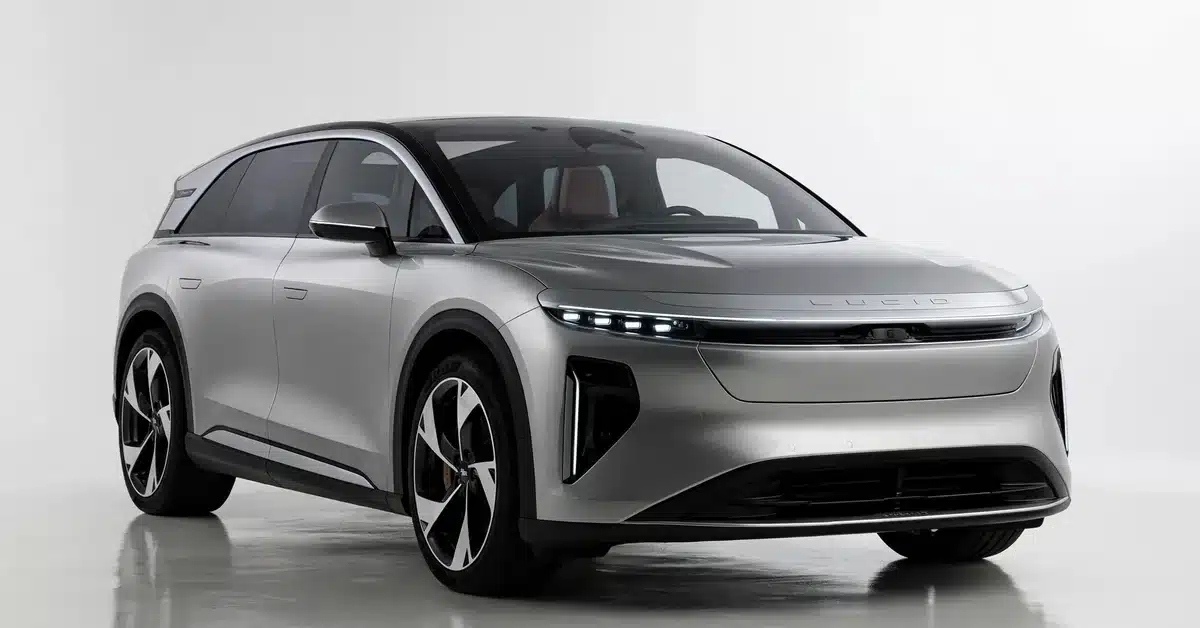
Researched from Lucid and Panasonic’s published material, EPA ratings, and the instrumented tests of Edmunds, Car and Driver, MotorTrend and State of Charge, November 2026.
Quick answer
The Lucid Gravity comes with two batteries: a 123 kWh pack in the Grand Touring (EPA range up to 450 miles, charging up to 400 kW) and an 89 kWh pack in the Touring (EPA up to 337 miles, up to 300 kW). Both use Panasonic 2170 cells. Independent testing has recorded a 419 kW charging peak and 400 miles of range against the 450-mile rating. Prices start at $79,900 for the Touring; the battery warranty is 8 years or 100,000 miles with a 70% capacity floor.
Lucid Gravity Battery Specs at a Glance
Two trims, two different batteries — most of this car’s confusion starts with treating them as one.
| Item | Gravity Touring | Gravity Grand Touring |
|---|---|---|
| Battery (total) | 89 kWh | 123 kWh |
| Pack voltage | ~672 V | 926 V (Lucid’s figure) |
| Power | 560 hp | 828 hp |
| EPA range (best configuration) | 337 miles | 450 miles |
| Peak DC charging | 300 kW | 400 kW (on 1,000 V chargers) |
| AC charging | 19.2 kW | 19.2 kW |
| Starting price | $79,900 | $94,900 (2026) |
Above the Grand Touring sits the GT-S for 2027 (1,070 hp, a projected ~373 miles, $127,750 including destination), which replaces the launch Dream Edition. Everything below concentrates on the two packs you can actually buy in volume, because they differ in more than size: different voltage, different charging ceiling, different range per dollar. Lucid builds the Gravity in Casa Grande, Arizona, in two-row (5-seat) and three-row (7-seat) forms, and the seating choice changes the EPA rating — the range section gives the full table.
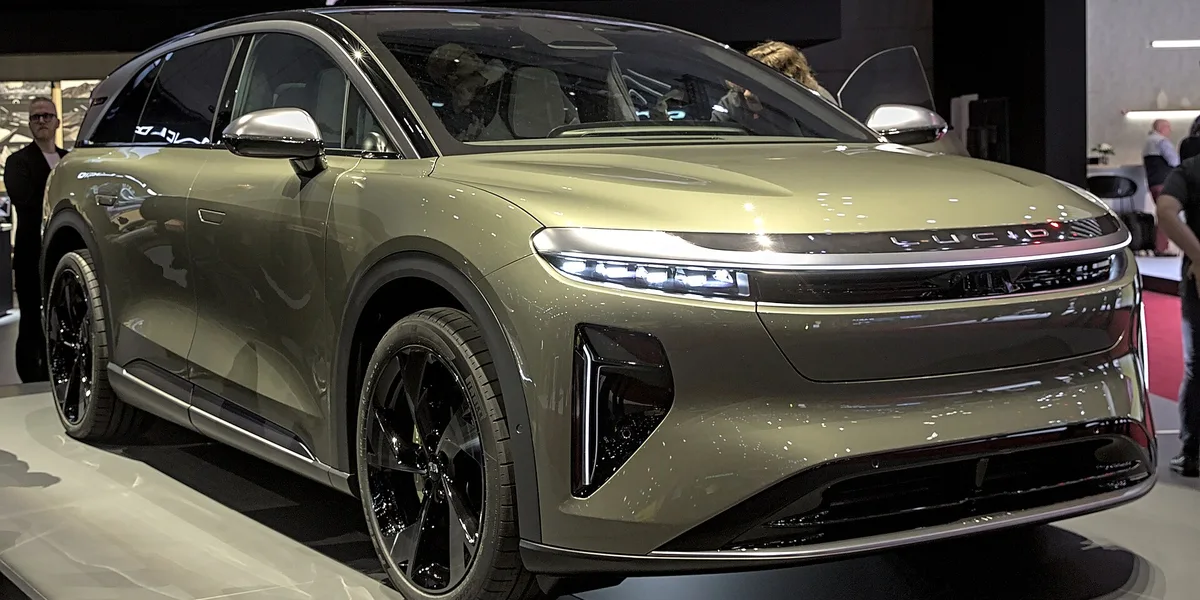
The Battery: Panasonic 2170 Cells, and Two Different Voltages
Both packs use the same confirmed cell — Panasonic’s latest 2170 — but they are not the same battery scaled; the Touring’s pack runs at roughly 672 volts against the GT’s 926.
The cell supply is one of the few things Lucid states outright: a joint Panasonic Energy and Lucid announcement in January 2025 confirms latest-generation Panasonic 2170 cylindrical cells, rated above 800 Wh/L, for the Gravity, and both trims use them. What neither company publishes is a chemistry designation — Electrek describes a nickel-rich cathode, and that is as specific as the sourced record gets. Pages labelling these cells with a precise NMC ratio are going further than the makers do.
Two honest gaps belong in any complete answer. Lucid publishes the GT’s total capacity (123 kWh) but not its usable capacity; independent estimates put usable at roughly 118–121 kWh depending on method, and that range — not a single figure — is what the evidence supports. And the voltage split matters for charging: the high-voltage GT pack needs a boost system (Lucid’s Wunderbox, housed in the rear drive unit) to charge at full-pack voltage on 500 V chargers, which is why the charging section reads differently from most rivals. Our 400V vs 800V architecture explainer covers why voltage changes charging behaviour at all.
Range: What the EPA Says, and What Testing Recorded
The GT’s 450-mile rating is real but belongs to one configuration — wheels and seats move it by more than 60 miles.
| Configuration | EPA range |
|---|---|
| Touring, 20/21″ wheels | 337 miles |
| Grand Touring, 20/21″ wheels, 2-row | 450 miles |
| Grand Touring, 20/21″ wheels, 3-row | 437 miles |
| Grand Touring, 21/22″ or 22/23″ wheels, 2-row | 407 miles |
| Grand Touring, big wheels, 3-row | 386 miles |
What did independent range tests record?
Edmunds’ EV Range Test is the cleanest check: a two-row GT on all-season tyres, rated at 450 miles, recorded 400 miles; on summer performance tyres, rated 407, it recorded 388 miles. Both are closer to their ratings than most large EVs manage. Car and Driver’s 75-mph highway test recorded 310 miles — the number to plan road trips around, since no EV matches its EPA figure at a steady 75.
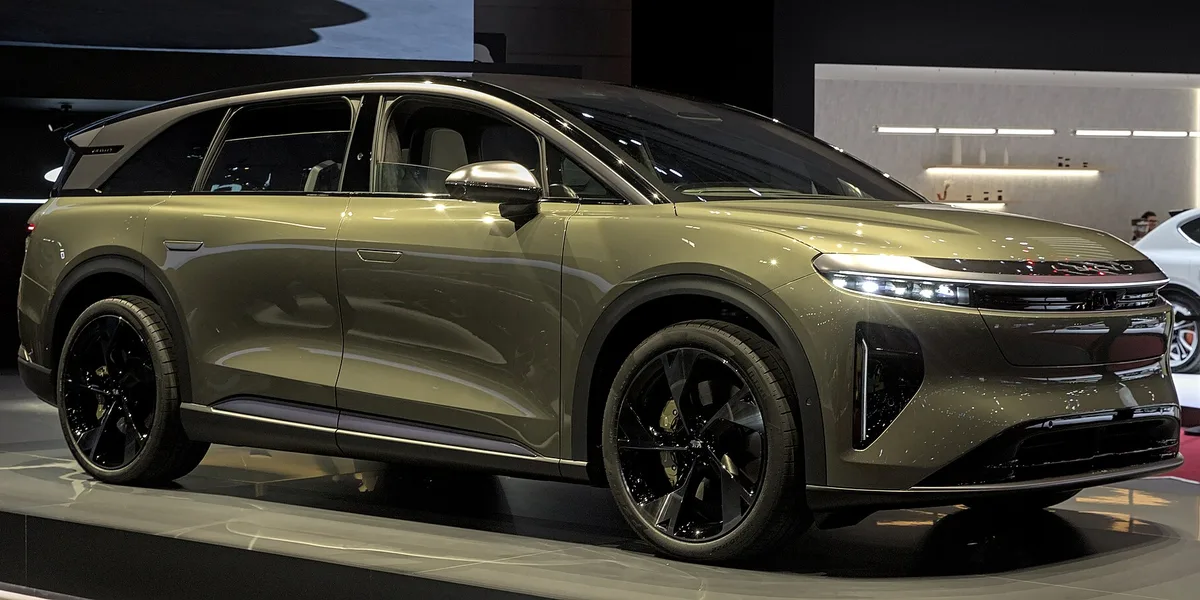
One test deserves its story told, because the wrong version circulates. State of Charge’s first 70-mph test recorded 345 miles, and that figure is still quoted — but the test car was later found to have a faulty rear drive unit, which Lucid repaired. The retest of the healthy car, in December 2025, recorded 401.7 miles at 3.43 mi/kWh on the same configuration that carries the 450-mile rating. MotorTrend’s road-trip test adds the Touring’s first big number: 264 miles, against 335 for a big-wheel GT.
401.7 miles — what a healthy Gravity GT recorded at a steady 70 mph in independent testing; the widely quoted 345-mile figure came from a car with a faulty drive unit.
Charging: 400 kW Is Real — With One Condition
The GT’s 400 kW peak exists, and has been beaten in measurement (419 kW) — but only where the charger itself runs at 1,000 volts, which is rarer than the signage suggests.
Where does the 400 kW actually happen?
Lucid’s own footnote ties the GT’s 400 kW (and the Touring’s 300 kW) to 1,000 V chargers. State of Charge, at a genuine 500 kW Tesla V4 site — V4 cabinet as well as V4 dispenser — measured a 419 kW peak, 10–80% in just over 24 minutes, and 202 EPA miles added in the first 10 minutes.
Electrek’s session peaked at 342 kW at a charger that was itself the limit, averaging roughly 240 kW across 0–80%. Edmunds’ charging test averaged 229 kW; Car and Driver averaged 161 kW across 10–90%. MotorTrend charged both trims from 5–80% in 25 minutes, adding 194 miles in 15 minutes (GT) and 156 (Touring) — consistent with Lucid’s claim of 200 miles in under 11 minutes for the GT.
What happens at an ordinary Supercharger?
Most stations signed “V4” still pair the new dispensers with older V3 cabinets, which are ~500 V hardware. There, the Gravity’s boost system holds roughly 200–225 kW — Lucid’s own comparison-page figure — because the car raises the charger’s voltage rather than splitting its pack. That is still faster than most rivals manage on the same hardware, and the car has a native NACS port with Supercharger access live; adapters are supplied for CCS and J1772 stations.
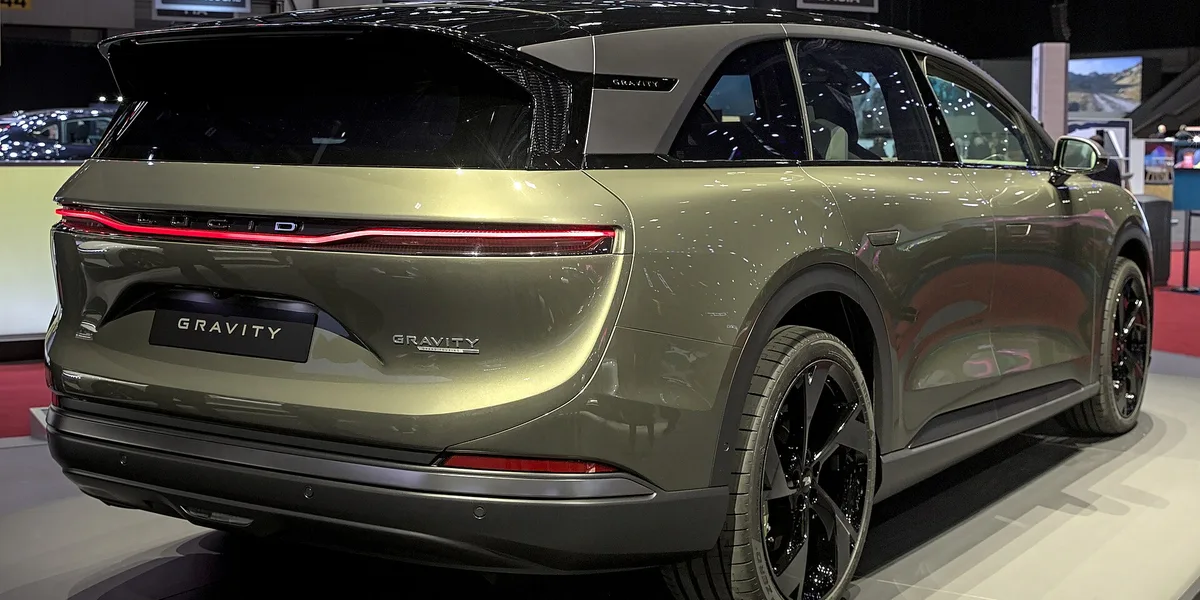
At home, the onboard charger takes up to 19.2 kW (80 A) — a full GT charge in roughly seven hours on Lucid’s home station — and the mobile cable delivers 9.6 kW from a 240 V outlet. Few owners will wire an 80-amp circuit for a car that adds this much range per hour at half that rate, but the capability is there and it is standard.
RangeXchange: What It Is, and What It Is Not
RangeXchange is a $125 adapter that lets a Gravity charge another electric car at up to 9.6 kW — genuinely useful, and routinely misdescribed.
The adapter works with Lucid’s mobile charging cable (a $650 kit, if the car doesn’t already carry the second-generation cable) and delivers up to 9.6 kW to a stranded EV — roughly 40 miles of range per hour. The Gravity’s version is NACS-specific; the Air’s is J1772, and they are not interchangeable. Some coverage, including this page’s previous version, merges RangeXchange with the car’s 19.2 kW figure; that number is the AC charging rate, not the vehicle-to-vehicle output.
The second correction matters more. The Gravity cannot yet power a home: Lucid describes its home charging station as hardware-ready for a future vehicle-to-home solution that is still under development. The bidirectional hardware is in the car, but no Lucid V2H or V2G product is on sale, at any price, as of late 2026. Buyers cross-shopping against trucks that advertise home backup today should weigh that honestly: here it is a promise with the wiring done, not a feature.
Warranty and Battery Health: the Hard Number and the Missing One
Lucid guarantees the Gravity’s battery for 8 years or 100,000 miles, to at least 70% of original capacity — that figure is verified, and it is the only degradation number about this car that is.
No Lucid-published degradation dataset exists for the Air or the Gravity, and no named study supports a precise annual loss figure for Lucid packs. The one fleet signal available is second-hand: reporting of Geotab’s large 2026 fleet study places the Air among its tracked models at about 94.2% capacity retention at 100,000 km — respectable, but it is a roundup’s summary of someone else’s data, not a Lucid measurement, and it is printed here as exactly that. Claims that the GT’s high voltage mechanically extends cell life are plausible reasoning without a study behind them.
So the buyer’s position is simple. The pack is new, its cells are a proven format from a top-tier supplier, and the enforceable promise is the 70% floor at 8 years/100,000 miles. Anything more precise — from any source, including this site’s previous version of this page — is an estimate wearing a fact’s clothes.
Prices, Trims and Availability in Late 2026
The lineup has already changed twice since launch: the Dream Edition is gone, a GT-S replaces it, and 2027 prices are higher.
For 2026, the Touring starts at $79,900 ($81,550 with destination) and the Grand Touring launched at $94,900. For 2027, announced in April 2026, the GT’s base rises to $98,900 ($100,750 with destination), the Touring lists at $81,750 with destination, and the new GT-S — 1,070 hp, a projected ~373 miles that is a Lucid estimate rather than an EPA figure — lists at $127,750 with destination. The GT also gains standard equipment for 2027, including larger wheels and a power package with three AC outlets.
Availability deserves one honest paragraph. Lucid’s Q3 2026 report records 2,954 vehicles produced and 3,806 delivered in the quarter, a second shift at the Arizona plant eliminated in June 2026, and the year’s production guidance withdrawn; a seat-supplier problem had already stalled Gravity deliveries for 29 days in Q1. None of that changes the battery in a car you buy — but it does mean delivery timing on a factory order is a question to ask the studio directly, and that the in-stock inventory Lucid ran down in Q3 is where the ready cars are.
Gravity vs the Premium Electric SUV Field
The Gravity’s battery case is range per charge and charging speed; each rival below answers with something of its own — price, network, or seats.
| Model | Battery | EPA range | Peak DC | Starting price |
|---|---|---|---|---|
| Lucid Gravity GT | 123 kWh | 450 miles | 400 kW | $94,900 |
| Tesla Model X | ~95 kWh usable* | 335 miles | 250 kW | $79,990 |
| Rivian R1S (Max pack) | 141.5 kWh usable | 410 miles | 220 kW | Builds from ~$85,900 |
| Kia EV9 (Long Range) | 99.8 kWh | 305 miles | ~239 kW | $57,900 |
| Mercedes EQS SUV | 108.4 kWh usable | 305 miles | 200 kW | $104,400 |
*Tesla does not publish the Model X’s capacity; the usable figure is EV Database’s.
The Model X is the value-and-network play: less range, slower charging, Tesla’s stations everywhere, and a much lower entry price. The R1S carries the biggest usable battery here and out-ranges everything but the Gravity — our Rivian R1S guide covers its three pack sizes in the same depth. The EV9 is the Gravity’s real problem: seven seats and 305 miles for roughly $37,000 less than a GT. The EQS SUV counters with cabin luxury at a higher price and ordinary charging. The Gravity’s answer to all four is the same: no rival combines 450 EPA miles with 400 kW charging — provided the buyer has access to the chargers that deliver it.
Frequently Asked Questions
How big is the Lucid Gravity’s battery?
Two sizes: 123 kWh in the Grand Touring (and GT-S) and 89 kWh in the Touring. Lucid publishes the totals; the GT’s usable capacity is not official, with independent estimates around 118–121 kWh.
What cells does the Gravity use?
Panasonic’s latest-generation 2170 cylindrical cells, confirmed in a joint Panasonic–Lucid announcement in January 2025. The makers describe a nickel-rich cathode and publish no more specific chemistry designation.
How far does the Gravity really go?
Against EPA ratings of 337 miles (Touring) and up to 450 (GT), independent tests recorded 400 miles (Edmunds, GT rated 450), 401.7 miles at a steady 70 mph (State of Charge retest of a healthy car), and 310 miles at a steady 75 mph (Car and Driver). Plan highway trips on the 75-mph figure.
How fast does the Gravity charge at a Tesla Supercharger?
It depends on the cabinet, not the plug. At a true V4-cabinet site the GT has measured a 419 kW peak. At the far more common V3-cabinet stations (~500 V), the car’s boost system holds roughly 200–225 kW. The Gravity has a native NACS port and Supercharger access is live.
Can the Gravity power my house?
Not yet. The car carries bidirectional hardware and Lucid’s home station is described as hardware-ready for a future vehicle-to-home solution that remains under development. No Lucid V2H product is on sale as of late 2026.
What is RangeXchange, and what does it cost?
A vehicle-to-vehicle charging adapter: $125, used with Lucid’s mobile charging cable ($650 if you need the current kit). It delivers up to 9.6 kW to another EV — about 40 miles of range per hour. The Gravity’s adapter is NACS-specific.
What is the Gravity’s battery warranty?
8 years or 100,000 miles, guaranteeing at least 70% of original capacity. The powertrain carries the same 8-year/100,000-mile term; basic cover is 4 years/50,000 miles.
Touring or Grand Touring — which battery should I buy?
The Touring’s 89 kWh and 337 EPA miles cover most families’ real use, charge at 300 kW, and save about $15,000. The GT earns its premium if you road-trip long distances where its 450-mile rating and 400 kW ceiling (on the right chargers) compress stops — or if you want the 828 hp. The battery chemistry and cells are the same either way.
Conclusion
The Gravity’s battery story is genuinely the strongest in its class — and it is a story with footnotes that most coverage, including this page’s previous version, skipped.
The verified core is impressive: two Panasonic-celled packs, a 450-mile EPA configuration, a measured 419 kW charging peak, and tested range that tracks the ratings unusually closely. The footnotes are equally factual: the 400 kW needs a 1,000 V charger, home backup power is promised rather than sold, the degradation record does not exist yet, and Lucid’s production has had a difficult year. Buy it with both halves in view and it is what it appears to be — the range-and-charging benchmark among three-row electric SUVs, from a young company whose service network you should check in your area before signing.
