
EV Charging vs Gas: Which Is Cheaper?

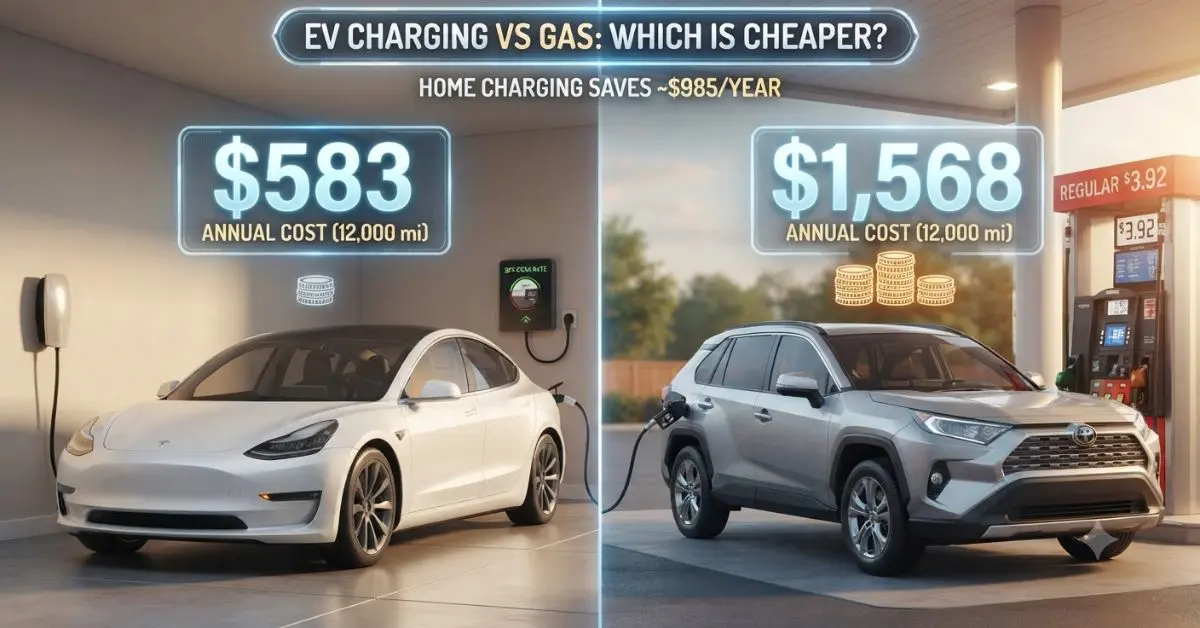
Charging an EV at home costs about $0.05 per mile, which is much cheaper than gas. At standard gas prices, a regular car costs about $0.131 per mile to drive. Home electricity and efficient energy use drop that driving cost down significantly.
Drivers save about $974 every year on fuel costs alone when they drive 12,000 miles annually. Home charging offers a clear financial advantage over traditional gasoline vehicles.
Buying a new EV soon? See our guide on how to get free EV charging with a new car purchase.
EV Charging vs Gas: Cost Per Mile Comparison
| Fuel Type | Cost | Efficiency | Cost Per Mile | Annual Cost (12,000 mi) |
|---|---|---|---|---|
| Gas (national avg) | $3.92/gal (AAA Jun 2026) | 30 mpg | $0.131/mile | ~$1,568 |
| EV home charging | $0.17/kWh (US avg) | 3.5 mi/kWh | $0.049/mile | ~$583 |
| EV public Level 2 | $0.30/kWh (avg) | 3.5 mi/kWh | $0.086/mile | ~$1,029 |
| EV DC fast charging | $0.50/kWh (avg) | 3.5 mi/kWh | $0.143/mile | ~$1,714 |
| Gas (California) | ~$4.80/gal | 30 mpg | $0.160/mile | ~$1,920 |
| EV home charging (California) | $0.31/kWh | 3.5 mi/kWh | $0.089/mile | ~$1,063 |
Why Home EV Charging Is the Cheapest Option
Lower Cost Per Mile
Home Level 2 charging is where EV economics are most compelling. At $0.17 per kWh, home charging delivers electricity at approximately 5 cents per mile compared with gasoline at approximately 13 cents per mile for a 30 mpg car. The saving of approximately 8 cents per mile translates to approximately $974 per year at 12,000 annual miles.
Savings Vary by Electricity Rates
In low electricity rate states like Washington or Texas, the advantage grows to more than $100 per month. Even in high electricity rate states like California, EV home charging still costs less than California’s high gas prices.
How Public EV Charging Affects Fuel Costs
Public Level 2 Charging
Public Level 2 charging at $0.25 to $0.40 per kWh reduces the EV cost advantage but does not eliminate it. Costs range from approximately $0.07 to $0.11 per mile compared with gas at approximately $0.13 per mile.
DC Fast Charging
DC fast charging at $0.50 per kWh closes the gap entirely. It costs approximately $0.14 per mile compared with approximately $0.13 per mile for gas.
Drivers who rely exclusively on DC fast charging can end up paying as much as or even more per mile than gas. This is why home Level 2 charging as the primary method is critical to the EV cost advantage. Relying on public DC fast charging as the only charging method largely removes the fuel savings.
Total Ownership Cost Beyond Fuel
Lower EV Maintenance Costs
Fuel is only part of the total cost of ownership comparison. EVs also benefit from significantly lower maintenance costs. They do not require oil changes, need fewer brake jobs because regenerative braking reduces brake pad wear, have no transmission service, and use simpler drivetrains with fewer failure points.
Combined Fuel and Maintenance Savings
Consumer Reports estimates EVs cost approximately 40% less to maintain than equivalent gas cars over 200,000 miles. When maintenance savings are added to fuel savings, the total operating cost advantage for EV owners averages approximately $1,500 to $3,000 per year compared with similar gas vehicles.
EV Charging vs Gas Costs by State
- Cheapest EV charging states (Washington, North Dakota, Louisiana): Home EV charging at $0.10–$0.11/kWh = approximately $0.029–$0.031/mile — 4–5x cheaper than local gas prices. Largest EV fuel savings in the country
- Average states (Texas, Florida, national average): EV home charging at $0.13–$0.17/kWh — $0.037–$0.049/mile vs gas at $0.11–$0.13/mile. EV clearly cheaper per mile
- High electricity states (California, Hawaii): EV home charging at $0.29–$0.41/kWh — $0.083–$0.117/mile. Still cheaper than California gas ($0.160/mile) but the advantage is narrower. TOU plans at off-peak rates restore full cost advantage
Conclusion
Home EV charging costs less than gas in every U.S. state. Drivers save 60 to 70 percent per mile compared to national average gas rates. Public Level 2 charging narrows this savings gap. Exclusive DC fast charging removes the savings completely.
The best fuel strategy uses home charging most often. Drivers should also use free workplace or destination Level 2 chargers. DC fast charging works best as a road trip tool instead of a daily habit.
This mix keeps monthly EV fuel costs between $40 and $60. Gas cars cost $120 to $180 for the same driving
