
Will EVs Ever Charge as Fast as Filling Up with Gas?

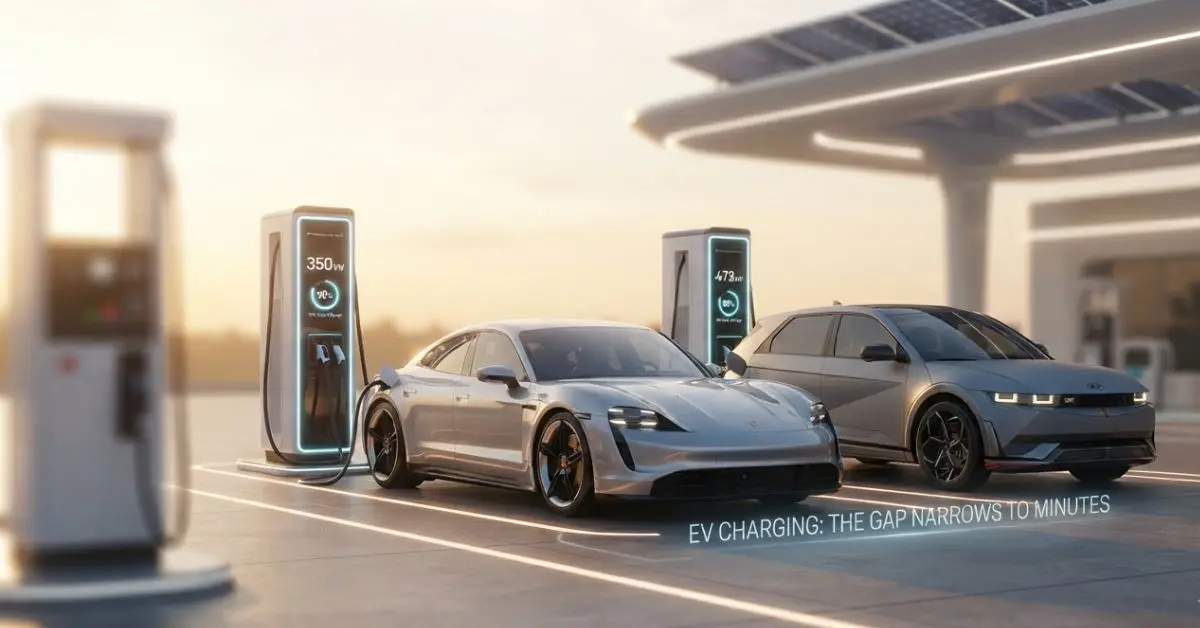
Imagine pulling into a charging station and getting 200+ miles of range in just a few minutes. That future is closer than many people think, and some EVs are already closing the gap with gas cars.
With modern 800V EVs completing 10 to 80% charging in 18 minutes and 350 kW ultra-fast chargers, EVs are approaching gas-station fill speeds for practical driving ranges. A Hyundai Ioniq 5 taking 18 minutes to add 250 miles compares favourably to the typical 8 to 12 minutes at a gas station, especially when gas station time includes getting out, inserting a card, pumping 300+ miles of fuel, and getting back in. Whether EVs will truly match gas fill speeds depends on whether “charging as fast as filling up” refers to the absolute fastest sessions or the overall refuelling experience.
Want to see the fastest public stations available today? See our guide on what ultra-fast 350 kW EV charging is.
Current EV Charging Speed Compared to Gas Cars
| Year | Fastest Consumer EV Charging | Session Time (10–80%) | Miles Added per Minute |
|---|---|---|---|
| 2019 | 270 kW (Porsche Taycan launch) | ~22 min | ~8 miles/min |
| 2022 | 350 kW (Ioniq 5 at Electrify America) | ~18 min | ~12 miles/min |
| 2024 | 473 kW (Zeekr 7X Core) | ~10 min | ~22 miles/min |
| 2026 | 473–500 kW (emerging vehicles) | ~10–12 min | ~20–25 miles/min |
| 2028 (projected) | ~600–800 kW (next-gen solid-state concepts) | ~7–9 min | ~30+ miles/min |
| Gas fill-up comparison | — (12 gallons at 30 mpg = 360 miles) | ~8–12 min total experience | ~30–45 miles/min |
Are EVs Already Close to Gas-Filling Speeds?
For 800V EVs at 350 to 473 kW stations, EV charging is already within 10 to 15 minutes of the total gas station experience. It is also faster than gas, especially since 80% of EV charging happens at home, with zero stop time at any station.
For 400V EVs at 150 to 250 kW, a 25 to 35-minute charging session is still longer than filling a gas tank. However, it fits naturally into a meal break or rest stop.
The remaining gap, from 18 minutes to around 8 to 10 minutes, is being reduced through 800V and higher-voltage systems, improved charging curves, and next-generation battery chemistries that can accommodate higher charging rates.
Technologies Making EV Charging Faster
Solid-State Batteries
Solid-state batteries use solid electrolytes instead of liquid electrolytes. They support much higher charging rates without the lithium plating risk that limits today’s lithium-ion batteries. These batteries could support 10C+ charging and reduce a 10-80% charge to under five minutes once production costs become affordable.
Higher Voltage Vehicle Architectures
Higher voltage systems between 900V and 1,200V reduce electrical current while delivering the same power. This makes charging more efficient and helps manage heat. The Lucid Air already uses a 924V architecture, and future EVs may exceed 1,000V.
Advanced Thermal Management
Better cooling systems allow battery cells to maintain high charging speeds for longer periods. Technologies such as advanced liquid cooling, phase-change materials, and direct liquid-cell cooling reduce heat buildup and improve the average charging rate throughout the session.
When Will a 5-Minute EV Charge Become Reality?
A five-minute charging session that adds more than 200 miles of driving range would match the convenience of filling a gas car in almost every practical situation.
To achieve that, a typical 75 kWh EV would require around 1,500 to 2,000 kW of charging power, which is about four to six times the output of today’s fastest public chargers.
The biggest challenge is not only building more powerful chargers. Battery cells must safely accept energy at these extreme rates without overheating or suffering long-term damage.
Most battery engineers expect commercial solid-state batteries capable of five-minute charging to reach the mass market within the next five to ten years, with premium EVs likely offering around 10-minute charging even earlier.
Not sure what your own EV’s real-world ceiling is? See our guide on what the maximum charging speed of your EV is.
Conclusion
EVs are not yet as fast to charge as gas cars are to fill, but the difference is shrinking quickly and is already much smaller than many people realise. Modern 800V EVs using 350 to 473 kW chargers can add 200 to 250 miles of range in just 10 to 18 minutes, putting them within about 5 to 10 minutes of a typical gas station visit.
For everyday driving, the comparison matters even less because most EV owners charge at home and avoid fuel station stops completely. As solid-state batteries become mainstream in the early to mid-2030s, EV charging is expected to reach gas-like convenience for most drivers.
Curious how far this power scales for heavy vehicles? See our guide on what megawatt charging is for electric semi trucks.
Frequently Asked Questions
Will EVs ever charge as fast as filling a gas tank?
Yes. Many experts expect mainstream EVs with solid-state batteries to reach gas-like charging times in the early to mid-2030s.
Why do 800V EVs charge faster than 400V EVs?
An 800V system can deliver higher charging power with less heat and lower electrical current, allowing the battery to charge more quickly.
What is stopping EVs from charging in five minutes today?
The biggest limitation is battery technology. Current battery cells cannot safely accept extremely high charging power without generating too much heat or reducing battery life.
