
What Is Megawatt Charging for Electric Semi Trucks?

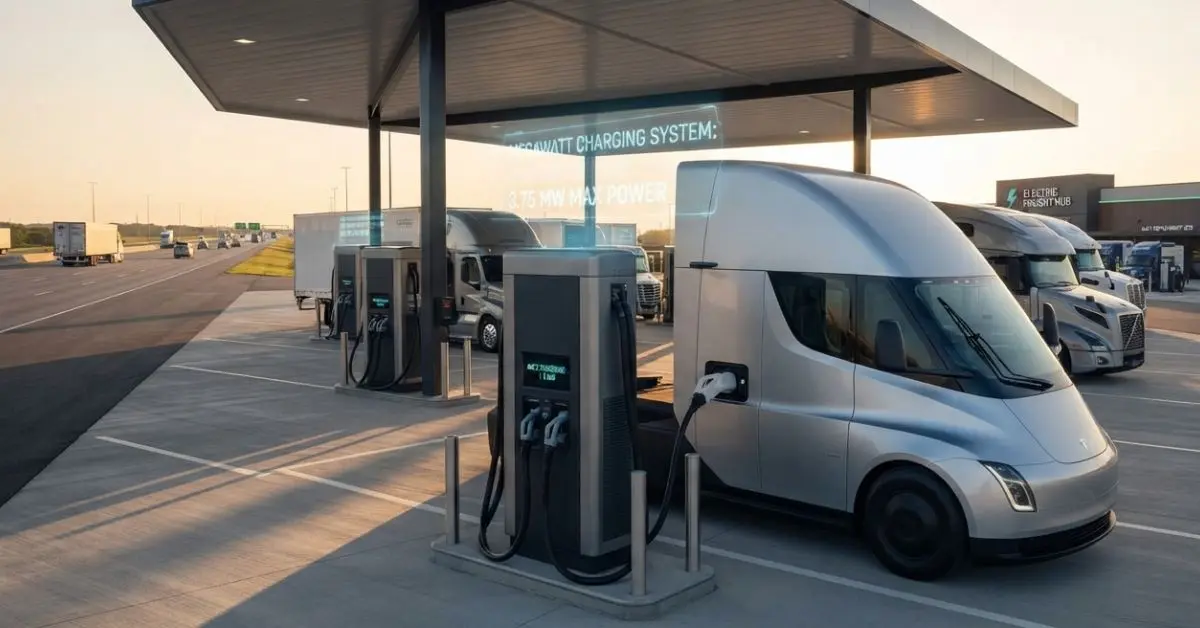
Megawatt charging is a new standard for electric semi-trucks, heavy-duty freight vehicles, and buses. It delivers up to 3.75 MW (3,750 kW) of power. This is about 15 times more powerful than the fastest charger for passenger electric vehicles, which offers 350 kW.
The Megawatt Charging System (MCS) became a final standard in 2023. Companies now place these chargers at truck stops, distribution centres, and along freight routes to support new electric trucks. Manufacturers like Tesla, Daimler, and Volvo Trucks are now deploying vehicles and equipment that use this system.
Curious how this compares to the fastest passenger-car charging? See our guide on what ultra-fast 350 kW EV charging is.
Why Semi-Trucks Need Megawatt Charging
Electric semi-trucks use batteries between 500 and 1,000 kWh. These batteries are 5 to 10 times larger than those in normal electric cars. A 250-kW Supercharger takes 4 to 5 hours to charge a 1,000-kWh battery. This speed does not work for trucking companies because they must follow strict delivery schedules.
A 1 MW charger fills the same truck in 60 to 70 minutes. At the maximum MCS speed of 3.75 MW, a 1,000 kWh truck could charge in 16 to 20 minutes. This speed matches the time a driver spends at a diesel fuel stop.
MCS Specifications
| Specification | Detail |
|---|---|
| Standard name | Megawatt Charging System (MCS) |
| Standard body | SAE International (SAE J3068 / CharIN MCS) |
| Maximum power | 3.75 MW (3,750 kW) |
| Typical deployment power | 1–1.5 MW (most current installations) |
| Voltage range | 400–1,250V DC |
| Maximum current | 3,000A |
| Connector design | Large manual connects with liquid-cooled cable |
| Primary application | Class 8 semi-trucks, heavy buses, and port equipment |
| Charge time (1,000 kWh truck at 1 MW) | ~60–70 minutes |
| Infrastructure status | Early deployment — truck stops, depots, ports |
Tesla Semi and Megawatt Charging
The Tesla Semi is the first electric semi-truck produced at a commercial scale. Tesla created its own Megawatt Charging technology to work alongside the MCS (Megawatt Charging System) standard. These charging stations currently deliver around 750 kW, with plans to increase speeds as the network grows.
Tesla is building a new charging network for the Semi along busy freight routes in California, Texas, and Nevada. Large companies like PepsiCo use these dedicated stations to keep their trucks powered and ready for long trips.
Where Megawatt Charging Infrastructure Is Being Deployed
Truck Stops and Travel Centres
Pilot’s Flying J, Love’s Travel Stops, and TA/Petro are installing MCS chargers at major interstate locations. These charging stations support Class 8 truck operators moving from diesel to electric fleets.
Distribution Centre Depots
Amazon, UPS, FedEx, and other major logistics companies are deploying MCS charging systems at their distribution centres. These chargers allow electric truck fleets to recharge overnight between delivery routes.
Port Facilities
The Port of Los Angeles, the Port of Long Beach, and other major ports are adding MCS chargers to support electric drayage trucks. These trucks transport shipping containers within port areas and nearby logistics hubs.
NEVI Truck Charging Program
The federal NEVI program includes funding for electric truck charging infrastructure along major commercial freight corridors. This investment aims to support the growing number of heavy-duty electric vehicles across the United States.
Wondering if passenger EVs will ever match diesel-fast fill times too? See our guide on whether EVs will ever charge as fast as filling up with gas.
Conclusion
Megawatt Charging System (MCS) technology makes long-haul electric trucking possible. Without this high-speed technology, charging times would make electric semi-trucks too slow for most shipping companies to use. The MCS standard offers a 3.75 MW maximum power rate. This allows these large trucks to charge as fast as a driver fills a diesel tank.
This technology is now appearing at truck stops, depots, and ports. Companies like Tesla, Daimler, Volvo Trucks, and Peterbilt are building more electric semi-trucks to match this growth. MCS is not for regular electric cars. Instead, it provides the power grid needed to turn the nearly 2 million Class 8 trucks on U.S. roads into electric vehicles over the next decade.
Curious what your own passenger EV’s actual charging limit is? See our guide on what the maximum charging speed of your EV is.
Frequently Asked Questions
How long does it take to charge an electric semi truck with MCS?
A 1,000 kWh electric semi truck can charge in about 60 to 70 minutes at 1 MW. At the maximum 3.75 MW, charging could theoretically take 16 to 20 minutes, depending on the vehicle and charger.
Can passenger electric cars use Megawatt Charging System chargers?
No. MCS chargers are designed specifically for heavy-duty vehicles such as electric semi trucks, commercial buses, and port equipment. Passenger EVs use different charging standards like CCS and NACS.
