
QuantumScape Solid-State Battery: Progress Update

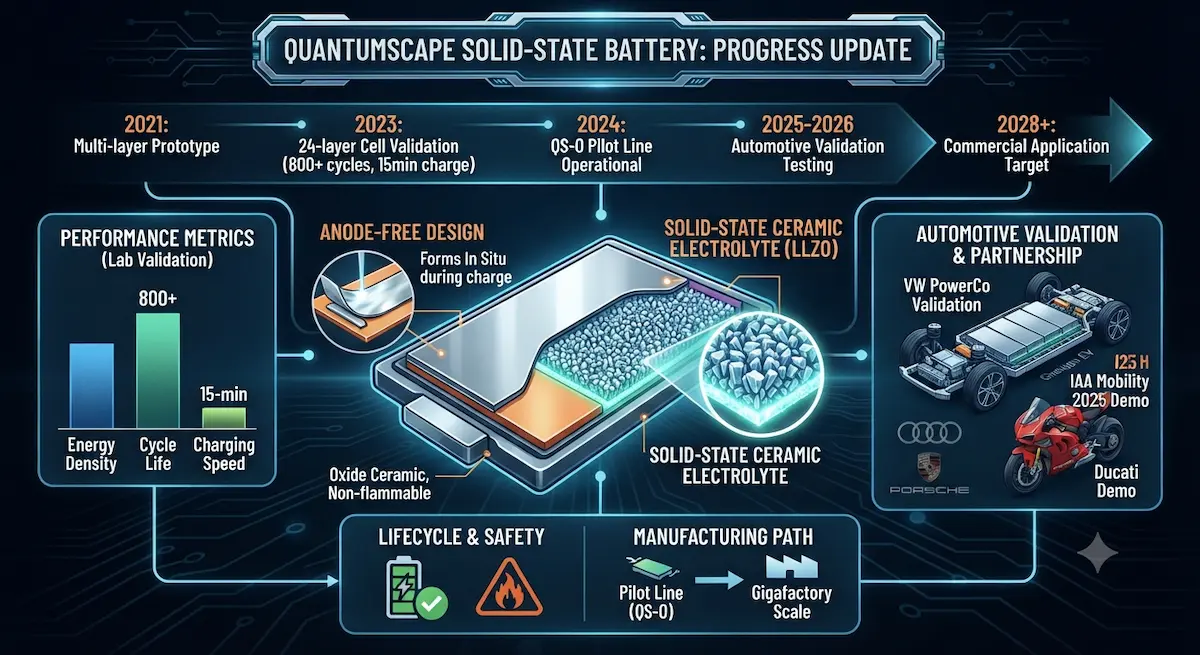
QuantumScape is one of the most closely watched solid-state battery startups in the world — backed by Volkswagen with over $300 million invested. As of late 2026, QuantumScape has anode-free solid-state cells in automotive validation testing, publicly demonstrated its technology by powering a Ducati motorcycle at IAA Mobility 2025, and maintains a commercial partnership with VW’s PowerCo for mass production. Here is the current status of QuantumScape’s solid-state battery progress.
Toyota is pursuing a competing sulfide-electrolyte approach with an even more aggressive timeline — see our full status update on Toyota’s solid-state battery.
QuantumScape’s solid-state battery is an anode-free lithium-metal design behind a ceramic separator. Its QSE-5 cell is in customer sampling, its Eagle Line pilot plant opened in February 2026, and VW’s PowerCo holds a licence to produce it. Commercial cars remain a 2028+ story.
Key figures:
Cell QSE-5 – Energy density 844 Wh/L (company figure) – Fast charge about 12 minutes (10-80%) – Pilot line Eagle Line, San Jose – First cars 2028+
November 2026 update: QuantumScape has since unveiled Osprey, a fully solid-state cell that ran 1,000 cycles at just one atmosphere of pressure — read our news report for the figures.
QuantumScape’s Technical Approach
QuantumScape uses two differentiating design choices:
- Anode-free design: There is no pre-formed anode. Instead, lithium metal plates directly onto the current collector during the first charge — forming the anode in place. This eliminates the weight and volume of a pre-manufactured anode, maximizing energy density and simplifying manufacturing.
- Oxide ceramic solid electrolyte: a proprietary ceramic, widely reported as an LLZO-type garnet — chemically stable, non-reactive with moisture (unlike sulfide electrolytes), and physically rigid. The trade-off is lower ionic conductivity vs sulfide electrolytes, and brittleness that must be managed in cell design.
QuantumScape Progress Timeline
| Date | Milestone |
|---|---|
| 2020 | IPO via SPAC; VW investment confirmed; initial single-layer cell data released |
| 2021 | Multi-layer prototype cells demonstrated (needed for automotive-scale energy) |
| 2023 | 24-layer cells achieving 15-minute 10–80% charging and 800+ cycles in testing |
| 2024 | QS-0 pilot manufacturing facility operational in San Jose |
| September 2025 | Publicly powered Ducati motorcycle with solid-state lithium-metal cells at IAA Mobility |
| 2025–2026 | Automotive validation testing with VW/PowerCo |
| February 2026 | Eagle Line pilot production line inaugurated in San Jose, with the Cobra separator process integrated |
| October 2026 | 100 MWh production line announced (Muehlbauer equipment), targeting production in 2028 |
| 2028+ | Target for first commercial automotive application |
Performance Claims vs Validation
QuantumScape’s most publicized results from their QS-0 pilot cells:
- 15-minute 10–80% charging capability
- 800+ charge cycles with >80% capacity retention
- Operating across a wide temperature range
- Energy density improvements over graphite-anode alternatives
Important context: these results are from small-format, single-stack cells in controlled lab conditions. Automotive-grade cells require much larger format and must maintain performance across automotive temperature ranges, vibration, and charge-discharge profiles. The gap between lab cells and automotive cells is one of the hardest scaling challenges in battery development.
The current cell is the QSE-5, QuantumScape’s first commercial-intent design. QuantumScape rates it at 844 Wh/L in energy density, with a 10 to 80 percent charge in about 12 minutes and more than 1,000 cycles in testing. Those are company figures for sample cells, not yet production-car numbers.
The VW/PowerCo Partnership
Volkswagen Group has invested over $300 million in QuantumScape and established a joint development agreement through PowerCo (VW’s battery subsidiary). The commercial plan: PowerCo would eventually license QuantumScape’s technology for manufacture in its European gigafactories, applying it across VW Group brands including Volkswagen, Audi, Porsche, and potentially others.
See our full explainer on the anode-free lithium metal design at the heart of this technology: what a lithium metal anode battery is.
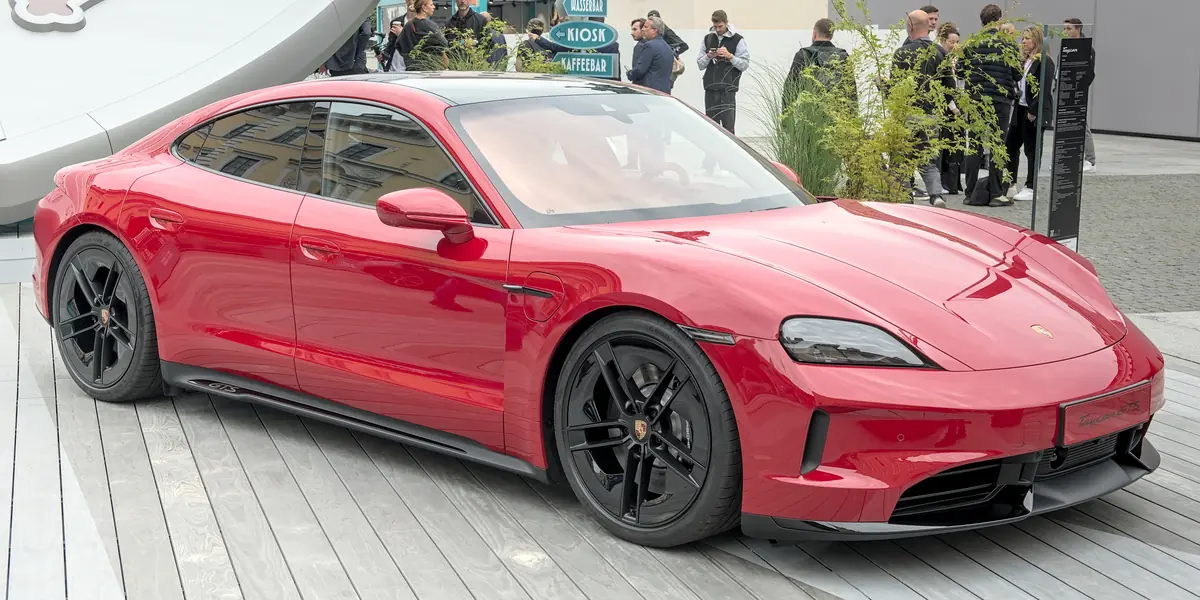
The deal has deepened since it was signed. In July 2025, PowerCo committed up to $131 million in milestone payments over two years, on top of its licence to produce up to 40 GWh of QuantumScape-based cells a year. In October 2026 the two sides trimmed $7 million from one development programme while talks on the next phase continued, and QuantumScape has begun pointing the same technology at data-center energy storage.
Frequently Asked Questions
What is the latest QuantumScape news?
As of late 2026: the Eagle Line pilot plant in San Jose opened in February 2026 and is producing QSE-5 sample cells with the Cobra process. In October 2026, QuantumScape announced a planned 100 MWh production line targeting 2028, and trimmed one PowerCo development programme by $7 million while wider talks continued.
What is QuantumScape’s current progress?
QuantumScape has working pilot production, QSE-5 cells shipped to Volkswagen for sampling, and a public Ducati demonstration from September 2025. Two more major carmakers signed on in 2025. What it does not yet have is mass production: the company is in the hardest phase, turning sample cells into factory output.
When will QuantumScape batteries be in cars?
The first commercial automotive use is targeted for 2028 or later, through PowerCo’s licensed production. QuantumScape’s own planned 100 MWh line is also aimed at 2028. Mainstream volumes come later, as licensed gigafactories are built.
Will QuantumScape’s battery be in VW cars?
That is the plan. PowerCo, Volkswagen’s battery company, holds a licence for up to 40 GWh a year of QuantumScape-based cells. Which brand gets them first, Volkswagen, Audi or Porsche, has not been confirmed.
How much does a QuantumScape battery cost?
There is no price to quote: QuantumScape sells no cells commercially today, and no per-kWh figure has been published. Its whole manufacturing push, the Cobra process and the Eagle Line, exists to bring the cost down to automotive levels, which is the test the next two years will answer.
What is the QuantumScape Cobra process?
Cobra is QuantumScape’s current production process for its ceramic separator. It runs about 25 times faster than the earlier Raptor process in a much smaller footprint. Cobra is built into the Eagle Line and is the process licensing partners would use at scale.
Conclusion
QuantumScape’s anode-free oxide ceramic approach represents a genuinely novel path to solid-state batteries — avoiding sulfide reactivity with moisture while maximizing energy density through the anode-free design. The 2025 IAA Ducati demonstration and automotive validation testing with PowerCo represent concrete progress beyond pure laboratory work. The 2028+ commercial target is achievable but requires successfully transitioning lab-validated single-stack cells to automotive-scale multi-stack cells at production quality — the defining challenge remaining. QuantumScape is a real technology, not vaporware — but the finish line is still years away.
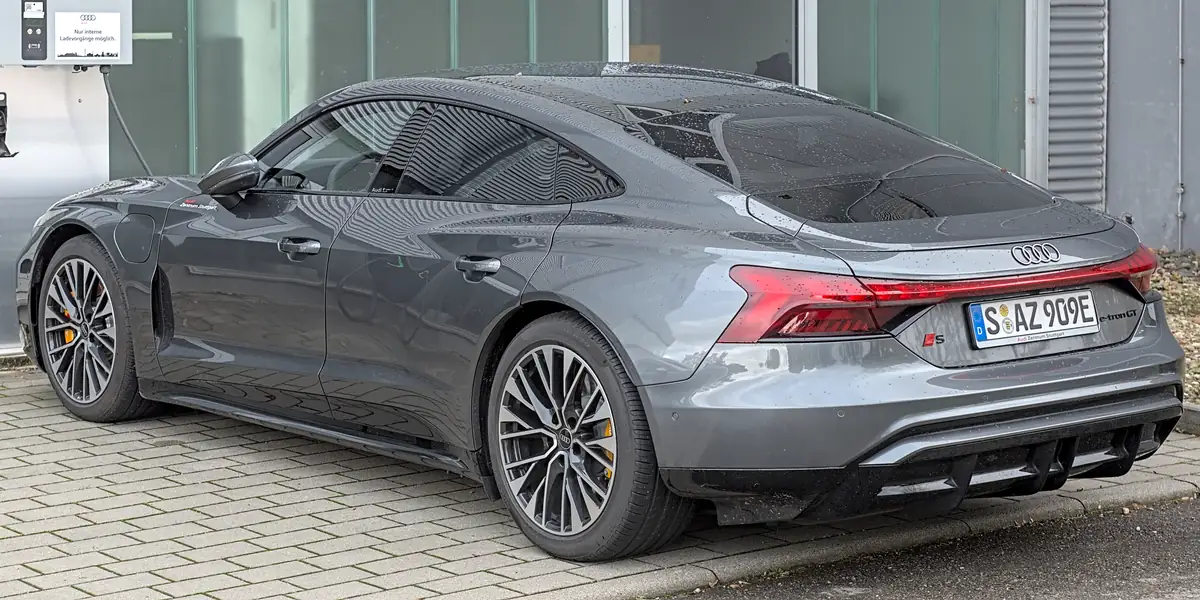
Curious who else is racing toward this same finish line? See our roundup of which car companies are working on solid-state batteries.
