
Top EV Battery Safety Myths Debunked With Real Data

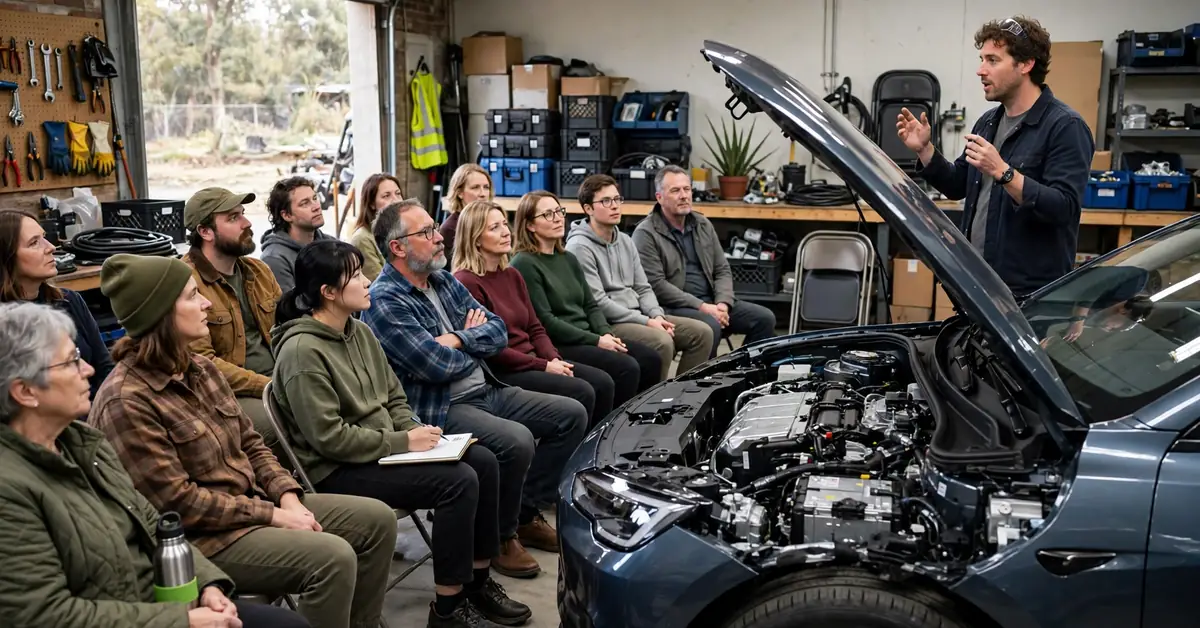
EV battery safety myths spread faster than the facts, often driven by rare, highly publicized incidents. Most of these claims don’t hold up against real crash, fire, and testing data. This guide checks the most common EV battery safety myths against the numbers, and explains the systems that keep batteries safe. For the broader basics, see our EV battery safety guide.
What Safety Systems Protect EV Batteries?
Modern EVs rely on several layered safety systems working together. No single feature carries the full weight of battery protection.
Battery Management Systems (BMS) continuously monitor voltage, current, and temperature across every cell. They can shut down or isolate sections of the battery if something looks abnormal.
Thermal management systems actively cool the battery during driving and charging. This keeps cells within a safe operating temperature range.
Reinforced enclosures protect the battery pack from crash damage and road debris. High-strength materials absorb impact energy before it reaches the cells.
Automatic high-voltage shutoffs disconnect the battery instantly during a detected crash. This reduces shock risk for occupants and first responders.
Sealed, isolated systems keep high-voltage components separate from the vehicle’s chassis and cabin during normal use.
These systems are tested against international standards before any EV reaches the market, covering everything from transport safety to crash performance.
Top EV Battery Safety Myths Debunked
Misinformation about EV batteries spreads faster than the facts. Here are the most common myths, checked against real data.
Myth: EVs catch fire more often than gas cars.
Fact: EVs catch fire far less often. Data shows roughly 25 fires per 100,000 EVs sold, compared to around 1,530 for gasoline vehicles.
Myth: EV batteries aren’t tested as thoroughly as other vehicle safety systems.
Fact: EV batteries must pass their own dedicated testing standards, in addition to the same Federal Motor Vehicle Safety Standards required for every car sold in the U.S.
Myth: Any bump or scratch can cause a battery fire.
Fact: Serious battery damage, not minor cosmetic issues, is the real trigger. Reinforced enclosures are specifically designed to absorb everyday impacts without reaching the cells.
Myth: EV batteries can’t handle extreme weather.
Fact: EV batteries are engineered for a wide range of climates. Extreme heat and cold do affect performance and charging behavior, but they don’t inherently make the battery unsafe.
Myth: Charging an EV overnight is dangerous.
Fact: Overnight charging is safe with a properly installed, certified charging setup. Most fires linked to charging trace back to wiring issues, not the act of charging itself.
The Bottom Line on EV Battery Safety Myths
EV battery safety myths rarely survive contact with the actual data. Fires are rarer than in gas-powered cars, and every EV battery goes through rigorous testing before hitting the road. Layered safety systems handle crash protection, thermal management, and electrical isolation automatically. Checking claims against real numbers, rather than headlines, is the best way to separate genuine risk from myth.
Frequently Asked Questions
Do all EVs have the same level of battery safety?
No, safety varies somewhat by manufacturer, battery chemistry, and vehicle design. All EVs sold in the U.S. must meet the same federal minimum standards, but specific safety features can differ between models.
Is it true that EV batteries degrade quickly and become unsafe?
No, most EV batteries retain over 80% of their capacity well past 200,000 kilometers, with typical wear around 2% per year. Degradation affects range more than safety in nearly all cases.
Are older EV models less safe than newer ones?
Generally, newer EVs benefit from improved battery chemistry, better thermal management, and updated safety standards. Older models can still be safe if properly maintained and free of unresolved recalls.
Where can I learn more about specific EV battery safety topics?
This guide focuses on myths and safety systems, while dedicated guides on our site go deeper into charging safety, electrocution safety, safety standards, public charging, and battery disposal.
