
Can the New Tesla Roadster Fly?


Based on Reuters and AP reporting of the 15 October 2026 demonstration, Snopes’ fact-check of the event footage, Tesla’s own published trim pages, and the statements of Tesla executives (November 2026).
The videos look like a render. A sports car drives up a wall, hangs upside down, drops, catches itself on jets of air, hovers, and flips over a row of parked cars. In October 2026 those videos were watched hundreds of millions of times, and the most common reaction was the reasonable one: this cannot be real.
It is real — with precise boundaries. What Tesla demonstrated was a prototype, uncrewed, performing seconds-long thruster manoeuvres at a rocket test site. What Tesla has not done is sell anyone a flying car. This page separates the two: the verified demonstration first, the physics second, and every claim labelled as a claim, because on this story the gap between “demonstrated” and “announced” is nine years wide.
Yes — a Tesla Roadster prototype has flown, briefly, and the footage is genuine (Snopes rated Tesla’s event videos authentic on 16 October 2026). At SpaceX’s McGregor site on 15 October 2026, an uncrewed Roadster prototype hung inverted on suction fans, righted itself with cold-gas thrusters, hovered for seconds, and kickflipped over five parked Teslas. The thruster system carries roughly 5–6 seconds of boost per fill (Tesla executive figure) — this is hopping, not flight, and no customer car exists yet.
Key figures: 10 thrusters (top trim) · ~600 litres of compressed air ≈ 250 kg · hover needs ~16,700 newtons for a car this weight · production: not started
What Actually Happened at McGregor on 15 October 2026
A livestreamed prototype demonstration — uncrewed, rehearsed, and verified by independent fact-checkers.
The event had already slipped once (a planned 1 October date was postponed for high winds) when Tesla livestreamed from SpaceX’s McGregor, Texas test site on the evening of 15 October 2026. As reported by Reuters and the AP, a Roadster prototype drove up a curved ramp, continuing until it hung inverted at about 170 degrees — held to the surface by suction fans, not by its tyres. The fans released; the car fell, fired its cold-gas thrusters, rotated upright in the air, hovered briefly, landed on its wheels, and — in the finale — used the thrusters to kickflip over a line of five parked Teslas.
Tesla also ran a thruster-assisted 0–60 mph launch timed at 0.81 seconds on Tesla’s own timer; the best figure quoted afterwards, 0.55 seconds, is, as Hagerty noted, a number with rollout — the timing convention that flatters every drag-strip claim. Tesla executive Lars Moravy gave the system’s working figures on stage: ten thrusters on the top version, about 600 litres of compressed air — roughly 250 kg of it — and about five to six seconds of boost per fill. On 4 November, Tesla released onboard point-of-view footage from the car, the newest development at the time of writing.
And the verdict on the question half the internet asked: Snopes examined the event videos and rated them True — authentic footage, not AI or CGI. That is the sentence this story turns on, and it is sourced, not vibes.
The Claim’s Nine-Year Run-Up
The flying Roadster was promised in tweets long before it was demonstrated — the timeline explains both the hype and the scepticism.
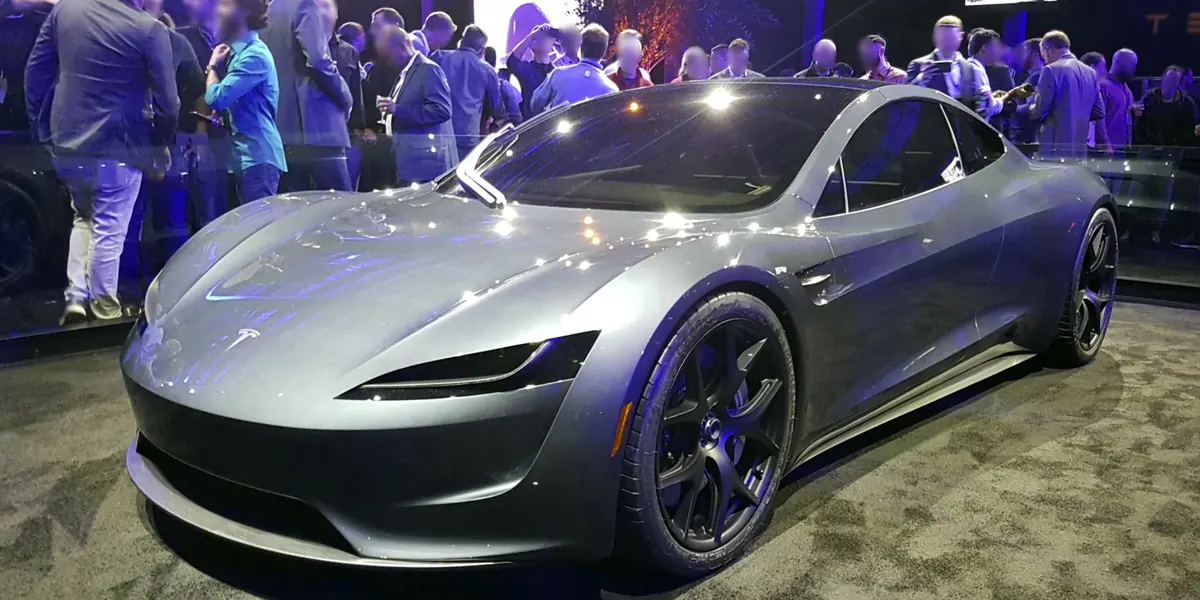
Tesla unveiled the second-generation Roadster in November 2017 with announced figures that were extraordinary even then: a 200 kWh battery, 620 miles of range, 0–60 mph in 1.9 seconds, a top speed above 250 mph, priced from $200,000 (Founders Series $250,000), with production promised for 2020. Those were announcement claims; the car did not enter production in 2020, or in any year since.
The flying part arrived on 9 June 2018, in a tweet: an optional SpaceX package with “around 10 small rocket thrusters” that would improve acceleration, braking, cornering and top speed — adding, “maybe they will even allow a Tesla to fly…” In January 2019 Musk described the mechanism: a composite overwrapped pressure vessel in place of the rear seats, an electric pump refilling it, and the hover claim repeated.
In February 2024 he raised the stakes again — 0–60 in under a second, which he called “the least interesting part” — and aimed to ship in 2025. That date, too, passed. The 2026 public event followed internal demonstrations earlier that year, and the reveal itself slipped through four documented dates (spring, then August, then 1 October, then 15 October). The pattern is the context for everything in the FAQ below: Tesla eventually demonstrated the machine — and its calendar claims deserve the discount its history has earned.
How Cold-Gas Thrusters Work
No combustion, no fuel — just very high-pressure air, released in aimed bursts, exactly as spacecraft have done for decades.
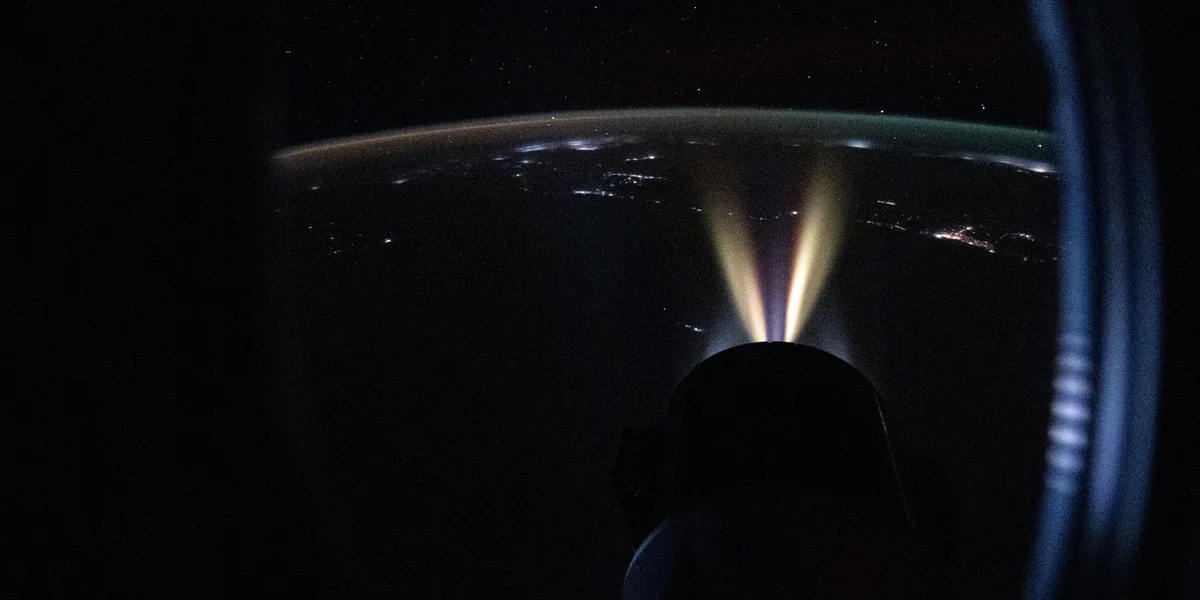
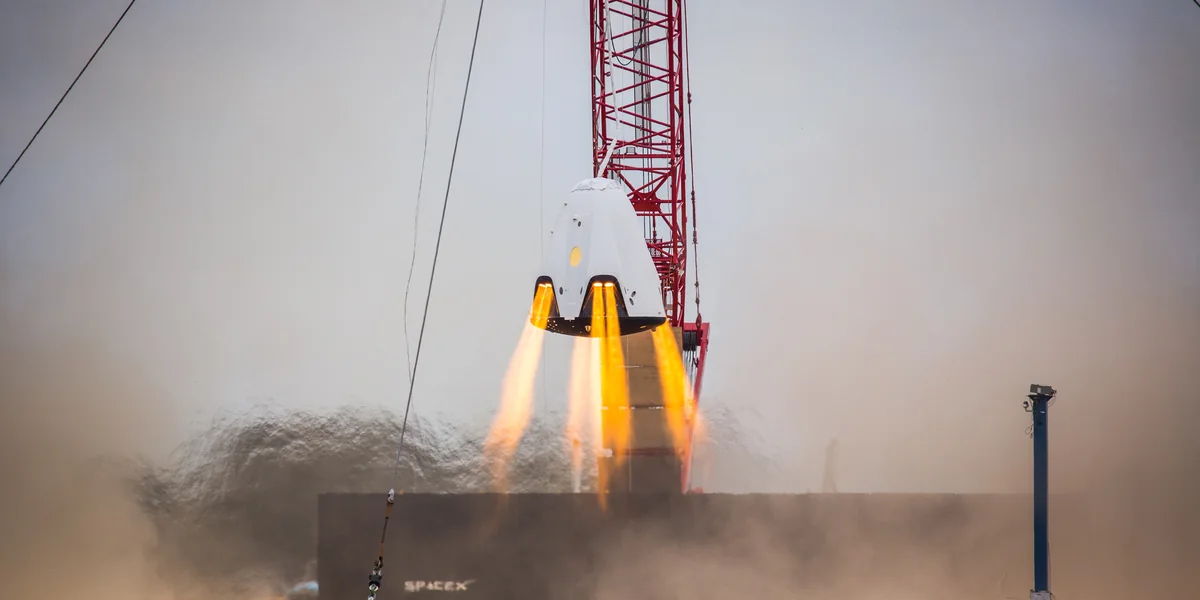
A cold-gas thruster is the simplest rocket there is: gas stored at extreme pressure in a tank, released through a nozzle. The escaping gas pushes the vehicle the other way. Spacecraft use the principle for attitude control because it is clean, instant and reliable; SpaceX’s Dragon capsules manoeuvre with thrusters of this family. The Roadster scales the idea sideways into a car: an electric compressor keeps a composite pressure vessel topped up with ordinary air, and computer-controlled nozzles around the body fire in whatever combination the moment needs — down for lift, sideways for rotation or cornering force, forward for braking, backward for launch thrust.
The elegance is real, and so is the limit: the car’s entire “fuel” is the air in the tank. Moravy’s numbers — about 600 litres, roughly 250 kg of air, five to six seconds of full boost — describe a system built for moments, not journeys. Between moments, the compressor refills the vessel from the battery, which is why the tank size grows with the trim (the mid version carries a 200-litre tank in the trunk; the top version gives up its rear seats and more). How the car’s battery and motors handle the ordinary driving is a separate story, covered in our Tesla battery technology overview.
The Physics of a Few Seconds
The arithmetic is unforgiving, and it agrees with Tesla’s own figures: this is hopping, engineered brilliantly.
Hovering means pushing down with force equal to the car’s weight. For a car of roughly 1,700 kg, that is about 16,700 newtons of continuous thrust. The total push a tank of gas can deliver — its impulse — is finite: 250 kg of air, expelled at cold-gas exhaust velocities, works out to on the order of 160,000 newton-seconds. Divide one by the other and the theoretical ceiling is under ten seconds of hovering, before manoeuvring, stability margins and inefficiency take their share. Tesla’s own “five to six seconds of boost” sits exactly where the arithmetic says it should. This is not a flaw in the demonstration; it is what the demonstration honestly was.
Two clarifications the viral clips blurred. First, the inverted ramp run was not flight at all — suction fans held the car to the surface, an adhesion trick (downforce’s mirror image) unrelated to the thrusters. Second, as the Smithsonian’s coverage put the whole achievement: “we are literally talking about hopping.” A hop that rotates a car upright in mid-air and lands it on its wheels is a genuine engineering feat. It is also, physically, a hop — and a vehicle that travels is a different invention, still unbuilt.
The Three Versions Tesla Is Taking Money For
Deposits are open; the faster the version, the more of the car the air tank eats.
Version | Deposit | Hardware | Tesla’s claim |
|---|---|---|---|
Performance | $50,000 | Suction-fan system, no thrusters | 0–60 mph under 1.6 s |
Thrust | $250,000 | 4 rear thrusters, 200-litre tank (in the trunk) | 0–60 mph under 0.9 s |
Rocket | Invite only | Single seat, 10 thrusters, 600 litres total | 0–60 mph under 0.59 s; “not approved for public road use” (Tesla’s words) |
Tesla’s site also implies a base version beneath Performance, which no opened source names — earlier drafts of this page called it “Standard”; that name appears nowhere in Tesla’s material or the wire coverage, so it is not used here. Read the deposit column carefully: these are reservation deposits against cars that do not yet exist in production, from a program whose announced dates have slipped for nine years. The full purchase prices have not been finalised in any source we could open. And one line in Tesla’s own Rocket description deserves quoting rather than paraphrasing: the version that flies most is the version Tesla itself says is not approved for public road use.
The Battery: What Is Known, and What Is Not
For a battery site, the honest headline is how much Tesla has not said.
Moravy’s on-stage figures describe a bespoke, high-voltage pack: 800–1,000 volts, nickel-based cells, 500 kW charging, and a claimed 15–85% charge in about ten minutes, with range quoted around 310–320 miles — roughly half the 620 miles announced in 2017, which tells its own story about the gap between announcement and engineering. One number was conspicuously absent: capacity. Tesla has not disclosed the pack’s kilowatt-hours. Figures circulating on retail and blog sites (around 150 kWh, or 100 kWh) trace back to an accessories retailer’s blog, not to Tesla — they are not printed here as fact, and any site stating a Roadster capacity as settled is guessing.
What can be said: a 500 kW charge rate and repeated compressor loads argue for exactly the high-voltage, high-output design Moravy described, and the pack architecture questions — cell format, cooling, buffers — are the ones our guide to how Tesla battery packs work takes apart for the cars you can actually buy.
Price, Deposits, and Where Production Stands
As of November 2026: a demonstrated prototype, open deposits, no production line, and claims still escalating.
Two days after the event, Musk posted that the production car would be “even crazier” than the prototype — floating a Grand Canyon jump and half the speed of sound. Those are claims, offered without evidence, on a social platform, about a car with no production date; they are recorded here because readers will meet them, and labelled for the same reason. Tesla’s stock, incidentally, tells the market’s version of the same split verdict: shares popped about 5.4% premarket on the event, then closed 16 October down 2.13% — on a day the Nasdaq fell about 2.15% ahead of Tesla’s earnings. “Investors shrugged” and “investors cheered” are both half-stories; the tape shows both, in sequence.
Is Any of This Legal?
The regulators have said remarkably little — and none of it is an approval.
Asked about the car, the FAA’s position, as reported by CBS News, is that the vehicle “does not meet the FAA’s definition of an aircraft” — it is not regulated as one; nor does that statement certify it as anything else. NHTSA, the road-safety regulator, told CBS the car must not “defy applicable Federal Motor Vehicle Safety Standards” — a requirement, not a blessing.
No approval from any agency for thruster flight on public roads exists, and Tesla’s own “not approved for public road use” line for the Rocket trim concedes the point for the version that matters. A demonstration on a closed rocket test site is legal the way any closed-course stunt is; what a customer may do with the production car, on a public road, remains unanswered by everyone.
The Other Flying Tesla
The Roadster story only makes sense with its prologue: the Tesla that has been flying since 2018 — as cargo.
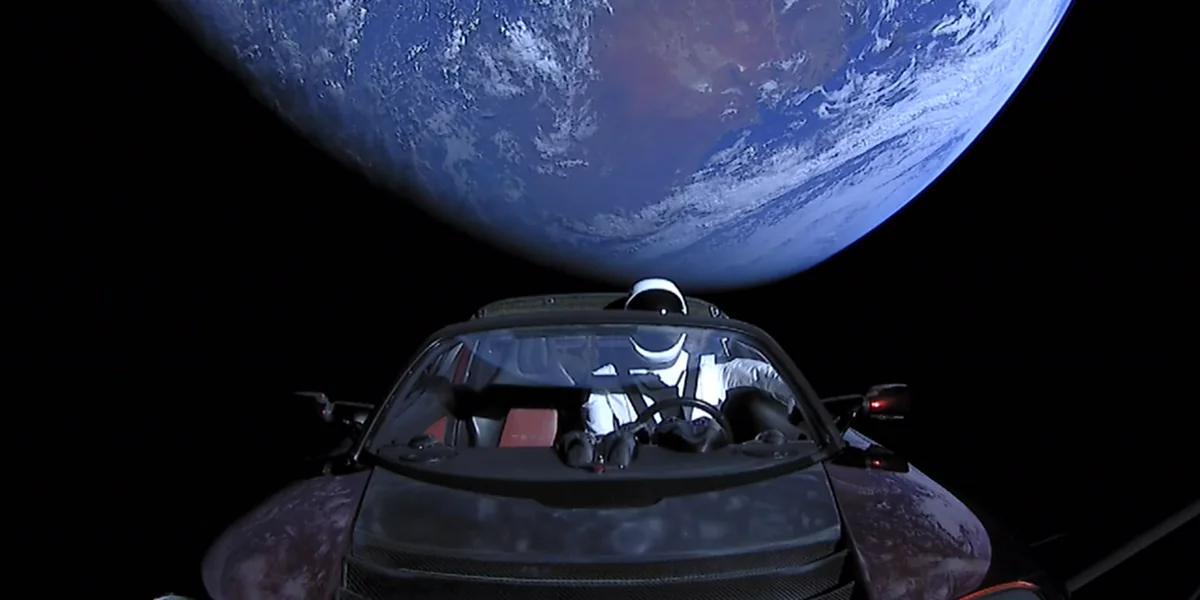
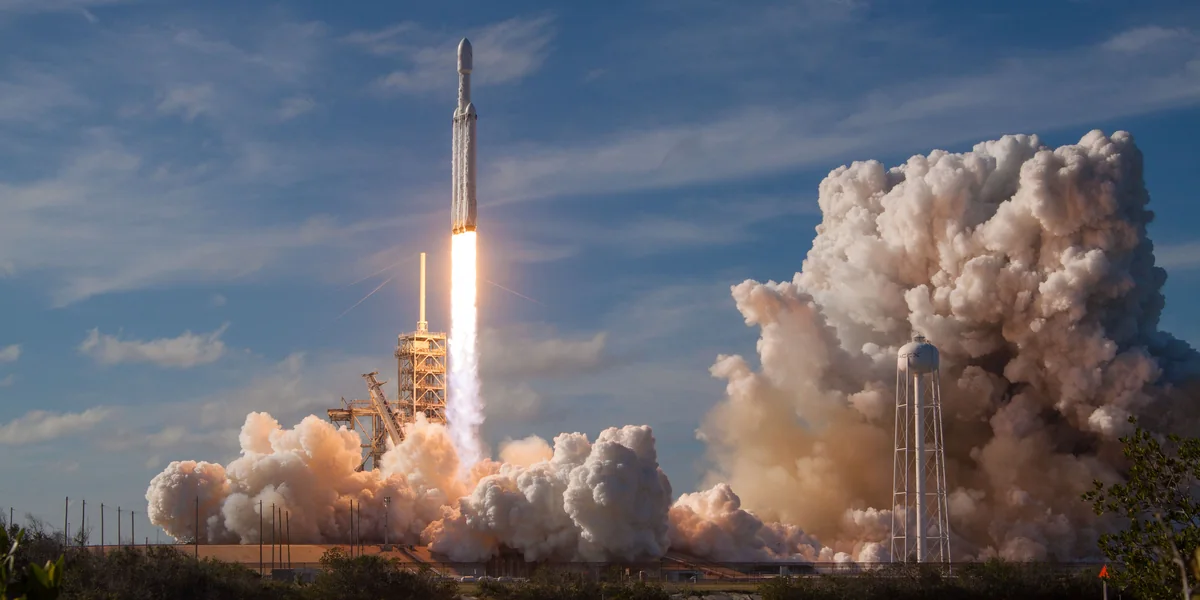
On 6 February 2018, SpaceX’s Falcon Heavy made its maiden flight from Kennedy Space Center’s LC-39A carrying Musk’s own first-generation Roadster, with a mannequin — Starman — at the wheel. The car was placed in a heliocentric orbit between roughly 0.99 and 1.66 AU with a period of about 557 days, and it is still out there, tracked by astronomers and hobbyists alike. That stunt is why “flying Tesla” never sounded absurd enough to dismiss: one Tesla genuinely left the planet. The distinction the 2026 event adds is propulsion — Starman was freight; the McGregor car moved itself, for seconds, under its own thrust. First of its kind, and still a beginning rather than an arrival.
Frequently Asked Questions
Can the Tesla Roadster fly?
Yes — the prototype can, in the specific sense demonstrated on 15 October 2026: short thruster-powered hops, a mid-air righting manoeuvre, a brief hover, and a kickflip, all uncrewed, at a test site. It cannot fly in the travelling sense — no version can carry you anywhere through the air — and no customer car has been delivered.
Is the Tesla Roadster flying video real or AI?
Real. Reuters and the AP reported the McGregor demonstration as it happened, and Snopes rated Tesla’s event videos True (authentic) on 16 October 2026. Tesla later released onboard footage (4 November). The videos that are not evidence are the fan edits and AI clips that flooded social feeds afterwards — check for the wire-service versions.
How does the Tesla Roadster fly?
With cold-gas thrusters: compressed air stored in a composite pressure vessel (kept topped up by an electric compressor) is released through computer-controlled nozzles. Fired downward, the jets lift the car; fired asymmetrically, they rotate it. The separate inverted-ramp stunt used suction fans, which is adhesion, not flight.
How long can the Tesla Roadster stay in the air?
Seconds. Tesla’s own figure is roughly five to six seconds of boost per fill of the air tank, and the physics agrees: hovering a ~1,700 kg car needs about 16,700 newtons continuously, and a tank’s total impulse runs out in under ten seconds at that rate. Refilling takes the compressor — and the battery — considerably longer.
What does the Tesla Roadster Thrust version do?
Thrust is the middle version: four rear thrusters with a 200-litre air tank in the trunk, a claimed 0–60 mph under 0.9 seconds, against a $250,000 deposit. It trades cargo space for straight-line rocket assistance; the full ten-thruster system is reserved for the single-seat Rocket version.
What is the Tesla Roadster flip?
The McGregor finale: the prototype used its thrusters to launch, rotate end-over-end (“kickflip” in Tesla’s own presentation language), and land on its wheels beyond a line of five parked Teslas. It is the manoeuvre that made the event famous — and a stunt, performed uncrewed on a closed course.
How much is the Tesla Roadster going to cost?
Firm final prices have not been published in any source we could open. What exists: deposits of $50,000 (Performance) and $250,000 (Thrust), with Rocket invite-only. The $200,000 figure readers remember is the 2017 announcement price for a car that was never built in that form.
When is the Tesla Roadster coming out?
Unknown. Production had not started as of November 2026, and the program’s announced dates — 2020, then several successors, then 2025 — have all passed unmet. The prototype is real; the calendar is a claim. Deposit-holders are, in effect, funding a reservation against Tesla’s intentions.
Is Elon Musk’s flying car legal?
On a closed test site, the demonstration was a lawful stunt. For public roads there is no approval of any kind: the FAA says the vehicle does not meet its definition of an aircraft, NHTSA says it must not defy federal motor-vehicle safety standards, and Tesla itself describes the top Rocket version as “not approved for public road use.”
What battery does the new Tesla Roadster use?
Tesla has not disclosed the capacity. What its executives have stated: a bespoke nickel-cell pack at 800–1,000 volts, 500 kW charging, and a claimed 15–85% charge in about ten minutes, targeting roughly 310–320 miles of range. Any source giving an exact kWh figure is guessing — the widely copied numbers trace to a retailer’s blog, not Tesla.
Who is competing with Tesla in flying cars?
A different industry: companies like Joby and Archer are building electric aircraft (eVTOL air taxis) that genuinely fly passengers — regulated as aircraft, from the start. Tesla’s Roadster is a car that can hop. The categories share a headline and almost nothing else, which is precisely why the Roadster’s feat, modest as flight goes, has no direct rival.
Final Verdict
Yes, the new Tesla Roadster can fly — the way a flea jumps, not the way a bird flies, and that distinction is the whole story. The McGregor demonstration was genuine, verified, and technically remarkable: a production-shaped car that rights itself in mid-air on jets of compressed air is a first. It is also five to six seconds of thrust, an uncrewed prototype, an unbuilt production car, and a regulatory blank page. Believe the footage. Discount the calendar. And when the next claim arrives — half the speed of sound, a canyon jump — remember which parts of this story were demonstrated, and which were only ever said.
