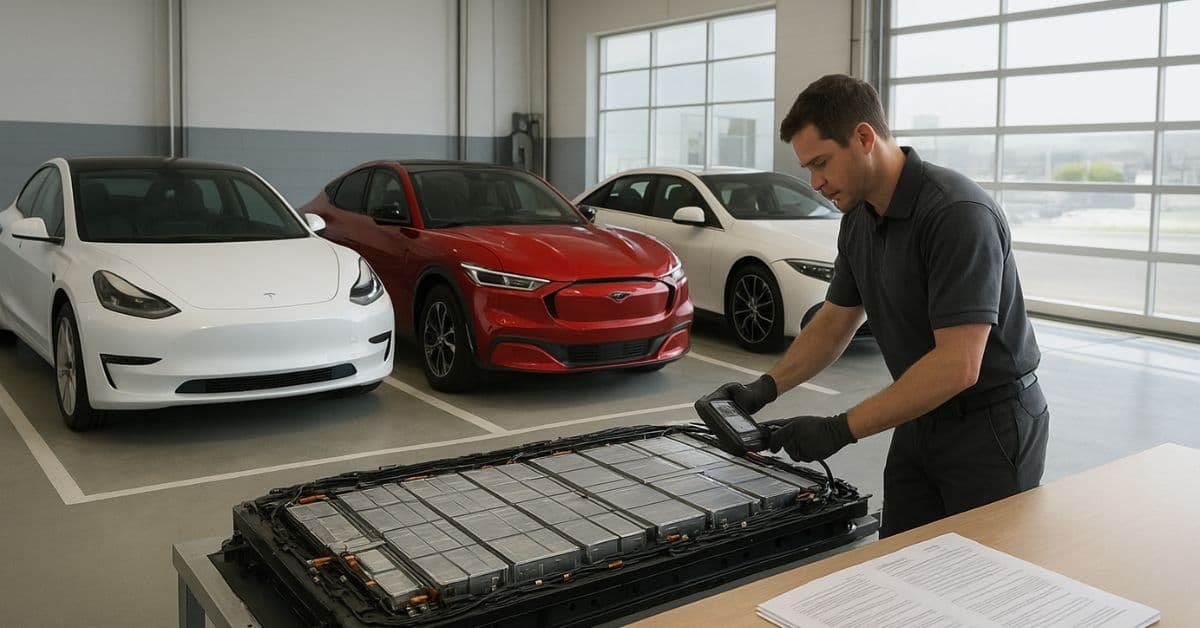
The best EV battery warranties from Tesla, Ford, and Mercedes protect your battery for 8 to 15 years or up to 150,000 miles. Tesla offers 8 years of coverage with mileage limits depending on the model. Ford offers 8 years or 100,000 miles. Mercedes offers the longest warranty, up to 15 years or 150,000 miles, ensuring strong battery protection and capacity retention.
Detailed guide: How Long Does a Tesla Model S Battery Really Last?.
Understanding the EV Battery Warranty
Before we compare companies, we need to know the three main parts of an electric car battery warranty.
1. Duration
- Federal Minimum: The US government requires a minimum of 8 years or 100,000 miles for the battery and related parts.
- Industry Standard: Most major car makers, such as Ford and Mercedes-Benz, follow the 8-year/100,000-mile rule.
- The Leaders: Some brands, such as Hyundai and Kia, offer 10-year coverage. Tesla varies mileage coverage by model, but it does not exceed 8 years.
2. Capacity Guarantee
This is the most important part of the warranty. It promises that the battery will keep a certain amount of its original power by the end of the warranty period.
- 70% Rule: Most car makers, including Tesla, Ford, and Mercedes-Benz, guarantee the battery will retain at least 70% of its original capacity. If the power drops below this level before the warranty ends, the company must repair or replace the battery at no cost.
- Why 70%? A battery with 70% power can still be used for a long time, but industry experts agree that this is when power loss becomes too high.
Check out this full resource: Tesla Battery Degradation: Complete Guide to Longevity.
3. What the Warranty Does NOT Cover
You must know that the warranty covers problems and too much power loss, but it does not cover everything.
- Accidental Damage: Damage from a crash, flood, or fire is covered by your car insurance, not the battery warranty.
- Misuse: Damage from incorrect charging (such as using an incompatible charger) or unauthorized modifications may render the warranty invalid.
- Expected Degradation: The warranty does not cover the normal, expected loss of power. If your battery has 75% power after 8 years, the warranty did its job, and it will not cover a replacement.
Warranty Comparison: Tesla, Ford, Mercedes
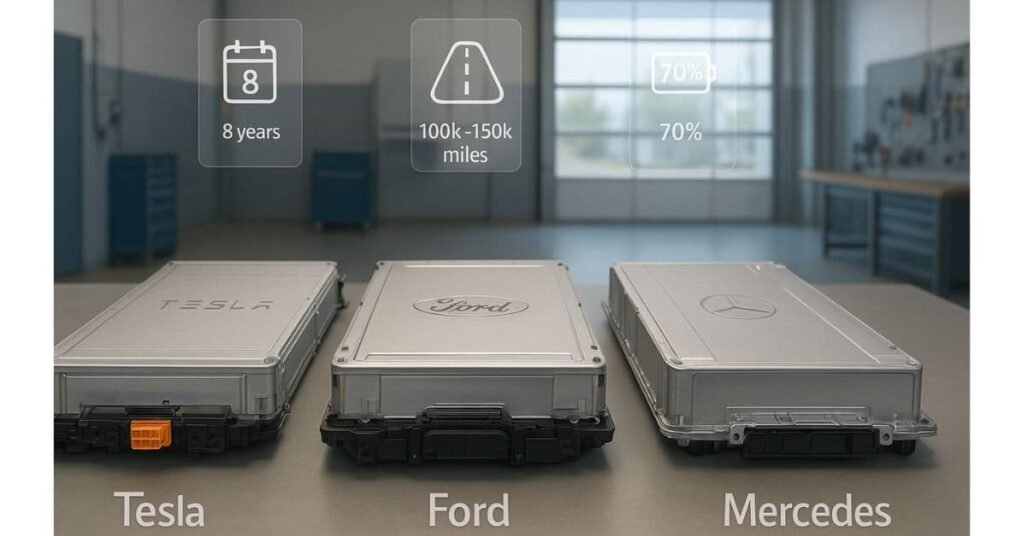
These three brands are the main parts of the electric car market: the new idea maker (Tesla), the old American giant (Ford), and the luxury leader (Mercedes-Benz). They differ clearly in how they provide warranty coverage.
1. Tesla
Tesla’s warranty differs by car model. It often gives more miles of coverage than other companies.
- Model S/X: 8 years or 150,000 miles, with a minimum of 70% power retention.
- Model 3/Y (Range/Performance): 8 years or 120,000 miles, with a minimum of 70% power retention.
- Model 3/Y (Standard Range/LFP): 8 years or 100,000 miles, with a minimum of 70% power retention.
Tesla’s confidence in its battery technology shows in its mileage limits.
Learn more about Tesla battery performance for different models here: Understanding Tesla Model Y Batteries: LFP vs NCA, 2170 vs 4680.
2. Ford
Ford offers a strong, comprehensive warranty for all its electric cars, including the Mustang Mach-E and F-150 Lightning.
- Coverage: 8 years or 100,000 miles, with a minimum of 70% power retention.
- Focus: Ford meets the federal minimum, giving EV buyers confidence.
3. Mercedes-Benz
Mercedes-Benz offers an industry-standard warranty backed by a premium service network.
Coverage: 8 years or 100,000 miles, with a minimum of 70% power retention.
The Fine Print: Some models, like the EQ series, offer up to 10 years or 155,000 miles coverage with over 70% power retention in some markets.
Brands with Extended Coverage
The 8-year/100,000-mile warranty is standard, but some manufacturers offer better. This appeals to buyers wanting long-term protection.
Hyundai and Kia
Hyundai and its sister company, Kia, are the clear leaders in warranty time.
- Coverage: 10 years or 100,000 miles on the battery and related electric car parts.
- Capacity Guarantee: 70% power retention.
- The Advantage: The extra two years of coverage give excellent peace of mind. This is true for drivers who plan to keep their car for ten years or more. This promise of long-term quality shows their skill in the electric car market.
Nissan
Nissan’s LEAF warranty is unique. It is tied to the number of “bars” on the battery power gauge.
- Coverage: 8 years or 100,000 miles.
- Capacity Guarantee: Battery replacement if capacity drops below 9 bars out of 12 (~75%), a higher threshold than the typical 70%.
Comprehensive EV Battery Warranty Comparison Table
| Manufacturer | Key Models | Warranty Duration | Warranty Mileage | Capacity Guarantee |
|---|---|---|---|---|
| Tesla | Model S / Model X | 8 years | 150,000 miles | 70% |
| Tesla | Model 3 / Model Y (Long Range & Performance) | 8 years | 120,000 miles | 70% |
| Tesla | Model 3 (Standard Range, LFP) | 8 years | 100,000 miles | 70% |
| Ford | Mustang Mach-E, F-150 Lightning | 8 years | 100,000 miles | 70% |
| Mercedes-Benz | EQ Lineup | 8 years | 100,000 miles | 70% |
| Hyundai | IONIQ 5, Kona EV | 10 years | 100,000 miles | 70% |
| Kia | EV6, Niro EV | 10 years | 100,000 miles | 70% |
| Chevrolet | Bolt, Ultium EVs | 8 years | 100,000 miles | 70% |
| Nissan | LEAF | 8 years | 100,000 miles | ~75% (9 of 12 bars) |
Case study: I was losing about 35% of my driving distance, which made long trips impossible. My car was still under the 8-year warranty, and the manufacturer’s guarantee was 70%. Since my battery was down to 65% power, they had to replace the entire pack. It was a massive relief, as a replacement would have cost me over $15,000. The warranty saved me.
Actionable Advice: What to Ask Your Dealer
When you shop for an electric car, use this knowledge to ask the right questions. This makes sure you are fully protected.
1- “What is the exact power level percentage guaranteed?” Do not accept a vague answer. It should be 70% or higher.
2- “Is the product warranty transferable upon resale to a second owner?” The warranty is fully transferable for most brands. This is a big help to the car’s resale value.
3- “What is the process for a warranty claim?” Understand the steps. A dealer usually does a test to check that the battery power has dropped below the guaranteed level.
4- “Does the warranty cover the charging port and on-board charger?” The warranty for the battery or electric car parts often covers these items, but it is always good to check.
Conclusion
The EV battery warranty is your financial safety net, protecting against costly battery repairs. Look for warranties with at least 8 years and 100,000 miles coverage and 70% capacity guarantees. Brands like Hyundai, Kia, and Tesla offer even better protection, making them strong choices for long-term peace of mind. By asking the right questions, you can feel secure in your EV investment.
For daily care tips that help your EV battery last longer, explore: Best Practices to Extend Your Tesla Battery Life.