EV Charging Connectors: NACS, CCS, J1772 & More

Not all EV charging plugs fit every electric vehicle. Using the wrong connector can stop your trip before it even starts.
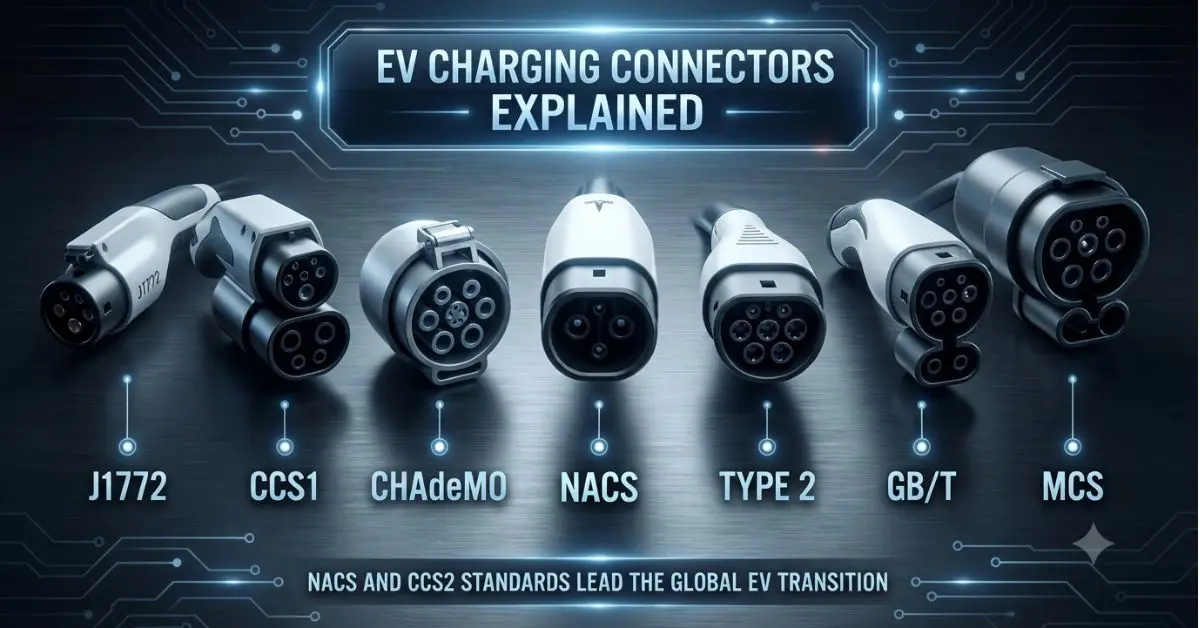
Electric vehicle (EV) charging connectors come in several standards. Knowing which one your car uses determines where you can charge. Common connectors worldwide include J1772 (AC, North America), NACS (AC and DC, North America), CCS1 (DC, North America), CCS2/Type 2 (Europe), CHAdeMO (older DC standard), GB/T (China), and MCS (heavy trucks).
NACS is rapidly becoming the main standard in North America, while CCS2/Type 2 dominates Europe. Choosing the right connector ensures you can charge your vehicle efficiently wherever you go.
EV Charging Connectors: Complete Guide
| Connector | Current Type | Max Power | Region | Status in 2026 |
|---|---|---|---|---|
| J1772 (Type 1) | AC only | 19.2 kW | North America, Japan | Still common — used for Level 1 and Level 2 AC charging |
| NACS (Tesla / SAE J3400) | AC and DC | 250+ kW DC | North America | Dominant — adopted by all major automakers from 2024 |
| CCS1 (J1772 + DC pins) | AC and DC | 350 kW DC | North America | Legacy — being replaced by NACS on new vehicles |
| CCS2 (Type 2 + DC pins) | AC and DC | 350 kW DC | Europe, Australia | Current standard in Europe — no change expected in the near term |
| Type 2 (Mennekes) | AC only | 43 kW AC (3-phase) | Europe, Australia | Standard European AC connector — used for Level 2 |
| CHAdeMO | DC only | 100–400 kW | Japan, some US/EU | Declining — used mainly in older Nissan Leafs; chargers rare |
| GB/T | AC and DC | 250 kW DC | China | Mandatory in China — not used outside China |
| MCS (Megawatt) | DC only | 3.75 MW | Global (commercial) | Emerging — for electric semi-trucks and heavy commercial vehicles |
J1772 (Type 1) Connector
The J1772 connector, also known as the Type 1 or “J-plug,” serves as the standard for AC charging in North America. Every electric vehicle sold in the U.S. supports this plug for AC charging, using an adapter for Tesla models. This connector can deliver up to 19.2 kW of power on a Level 2 circuit.
However, the J1772 does not work for DC fast charging. For that, American EVs used either the CCS1 or the NACS port. Manufacturers are now phasing out the J1772 on new vehicles because the NACS has become the universal standard for both AC and DC charging.
NACS (SAE J3400) Connector
The North American Charging Standard (NACS), also known as SAE J3400, is now the main charging plug for vehicles in North America. Tesla first created this design for its own cars. Unlike the older J1772 or CCS1 plugs, the NACS connector is compact and handles both AC and DC charging at speeds over 250 kW.
All Tesla Supercharger stations use this NACS design. Major automakers, including Ford, GM, Rivian, Honda, Toyota, Hyundai, Kia, BMW, Mercedes, and Volkswagen, adopted it for their vehicles starting in 2024. By 2026, almost all new electric vehicles in North America will use the NACS connector as the standard.
CCS1 (Combined Charging System) Connector
The CCS1 connector combines the J1772 AC plug with two extra DC pins at the bottom. This design creates a “combo” port that supports both AC Level 2 and DC fast charging in a single opening. CCS1 served as the main U.S. standard for DC fast charging from 2013 to 2023.
Companies like Electrify America, EVgo, and ChargePoint used CCS1 for their chargers. Most non-Tesla stations relied on this plug. However, the industry is now switching to NACS. As a result, CCS1 is now a legacy connector. You will find it on EVs from 2013 to 2024, but new models no longer use it. Owners can buy a CCS1-to-NACS adapter for $200–$250 to use Tesla Superchargers.
European Charging Standards: Type 2 and CCS2
The Type 2 (Mennekes) connector is the European equivalent of the J1772 plug. This 7-pin connector supports AC charging up to 43 kW. Every electric vehicle sold in Europe uses this port for AC charging.
The CCS2 standard adds extra pins to the Type 2 port. These pins allow for DC fast charging up to 350 kW. Networks like Ionity, Fastned, and Allego use this standard. As of 2026, Europe continues to use CCS2 instead of NACS, and no plans exist to change this.
CHAdeMO: The Declining Japanese Standard
Japan developed CHAdeMO as the first common DC fast-charging standard. Early Nissan Leaf and Mitsubishi i-MiEV models used this system. While CHAdeMO 3.0 could support 400 kW, real-world chargers rarely went above 100 kW.
Nissan stopped using CHAdeMO for the 2026 Leaf to switch to NACS. CHAdeMO chargers are now rare in North America and Europe, as many sites replaced them with CCS or NACS. However, the standard remains common in Japan for older vehicles.
MCS (Megawatt Charging System)
The Megawatt Charging System (MCS) is a new standard for electric semi-trucks, heavy freight vehicles, and commercial buses. It does not work with passenger electric vehicles. This system delivers up to 3.75 MW (3,750 kW) of power. That is 15 times more power than the fastest charger for regular electric cars.
This high power lets a large 500–1,000 kWh commercial truck battery charge in 30–45 minutes. This speed is like a quick stop for fuel. Tesla developed its own Megawatt Charging System with industry partners for the Tesla Semi. As of 2026, companies are starting to install this equipment at truck stops and shipping centers.
Which Connector Does Your EV Use?
- All 2024+ US/Canadian EVs (Ford, GM, Honda, Hyundai, Kia, Toyota, Rivian, etc.): NACS — plug directly into any Supercharger or compatible station
- 2013–2023 US/Canadian non-Tesla EVs: CCS1 for DC fast charging + J1772 for Level 2 AC — need Tesla’s CCS1-to-NACS adapter for Supercharger access
- All Tesla vehicles (pre-2020 US): Tesla proprietary (now NACS) — all Teslas use the same NACS connector since 2020+
- European EVs: Type 2 for AC + CCS2 for DC fast — incompatible with US NACS chargers (different standard)
- Old Nissan Leaf (2011–2022): J1772 for AC + CHAdeMO for DC — CHAdeMO is rapidly disappearing in the US
Conclusion
EV charging plugs are shifting to two main styles worldwide. North America uses the NACS style, while Europe uses CCS2. Most major car companies adopted NACS between 2024 and 2026. This move ends the confusion between CCS1 and NACS plugs in the United States. Meanwhile, CHAdeMO is disappearing, and China uses its own GB/T standard. MCS is the new standard built just for large commercial trucks.
For new EV buyers in North America in 2026, NACS makes charging simple. You get “plug-and-charge” access to Tesla Superchargers and other public fast-charging networks. You no longer need to carry extra adapters or worry about having the wrong plug for your car.
FAQs
What is the difference between NACS and CCS?
NACS is the new charging standard in North America that supports both AC and DC charging via a single compact connector. CCS uses a larger connector and is being phased out on new North American EVs.
Can I use a Tesla Supercharger with a CCS1 EV?
Yes. Many CCS1 vehicles can access compatible Tesla Superchargers by using a CCS1-to-NACS adapter, provided the vehicle and charging station support it.
Which EV charging connector is used in Europe?
Most European EVs use the Type 2 connector for AC charging and the CCS2 connector for DC fast charging. CCS2 remains the standard across Europe.
