What Is OCPP and Why Does It Matter for EV Charging?

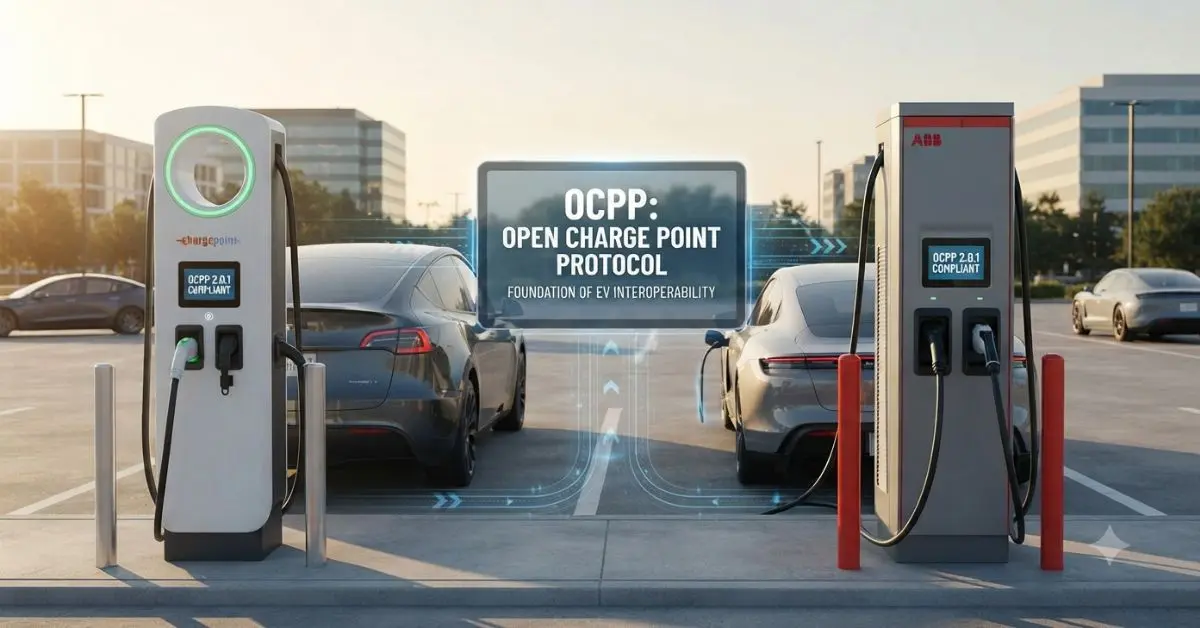
The Open Charge Point Protocol (OCPP) is an open standard. It lets electric vehicle charging stations from different makers connect to any compatible charging management system (CMS). Without this, companies would lock their chargers to one specific software platform.
OCPP creates flexibility. A ChargePoint charger can operate on a Greenlots network, and an ABB charger can communicate with a fleet management system. Businesses can also switch software providers without replacing their hardware. This protocol serves as the foundation for how commercial chargers interact.
What Is OCPP? A Simple Explanation
OCPP acts like the USB standard for computers. It creates a common language so devices from different makers work together. Without this, every company would need its own special cable and port.
OCPP does the same for EV chargers and management systems. It defines the messages and rules for how a charger talks to its software. Because of this, you can pick the best hardware and software separately.
OCPP Versions: What Each One Does
| Version | Release Year | Key Features | Current Status |
|---|---|---|---|
| OCPP 1.5 | 2012 | Basic start/stop, status monitoring, heartbeat | Legacy — largely replaced |
| OCPP 1.6 | 2015 | Smart charging profiles, local auth, OTA updates, remote management | Most widely deployed — still common |
| OCPP 2.0 | 2018 | Enhanced security, ISO 15118 (Plug & Charge), V2G support | Deployed at newer stations |
| OCPP 2.0.1 | 2020 | Bug fixes and clarifications to 2.0; security improvements | Current recommended version |
| OCPP 2.1 (draft) | 2024 | V2X (bidirectional), improved smart charging, ISO 15118-20 | In development — emerging adoption |
Why OCPP Matters for Businesses Installing EV Charging
Businesses should prioritize OCPP compliance when buying EV chargers. OCPP stands for Open Charge Point Protocol. This standard lets you choose any compatible software to manage your chargers. It also helps you connect your equipment to billing, energy management, and fleet systems. Furthermore, it enables features such as Plug & Charge, which simplifies the process for drivers.
Avoid chargers that use proprietary software. These “closed” systems lock you into one manufacturer forever. You will not be able to switch software or add new features later. This creates serious financial and operational risks over the 5 to 10 years you will own the hardware.
Understanding OCPP Smart Charging Features
OCPP 1.6 brought us Smart Charging Profiles. This technology lets a management system adjust the power a charger delivers in real time. It helps with fleet management, avoiding high-demand costs, and saving money using time-of-use (TOU) pricing.
If a utility sends a signal during a power emergency, the charger receives it. It then automatically lowers its power output and tells the system that it followed the rules. All of this happens without anyone needing to touch the charger.
Newer versions, such as OCPP 2.0.1, add more features. They now support vehicle-to-grid (V2G) power sharing and use better security certificates to keep everything safe.
Understanding OCPP Smart Charging Features (ISO 15118)
OCPP 1.6 brought us Smart Charging Profiles. This technology lets a management system adjust the power a charger delivers in real time. It helps with fleet management, avoiding high-demand costs, and saving money using time-of-use (TOU) pricing.
If a utility sends a signal during a power emergency, the charger receives it. It then automatically lowers its power output and tells the system that it followed the rules. All of this happens without anyone needing to touch the charger.
Newer versions, such as OCPP 2.0.1, add more features. They now support vehicle-to-grid (V2G) power sharing and use better security certificates to keep everything safe.
NEVI Program Charging Standards
The U.S. federal NEVI program requires all funded charging stations to comply with OCPP 1.6 or 2.0+. This rule ensures that different charging systems can work together easily. It also prevents the industry from relying on just one company for equipment.
The OCPP requirement forces the U.S. market to move away from closed, private hardware. By choosing open-standard equipment, the industry improves long-term flexibility. This change also increases competition in the charging infrastructure market.
Conclusion
OCPP is an open standard that stops charging stations from being separate, locked-off systems. For drivers, it allows smart features like “Plug & Charge” that make using public chargers easy and cheap.
For business owners, using OCPP is a must. It prevents them from being stuck with one company and keeps their equipment ready for future updates. As more chargers appear, this standard keeps everything working together. It will even support new, advanced power-sharing features, such as V2X (vehicle-to-everything) charging, in the future.
FAQs
What Is Plug and Charge (ISO 15118)?
OCPP 2.0 and 2.0.1 include full support for ISO 15118 (Plug & Charge) — the standard that allows an EV to automatically identify itself to a charger and start billing without any card, app, or QR code interaction.
How Plug and Charge Works
The car and charger exchange digital certificates, authenticate each other, and begin the session seamlessly upon plug-in.
Do I need an app or RFID card with Plug and Charge?
No. Plug and Charge automatically authenticates the vehicle and starts the charging session without extra steps.
Why is OCPP 2.0 important for Plug and Charge?
OCPP 2.0 and 2.0.1 provide the communication features needed to support ISO 15118, enabling secure authentication and automatic billing.
