How Do Electric Motorcycles Charge?

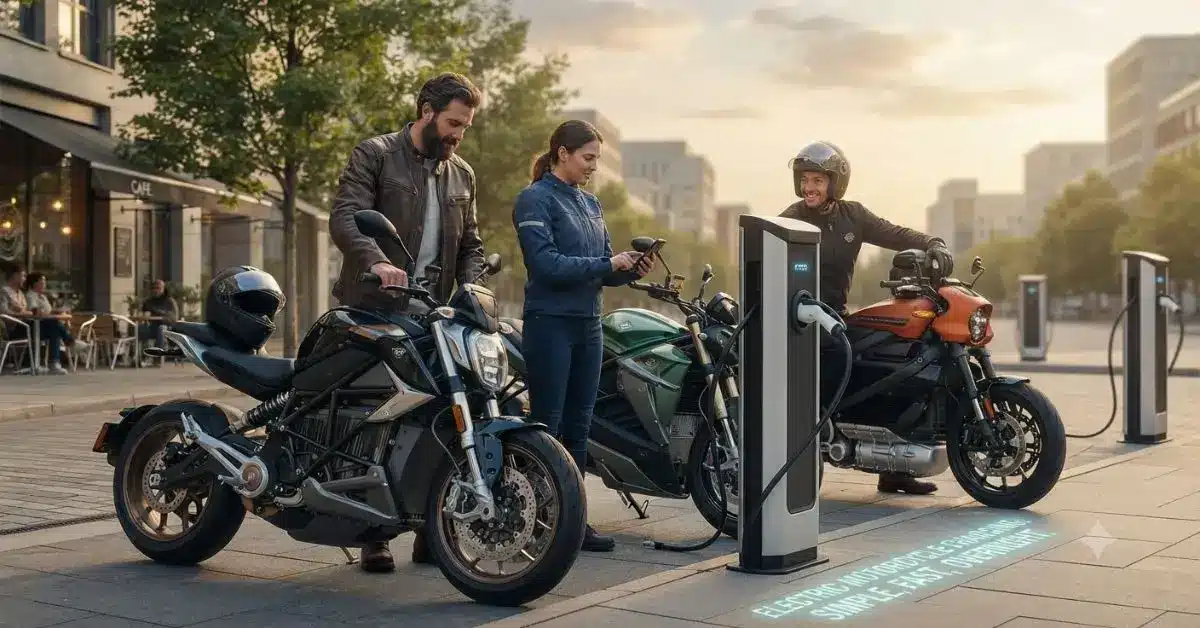
You don’t need a complicated charging setup to own an electric motorcycle. In fact, many riders plug in at home overnight and wake up to a fully charged battery.
Electric motorcycles charge using standard household outlets, Level 2 AC chargers, or DC fast chargers. The exact method depends on the bike model and its battery size. Most motorcycles have small batteries ranging from 5 to 30 kWh. These batteries charge fully in 1 to 8 hours using a standard outlet or in 30 to 60 minutes with a DC fast charger.
Different brands use different plugs. Zero Motorcycles and Energica use the J1772 plug for AC charging. Harley-Davidson’s LiveWire uses both the J1772 and the CCS1 DC connectors. Because these batteries are much smaller than those in electric cars, they charge faster and more easily.
Electric Motorcycle Charging: Key Models Compared
| Model | Battery | Range | Level 1 (120V) | Level 2 (6.6 kW) | DC Fast (CCS1) |
|---|---|---|---|---|---|
| Zero SR/F | 14.4 kWh | ~161 miles city | ~9 hours | ~2.5 hours | Not standard (optional) |
| Zero SR/S | 14.4 kWh | ~183 miles city | ~9 hours | ~2.5 hours | Optional rapid charge |
| Harley-Davidson LiveWire ONE | 15.5 kWh | ~146 miles city | ~12 hours | ~1 hour (11 kW) | ~30 min (10–80%, CCS1) |
| Energica Eva Ribelle RS | 22.5 kWh | ~261 miles city | ~22 hours | ~3.5 hours | ~40 min (CCS2, 22 kW DC) |
| CAKE Kalk OR | 2.6 kWh | ~50 miles off-road | ~3 hours | ~1 hour | Not supported |
| Triumph TE-1 | 15 kWh | ~100 miles | ~10 hours | ~2.5 hours | ~20 min (DC) |
Home Charging Setup for Electric Motorcycles
1. Charge from a Standard Household Outlet (Level 1)
Most electric motorcycles have batteries between 5 and 15 kWh, so a standard 120V household outlet is enough for daily charging. Most riders can fully recharge their motorcycle overnight without installing any extra equipment.
2. Install a Level 2 Home Charger for Faster Charging
A Level 2 home charger can reduce charging time from about 9 hours to around 2.5 hours for a 14.4 kWh battery. It is a good option if you ride long distances or need to recharge several times a day.
3. Check Your Motorcycle’s Charging Connector
Before buying a home charger, make sure it matches your motorcycle’s charging connector. Most electric motorcycles in North America use the J1772 connector for AC charging, while some models also support CCS1 or CCS2 DC fast charging.
Using Public Charging Stations
1. Level 2 Public Chargers
Most public Level 2 charging stations with J1772 connectors work directly with brands like Zero, LiveWire, and many other electric motorcycles. In most cases, no adapter is needed.
2. DC Fast Charging
Only motorcycles with DC fast charging support, such as the Harley-Davidson LiveWire ONE and Energica models, can use CCS fast chargers. These chargers can recharge the battery much faster than Level 2 AC charging.
Charging Examples by Brand
1. Zero Motorcycle
Zero Motorcycles use a J1772 connector for AC charging, making them compatible with most Level 2 public chargers and home wallboxes. A Level 1 household outlet charges the Zero SR/F (14.4 kWh) in about 9 hours. With the optional Charge Tank, Level 2 charging at 6.6 kW cuts charging time to around 2.5 hours. Some newer models also support optional CCS1 DC fast charging for quicker top-ups.
2. Harley-Davidson LiveWire
The Harley-Davidson LiveWire ONE supports both J1772 Level 2 AC charging and CCS1 DC fast charging. A DC fast charger can charge the battery from 10% to 80% in about 30 minutes, while an 11 kW Level 2 charger fills the battery in about 1 hour. It can use the same CCS1 fast chargers found at many public EV charging stations.
3. Energica
Energica motorcycles support both Level 2 AC charging and DC fast charging. Most models use a Type 2 connector for AC charging and CCS2 for DC fast charging. A DC fast charger can recharge the battery from 0% to 80% in about 40 minutes, making Energica one of the fastest-charging electric motorcycle brands.
4. Can-Am Pulse and Origin
Can-Am’s new electric motorcycles use the J1772 connector for Level 2 AC charging. Their Rotax E-Power battery supports charging from 20% to 80% in about 50 minutes on a Level 2 charger. They do not support DC fast charging.
5. BMW CE 04
The BMW CE 04 electric scooter charges with a standard Level 2 AC charger using the Type 2 connector in Europe (J1772 in North America, where applicable). With the optional Quick Charger, the battery charges much faster than with the standard charger, making it practical for daily commuting.
6. Ryvid Anthem
The Ryvid Anthem uses a removable battery that can be charged either on or off the motorcycle. Riders can plug it into a standard household outlet or a compatible Level 2 charger, giving flexibility for home charging even without a garage.
7. Verge Motorcycles
Verge electric motorcycles support both AC and DC fast charging. Depending on the model, DC fast charging can recharge the battery from 0% to 80% in about 35 minutes, making it suitable for longer rides.
Conclusion
Electric motorcycles charge easily using any standard home outlet. Since these bikes have small batteries (5–22 kWh), they charge fully overnight on a standard 120V garage socket. You do not need any extra equipment for this.
Level 2 AC charging at home or public stations speeds things up, taking only 1 to 4 hours. The Harley-Davidson LiveWire ONE also offers CCS1 DC fast charging, enabling quick 30-minute top-ups on the highway.
Most owners who commute less than 100 miles daily already have all the charging power they need in their own garages. This convenience makes electric motorcycles the easiest type of electric vehicle to charge.
FAQs
Can you charge an electric motorcycle with a regular household outlet?
Yes. Most electric motorcycles can charge from a standard 120V household outlet using Level 1 charging. For many riders, an overnight charge is enough for daily commuting.
Do all electric motorcycles support DC fast charging?
No. Only some models, such as the Harley-Davidson LiveWire ONE and certain Energica motorcycles, support DC fast charging. Many electric motorcycles only support Level 1 and Level 2 AC charging.
How long does it take to fully charge an electric motorcycle?
Charging time depends on the battery size and charger type. Most electric motorcycles take about 1–8 hours to fully charge, while compatible DC fast chargers can recharge many models from 10% to 80% in around 20–40 minutes.
