EV Charging Around the World: USA vs Europe vs China

Electric vehicle (EV) charging is not the same everywhere. Differences in charging networks, plugs, costs, and speeds change how you own and drive an electric car.
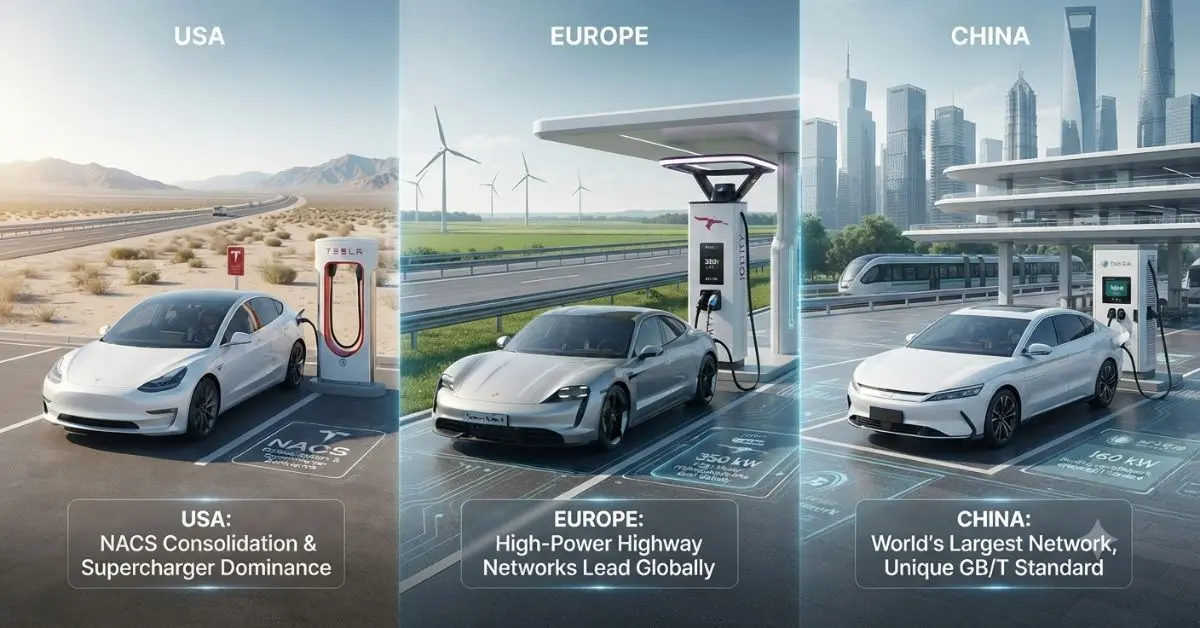
Charging systems vary greatly between the U.S., Europe, and China. In the U.S., Tesla’s Supercharger network and the NACS plug are becoming the standard. Europe focuses on high-power networks like IONITY and has many public chargers. China has the world’s largest network with over 10 million public points. China uses the unique GB/T standard, which does not work with plugs in other countries.
EV Charging: USA vs Europe vs China at a Glance
| Feature | United States | Europe | China |
|---|---|---|---|
| Total public charging points | ~248,000 | ~700,000+ | ~10 million+ |
| Dominant fast-charge connector | NACS (all 2024+ EVs) | CCS2 (Type 2 combo) | GB/T (AC + DC) |
| Leading network | Tesla Supercharger | IONITY (Highway) | State Grid / Teld / BJEV |
| Typical highway DC speed | 250 kW (Supercharger V3) | 350 kW (IONITY) | 120–250 kW |
| Home charging prevalence | High (most homes have garages) | Moderate (many apartments) | Lower (high-rise living is common) |
| Payment method | App, credit card tap, Plug & Charge | App, RFID, credit card (varies) | WeChat Pay, Alipay, app-based |
| Charging cost (fast) | $0.32–$0.55/kWh | €0.45–€0.70/kWh | ¥1.2–2.0/kWh (~$0.17–$0.28) |
The State of U.S. EV Charging in 2026
In 2026, the U.S. market is shifting to the North American Charging Standard (NACS). Every major car company now uses this Tesla plug design. This change gives all new electric vehicles (EVs) access to over 37,400 Tesla Supercharger ports. This network is the most reliable fast-charging system in the country.
The government’s NEVI program is also building thousands of new DC fast-charging stations along highways. While the U.S. has fewer total chargers than Europe, the Tesla network offers better reliability. However, rural areas still lack enough chargers. In parts of the Mountain West and Great Plains, you may find over 100 miles between stations.
European EV Charging Infrastructure Overview
Europe leads the world in fast-charging quality. The IONITY network provides 350 kW of power at stations every 100–150 km along major highways. All new European electric vehicles use the CCS2 plug as the universal standard.
Because many people live in apartments, home charging is less common than in the U.S. This makes public charging stations essential. Companies like Shell Recharge, BP Pulse, and Pod Point are rapidly expanding their coverage in the UK.
Drivers use roaming protocols to access multiple networks with a single account or RFID card. This system makes travel easier in Europe compared to the fragmented networks in the U.S.
China: World’s Largest Network with Unique Standards
China operates the world’s largest EV charging network by a massive margin — over 10 million public charging points vs approximately 700,000 in Europe and 248,000 in the U.S.
Largest Charging Networks
State Grid Corporation, TELD, and Star Charge operate the largest Chinese networks.
GB/T Connector Standard
The GB/T connector standard is mandatory in China — incompatible with CCS1/CCS2 and NACS.
Charging Speed and Cost
Chinese fast charging typically runs at 120–250 kW; the newest 800V Chinese EVs (BYD Han EV, XPENG G6) support 480 kW+ at compatible ultra-fast chargers. Charging costs are significantly lower in China — approximately $0.17–$0.28/kWh equivalent vs $0.35–$0.55/kWh in the U.S. and €0.45–€0.70/kWh in Europe.
Which Region Has the Best EV Charging Experience?
- Best reliability: U.S. (Tesla Supercharger) — highest uptime and user satisfaction scores globally
- Best highway speed: Europe (IONITY 350 kW, widely deployed along motorways)
- Best coverage density: China (10 million+ points — more charging points per EV than any other region)
- Lowest cost: China (subsidized electricity and lower operating costs produce significantly cheaper public charging)
- Best roaming interoperability: Europe (eMSP roaming allows seamless cross-network access with one account)
Conclusion
Electric vehicle (EV) charging works differently in the U.S., Europe, and China. The U.S. focuses on the reliable NACS standard. Europe prioritizes fast highway speeds and network compatibility. China focuses on building a large number of low-cost chargers. Each region designs its network based on how people drive and local laws.
If you travel between countries, you will face connector issues. The U.S. uses NACS, Europe uses CCS2, and China uses GB/T. These plugs do not fit together. You would need special adapters to use them, but these are rarely available outside of their home regions.
FAQs
Is the same EV charging connector used in the U.S., Europe, and China?
No. The U.S. mainly uses NACS, Europe uses CCS2, and China uses GB/T. These standards are not directly compatible.
Which region has the largest EV charging network?
China has the world’s largest EV charging network, with more than 10 million public charging points.
Which region offers the fastest EV charging on highways?
Europe leads in highway charging speeds, with IONITY stations providing up to 350 kW DC fast charging along major routes.
