
PHEV vs BEV Charging: What’s Different?

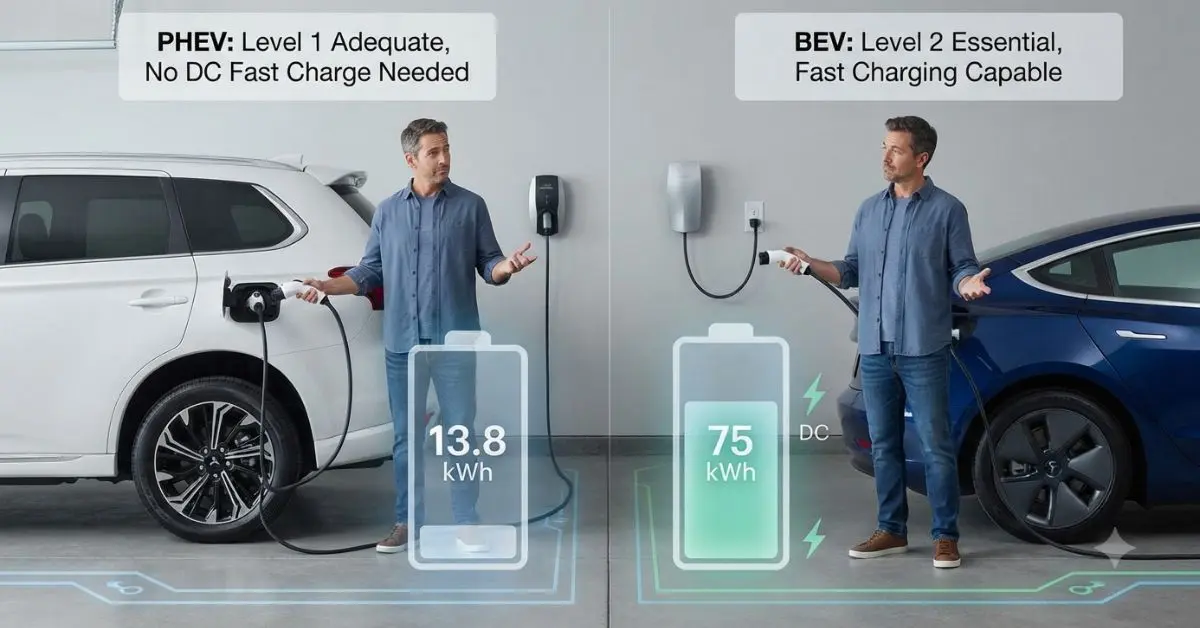
Choosing between a plug-in hybrid (PHEV) and a battery electric vehicle (BEV) is only part of the decision. Understanding how each one charges can have a bigger impact on your daily driving, charging costs, and long-distance travel.
PHEV (plug-in hybrid) and BEV (battery electric vehicle) chargers use the same equipment, such as Level 1 and Level 2 AC chargers. However, these vehicles differ in battery size, charging time, and DC fast charging support.
The main difference is the battery size. A PHEV has an 8–50 kWh battery that can be charged in just a few hours. A BEV uses a larger 60–130 kWh battery that often requires overnight charging.
PHEV vs BEV Charging: Complete Comparison
| Feature | PHEV | BEV |
|---|---|---|
| Typical battery size | 8–50 kWh | 40–200+ kWh |
| Electric range | 15–60 miles | 150–400+ miles |
| Level 1 fill time (120V) | 2–12 hours (full) | 20–60+ hours (full) |
| Level 2 fill time (7–11 kW) | 1.5–5 hours (full) | 5–12 hours (full) |
| DC fast charging | Not supported (most models) | Standard (50–473 kW) |
| Daily charge frequency | Daily charge beneficial (short EV range) | Daily charge optimal |
| Charge limit setting | 100% always (small pack is fine) | 80% daily (NMC); 100% daily (LFP) |
| Cost to fill | $1–$8 (small battery) | $8–$25 (full charge) |
| Primary charging method | Level 1 is adequate for most; Level 2 is ideal | Level 2 strongly recommended |
| Road trip strategy | Use petrol engine — no charging needed | Plan DC fast charging stops |
The Biggest Difference Between PHEV and BEV Charging
1. DC Fast Charging Differences: PHEVs vs. BEVs
The main difference between Plug-in Hybrid Electric Vehicles (PHEVs) and Battery Electric Vehicles (BEVs) is the availability of DC fast charging. Almost all BEVs support DC fast charging. This feature adds 100 to 300 miles of range in just 20 to 45 minutes at highway stations.
Most PHEVs do not support DC fast charging because they do not need it. A typical PHEV battery holds only 13 to 23 kWh and provides just 30 to 60 miles of range. Because the gas engine handles long trips, drivers do not need fast charging on the highway for a PHEV.
2. Level 1 vs Level 2 Charging
Charging a PHEV
For a PHEV owner, the decision between Level 1 and Level 2 is less critical than for a BEV owner. A 13.8 kWh PHEV battery fills overnight in 10–12 hours on Level 1 — perfectly adequate for restoring full electric range every morning.
Charging a BEV
A 75 kWh BEV on Level 1 takes 50–60 hours — far too slow for practical daily replenishment. BEV owners who rely primarily on Level 1 charging will often find their batteries partially depleted if they drive more than 25–30 miles daily. Level 2 is essential for most full-time BEV owners; it is a convenience upgrade (not a necessity) for most PHEV owners.
Charging Strategy for PHEVs and BEVs
1. PHEV Daily Charging Strategy
Plug in every night on Level 1 or Level 2 — restore full electric range every morning. Use EV-only mode for daily commuting. Use the petrol engine for anything beyond the electric range. No road trip charging planning is needed.
2. BEV Daily Charging Strategy
Plug into Level 2 every night — set the charge limit to 80% (NMC) or 100% (LFP). Use the car’s navigation to trigger battery preconditioning before any DC fast-charging stop. Plan road trips around charging stops using ABRP.
3. Annual Fuel Cost Difference
PHEV savings depend heavily on charging frequency — owners who never charge see minimal savings over a non-plug-in hybrid; owners who charge daily and commute within EV range see savings similar to a full BEV for daily use.
PHEVs vs. BEVs: Choosing the Right Vehicle for Your Needs
Plug-in Hybrid Electric Vehicles (PHEVs) help drivers who worry about driving range or cannot charge at home. They also help people who often drive long distances and find DC fast chargers hard to find. You never need to worry about power because the petrol engine provides a backup.
Battery Electric Vehicles (BEVs) are cheaper and easier to use if you can charge at home. They work well for people with predictable daily commutes and trips where DC fast chargers are available. For most suburban homeowners with a Level 2 charger and short daily drives, a BEV is simpler and cheaper than a PHEV.
Conclusion
PHEV and BEV charging use the same plugs and equipment. However, the size, strategy, and daily needs differ significantly. PHEVs (Plug-in Hybrid Electric Vehicles) have small batteries. They charge quickly and only need Level 1 or Level 2 chargers. Owners do not need to plan road trips around charging stops.
BEVs (Battery Electric Vehicles) need a Level 2 charger for daily use. Drivers must also rely on DC fast charging stations for long trips. PHEVs are a good bridge for people who cannot get a home charger. BEVs are the best long-term choice for most drivers with a home charging option because they cost less per mile and are simple to use.
FAQs
Can a PHEV use a DC fast charger?
No. Most PHEVs do not support DC fast charging because their batteries are much smaller and the petrol engine handles long-distance driving.
Do BEVs need a Level 2 charger at home?
For most owners, yes. A Level 2 charger provides practical overnight charging and is much faster than Level 1 for larger BEV batteries.
Is it cheaper to charge a PHEV or a BEV?
A PHEV costs less per full charge because it has a smaller battery. However, a BEV is usually cheaper to operate per mile if you charge regularly at home.
