
Mercedes EQB Battery: Size, Range, Charging and Warranty

Researched from Mercedes-Benz’s own EQ warranty booklets (US and Canada), EV Database, published EPA ratings, NHTSA recall filings, and the used-buyer research of Electrifying and Auto Express.
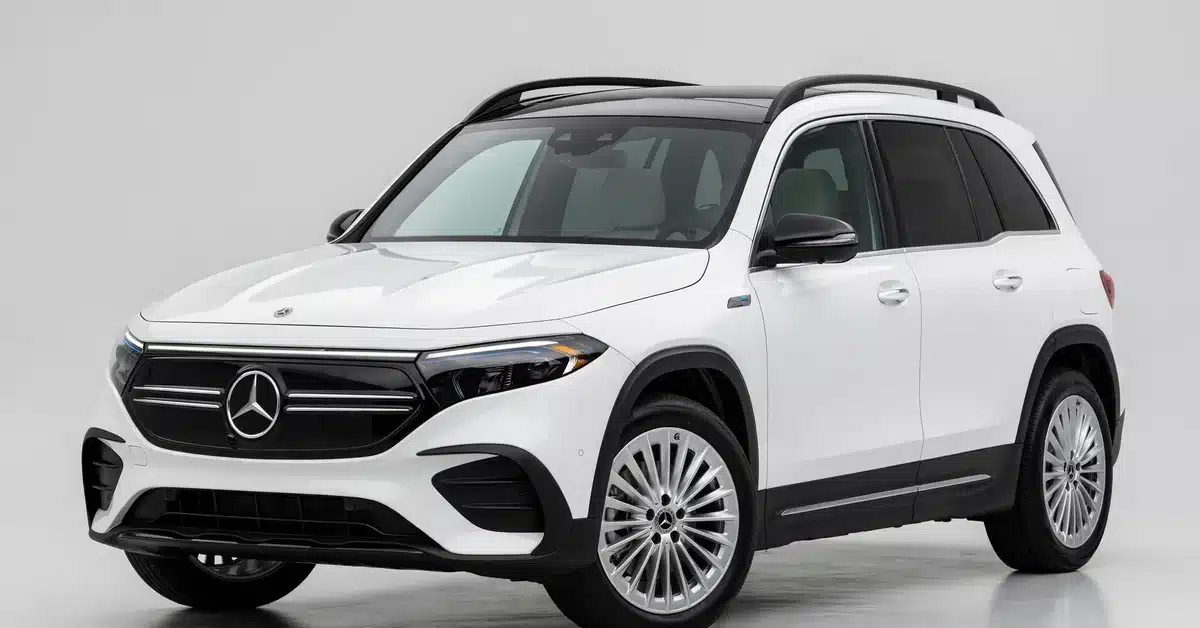
The EQB is the battery-electric version of the GLB — same upright, boxy body, same optional third row, with a battery under the floor instead of an engine up front. It was built in Kecskemét, Hungary (model code X243, on the MFA2 platform) and sold in the US from model year 2022. Four versions were offered — EQB 250, 250+, 300 4MATIC and 350 4MATIC — but only two battery packs between them, and working out which pack a car has is where most listings go wrong.
Mercedes has stopped building it — the replacement, the GLB with EQ Technology, was unveiled in December 2025 — so in 2026 the EQB is a used buy, and for a used buy the battery is the whole decision. This guide covers both pack sizes variant by variant, range by model year, the honest charging picture, the fire-risk recall that dominates this car’s reliability story, and the warranty in exact terms, including the capacity floor most roundups get wrong.
Every EQB runs one of two packs: 66.5 kWh usable in the EQB 250, 300 4MATIC and 350 4MATIC, or 70.5 kWh usable in the EQB 250+. Charging tops out at 100 kW DC, the US battery warranty is 8 years/100,000 miles, and most US 2022–2024 cars get a complete replacement pack free under a fire-risk recall.
• Pack sizes: 66.5 kWh usable (69.7 kWh gross) or 70.5 kWh usable (73.9 kWh gross)
• DC charging: 100 kW maximum, 10–80% in about 32 minutes
• US range: 205–251 miles (EPA), depending on variant and model year
• Warranty: 8 years/100,000 miles (US) with a capacity floor of roughly 70%
• Recall: free full battery replacement on 11,895 US cars (NHTSA 26V073)
How Big Is the Mercedes EQB Battery?
Two packs cover the whole range — 66.5 kWh usable for the 250, 300 and 350, and 70.5 kWh usable for the 250+ — and the two numbers get mixed up constantly.
The confusion starts with the figures themselves. The "66.5" and "70.5" quoted everywhere are usable capacities for two different packs, yet launch coverage of the 2023 US cars printed 70.5 kWh for all three versions, all-wheel-drive cars included. That is wrong: the AWD cars kept the smaller pack for the EQB’s entire run. The table below is the split to trust, with gross (nominal) capacity alongside usable — the gap between the two is where sloppy spec pages invent a third, imaginary battery.
| Variant | Battery, usable | Battery, gross | Drive | Power |
|---|---|---|---|---|
| EQB 250 | 66.5 kWh | 69.7 kWh | Front-wheel drive | 140 kW (188 hp) |
| EQB 250+ | 70.5 kWh | 73.9 kWh | Front-wheel drive | 140 kW (188 hp) |
| EQB 300 4MATIC | 66.5 kWh | 69.7 kWh | All-wheel drive | 168 kW (225 hp) |
| EQB 350 4MATIC | 66.5 kWh | 69.7 kWh | All-wheel drive | 215 kW (288 hp) |
Pack figures: EV Database.
EQB 250 and EQB 250+ — the front-wheel-drive cars
The 250+ is the one to buy: it pairs the bigger 70.5 kWh pack with the efficient single-motor layout, which is why it out-ranges everything else in the range.
The plain EQB 250 was the European entry model from 2021, using the 66.5 kWh pack. The 250+ arrived with the facelift in late 2023 (UK cars from early 2024; the US had it from 2023), bringing the 70.5 kWh pack with it. Both use the same 140 kW front motor, so the 250+ gives up nothing in performance for its extra range — used, it is worth a premium over a same-age 300.
EQB 300 and EQB 350 4MATIC — the all-wheel-drive cars
The 300 and 350 kept the 66.5 kWh pack from first car to last, so their extra performance is paid for directly in range.
A second motor on the rear axle takes the 300 to 168 kW and the 350 to 215 kW, and the 350 is genuinely quick. But neither car ever received the bigger battery, even after the facelift. That explains the EPA numbers in the next section: the AWD cars rate 20–45 miles lower than the 250+, depending on the year. Buy one for traction or pace, not for distance.
Where is the battery, and how much does it weigh?
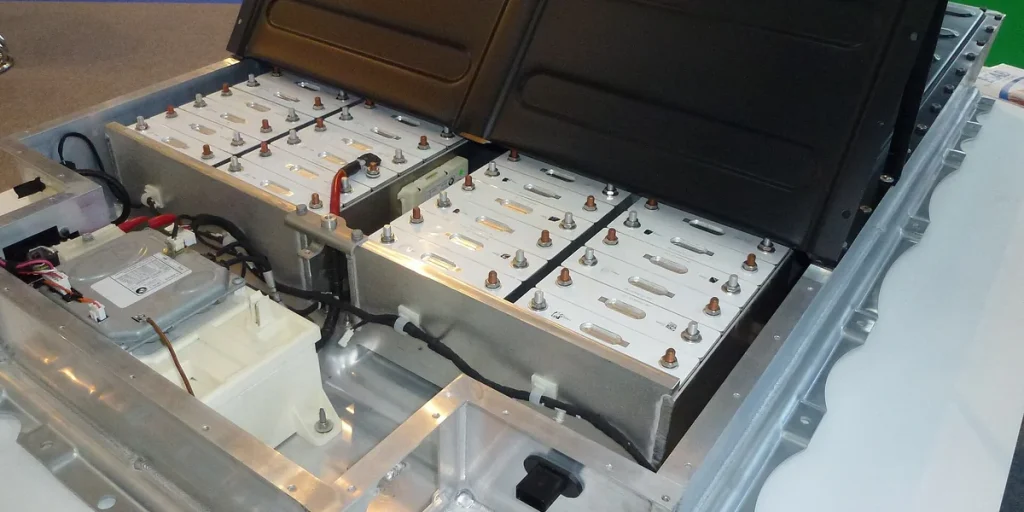
The pack sits flat beneath the cabin floor, spread in modules between the axles — and the 66.5 kWh version weighs 469 kg.
That underfloor layout, from Mercedes’ own launch material, keeps the centre of gravity low and the floor flat. Mercedes publishes the smaller pack’s weight (469 kg) but not the 250+ pack’s, so any source quoting a weight for the bigger battery is guessing. One more point that comes up in search: this is a 400-volt car — pack voltage runs at roughly 400–420 V depending on version. There is no 800-volt EQB.
What Is the EQB’s Real Range?
There is no single EQB range figure: US ratings run from 205 to 251 miles depending on variant and model year, and a 2022 car is officially rated higher than a 2025 one.
EPA range by model year (US)
The ratings moved a lot between years — the 2022 EQB 300 was rated at 243 miles, while the same car three years later rates 205.
| Model year | EQB 250+ | EQB 300 4MATIC | EQB 350 4MATIC |
|---|---|---|---|
| 2022 | Not sold in the US | 243 miles | 227 miles |
| 2023 | 245 miles | 232 miles | 221 miles |
| 2025 | 251 miles | 205 miles | 207 miles |
2022–2023 figures are EPA label ratings; 2025 figures are compiled from EPA certification data.
The pattern matters when you judge a used car. The 250+ improved slightly over the years, but the AWD cars fell hard, mainly because larger wheels became standard fit — and wheels are range poison. A low EPA figure on a newer 300 or 350 does not mean its battery is tired; it left the factory that way. Compare a car against its own model year, not the best number ever printed for the badge.
WLTP range (Europe and UK)
On the European WLTP cycle the EQB 250+ is the long-distance version again, at up to 535 km, with the all-wheel-drive cars at up to 412 km.
Pre-facelift, the EQB 250 was rated at up to 452 km (281 miles) and the 300/350 4MATIC at up to 412 km (256 miles). The 250+ raised that to up to 535 km — UK material quotes up to 321 miles depending on trim — while facelift 350 4MATIC cars sit between 397 and 447 km by trim and wheels. Keep the test cycles separate in your head: WLTP is systematically more generous than EPA, so a UK car’s "321 miles" and a US car’s "245 miles" can describe near-identical real-world ability.
What owners actually see in the real world
Expect roughly 230–300 miles from a 250+ in mixed driving and 180–230 from the 4MATIC cars — call it a 250-mile car and a 200-mile car, respectively.
EV Database puts real-world range at about 255 miles for the 250+ and about 215 miles for the 350 4MATIC, and Electrifying’s used review lands in the same place: 230–300 miles from a 250+ in mixed use, 180–230 from the AWD cars. Winter takes its usual cut — Bjørn Nyland’s cold-weather test of a 350 4MATIC worked out at an estimated 332 km (206 miles) at a steady 90 km/h. Not outstanding for the class, but honest, usable range if your life fits inside it.
How Fast Does the EQB Charge?
Charging is the EQB’s weak point: 100 kW DC at best and about 32 minutes from 10–80%, with no faster version at any price.
DC fast charging — 100 kW and about 32 minutes
Every EQB, from the base 250 to the 350, peaks at the same 100 kW — enough for a 10–80% charge in roughly 32 minutes at full rate.
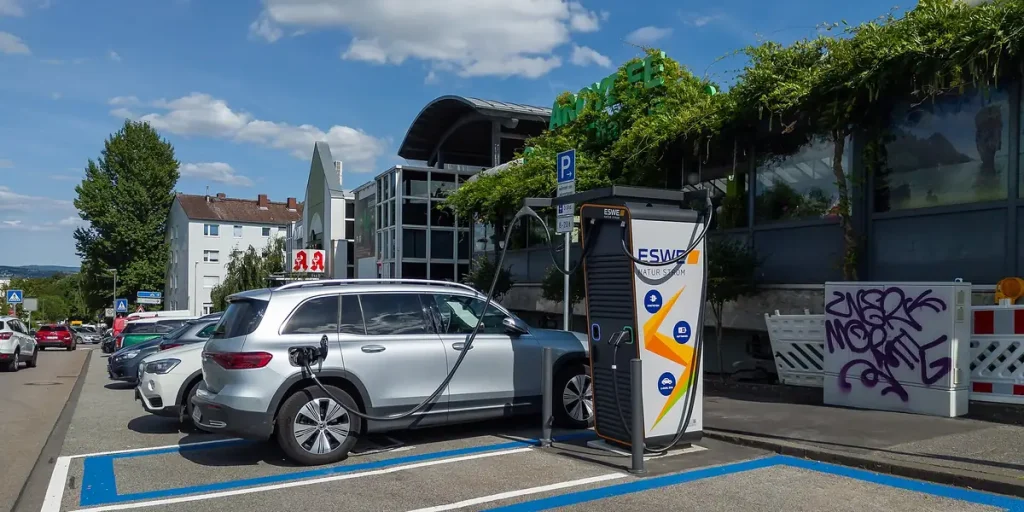
That was respectable in 2021 and is slow in 2026, when the rivals below charge at 150 kW or more. On road trips the EQB is a top-up-and-go car: plan stops around a meal, not a coffee. US owners do get one genuine upgrade — CCS1 cars can use Tesla Superchargers with the Mercedes-approved NACS-to-CCS adapter, activated through the Mercedes-Benz app, which widens the reliable fast-charging map considerably.
Home and AC charging
Europe gets an 11 kW three-phase onboard charger; US cars have a 9.6 kW unit — either way, this is a car designed to fill overnight at home.
On 11 kW, a full charge takes about 6 hours 45 minutes for the 66.5 kWh cars and about 7 hours 15 minutes for the 250+; a US 250+ needs roughly 7.5 hours on its 9.6 kW charger. That is the EQB’s natural rhythm — plugged in when you get home, full when you leave. If your driving fits that pattern, the mediocre DC speed barely matters.
Does the EQB precondition its battery?
Yes — navigate to a DC fast charger with the car’s own route guidance and it warms or cools the pack to the right temperature on the way, which matters most in cold weather.
Preconditioning is the difference between seeing the full 100 kW and watching a cold pack trickle. Cabin pre-heating works from the app too, and it answers a question owners genuinely ask: pre-heat while plugged in and the energy comes from the charger, not the battery — a warm cabin and a full pack. Do it unplugged and the same comfort comes straight out of your range.
Charging tips that actually help
- Charge to 80% for daily use. It is kinder to the pack, and for recall-affected cars (next section) 80% is not advice — it is the instruction until the new battery is fitted.
- Set the charger as the navigation destination before a DC stop, so preconditioning has time to work.
- Home-charge overnight whenever you can; at 9.6–11 kW the car is full by morning and you will rarely need public charging at all.
- Use the Mercedes-approved NACS adapter for Supercharger access in the US rather than an unbranded one.
Is the Mercedes EQB Battery Reliable?
The packs themselves are ageing well — but the EQB’s reliability story is dominated by a fire-risk recall that ends with Mercedes replacing the entire battery, free, on most US 2022–2024 cars.
The battery fire recalls, explained (25V050 → 26V073)
It started with a software fix and ended with new batteries: recall 25V050 (February 2025) covered about 12,236 US cars, and its replacement, 26V073 (February 2026), covers 11,895 cars with a complete new pack as the remedy.
The original recall covered 2022–2024 EQB 250, 300 4MATIC and 350 4MATIC cars built between 13 December 2021 and 23 January 2024. Mercedes told NHTSA that an internal short circuit in a high-voltage battery cell could cause a fire, driven or parked — and the filing names the cell supplier, Farasis Energy (Ganzhou). The first remedy was a battery-management software update, owners were told to charge to no more than 80% in the meantime, and production changes from 31 July 2024 builds ended the condition in new cars.
Software was not enough. In February 2026, recall 26V073 superseded it, and this time the remedy is a complete replacement of the high-voltage battery pack, free of charge — a smaller December 2025 campaign (25V894, 169 cars) was folded into it. This is the remedy carmakers avoid unless they truly need it. The UK saw a separate, far smaller recall in April 2025: just three cars, for a software fault that could lead to a battery fire.
What should owners do until the new pack is fitted?
Park outside, away from structures, and keep charging at or below 80% until your car has its replacement battery.
That is Mercedes’ own interim advice under 26V073, and it is worth following literally. If you are buying, check the car’s status by VIN — recall completion is recorded against the car, and an open recall on a forecourt car is a negotiating point, not a reason to walk away. My honest take: a recalled car with the new pack already fitted is arguably the safest used EQB of all, because its battery is newer than the car around it.
How well do EQB batteries hold their capacity?
Very well, on the evidence available: independent health checks found a 2022 EQB 350 at 95% state of health after 91,800 miles, and another at 97% after 41,700 miles.
Those figures come from battery-health certificates on dealer cars, checked by Electrifying — one source looking at individual cars, not a fleet study, and I am presenting them as exactly that. Auto Express’s buyer’s guide reaches the same conclusion: so far, the batteries are lasting very well. The honest gap is that no large public degradation dataset exists for this car — the EQB never featured in the What Car? Reliability Survey — so treat the certificates as encouraging evidence, not statistics.
The smaller battery recall (25V487, loss of drive power)
A second, much smaller battery recall hit 660 US cars in July 2025: incorrect screws inside the battery can cause a sudden loss of drive power.
Recall 25V487 covers certain 2022–2023 cars; the remedy is an inspection or, where needed, battery replacement. It is a different fault from the fire recall — mechanical, not chemical — but it belongs on the checklist when you run a VIN. Two battery recalls on one model sounds alarming; in practice both end with Mercedes inspecting or replacing the pack at its own cost.
What Does the Mercedes EQB Battery Warranty Cover?
In the US, the EQB battery is warranted for 8 years or 100,000 miles — not the 10 years/155,000 miles of the EQE and EQS — and the capacity floor is written in amp-hours: 133 or 160 Ah, roughly 70% of the original capacity.
US warranty — 8 years/100,000 miles and the amp-hour floor
Mercedes-Benz USA’s own EQ warranty booklet puts the EQB in the 8-year/100,000-mile group, and promises the battery will hold at least 133 Ah or 160 Ah during that term.
The two amp-hour figures exist because the two packs differ, and they work out at roughly 70% of each pack’s original capacity — the booklet just says it in electrical units instead of the percentage every other brand quotes. That is the number behind the "minimum battery capacity warranty" question owners search for: fall below it inside the term and the battery is repaired or replaced under warranty. Our guide to the best EV battery warranties shows how the floor compares across brands.
UK, European and Australian warranty — 8 years/160,000 km
Outside the US the term is 8 years/160,000 km (100,000 miles in the UK), with the UK stating the floor plainly as 70% capacity.
Canada matches the US structure at 8 years/160,000 km with the same 133/160 Ah capacity floor in its EQ booklet. UK cover is 8 years or 100,000 miles, expressed as capacity not dropping below 70%. European cars carry 8 years/160,000 km, and Australia follows the same 160,000 km pattern — which is why the Australian "70% degradation" searches land on this page.
Why the EQB does not get the EQE/EQS 10-year cover
The 10-year/155,000-mile cover belongs to the EQE and EQS; the EQB, as the entry-level EQ built on the GLB platform, was never in that group.
This is the single most common error in EQB warranty content — at least one widely read warranty roundup still lists the EQB at 10 years/155,000 miles, and it is simply wrong. The booklet is unambiguous: 8 years/100,000 miles. If a seller tells you a used EQB has ten years of battery cover, ask to see the document. They will not be able to show you one.
EQB Battery vs Its Rivals
On battery numbers alone the EQB is mid-pack at best — you buy it for seven seats in a compact body, not for capacity or charging speed.
The closest seven-seat rival, Peugeot’s e-5008, carries a 73 kWh usable battery, up to about 311 miles of WLTP range, and 160 kW DC charging — it charges notably faster than the EQB’s 100 kW, on the same 8-year/100,000-mile battery warranty to 70%. Its third row also fits adults better; the EQB’s counter-argument is its smaller, easier-to-park footprint. Volkswagen’s ID.4 is the other obvious cross-shop — five seats only, but covered in the same detail in our VW ID.4 battery guide.
And if the third row turns out to be a nice-to-have rather than a need, Mercedes’ own smaller EQA is the first alternative to price up — our Mercedes EQA battery guide covers its packs and warranty. The EQB only makes sense once you have decided the extra seats are worth the compromises elsewhere. For plenty of families, they are.
The Optional Third Row — the EQB’s Party Trick
The third row is why the EQB exists — but it is a row for people up to about 1.65 m tall, no child seats are allowed in it, and it leaves just 110 litres of boot space.
With all seven seats up, the boot shrinks to 110 litres — a couple of soft bags, not a weekly shop. Drop the third row and you get 465 litres with the second row in use, and up to 1,620 litres with everything stowed; five-seat cars offer 495 litres, or 1,410 litres folded. The seat-occupant limit and the child-seat ban come from Mercedes’ own documentation, so treat the back row as a school-run and short-hop solution for smaller passengers, which is honestly what most buyers use it for.
One market trap: in the UK every EQB came with seven seats as standard, while in the US and other markets the third row was an option. A US listing that does not mention seat count may well be a five-seat car. Check before you travel to see it.
What Does an EQB Battery Replacement Cost?
There is no published price — Mercedes does not quote the EQB’s traction battery publicly, and any exact figure you find online is an estimate, not a quote.
I checked for a dealer or official price the way I always do for this section, and it is not there: Mercedes dealer service pages happily price the EQB’s 12-volt battery (offers around $380–400) and decline to price the traction pack at all. So the truthful answer is that an out-of-warranty pack price is whatever a dealer quotes you on the day, and no honest guide can put a number on it today. Anyone who does is modelling, not quoting.
The exception is the one that matters most. For the 11,895 US cars under recall 26V073, a replacement pack costs the owner exactly nothing, and the 8-year warranty stands behind capacity failure for everyone else. The practical conclusion: replacement cost should not drive an EQB buying decision. Recall status, a battery health certificate, and how much warranty is left matter far more.
Frequently Asked Questions
The short answers: the battery is under the floor, it is a 400-volt pack, the warranty floor is about 70%, and recalled cars are getting new packs free.
Where is the EQB’s battery located?
Under the cabin floor, spread in modules between the axles, which keeps the centre of gravity low and the floor flat. The 66.5 kWh pack weighs 469 kg; Mercedes does not publish a weight for the 70.5 kWh pack in the 250+.
Is the Mercedes EQB a 400-volt car?
Yes. The pack runs in the 400-volt class — roughly 400–420 V depending on version — which is also why its DC charging peaks at 100 kW. No EQB uses an 800-volt architecture.
How long does the EQB battery last?
The warranty runs 8 years/100,000 miles in the US (8 years/160,000 km in Europe), with a capacity floor of about 70%. Real cars are ageing better than that floor suggests: independent health checks have recorded 95% state of health at 91,800 miles on a 2022 EQB 350. There is no large public degradation dataset for the model, so those checks are evidence, not guarantees.
When will recalled EQB cars get their new battery?
Under recall 26V073, Mercedes is replacing the high-voltage battery pack free of charge on 11,895 US 2022–2024 cars, superseding the earlier software-only fix. Until your car is done, follow the interim rules: charge to no more than 80% and park outdoors away from structures. Check your VIN to see whether your car is in the campaign and whether the work is recorded as complete.
Does pre-heating the cabin drain the EQB’s battery?
Barely, and not at all if you do it while plugged in — the energy then comes from the charger, not the pack. Pre-heating unplugged costs a little range. The related feature worth using is battery preconditioning: set a DC fast charger as the navigation destination and the car brings the pack to the right temperature on the way, so you actually see the full 100 kW when you plug in.
Conclusion
Buy the EQB for the seats, but choose it by the battery: a front-wheel-drive 250+ with the recall checked and a health certificate in hand is the sweet spot of the range.
The EQB’s battery story is better than its headlines. The packs hold their capacity well, the warranty is a fair 8 years with a real capacity floor, and the worst news in the car’s history — the fire recall — resolves into a free new battery for the cars affected. Its genuine weakness is charging speed, and that only bites if you road-trip on public chargers every week; for a home-charged family car it barely matters.
So judge any individual car on three things: which of the two packs it has, whether its recall work is done, and how much of the 8-year warranty remains. Get those right and the EQB is a lot of seven-seat electric car for used money — the 2025 US 250+ listed from $53,050 new, and it is a used-only proposition now. Get them wrong, and you have bought the badge and missed the point.
