
Peugeot e-208 Battery: Complete Guide


Battery and specification figures are Peugeot’s and Stellantis’s published data and price lists, cross-checked against EV Database; measured efficiency and range figures are ADAC’s and the named testers’; recall details are UK DVSA records; the safety rating is Euro NCAP’s.
The Peugeot e-208 is the electric version of the second-generation 208 hatchback, revealed in 2019 and on sale in Europe and the UK since early 2020. It sits on Stellantis’s e-CMP platform, shares its hardware with the Vauxhall and Opel Corsa Electric, and has never been sold in the United States or Australia.
The complication — and the reason this guide is organised by era — is that the car has used three different batteries under two headline names. The original pack was sold as “50 kWh”, its successor as “51 kWh”, and since April 2025 the car has carried a larger pack that Peugeot still markets as “51 kWh” in several countries. What follows separates the three, with the usable capacity of each stated plainly, because usable capacity is what decides real range.
Quick answer: The e-208’s batteries are all NMC — 50 kWh gross (46.3 kWh usable, up to 362 km WLTP) in the original car, 51 kWh gross (48.1 usable, 400 km) from 2023, and a 54 kWh gross pack (50.8 usable, 433 km) in the current car. All versions fast-charge at up to 100 kW DC. The battery warranty is 8 years or 160,000 km with at least 70% capacity guaranteed.
Key figures: 46.3 / 48.1 / 50.8 kWh usable · 362–433 km WLTP · DC 100 kW · AC 7.4 kW standard · warranty 8 yr / 160,000 km.
Battery Sizes and Specifications
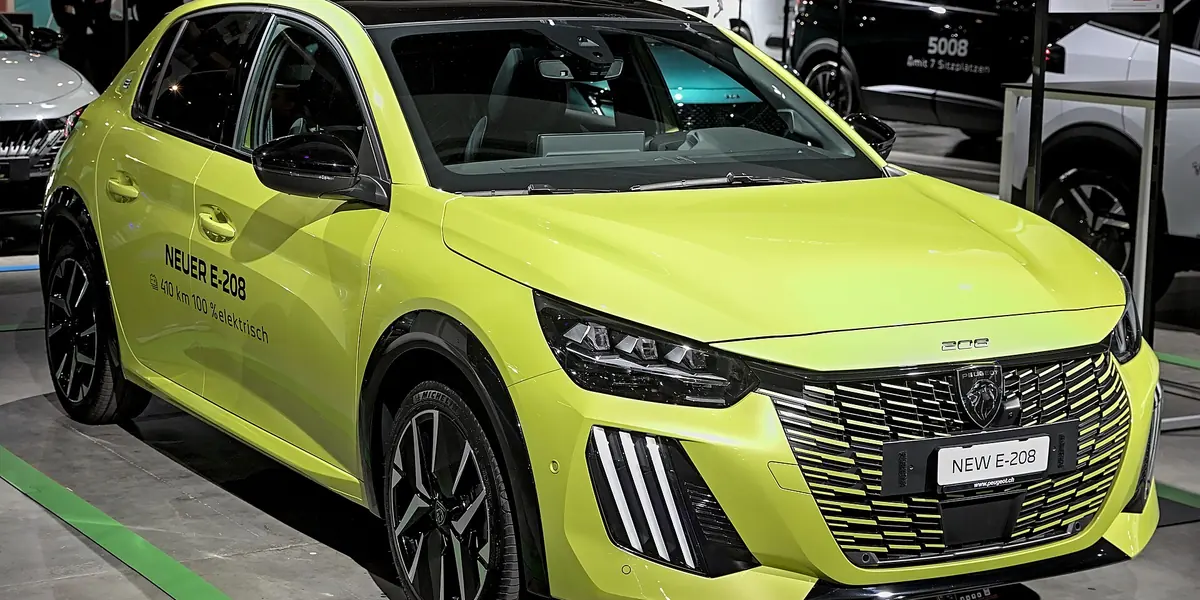
Three NMC packs have powered the e-208: 46.3 kWh usable in the original car, 48.1 in the 2023 car, and 50.8 in the current one.
| Battery era | Gross | Usable | Chemistry | Motor | WLTP range | 0–100 km/h | DC charging |
|---|---|---|---|---|---|---|---|
| Original (2019– ) | 50 kWh | 46.3 kWh | NMC622 | 100 kW (136 hp) | 340 km, then 362 km from 2022 | 8.1 s | 100 kW |
| Second (2023–2025) | 51 kWh | 48.1 kWh | NMC811 | 115 kW (156 hp) | 400 km | 8.2 s | 100 kW |
| Current (2025– ) | 54 kWh | 50.8 kWh | NMC811 | 115 kW (156 hp) | 433 km | 8.2 s | 100 kW |
Peugeot’s headline figures are gross capacities; the usable figures in the middle column are the ones that matter, and they explain the naming trap in today’s listings. The current car’s pack holds 54 kWh in total and 50.8 kWh usable — close enough to 51 that Peugeot and its dealers still advertise the car as the “51 kWh” e-208 in several markets. When a listing says 51 kWh, it may mean the 2023 car’s gross figure or the current car’s usable one; the build date tells you which car you are looking at.
The packs differ inside as well as in size: the original uses 216 prismatic cells in a 108s2p layout at about 400 V, the 51 kWh pack 96 cells in a 96s1p layout at about 355 V, and the current pack 102 cells at about 377 V (EV Database).
The Three Battery Eras
The e-208’s battery story has four dates that matter: 2019, 2022, 2023 and 2025.
How did the e-208’s battery change in 2022 and 2023?
The car launched with the 50 kWh pack and a certified 340 km (211-mile) WLTP range. From the start of 2022 an optimisation package — a new heat pump with a humidity sensor, lower-rolling-resistance tyres and a revised gearbox ratio — lifted the rating to 362 km (225 miles); no battery change was involved. In September 2022 Peugeot announced the drivetrain the car is now known for: a new 115 kW motor and the 51 kWh battery, on sale during 2023 first in the pre-facelift body and then in the facelifted car, with the older 136 hp version sold alongside it for a time.
What changed in April 2025?
The fourth date is the one most guides miss. In April 2025 Peugeot raised the 156 hp car’s range to 433 km WLTP, added vehicle-to-load pre-installation, a trip planner and an 80% charge-limit feature. The range step came from the larger 54 kWh pack described above. A car advertised today as a new e-208 is that car, whatever the “51 kWh” badge in the listing says.
Real-World Range: The Efficiency Champion
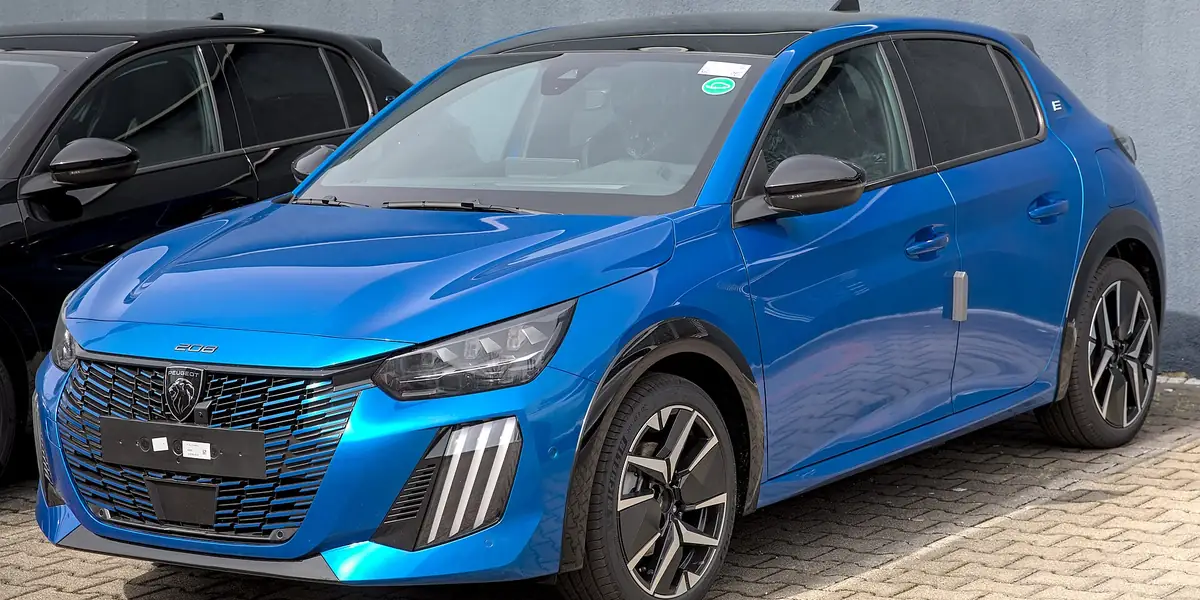
The e-208 is one of the most efficient electric cars ever measured — ADAC ranked it first of 84 models — and realistic range is about 270–335 km depending on the battery.
In ADAC’s Ecotest the e-208 consumed 16.0 kWh per 100 km including charging losses — the lowest figure of all 84 models in the test round, and the best ADAC had recorded on the European market (ADAC via Stellantis, January 2025).
EV Database’s estimates, labelled as estimates, put real-world range at about 270 km for the original car (about 295 km for the optimised post-2022 version), about 305–315 km for the 51 kWh car and about 335 km for the current 54 kWh car. Tester experience agrees with the shape of those numbers: Fleet News measured 3.8 miles per kWh in the 51 kWh car, good for roughly 195 miles, and Autocar’s long-term test of the same version averaged 4.1 miles per kWh, around 217 miles per charge.
The honest counterweight is the early car: Parkers found their original 50 kWh test car struggled to cover more than 150 miles, a reminder that the 2022 optimisation and the later packs genuinely improved the car.
Charging: Windows Matter
Every e-208 fast-charges at up to 100 kW DC, but Peugeot’s time claims use different charge windows for different eras — quoting one “30 minutes” for all of them is how errors start.
What are the DC charging times by era?
For the original car Peugeot claimed 0–80% in 30 minutes. For the 51 kWh car the claim is 20–80% in 24 minutes, and for the current car 20–80% in 27 minutes. EV Database’s standardised estimate for all three packs is 10–80% in about 28 minutes, which is the fairest single comparison figure — provided it is labelled as an estimate, as here.
At home, the standard onboard charger is a 7.4 kW single-phase unit (a full charge in roughly 7 hours 30 minutes for the original car, 8 hours 15 minutes for the current one); an 11 kW three-phase charger is an option in most markets and cuts those times to about 5 and 5 hours 30 minutes. The 11 kW unit is not the standard fit, whatever a listing implies.
What about AC charging and the heat pump?
The heat pump’s position is the one most often misstated. A new heat pump arrived as part of the start-of-2022 optimisation, but fitment has always varied by market, trim and model year — Peugeot never made it standard across the range on a single date. In the UK it is an option or a higher-trim feature depending on the year, so a used buyer who cares about winter range should check the individual car’s specification rather than its build year. The current car’s specification sheet likewise lists the heat pump as varying by country.
Prices in the UK and Europe
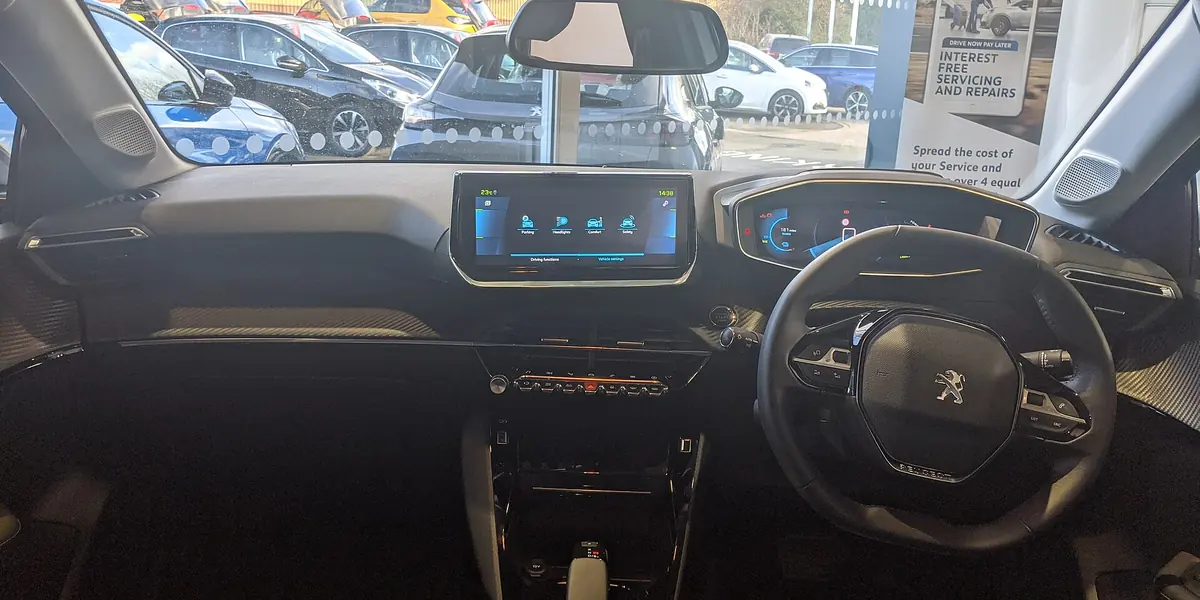
The e-208 launched in the UK from £25,050 including the government grant in 2019, and today’s range spans roughly £25,065 to £34,995 before the current £1,500 Electric Car Grant.
The launch price bought the 136 hp car; the GT sat at £29,650. Prices climbed through the car’s life as the new drivetrain arrived — the facelift launched in Germany from €36,775 in September 2023 — and French list prices in late 2026 start at €27,900 for the 136 hp car and €32,090 for the 156 hp car (secondary price-guide figures, given as indicative). As with every car in this series, a price is meaningless without its market and its date attached, and there is no US price: the car has never been sold there.
Battery Health: Checking a Used e-208
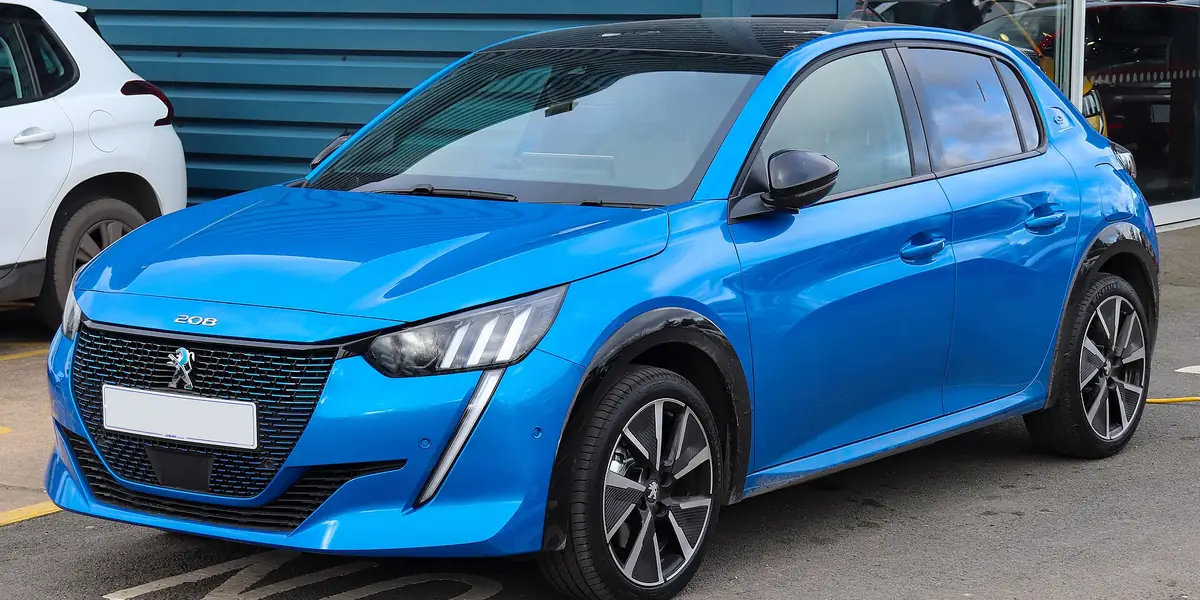
The e-208’s state of health can be read from the car itself, and it is the first thing to check on a used example — Peugeot’s warranty floor is 70% of original capacity.
State of health (SoH) expresses the battery’s remaining usable capacity as a percentage of what it held when new. Owner communities commonly read it with an OBD2 adapter and the CarScanner app’s PSA EV profile, which reports the battery’s state and energy content; a Peugeot dealer can produce the same figure at a service. There is no verified fleet dataset for the e-208’s degradation, and this guide prints no fixed “percent per year” figure, because none exists from a source that measured these cars.
What can be said is structural: the car is covered to 70% for 8 years or 160,000 km, the packs are liquid-cooled, and the earliest cars are now six years old — so a health reading, not a rule of thumb, is the right way to judge any individual example.
Battery Replacement Cost: No Official Price Exists
Peugeot does not publish a replacement-pack price for the e-208, and no verified dealer price for any of its three packs has surfaced.
The one precise figure that circulates in this context — a Portuguese dealer’s quote of €23,335.53 — prices a pack for the discontinued Peugeot iOn, a different and much older city car, and says nothing about the e-208. Most “e-208 battery price” results are for the ordinary 12-volt battery, a €60–£150 part. In practice, an out-of-warranty pack failure on a car of this value is usually handled by module-level repair at a specialist or by a used pack, not by a new-pack purchase. For how replacement pricing works across EVs in general, see our EV battery replacement cost guide.
Warranty and Recalls
The battery warranty is 8 years or 160,000 km (100,000 miles in the UK) with at least 70% capacity guaranteed, and Peugeot Care extends cover on the rest of the powertrain.
What does Peugeot Care cover?
The UK vehicle warranty is 3 years or 60,000 miles. Peugeot Care — the service-activated programme Peugeot launched on the E-3008 — has covered the e-208 since 15 May 2024: keep the car serviced in the Peugeot network and cover for the electric motor, charger, transmission and main electrical components renews in two-year steps up to the same 8-year span. It sits alongside the battery warranty, not instead of it.
What has the e-208 been recalled for?
The car’s recalls are software campaigns, not battery defects. UK records for the platform document an A/C compressor wiring fault that could cut the powertrain (cars built October 2019 to November 2022, fixed with a software update), a traction-battery control-unit calibration error that could cause a loss of propulsion (cars built August to December 2022), and a battery monitoring unit software update for the same build window. No recall anywhere concerns the battery cells themselves, and no battery-fire recall exists for this car. Two widely reported 208 recalls — a clutch calibration fault and a 2026 fire-risk campaign — concern the petrol and mild-hybrid cars, not the e-208.
What is the known onboard-charger weakness?
The best-documented genuine weakness is the onboard charger on 2019–2022 cars, whose failure disables AC charging (DC rapid charging usually still works); reports put an out-of-warranty replacement near £3,000, and the supplier was changed from around mid-2022.
Safety Rating
The 208 range, including the e-208, scored four stars in Euro NCAP’s 2019 tests.
Its category scores were 91% for adult occupant protection, 86% for child occupants, 56% for vulnerable road users and 71% for safety assist. No separate re-test of the facelifted car has been published, and the car is a four-star car — not five — under the protocol of its test year.
The GTi and the Corsa Twin
Two relatives need fencing off: the e-208 GTi uses this car’s battery with a far stronger motor, and the Corsa Electric shares the hardware but not the certified figures.
The e-208 GTi, priced in 2026 from £34,995 or €42,900, pairs a 280 PS motor with the same 54 kWh gross, roughly 51 kWh usable battery as the standard car, for 375 km of WLTP range on its standard tyres and a 5.5-second 0–62 mph time; vehicle-to-load is standard on it. The standard car’s V2L position is narrower: pre-installation on 156 hp cars built from April 2025, working through a bidirectional adapter accessory rated up to 3.5 kW.
Our Vauxhall Corsa Electric battery guide covers the platform twin in full; its packs and motors match the e-208’s, but its certified ranges differ slightly at every step (337 rather than 340 km at launch, 428 rather than 433 km today), so the two cars’ figures should never be copied across. The smaller Citroën ë-C3 is a different car altogether — a different platform and a lithium-iron-phosphate battery — and none of its figures belong here.
Frequently Asked Questions
What battery sizes does the Peugeot e-208 have?
Three packs across its life: 50 kWh gross (46.3 kWh usable) in the original car, 51 kWh gross (48.1 usable) from 2023, and 54 kWh gross (50.8 usable) in the current car from April 2025. All are NMC lithium-ion. Listings may still call the current car “51 kWh” — that is its approximate usable figure.
Is the e-208 battery NMC or LFP?
NMC in every version — NMC622 in the original pack and NMC811 in the two later ones. The LFP battery in this size class belongs to the Citroën ë-C3, a different car on a different platform.
What is the real range of a Peugeot e-208?
EV Database estimates about 270 km for the original car, 305–315 km for the 51 kWh car and about 335 km for the current car. Testers recorded roughly 195 miles (Fleet News) and 217 miles (Autocar long-term) in the 51 kWh version; early 50 kWh cars can fall nearer 150 miles in hard use.
How long does the e-208 take to charge?
Peugeot’s claims are 0–80% in 30 minutes for the original car and 20–80% in 24 minutes (51 kWh) or 27 minutes (current car) at up to 100 kW DC; EV Database estimates 10–80% at about 28 minutes for all three. At home, the standard 7.4 kW charger needs roughly 7 hours 30 minutes to 8 hours 15 minutes for a full charge depending on the pack; the optional 11 kW charger cuts that to about 5 to 5 hours 30 minutes.
Is the heat pump standard on the e-208?
No single date made it standard. A revised heat pump arrived with the start-of-2022 optimisation, but fitment varies by market, trim and model year — in the UK it is an option or a higher-trim feature. Check the individual car’s specification.
How can I check a used e-208’s battery health?
Read the state of health via an OBD2 adapter with the CarScanner app’s PSA EV profile, or ask a Peugeot dealer for the figure at a service. Peugeot guarantees at least 70% of original capacity for 8 years or 160,000 km.
What does a replacement e-208 battery cost?
There is no official price — Peugeot publishes none and no verified dealer price exists. The widely quoted €23,336 dealer figure prices a pack for the old Peugeot iOn, not this car. Out-of-warranty failures are usually handled by module repair or a used pack.
How long is the e-208 battery warranty?
Eight years or 160,000 km (100,000 miles in the UK), with at least 70% of capacity guaranteed. Peugeot Care can extend cover on the motor, charger and powertrain to the same span with network servicing.
Does the e-208 have vehicle-to-load (V2L)?
Only in its newest form: V2L pre-installation is fitted to 156 hp cars built from April 2025, working through a bidirectional adapter accessory (up to 3.5 kW). Earlier cars do not have it. The e-208 GTi has V2L as standard.
Is the e-208 sold in the United States?
No. Peugeot has no US retail presence; the e-208 is a Europe-and-UK car, and it was never launched in Australia either.
Judged on its batteries alone, the e-208 improved at every step: more usable capacity, better efficiency crowned by ADAC’s test programme, and a current version whose 433 km rating leads its class — provided the three eras are kept separate, which is where most guides fail it. Get the era right and the rest of the car follows. For its larger sibling, our Peugeot e-3008 battery guide applies the same treatment to the STLA Medium SUV.
