
Polestar 3 Battery: Complete Guide

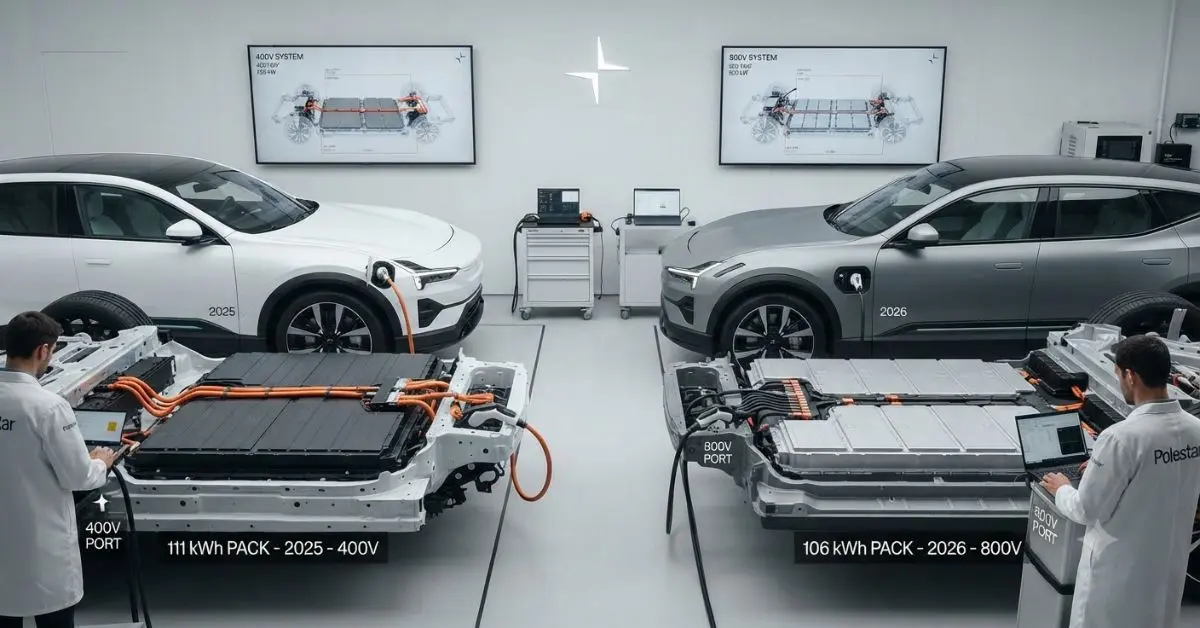
The Polestar 3 battery received a major upgrade in 2026. The car moved from a 400-volt system to a more powerful 800-volt system. This high-voltage setup uses CATL battery packs with 92 kWh for the Single Motor version or 106 kWh for the Dual Motor and Performance versions. This change helps the car charge much faster. Peak DC charging power jumped from 250 kW to 350 kW. You can now charge from 10% to 80% in about 20 minutes instead of 30 minutes, and the car is up to 6% more efficient.
While the 2025 model used a larger 111 kWh pack to reach 350 miles of EPA range, the 2026 model uses a smaller pack for better speed and efficiency. This makes it one of the fastest-charging luxury SUVs you can buy. The Polestar 3 also shares its CMA platform base with the Volvo EC40. This guide provides all the official facts and owner data for both car versions.
Polestar 3 Battery: 2025 vs 2026 Key Differences
| Spec | 2025 Polestar 3 (All trims) | 2026 Single Motor RWD | 2026 Dual Motor / Performance AWD |
|---|---|---|---|
| Battery (gross) | 111 kWh | 92 kWh | 106 kWh |
| Battery (usable) | ~107 kWh | ~88 kWh | ~102 kWh |
| Chemistry | NMC (CATL) | NMC (CATL) | NMC (CATL) |
| Architecture | 400V | 800V | 800V |
| Peak DC charge rate | 250 kW | 310 kW | 350 kW |
| 10–80% DC charge time | ~30 min | Low 20s minutes | Low 20s minutes |
| EPA range | 279–350 miles | TBC (lower than 350) | TBC (similar ~315+) |
| Efficiency improvement | — | Up to 6% | Up to 6% |
Why Polestar Switched to 800V for 2026
The 2026 Polestar 3 uses a new 800-volt system to improve charging and performance. This upgrade beats the 2025 model’s 400-volt system in three ways. First, it reaches a higher peak power of 350 kW, saving 7 to 10 minutes per charging session. Second, it reduces heat in the cables and connectors because the system uses less current. Third, the new motor design makes the whole car more efficient by reducing energy waste in the wiring and the motor.
Engineers shrunk the battery packs for 2026, but the car still travels as far as the older models. The Single Motor version now has a 92 kWh battery instead of 111 kWh, while the Dual Motor version uses a 106 kWh battery instead of 111 kWh. Because the new system is 6% more efficient, these smaller batteries provide nearly the same driving range as before. You get the same distance with much faster charging times.
2025 Polestar 3 Battery: The 111 kWh Foundation
The Polestar 3 uses a large 111 kWh battery to power all its models. This is one of the biggest batteries found in any luxury SUV. The company CATL makes the battery cells for these cars.
This battery provides a long driving range. The Single Motor model travels 350 miles, while the Dual Motor model travels 315 miles. These numbers match competitors like the BMW iX, Mercedes EQE SUV, and the Tesla Model X.
In real-world driving at highway speeds of 70–80 mph, range varies with weather conditions. In moderate temperatures, the Dual Motor model typically travels 280–320 miles. The Single Motor model covers 310–340 miles.
Polestar 3 Charging Speeds Compared
| Charging Method | 2025 (111 kWh, 400V) | 2026 Dual Motor (106 kWh, 800V) |
|---|---|---|
| Level 2 (11 kW AC) | ~11.5 hours full | ~11 hours full |
| DC Fast (250 kW) | ~30 min (10–80%) | — |
| DC Fast (350 kW, 800V) | — | Low 20 min (10–80%) |
Polestar 3 Battery Degradation
The Polestar 3 launched in 2023–2024 and has limited long-term degradation data. However, it shares CATL NMC chemistry with the Polestar 2, which has shown strong real-world durability (92–95% BSOH at 80,000+ km). Key expectations:
- Annual degradation rate: Approximately 1.5–2% per year is expected for NMC under active liquid cooling
- Large pack advantage: The 2025 model’s 107 kWh usable capacity means each daily drive uses a small percentage of total capacity, reducing cycle depth and slowing degradation
- Real-world driving: Plan for 150–220 miles between highway charging stops for comfortable trips — build in a 10–15% SoC buffer if unfamiliar with the route
- Key habit: Limit daily charging to 90% (Polestar’s recommendation for NMC) and use 100% only before long trips
Polestar 3 Battery Warranty
Polestar covers the 3’s battery with an 8-year / 100,000-mile warranty against defects and capacity loss below 70% of original capacity — consistent with the Polestar 2’s coverage. Polestar also offered existing 2025 Polestar 3 owners a complimentary upgrade to the 2026 model’s new Nvidia Drive AGX Orin processor — a goodwill gesture that improves infotainment responsiveness without requiring a hardware purchase.
Charging Tips for Polestar 3 Owners
- Set daily charge limit to 90%: Polestar’s recommendation for NMC chemistry. At 90%, the 2025 model provides ~96 kWh — more than enough for most multi-day driving needs.
- Use Google Maps in Android Automotive for charging routing: The Polestar 3’s Android Automotive can route to DC fast chargers, enabling automatic battery conditioning before arrival.
- 2026 owners: seek 800V stations: The 350 kW capability of the 2026 architecture is only accessible at 800V DC stations. Standard 400V chargers will deliver up to approximately 150 kW on the 2026 model.
- 2025 owners: 250 kW is still very fast: A 30-minute 10–80% charge stop means only one stop is needed on most U.S. coast-to-coast driving days — the 2025’s charging performance remains highly practical.
Conclusion
The Polestar 3 battery comes in two versions. The 2025 model uses one of the biggest NMC packs in a luxury SUV. It holds 111 kWh of energy, with 107 kWh available for driving. This helps the car reach a 350-mile range on a 400-volt system. It charges at speeds up to 250 kW. NMC stands for Nickel Manganese Cobalt, which refers to the chemical composition of the battery cells.
The 2026 model makes big changes to improve performance. It uses a new 800-volt system that allows faster charging up to 350 kW. This upgrade also makes the car 6% more efficient, even though the battery holds less total energy. Buyers looking for a similar Volvo SUV should check out our Volvo EC40 battery guide. Both cars provide a great range for long trips. The 2026 upgrades make the Polestar 3 one of the fastest-charging large luxury SUVs on the market today.
