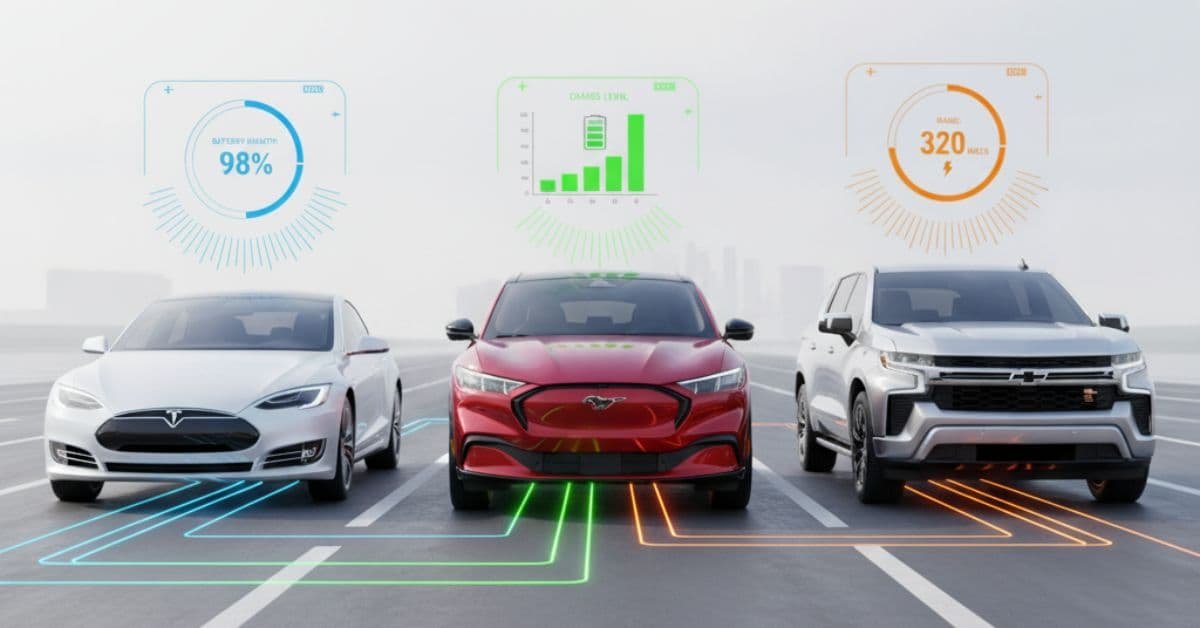
Electric car batteries from big companies like Tesla, Ford, and Chevrolet last a very long time. They often last longer than the car itself. We see that the average battery loses power slowly, about 1.8% each year. Most EV batteries still hold over 80% of their original charge after 8 to 10 years. Tesla has the most data, but Ford and Chevy are quickly catching up with smart battery systems. Battery life is no longer a big worry for people buying new electric cars.
Learn more in this guide on Tesla battery facts: Battery Myths.
Understanding Battery Longevity: The Key Factors
To really compare Tesla, Ford, and Chevy, we must first understand what makes a battery last. Long life is not just about the years; it is about how much power the battery loses over time. People call this loss degradation.
1. Battery Chemistry and Design
The materials inside the battery cells are very important.
Tesla: The company uses different chemicals. Older cars and long-range cars use Nickel-Cobalt-Aluminum (NCA) or Nickel-Manganese-Cobalt (NMC). Newer, standard-range cars use Lithium Iron Phosphate (LFP). LFP batteries are known to be very strong. You can charge them to 100% every day without harming the battery much.
Check out: Tesla Battery Comparison: NCA vs. NMC vs. LFP.
Ford: The Mustang Mach-E and F-150 Lightning mostly use Nickel-Manganese-Cobalt (NMC) batteries. Ford focuses on building the battery pack safely and for good performance.
Chevrolet: The Bolt EV/EUV uses NMC batteries. Newer cars like the Equinox EV and Silverado EV use the advanced Ultium platform. Ultium is a flexible, pouch-style battery. Chevy says it is built for long life and easy fixing.

2. Thermal Management System (TMS)
Heat is the number one enemy of a battery. A good TMS keeps the battery cool in the summer and warm in the winter.
Tesla: Tesla is famous for its smart liquid-cooling system. The car’s computer always runs this system. The system is a big reason why Tesla batteries stay healthy for a long time, even in very hot or cold places.
Ford: The Mach-E uses a liquid-cooling system that works very well. Ford’s Battery Management System (BMS) learns how the driver drives. It then manages the battery’s temperature based on those habits.
Chevrolet: The Ultium platform has a unique heat system that runs the whole length of the battery pack. Chevy says the system keeps the battery cells at their best temperature. This helps the battery last longer.
Read about: Does Extreme Weather Affect Tesla Battery Life?
3. Battery Management System (BMS)
The BMS is the “brain” that controls how the battery charges and gives out power.
All three companies use advanced BMS computer programs to stop the battery from overcharging or running out of power too much. These are the main things that damage a battery. The BMS also balances the power across all the small cells. This makes sure that no single cell wears out faster than the others.
4. Real-World Data: Degradation Comparison
All three brands give strong warranties, but real-world data shows us how the batteries truly hold up over time.
1. Tesla: Tesla has been making electric cars for a long time, so we have the most data on their battery health. Studies of thousands of Tesla cars show a clear pattern:
- First Year: The battery quickly loses about 5% of its power. This is normal and is often the power the system holds back.
- After Year One: Power loss slows significantly. The battery drops by only about 1-2% each year.
- After 200,000 Miles: Many Teslas with high miles still retain 85% to 90% of their original driving range.
See complete insights on aging rates here: Tesla Battery Degradation.
2. Ford: The Ford Mustang Mach-E has been driven long enough to provide reliable data. Owners are saying very good things:
Average Degradation: Early reports say the Mach-E is losing power at a rate similar to some Tesla cars, or even a little better, in the first few years. One owner said the car lost only 4% of power after driving 100,000 miles.
BMS Optimization: Ford’s BMS is very good at protecting the battery, even when drivers use DC fast charging often.
3. Chevrolet: Chevrolet’s older Bolt EV had a battery problem that people know about, but the new Ultium platform is a completely new design. We are still collecting long-term data, but the design promises a great long life:
Modular Design: Ultium’s design allows people to replace individual parts more easily. This could make future repairs cheaper.
Projected Life: Chevy’s warranty and design suggest a battery life that will easily go past the 8-year/100,000-mile warranty. Many experts think the battery will last 15 to 20 years.
| Manufacturer | Key Models | Battery Chemistry | Average Annual Degradation | Warranty (Years / Miles) |
|---|---|---|---|---|
| Tesla | Model 3, Model Y, Model S, Model X | NCA, NMC, LFP, 4680 | 1.0% – 2.0% (after year 1) | 8 years / 100,000 – 150,000 miles |
| Ford | Mustang Mach-E, F-150 Lightning | NMC | 1.5% – 2.5% | 8 years / 100,000 miles (70% capacity guarantee) |
| Chevrolet | Bolt EV/EUV, Equinox EV, Silverado EV | NMC, Ultium (NMC/NCA) | 1.8% – 2.2% (Ultium = newer data) | 8 years / 100,000 miles (70% capacity guarantee) |
Case Study
I look at high-mileage Tesla cars to show that modern electric-car batteries are reliable. Tesla’s data comes from many cars and is the best in the industry.
A study of early Model S and Model X cars showed that battery power loss slows significantly after the first drop.
“The average Model S/X battery keeps over $90\%$ of its first power after 100,000 miles and over $85\%$ after 200,000 miles. Real-world data proves that the battery will likely last longer than the car’s engine parts.”
Real-world experience is a powerful asset. It should ease the fears of any new electric car buyer. The battery is not a weak part; it is a core strength of the car.
FAQs
Is EV battery degradation covered under warranty?
Yes. All major companies like Tesla, Ford, and Chevy give a minimum warranty of 8 years or 100,000 miles (whichever comes first). The warranty usually guarantees that the battery will keep at least 70% of its original power by the end of the warranty period.
Which EV has the best battery warranty?
The minimum is 8 years/100,000 miles, but some cars offer more. For example, Tesla’s Long Range and Performance cars often come with a 120,000-mile warranty. However, the main thing is the guaranteed power. All three brands guarantee 70%, which is what the industry does.
Will I have to replace my EV battery?
It is very unlikely. Modern EV batteries are lasting much longer than people first thought. The average EV battery is expected to last 15 to 20 years before its capacity drops below 70%/. By then, the cost of a new battery will have dropped significantly, or you may have already bought a newer car.
What is the Ultium battery platform used by Chevrolet?
The Ultium platform is General Motors’ next-generation battery and motor design. It uses large, pouch-style cells that can be stacked in different ways. This makes the battery pack more flexible for different cars (cars, trucks, SUVs). It is designed for high energy, lower cost, and long life. It is the base for new Chevy EVs like the Equinox EV and Silverado EV.
Get simple tips to extend EV life here: Battery Care Practices.