NCA vs NMC vs LFP: Which Tesla Battery Is Best?

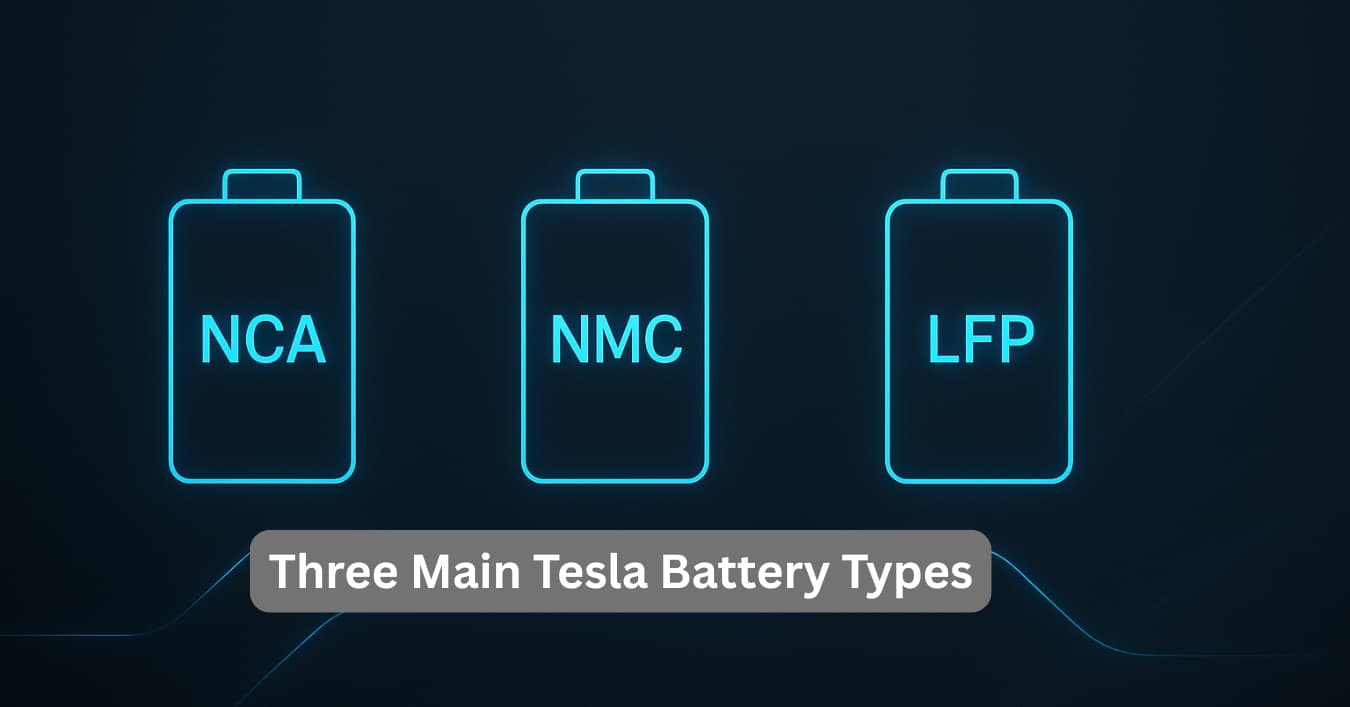
Tesla uses three battery chemistries across its lineup: NCA (Nickel Cobalt Aluminum), NMC (Nickel Manganese Cobalt), and LFP (Lithium Iron Phosphate). Each chemistry appears in specific Tesla models, changes how you should charge the car every day, and affects long-term battery life in different ways. This guide tells you exactly which chemistry is in your Tesla and what it means for how you drive and charge.
If you want a broader industry comparison of LFP and NMC across all EV brands, see our separate guide: LFP vs NMC Batteries: Full EV Industry Comparison.
The Three Tesla Battery Chemistries at a Glance
| Chemistry | Tesla Models | Range | Daily Charge Limit | Cycle Life |
|---|---|---|---|---|
| NCA | Older Model S, Model X (pre-2021) | Highest | 80 to 90% | ~1,500 to 2,000 |
| NMC | Model 3 LR, Model Y LR, newer Model S, Model X | Very High | 80 to 90% | ~2,000 to 3,500 |
| LFP | Model 3 Standard Range, Model Y Standard Range | Lower | 100% regularly | ~3,000 to 5,000 |
NCA Batteries: Tesla’s Original High-Performance Chemistry
NCA stands for Nickel Cobalt Aluminum. Tesla used this chemistry in partnership with Panasonic for many years, particularly in the Model S and Model X. It offers the highest energy density of the three chemistries, meaning it packs the most energy into the smallest physical space. This is why older Model S vehicles could achieve exceptional range figures even with battery packs that were physically smaller than what competitors used.
Key Characteristics of NCA
- Energy density: Very high, enabling maximum range per kilogram of battery weight.
- Thermal sensitivity: NCA requires careful temperature management. The chemistry is more reactive at high temperatures, making Tesla’s liquid cooling system critical to long-term health.
- Charging rule: Set daily charge limit to 80 to 90%. Only charge to 100% immediately before a long trip, and start driving soon after reaching full charge.
- Where it lives: Primarily in older Model S and Model X vehicles built before 2021. Tesla has largely transitioned away from NCA in favour of NMC for newer high-performance vehicles.
NMC Batteries: The Current High-Range Standard
NMC stands for Nickel Manganese Cobalt. Tesla now uses NMC chemistry in its Long Range and Performance variants across the Model 3, Model Y, and the newer Model S and Model X lineup. Manganese replaces some of the aluminum found in NCA, making the chemistry slightly more thermally stable and reducing reliance on cobalt. NMC is the dominant chemistry in premium EVs across the industry because it balances energy density, power output, and longevity well.
Key Characteristics of NMC
- Energy density: Very high, slightly lower than NCA but more thermally stable.
- Cobalt content: Tesla is progressively reducing cobalt content in NMC formulations, moving toward high-nickel variants (sometimes called NCMA) to improve energy density while lowering cost.
- Charging rule: Same as NCA. Set daily limit to 80 to 90%. High-nickel NMC cells experience accelerated stress when kept at 100% charge for extended periods.
- Where it lives: Model 3 Long Range and Performance, Model Y Long Range and Performance, newer Model S and Model X.
LFP Batteries: The Long-Life Affordable Chemistry
LFP stands for Lithium Iron Phosphate. Tesla introduced LFP into its lineup starting with Standard Range models in 2021, sourcing cells from CATL in China. LFP replaces cobalt and nickel with iron and phosphate, materials that are cheaper, more abundant, and far more thermally stable. The result is a battery that lasts significantly more charge cycles, is safer, and can be charged to 100% regularly without the same degradation risk as NCA or NMC.
Key Characteristics of LFP
- Energy density: Lower than NCA or NMC. This is why Standard Range models have less range than Long Range models despite similar physical pack sizes.
- Thermal stability: Excellent. LFP cells are far less prone to thermal runaway, making them the safest lithium-ion chemistry currently in production EVs.
- Charging rule: Charge to 100% at least once a week. Unlike NCA and NMC, LFP chemistry does not suffer the same degradation at full charge states. The 100% charge is also important for Battery Management System calibration, keeping the range estimate accurate.
- Where it lives: Model 3 Standard Range, Model Y Standard Range (RWD).
Head-to-Head Comparison: NCA vs NMC vs LFP
| Property | NCA | NMC | LFP |
|---|---|---|---|
| Energy Density | Highest | Very High | Lower |
| Thermal Safety | Moderate | Good | Excellent |
| Cycle Life | ~1,500 to 2,000 | ~2,000 to 3,500 | ~3,000 to 5,000 |
| Cobalt Use | High | Medium (falling) | None |
| Daily Charge Limit | 80 to 90% | 80 to 90% | 100% |
| Cold Weather Performance | Moderate | Moderate | Weaker |
| Cost to Produce | High | Medium | Lower |
| Best For | Max range (older models) | Range and performance | Affordability and longevity |
How to Find Out Which Battery Chemistry Is in Your Tesla
Tesla does not always make this obvious. Here are three reliable ways to find out which chemistry powers your car.
1. Check the Charging Screen
Go to Controls, then Charging on your Tesla touchscreen. If you see the recommended charge limit set to 100% by default with a note about setting it to 100% for best performance, you have an LFP battery. If the default recommended limit is 80 to 90%, you have NCA or NMC.
2. Check by Model and Year
- Model 3 Standard Range (2021 onwards): LFP
- Model 3 Long Range and Performance: NMC
- Model Y Standard Range (RWD, 2021 onwards): LFP
- Model Y Long Range and Performance: NMC
- Model S and Model X (2021 onwards): NMC
- Model S and Model X (pre-2021): NCA
3. Use a Third-Party App
Apps like Tessie or Stats App can display your battery chemistry and detailed cell data once connected to your Tesla account. These tools also track degradation over time so you can see how well your specific battery is holding up.
Which Tesla Battery Chemistry Is Best?
The answer depends entirely on what you need from the car.
If maximum driving range is the priority, NMC wins. The Long Range and Performance variants of the Model 3 and Model Y use NMC and deliver 315 to 333 miles of EPA range. The Model S with NMC reaches up to 405 miles.
If longevity, low cost, and simplicity are the priority, LFP wins. It lasts significantly more charge cycles, tolerates daily 100% charging without issue, and is the safest lithium-ion chemistry available. For city drivers who rarely need more than 200 to 250 miles per charge, LFP is the smarter long-term choice.
NCA is largely being phased out of new Tesla production. If you own an older Model S or X with NCA cells, the chemistry still performs excellently when maintained well. The same charging rules as NMC apply.
Want to compare LFP vs NMC across the full EV industry beyond Tesla? See: LFP vs NMC Batteries: Full EV Industry Comparison
Conclusion
Tesla’s three battery chemistries serve different purposes. NCA delivers the highest energy density and powered Tesla’s long-range reputation for years, though it is being phased out. NMC is the current standard for all Long Range and Performance models, balancing range, power, and longevity well. LFP is the choice for Standard Range models, offering exceptional cycle life, simpler charging habits, and lower production cost at the expense of some range.
The most important practical takeaway: if you own an NCA or NMC Tesla, keep your daily charge limit at 80 to 90%. If you own an LFP Tesla, charge to 100% at least once a week. These two habits are the single biggest factor in how long your battery maintains its original capacity.
