
What Is the Best Time of Day to Charge an EV at Home?

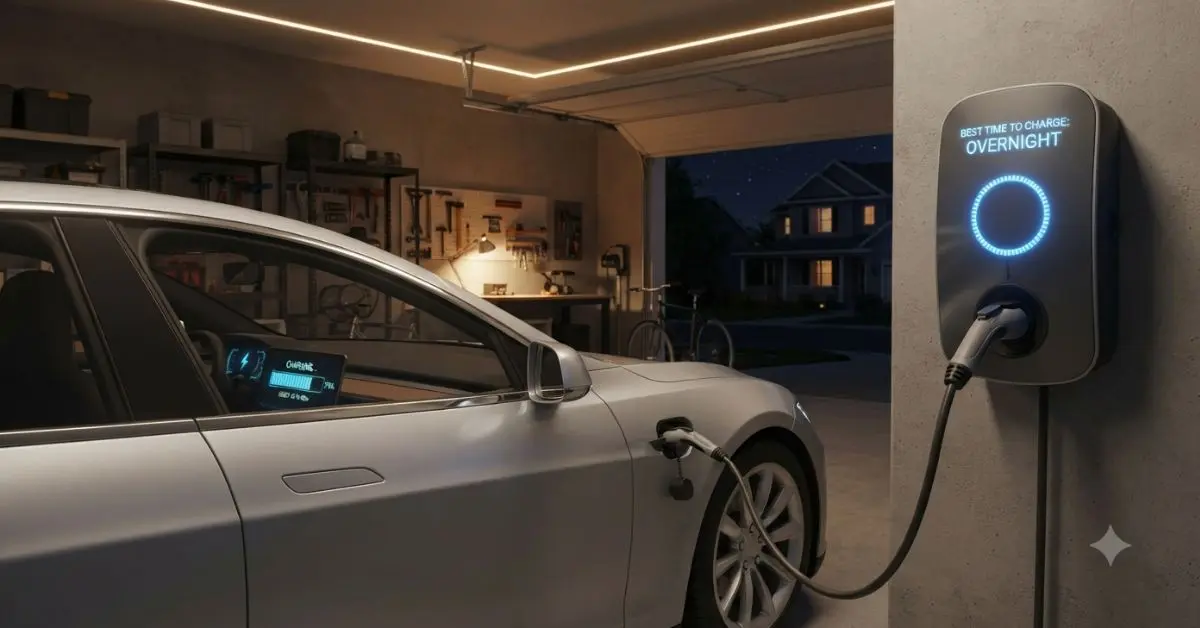
Charge your electric vehicle (EV) at home overnight, ideally between 11 p.m. and 7 a.m. This schedule saves money through lower off-peak electricity rates. It also protects your battery from extreme temperatures and ensures your car has a full charge for your morning trip.
If you have a Time-of-Use (TOU) electricity plan, overnight charging cuts costs by 30% to 50% compared to daytime rates. Follow this guide to help you manage your EV charging schedule effectively.
Why Overnight Charging Is Best
| Factor | Overnight (11 pm–7 am) | Daytime (9am–5pm) | Evening Peak (4–9pm) |
|---|---|---|---|
| Electricity rate (TOU plan) | Lowest — off-peak | Mid-range | Highest — peak |
| Grid stress | Minimal — good for the environment | Moderate | High — worst for grid |
| Battery temperature | Cooler — better for longevity | Warmer in summer | Moderate |
| Ready for departure? | Yes — finishes before morning | Maybe | Yes — but at peak rate |
| Cost saving vs daytime | 30–50% cheaper (TOU plan) | Baseline rate | 30–50% more expensive |
Understanding Time-of-Use (TOU) Electricity Rates
Time-of-Use (TOU) pricing charges different rates for electricity based on the time of day. Most utility companies charge the most during peak hours from 4 pm to 9 pm. They charge the least during off-peak hours from 11 pm to 7 am. Many utility companies offer special EV plans with lower overnight rates. These rates can be as low as $0.07 per kWh and as high as $0.12 per kWh. This is much cheaper than the $0.25-$0.45 per kWh you pay during peak times.
California’s CARE EV-A rate plan offers rates as low as $0.07 per kWh at night. Florida’s FPL EV plan lowers costs significantly after 11 pm. Some markets in Texas even offer free electricity at night for EV owners. Check your utility company’s website or call their EV program line to find available plans. Choosing the right plan helps you lower your home charging costs the most.
How to Schedule Overnight Charging
There are two ways to schedule overnight charging — through your car’s built-in settings or through your smart charger’s app. Both methods work equally well. The key is ensuring charging finishes just before your departure time rather than at midnight — a freshly charged battery is slightly warmer and more efficient than one that finished hours ago.
Schedule Charging Through Your EV
In your car (most EVs): Go to Settings → Charging → Scheduled Charging. Set your departure time (e.g., 7:30 am). The car calculates when to start charging so it reaches your set limit just before departure.
Schedule Charging With a Smart Charger App
ChargePoint, JuiceBox, Emporia, and most smart wallboxes allow scheduling in the app. Set a start time of 11 pm or a finish time of 7 am.
Use Your Utility’s Smart Charging Program
Some utilities remotely manage charging through connected chargers. Enrolling gives you automatic off-peak charging and, in some cases, additional rebates for helping balance the electrical grid.
What If You Don’t Have a TOU Plan?
Overnight charging helps your battery stay healthy because it stays cooler than charging during a hot afternoon. It also keeps your car cabin comfortable when you leave in the morning. Additionally, charging at night prevents you from overloading your home’s electrical circuits when other appliances are running.
You will not save much money on your electricity bill unless your utility company has Time-of-Use (TOU) pricing. These plans charge different rates depending on the time of day. Ask your utility company if they offer special rates for electric vehicle owners.
Saving Money on TOU Charging Plans
Most Time-of-Use (TOU) plans charge the highest rates between 4 p.m. and 9 p.m. These prices are often two to three times higher than off-peak rates. During this time, the electrical grid faces high demand, many homes use multiple appliances, and solar panels stop producing energy.
Charging during this window can double your monthly costs. If you arrive home and plug in at 6 p.m., set your car or charger app to start at 11 p.m. instead. This simple delay helps you avoid expensive peak prices.
Special Cases: When to Charge at Non-Standard Times
Charging an EV With Solar Panels
Charge during peak solar production hours (10 am–3 pm) to use free solar energy. Your EV can store excess electricity that would otherwise be exported to the grid at lower rates.
Charging Before a Road Trip
Charge the battery to 100% the night before a long journey. Set the charging schedule so the battery reaches full charge shortly before you leave.
Emergency Charging
If you need to drive immediately and your battery is low, charge your EV right away. Paying a higher electricity rate is better than running out of battery power.
Conclusion
The best time to charge your EV at home is overnight between 11 p.m. and 7 a.m. You should set your charger to finish 30 to 60 minutes before you leave in the morning. Using a Time-of-Use (TOU) electricity plan during these hours saves you 30% to 50% on costs. This can save a typical driver $15 to $30 each month.
To make charging automatic and cheap, set a departure time in your car or your smart charger app. You should also sign up for your utility company’s EV rate plan. Avoid charging during the 4 p.m. to 9 p.m. peak window unless you absolutely need the power.
FAQs
Is it cheaper to charge an EV overnight?
Yes. On most Time-of-Use (TOU) electricity plans, overnight charging uses off-peak rates that can reduce charging costs by 30–50% compared to peak hours.
Should I charge my EV every night?
If you drive daily, charging overnight is a convenient way to keep your battery ready. However, only charge as much as you need and follow your vehicle manufacturer’s recommended charge limit for daily use.
Can I save money by charging my EV with solar panels?
Yes. If you have rooftop solar, charging between 10am and 3pm lets you use your own solar electricity instead of buying power from the grid.
