
Jeep Avenger Electric Battery: Complete Guide

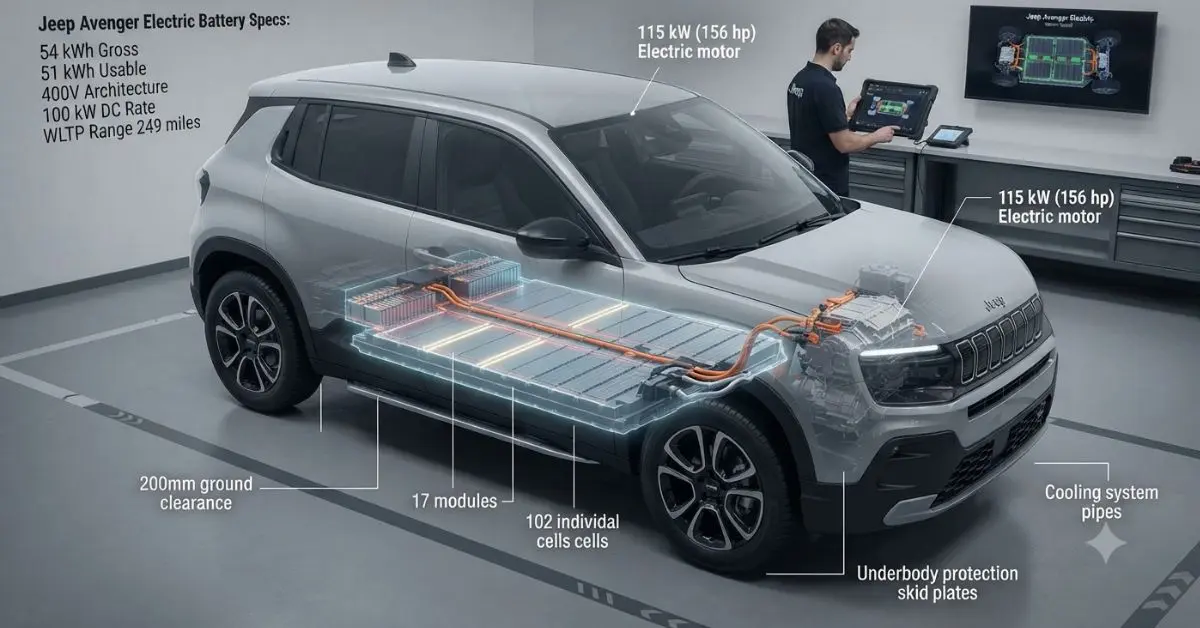
The Jeep Avenger Electric uses a 54 kWh NMC lithium-ion battery. This battery has 51 kWh of usable power. Other cars, such as the Alfa Romeo Junior Elettrica, Vauxhall Mokka Electric, and Peugeot e-2008, use the same battery. A 156-hp motor drives the front wheels and provides a range of 248–249 miles. You can charge the battery from 20% to 80% in about 27 minutes using a 100 kW DC fast charger. The car also includes an 11 kW onboard AC charger.
Jeep launched the Avenger Electric as its first fully electric vehicle. By July 2025, customers in Europe had purchased a total of 200,000 Avenger models. At the initial launch, Jeep included a heat pump as a standard feature. However, the company made the heat pump a £500 option in 2025 to help lower the car’s base price
Jeep Avenger Electric Battery: Full Specs
| Specification | Detail |
|---|---|
| Battery capacity (gross) | 54 kWh NMC |
| Battery capacity (usable) | 51 kWh (50.8 kWh) |
| Battery modules | 17 modules, 102 cells |
| Architecture | 400V (CMP platform) |
| WLTP range | 248–249 miles |
| Motor power | 115 kW (156 hp) FWD |
| Torque | 260 Nm |
| 0–62 mph | 8.7 sec (Sport mode) |
| Top speed | 93 mph (150 km/h) |
| Peak DC rate | 100 kW |
| 20–80% DC time | ~27 min |
| AC onboard charger | 11 kW standard |
| Full charge (7 kW) | ~8+ hours |
| Heat pump | £500 option (standard pre-2025) |
| Ground clearance | 200 mm |
| Euro NCAP | 3 stars (2024) |
| Starting price (UK) | ~£29,995 |
The Avenger Electric Battery Design
The Avenger Electric uses the same 54 kWh CMP battery as five other Stellantis electric vehicles. Stellantis developed and built this battery in-house. Engineers tested it for more than 1.6 million miles before the car launched.
Stellantis places the battery cells under the front and rear seats and through the center of the car. The company protects the battery with 200mm of ground clearance and strong underbody plates. This design keeps the cabin floor flat, so passengers still have plenty of room.
Jeep Avenger Electric Features
The Avenger Electric retains many tough off-road features even though it uses only front-wheel drive. Its 200mm ground clearance, protective underbody skid plates, and specific approach and departure angles set it apart from city cars like the Citroën ë-C3. These features come from Jeep’s long history of making SUVs.
The My Terrain selector helps the car handle different surfaces by adjusting its torque, which is the turning power sent to the wheels. Drivers can choose between Snow, Sand, and Mud modes to improve grip. Jeep also added a 4xe hybrid version for drivers who need all-wheel drive to handle rougher ground.
Avenger Electric Charging Speeds
| Method | Power | Avenger Electric (51 kWh usable) |
|---|---|---|
| Level 2 (7 kW) | 7 kW | ~8+ hours full |
| Level 2 (11 kW) | 11 kW | ~5.5 hours full |
| DC Fast (100 kW peak) | 100 kW | ~27 min (20–80%) |
Real-World Range
- With heat pump, 9°C, Normal mode: 3.9 miles/kWh (Electrifying.com) — approximately 199 miles real-world
- Warm weather, mixed roads: 4.9 miles/kWh — approximately 249 miles, matching the WLTP claim closely
- Without heat pump, cold weather: Approximately 170–195 miles — heat pump is now a £500 option; cold-weather buyers should add it
- 3 driving modes: Eco (81 hp, maximum range), Normal (108 hp), Sport (156 hp, full power) — mode selection significantly affects real-world range
Jeep Avenger Safety Rating Review
The Jeep Avenger earned a 3-star safety rating from Euro NCAP in 2024. This score trails most other cars in its class. Experts criticized the automatic emergency braking system and the lack of a warning when doors open as cyclists approach. While the car protects adults well, it does not lead the class in safety.
Families who prioritize safety should consider other options. The Renault 4 earned 5 stars, and the VW ID. Polo expects a 5-star rating. Both cars offer better safety results for a similar price.
Jeep Avenger Electric Warranty and Battery Performance
Jeep covers the Jeep Avenger Electric battery with an 8-year or 100,000-mile warranty. This warranty protects you if the battery capacity drops below 70%. The vehicle itself comes with a 3-year or 60,000-mile warranty.
Stellantis fleet data show that this battery loses about 2% to 2.5% of its charge capacity each year. This battery uses a common chemistry and management system found in five other Stellantis vehicles. As of 2026, engineers understand this battery pack very well.
Jeep Avenger Electric vs Competitors
| Model | Battery (Usable) | WLTP Range | DC Rate | Euro NCAP | Starting Price (UK) |
|---|---|---|---|---|---|
| Jeep Avenger Electric | 51 kWh NMC | 249 miles | 100 kW | 3 stars | ~£29,995 |
| Vauxhall Mokka Electric | 51 kWh NMC | 252 miles | 100 kW | Not rated | ~£31,680 |
| Leapmotor B10 (67.1 kWh) | 67.1 kWh LFP | 270 miles | 168 kW | 5 stars | £29,995 |
| Renault 4 E-Tech (52 kWh) | 52 kWh NMC | 247 miles | 100 kW | 5 stars | £23,445 (after grant) |
Conclusion
The Jeep Avenger Electric uses a 51 kWh battery from Stellantis. This battery gives the car a range of 249 miles based on WLTP testing. You can charge it from 10% to 80% in 27 minutes using a DC fast charger. As Jeep’s first fully electric car, it uses the same platform as the Alfa Romeo Junior Elettrica and Vauxhall Mokka Electric.
Some downsides exist for this model. A heat pump now costs £500 extra. Also, the car received a 3-star safety rating from Euro NCAP. Meanwhile, the Renault 4 costs £6,500 less and holds a 5-star safety rating.
In 2026, the Avenger still appeals to buyers who love the Jeep brand. It offers 200mm of ground clearance and special driving modes for rougher paths. These features, combined with the classic Jeep look and a price under £30,000, make it a strong choice.
