
Essential EV Battery Thermal Management System

Have you noticed your electric car feels slow on a cold winter morning? Or does its range drop quickly during a summer heatwave? This happens because of your car’s battery temperature.
Most electric cars are powered by lithium-ion EV batteries, which can be sensitive in certain conditions. These batteries perform optimally in an environment that is neither hot nor cold—it’s like their comfort zone. Notably, different chemistries respond to heat and cold in distinct ways — for example, LFP handles high temperatures better than NMC but is more affected by cold. For a deeper look at how the two main battery types handle thermal stress, see this comparison of LFP and NMC battery behavior.
The Battery Thermal Management System, or BTMS, helps with this. You might not see it advertised, but this system works hard behind the scenes. It’s like a special climate control just for your car’s battery.
Why is this important? Maintaining the battery at the proper temperature is crucial for three main reasons:
1. Performance: Getting the power and range you expect.
2. Safety: Preventing dangerous overheating situations.
3. Lifespan: Making sure your expensive battery lasts as long as possible.
In this guide, we’ll dive into the world of EV battery thermal management systems. We’ll explore why temperature is such a big deal for lithium-ion batteries, look at the different types of BTMS used in EVs today, from simple air cooling to advanced liquid systems, and discuss what the latest advances in battery cooling and heating mean for the future of electric driving.
The Battery “Goldilocks Zone”: Not Too Hot, Not Too Cold
Just like Goldilocks looked for the perfect porridge, your electric vehicle (EV) battery has an ideal temperature range. In this range, it works best.
Experts say this ideal temperature is between 15°C and 35°C (60°F to 95°F). Some sources, like Thermtest, even suggest peak performance is often between 20°C and 30°C (68°F to 86°F). A research paper from MDPI states that keeping these batteries between 12°C and 37°C is essential for top performance.
Why this specific range? It’s all about the battery’s internal chemistry. Within this “Goldilocks zone,” the chemical reactions that store and release energy happen most effectively and safely.
But what happens if the temperature goes outside this ideal range? Let’s find out:
When it’s Too Hot:
- Faster Aging: Heat speeds up chemical reactions that degrade the battery. Think of food spoiling faster in the sun. Your battery loses capacity and power over time.
- Shorter Lifespan: This faster aging directly shortens the battery’s overall life.
- Safety Risks: Too much heat can cause a dangerous chain reaction called thermal runaway. This can lead to fires or explosions. Good cooling is crucial to prevent this.
- Lower Efficiency: More energy can turn into wasted heat. This reduces overall efficiency.
When it’s Too Cold:
- Slow Performance: Chemical reactions significantly slow down in cold temperatures, which prevents the battery from providing power quickly. This leads to slower acceleration and a sluggish feeling.
- Slower Charging: The battery cannot accept a charge as quickly. Charging times become much longer in freezing temperatures.
- Reduced Range (Temporary): When cold, the battery cannot access all its stored energy, temporarily reducing driving range.
- Risk of Damage: Charging a very cold lithium-ion battery (especially below freezing) can damage it. Lithium metal can build up on the anode surface, causing permanent damage.
Therefore, a primary goal of any Battery Thermal Management System (BTMS) is not just to cool things down, but to actively manage the temperature to ensure the entire battery pack remains in its optimal operating range. Another critical job is ensuring temperature uniformity, keeping all the individual cells within the pack at roughly the same temperature.
Where Does Battery Heat Come From?
Batteries don’t work well when they get too hot. But where does this heat come from, even when it’s not hot outside?
Joule Heating (Resistance Heating)
This is the biggest reason for heat. When electricity flows through the battery (while charging or using it), parts inside the battery resist this flow. The key components are electrodes, electrolyte, and connectors. Resistance converts some electricity into heat. The more electricity that flows (like during fast acceleration or fast charging), the more heat the battery generates.
Entropic Heat (Heat From Chemical Reactions)
This heat comes from the chemical changes as lithium moves in and out of the battery materials. Depending on the battery’s makeup and how much charge it has, these reactions can create a little more heat or even cool the battery slightly. However, Joule heating usually produces much more heat.
Types of Battery Thermal Management Systems
So, how do EVs actually manage this crucial temperature balancing act? Engineers utilize different types of Battery Thermal Management Systems (BTMS). We can broadly group these into three main categories:
Passive Cooling Systems: These systems don’t use any extra power to operate. They rely on natural processes and clever material choices to dissipate heat.
Active Cooling Systems: These are the workhorses. They use components like pumps, fans, or compressors to actively move heat away from the battery or bring heat to it.
Hybrid Cooling Systems: As the name suggests, these combine elements of both passive and active systems, aiming to get the best performance and efficiency.
1. Passive Cooling Strategies: Simple But Limited
Passive cooling systems are simple and attractive because they are lighter, cheaper, and do not use extra energy from the battery. However, their cooling power is often limited. Common passive cooling methods include natural convection/radiation, heat sinks and fins, heat pipes/vapor chambers, and phase change materials (PCM).
2. Active Cooling Strategies
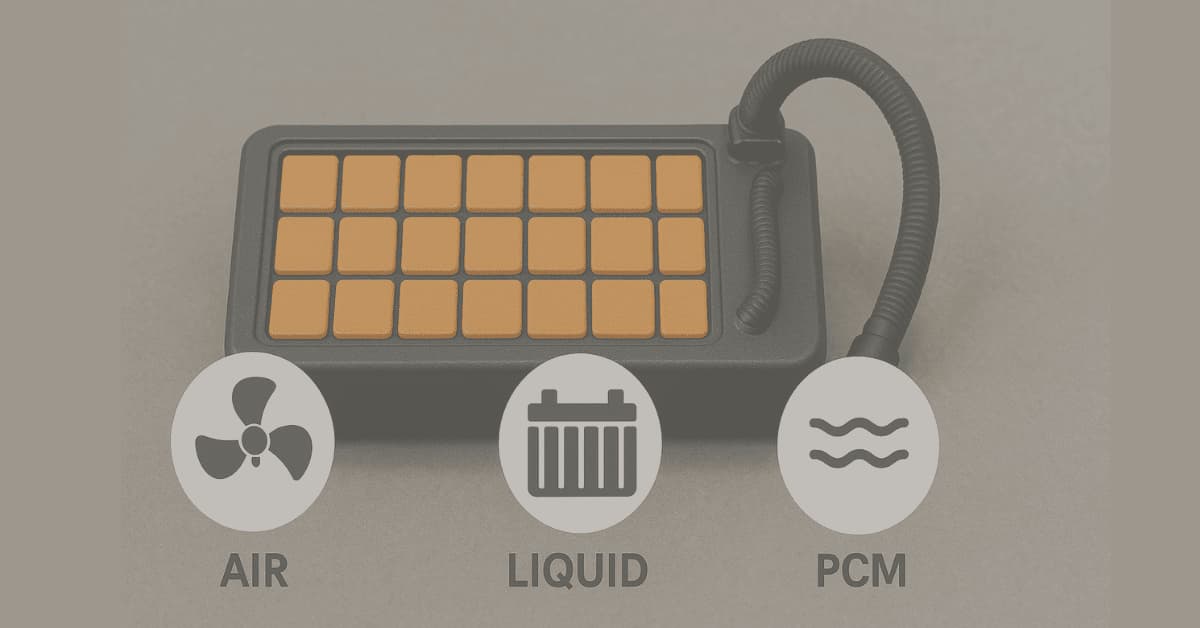
High-performance electric vehicles (EVs) need active cooling. This is especially true for EVs with big battery packs and fast charging. The main types include air cooling, liquid cooling (most common in today’s EVs), and refrigerant cooling.
3. Hybrid Cooling Systems: The Best of Both Worlds?
No single cooling method works perfectly everywhere. So, engineers are now using hybrid cooling systems more often. These systems combine the best parts of different cooling technologies — for example, PCM combined with liquid cooling to handle peak heat loads while maintaining even temperature distribution.
The Brains Behind The Operation: BMS And Thermal Control
A sophisticated Battery Thermal Management System (BTMS) doesn’t operate in isolation. It’s controlled by the overarching Battery Management System (BMS) – the central computer for the battery pack.
Conclusion
Thermal management systems for electric vehicle (EV) batteries are very important. They are not just simple cooling systems. These complex systems directly affect how an EV works. They impact how far it can travel, how fast it can charge, and how long its expensive battery will last. The most important aspect is that they guarantee the safety of the battery.
Simple cooling systems exist, but modern EVs need stronger, smarter systems. These often combine different technologies, which are always improving. Future battery temperature control systems will be even smarter and more efficient, leading to even better electric vehicles.
