
What Is a 400V vs 800V EV Battery Architecture?

Voltages and charging figures are taken from manufacturer specifications and owner’s manuals, EPA certification filings and instrumented charging tests.
Almost every EV on sale belongs to one of two electrical families — and the family decides how fast it can charge, not how far it can go. Voltage class has nothing to do with battery size or range: a big 400V pack out-ranges a small 800V one. What the class changes is the plumbing — how much power can move through cables, motors and chargers before current, and the heat that comes with it, becomes the limit. This guide explains what the labels really mean (the numbers are not what they seem), what the difference is worth at a charger, what happens when the two worlds meet, and which cars sit in which camp.
Quick answer
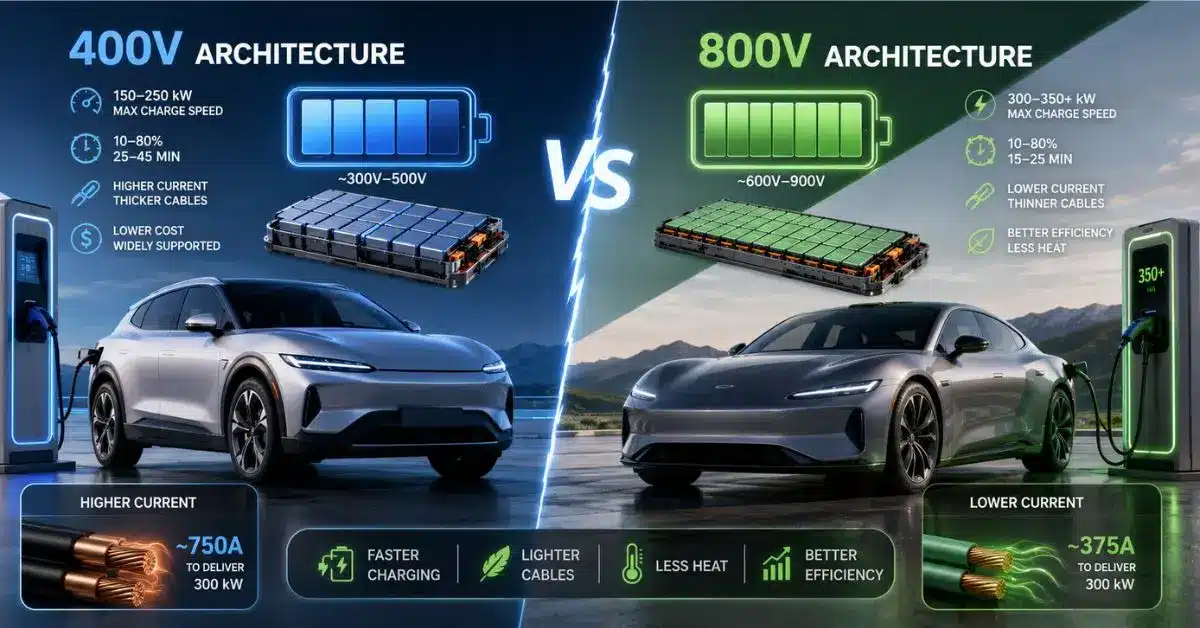
“400V” and “800V” are class labels, not exact voltages. A 400V-class pack actually runs about 300–500 volts (a Tesla Model Y’s nominal is roughly 360V); an 800V-class pack runs about 600–900 volts. The higher class exists for one main reason: at the cable currents chargers can deliver, double the voltage means roughly double the charging power — which is why 800V cars like the Hyundai Ioniq 5 can charge 10–80% in about 18 minutes.
Key figures:
Cable limit arithmetic: 500 A × 400V = 200 kW · 500 A × 800V = 400 kW · Fastest 800V stops: ~18–22 minutes (10–80%) · Most EVs sold today are still 400V class
What “400V” and “800V” actually mean
What does a 400V car actually run at?
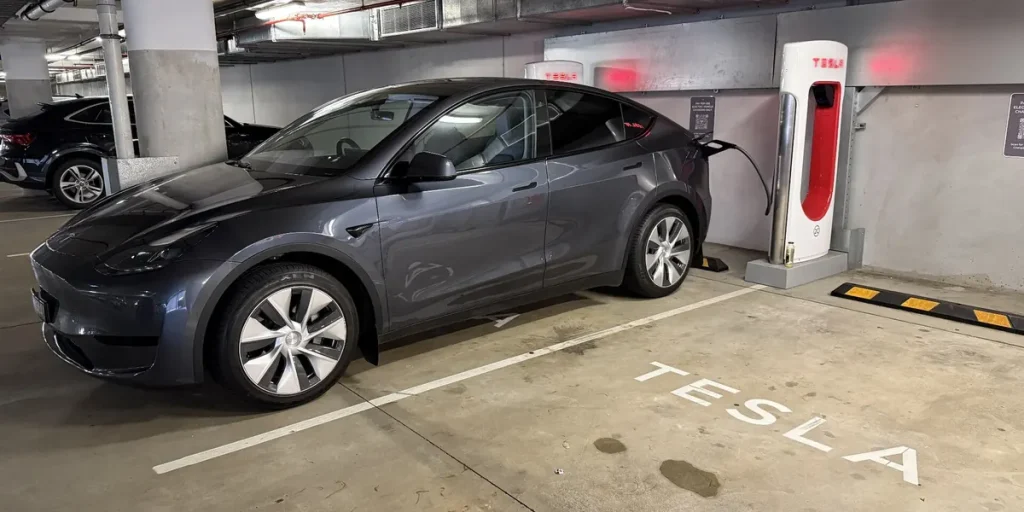
Neither number is the voltage of any real battery — both are class names for a range, quoted at the pack’s nominal (mid-charge) point. A lithium-ion cell’s voltage rises as it charges, so a pack’s voltage is a window, not a fixed number. A 400V-class car runs roughly 300–500 volts — Tesla’s owner’s manual gives the Model 3 and Model Y a nominal 355–360 volts, and most rivals sit in the same band.
What does an 800V car actually run at?
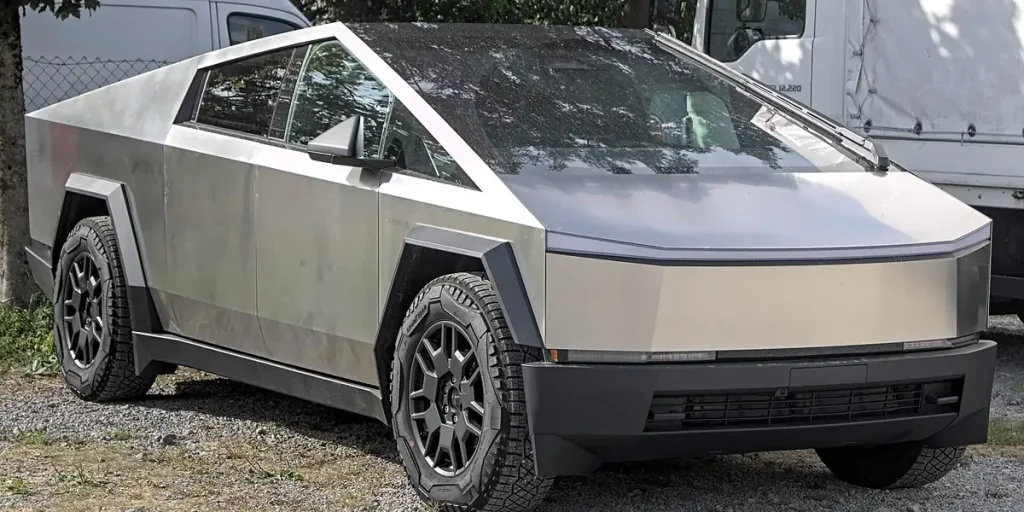
An 800V-class car runs roughly 600–900 volts: the Taycan’s larger pack is about 723V nominal, running 610–835 across its window; Hyundai-Kia’s E-GMP platform is rated 697V; the Cybertruck’s nominal is 816V per its EPA certification filing; and Lucid’s 800V-class pack has a window topping near 924V, marketed as “900V+” — the top of the window, not the middle.
How do the cells add up?
The arithmetic behind the classes is cells in series. At roughly 3.7 volts per cell, a 400V-class pack strings about 96–108 cells in series; an 800V-class pack strings about twice as many — 192 in the E-GMP pack, 198 in the Taycan’s. Everything downstream — motor, inverter, cables, charger — is then built for that voltage class.
The physics: why voltage matters
Charging power is voltage times current (P = V × I) — so at the same current, doubling the voltage doubles the power. Current is the constrained half of that equation: the cables and connectors of a DC fast charger top out around 500 amps before they need liquid cooling, and resistive heat rises with the square of current (I²R). Deliver the same power at half the current and the losses fall to a quarter — that is the whole case for 800V: more power through the same hardware with less heat, letting a car hold its peak rate longer.
The cable arithmetic that runs this whole subject: at the ~500-amp practical cable limit, a 400V car can take about 200 kW, an 800V car about 400 kW — the charger’s voltage ceiling, not the car alone, decides which you get.
The two classes side by side
Same job, different plumbing — here is the honest comparison, including the places where 800V does not help.
| 400V class | 800V class | |
|---|---|---|
| Actual pack voltage | ~300–500V (nominal ~350–400V) | ~600–900V (nominal ~700–825V) |
| Cells in series | ~96–108 | ~192–198 |
| Typical DC peak | 100–250 kW | 225–350 kW |
| Best 10–80% times | ~25–35 minutes | ~18–22 minutes |
| On a 400V-only charger | Native — full speed | Needs boost hardware; sometimes capped (see below) |
| Components | Cheaper, mature, widely available | Silicon-carbide inverters, costlier insulation and parts |
| Cars | Most EVs: Tesla 3/Y, VW ID.4, Ford Mach-E, Rivian, Mercedes EQE/EQS | Hyundai/Kia E-GMP, Porsche Taycan, Audi e-tron GT, Tesla Cybertruck, Volvo EX90 (2026) |
Charging speed in the real world
How fast do the best 800V cars charge?
On a charger that can feed them, the best 800V cars finish a 10–80% stop in about 18–22 minutes — the best 400V cars need roughly 25–35. Hyundai and Kia’s E-GMP cars quote 10–80% in about 18 minutes, peaking at 239 kW originally and 260 kW in the facelifted Ioniq 5; the facelifted Taycan peaks at 320 kW; and the Volvo EX90 for 2026 quotes 350 kW and 22 minutes.
What do the best 400V cars manage?
The strongest 400V cars — the Tesla Model 3 and Model Y — peak at 250 kW, and most 400V rivals sit well below that.
What hides inside the headline times?
Two conditions sit behind the headline figures. First, the charger has to deliver both the voltage and the current — a 150 kW post halves an E-GMP car’s speed. Second, a peak is a peak: what matters is the average across the 10–80% window, and that is where 800V cars’ flatter charging curves help.
When an 800V car meets a 400V charger
How do Hyundai and Kia boost 400V?
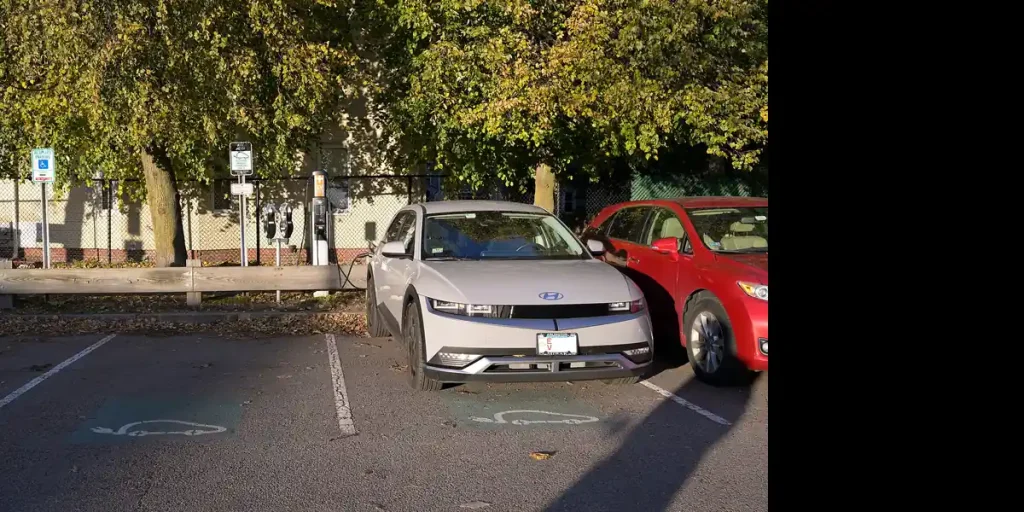
Every 800V car can charge on older infrastructure — but how, and how fast, depends entirely on the brand’s trick. Hyundai and Kia fit no separate converter: on E-GMP cars the rear motor and its inverter double as the boost converter, stepping 400V up to pack voltage.
What does Porsche’s booster do?
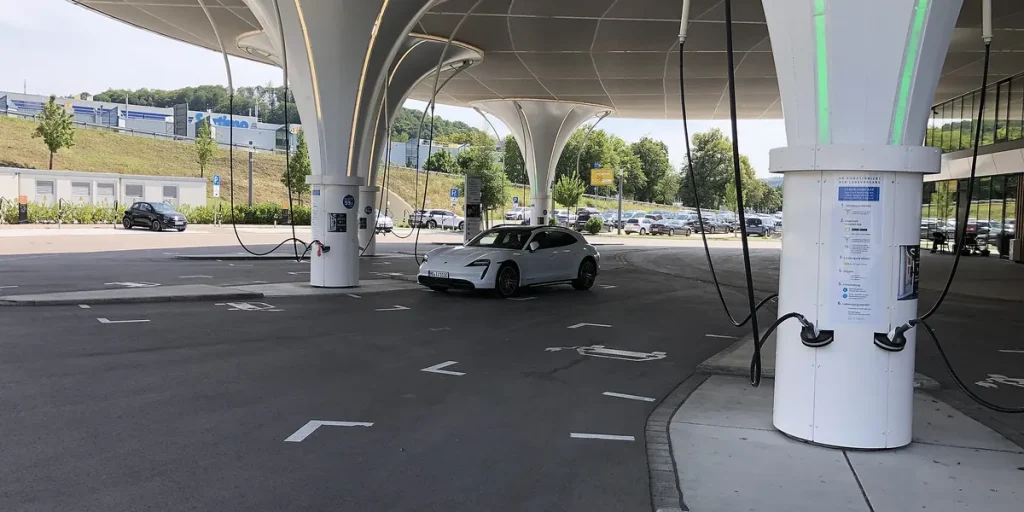
Porsche gives the Taycan a dedicated charge booster — 2020–24 cars were limited to 50 kW unless the optional 150 kW booster was fitted; from the 2025 facelift the 150 kW converter is standard.
What about Tesla, Lucid and the CLA?
Tesla splits the difference literally: the Cybertruck’s pack divides into two ~400V halves for older chargers and recombines for 800V ones. The limits are real: at Tesla V3 Superchargers, whose cabinets top out around 500 volts, tested E-GMP cars cap at roughly 97 kW (EV6) to 126 kW (Ioniq 5, Ioniq 9, EV9), and Lucid’s own documentation caps the Air at 50 kW on ~400V Superchargers. One brand skipped the trick entirely: the Mercedes CLA launched in parts of Europe with no 400V DC charging at all, a reminder that “800V cars can use 400V chargers” is a per-model question, not a rule.
Which EVs use which class?
The question readers actually ask, answered model by model — including the cars that are neither.
- 400V class: Tesla Model 3 and Model Y (~360V nominal), Model S and X, Volkswagen ID.4 and ID. Buzz, Ford Mustang Mach-E, Rivian R1T and R1S, Chevrolet’s Ultium cars, and Mercedes’ EQE and EQS (396V rated, 200 kW maximum — even the AMG EQS 53; the 800V EQS arrives only with its 2027 facelift).
- 800V class: Hyundai Ioniq 5 and 6, Kia EV6 and EV9, Genesis GV60, Porsche Taycan and Audi e-tron GT, their PPE-platform successors (Audi Q6 e-tron, Porsche Macan Electric — in production since 2024), the Tesla Cybertruck (816V), Volvo’s EX90 from model year 2026, and BMW’s Neue Klasse cars starting with the new iX3 (400 kW peak).
- Above the label: Lucid’s Air and Gravity run an 800V-class pack whose window reaches ~924V.
- And one genuine hybrid: GM’s Hummer EV and Silverado EV packs are two ~400V layers that drive as 400V but connect in series to charge at 800V and up to 350 kW.
Benefits beyond charging
What gets lighter?
The honest list is shorter than the marketing list — and part of the credit belongs to silicon carbide, not voltage. Higher voltage at the same power means lower current everywhere, so cables and busbars can be thinner and lighter, and resistive losses fall — real gains, but measured in kilograms and single-digit percentages, not in added range.
What do drivers feel?
What drivers feel is sustained performance: less heat lets an 800V car hold high charge rates and repeat hard acceleration with less power fade.
Who deserves the efficiency credit?
The efficiency gains usually credited to 800V arrive largely because 800V systems are built with silicon-carbide inverters, whose lower switching losses would help a car of either class — the two technologies simply tend to be specified together. Voltage alone does not add range: range is battery size and efficiency, and the longest-range EVs on sale include 400V cars.
Why 400V still dominates
How big is 800V, really?
Because it is cheaper, proven, and good enough for how most people charge — most EVs sold are still 400V class. Industry estimates put 800V at roughly 12% of global EV sales in 2025.
Why does cost decide it?
The reasons are economic: 400V components come from a mature, competitive supply chain, while 800V demands silicon-carbide semiconductors and higher-grade insulation that cost more per car.
Has the network caught up?
The infrastructure argument has also flipped: most public fast chargers installed in the last few years already output up to 800–1,000 volts, so the network no longer holds 800V cars back — the purchase price does. For a car that charges at home overnight and fast-charges a few times a year, the class difference is nearly invisible in use.
Does 800V degrade slower?
No — voltage class is not a battery-lifespan factor, whatever the forum posts say. Battery degradation is driven by heat, time spent at high charge levels, charge throughput and chemistry. An 800V car does generate less resistive heat at a given charging power, which is kinder during a fast-charge session, but its cells see the same voltages per cell as any other pack — the pack voltage comes from how many cells are strung together, not from stressing each one harder or softer. Buy on chemistry, warranty and charging habits, not on voltage class.
The future
Which platforms have already moved?
800V is becoming the default for new platforms — arriving model by model, not as a switch the industry flips. The confirmed moves: BMW’s Neue Klasse (800V, from the new iX3), Mercedes’ MMA platform (the CLA, 800V), Volvo’s EX90 (800V from model year 2026), and VW Group’s PPE (800V in production since 2024) — while Hyundai and Kia continue with E-GMP’s successors and Tesla stays split, Cybertruck at 800V and the high-volume cars at 400V.
What comes next?
Above the class, BYD’s 1,000-volt Super e-Platform (China, March 2025) shows where the ceiling moves next. Expect the mass market to follow as silicon-carbide costs fall; expect today’s 400V cars to charge happily for their whole lives, because the network serves both.
Frequently asked questions
Is 800V better than 400V?
For fast charging, yes — on a charger that can feed it, an 800V car typically finishes a 10–80% stop in about 18–22 minutes against 25–35 for a good 400V car. For range, efficiency and battery life the difference is small to none, and 400V cars cost less to build and buy.
Can an 800V car use a 400V charger?
Yes, with built-in boost hardware — Hyundai and Kia use the rear motor and inverter, Porsche a charge booster (150 kW standard from 2025), Tesla a split pack in the Cybertruck — but speeds can be capped: roughly 97–126 kW for E-GMP cars at Tesla V3 Superchargers, and 50 kW for a Lucid Air. Check your model’s figure; a few cars (the European-launch Mercedes CLA) cannot use 400V DC chargers at all.
Which Tesla models are 800V?
Only the Cybertruck (816V nominal). The Model 3, Model Y, Model S and Model X are 400V class, with nominal pack voltages around 355–400 volts depending on the pack.
Is Rivian 400V or 800V?
400V class. Rivian’s current R1T and R1S run a ~400V-class architecture; the company has discussed higher voltage for future platforms without shipping one.
How many cells are in a 400V battery?
About 96–108 cells in series (at ~3.7 volts each) form the 400V string; an 800V pack strings roughly twice as many, 192–198 in the Hyundai-Kia and Porsche packs. Total cell counts run into the thousands because series strings are paralleled for capacity.
Does 800V charging damage the battery faster?
No. Degradation follows heat, charge level and chemistry, not pack voltage; each cell in an 800V pack works at the same voltage as a cell in a 400V pack. The lower currents of an 800V system actually reduce resistive heating during fast charging.
Will all EVs be 800V eventually?
Most new platforms are moving that way (BMW Neue Klasse, Mercedes MMA, Volvo, VW’s PPE), and China already has a 1,000V platform from BYD. But 400V will remain common in cheaper cars for years, and chargers serve both classes.
Conclusion
400V and 800V are plumbing choices, not quality grades. The higher class buys charging speed and sustained performance where the network can feed it; the lower class buys lower cost and total adequacy for everyone else. Judge a car by its measured charging curve, its battery chemistry and its warranty — the voltage on the spec sheet is only the beginning of that story.
