
How Much Lithium Is Really Inside an EV Battery?

Figures checked against the US Geological Survey’s Mineral Commodity Summaries 2026, the ICCT’s battery-material research, Argonne National Laboratory’s GREET battery data and a 2025 peer-reviewed compilation of lithium content per kWh.
Ask ten websites how much lithium is in an EV battery and you will get answers from 5 kilograms to over 60 — for the same car. The gap is not a scientific disagreement. It is a units error that has been copied from page to page for years, and this guide exists to end it for our readers.
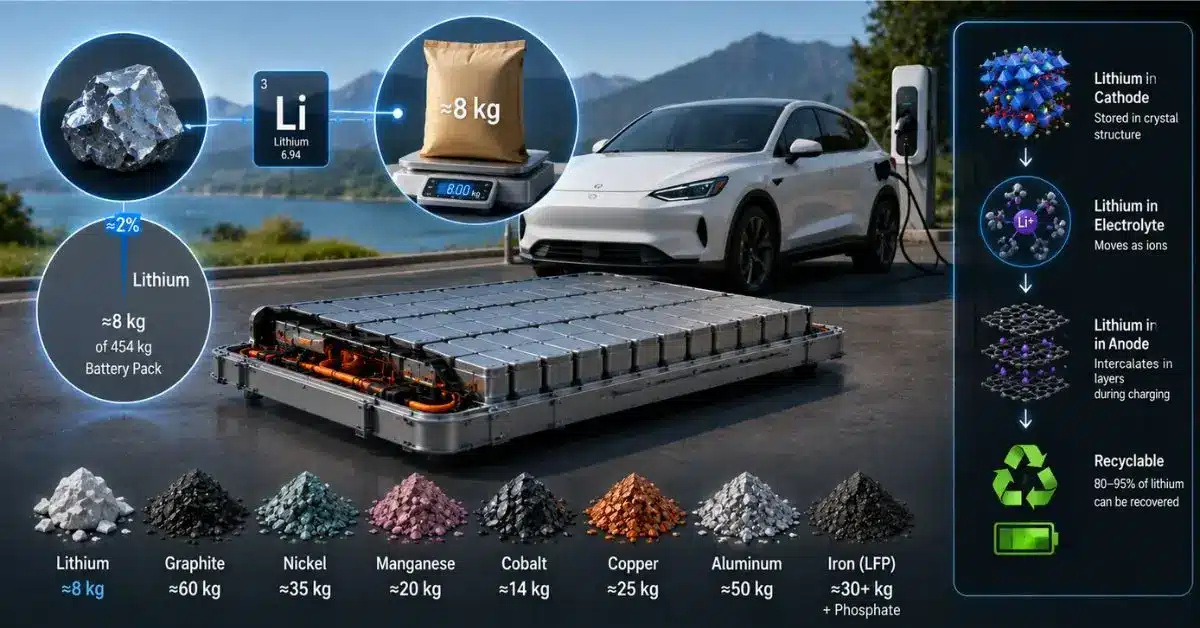
The honest answer is smaller than the headlines suggest. A typical electric car carries about 5 to 8 kilograms of lithium — roughly 1.5% of its battery pack’s weight. Below is where that number comes from, how it changes with battery chemistry and car size, and how to spot the inflated figures when you meet them.
A typical EV battery (60–75 kWh) contains about 5–8 kg of elemental lithium — 0.08–0.12 kg per kWh depending on chemistry (LFP lowest, then NMC and NCA). That is roughly 1.5% of the pack’s weight. Figures of 30–60 kg describe the same lithium counted as lithium carbonate equivalent (LCE), a unit 5.32× larger — not extra lithium.
Key figures: 5–8 kg per typical car · 0.08–0.12 kg/kWh · ~1.5% of pack weight · 1 kg lithium = 5.32 kg LCE
How Much Lithium Is in an EV Battery? The Short Answer in Kilograms
Between 0.08 and 0.12 kilograms per kWh — so the size of the battery and its chemistry decide the total.
Lithium content scales with capacity, which is why every honest answer starts per kilowatt-hour. The figures below come from the ICCT’s battery-material research, and a 2025 peer-reviewed compilation of published intensities lands in the same place:
- LFP (lithium iron phosphate): about 0.08 kg of lithium per kWh
- NMC (nickel manganese cobalt): about 0.09–0.12 kg per kWh
- NCA (nickel cobalt aluminium): about 0.095–0.10 kg per kWh
How the calculation works
Multiply the pack size by the intensity — that is the whole method.
A 75 kWh Long Range pack on a nickel chemistry works out at 75 × 0.09–0.11, so roughly 7–8 kg of lithium. A 60 kWh LFP car works out at 60 × 0.08, so roughly 5 kg. No manufacturer publishes a per-model lithium bill of materials, so every figure in this guide — and every honest figure anywhere — is a calculation of this kind, not a teardown measurement. Any page that gives you a suspiciously precise number (“exactly 11.4 kg”) without showing this arithmetic is guessing.
What percentage of the battery is lithium?
About 1.5% by weight — the rest is cathode metals, graphite, copper, aluminium, steel and electronics.
Take the worked example: a Tesla Model Y Long Range pack weighs about 480 kg, and its calculated lithium content is roughly 6.8–8.3 kg. That is 1.4–1.7% of the pack. Lithium is the lightest metal and the cell only needs a thin seasoning of it — its outsized reputation comes from how essential it is, not how much of it there is.
Why the Numbers You Have Seen Are Wrong: Lithium vs LCE
Most inflated figures are the same lithium weighed in a different unit — lithium carbonate equivalent, 5.32 times heavier.
I was trained in chemical technology, and the first habit that training builds is checking the unit before believing the number. This topic is where that habit pays. Lithium is traded and reported as lithium carbonate equivalent (LCE) — the weight of lithium carbonate that contains the lithium in question. Lithium is only 18.8% of lithium carbonate by mass, so 1 kg of lithium = 5.32 kg of LCE.
The 62.6 kg Tesla is a units error
A Model S holds about 9–10.5 kg of lithium. The famous 62.6 kg figure is an LCE-scale number printed as metal.
The “62.6 kg of lithium in a Tesla” claim appears on the top-ranking page for this search and on dozens of copies. Read as LCE, it converts back to roughly 11–12 kg of lithium — the right neighbourhood. Printed as elemental lithium, it overstates the truth about six times over, and any table built on it (including, until now, this page’s own) inherits the error. When a figure looks five times larger than its neighbours, it is almost always LCE wearing a metal label.
Smaller devices get the same treatment
The “3.3 grams in a phone” figure is a shipping-regulation formula, not a measurement.
Phone and laptop numbers are inflated by a different rule: air-transport rules compute an “equivalent lithium content” of 0.3 grams per amp-hour, a safety metric that was never meant to describe what is physically inside. Measured elemental content is lower — well under a gram to about a gram in a phone, as the comparison section below shows.
How Much Lithium Is in Real Cars?
Real-car figures, calculated from pack size and chemistry — use them as ranges, not gospel.
Car / pack | Chemistry | Lithium (elemental) | The same lithium as LCE |
|---|---|---|---|
Compact LFP car, ~55 kWh | LFP | ≈4.2–5.0 kg | ≈23–27 kg |
Tesla Model 3 RWD, 57.5 kWh | LFP | ≈4.6–5.2 kg | ≈25–28 kg |
Tesla Model Y Long Range, ~75 kWh | NCA/NMC | ≈6.8–8.3 kg | ≈36–44 kg |
Tesla Model S, ~100 kWh | High-nickel | ≈9–10.5 kg | ≈48–56 kg |
Tesla Cybertruck, ~123 kWh | NMC | ≈11–13.5 kg | ≈59–72 kg |
Two things are worth noticing in that table. First, even the largest pack on sale carries only about 13 kg of lithium at the top of its range — the “30–60 kg per car” claims collapse once the unit is fixed. Second, LFP cars sit at the low end per kWh, which surprises readers who have seen the opposite claimed: on the ICCT and peer-reviewed figures, LFP uses slightly less lithium per kWh than NMC or NCA, not more.
What Form Is the Lithium In — and Where Does It Sit?
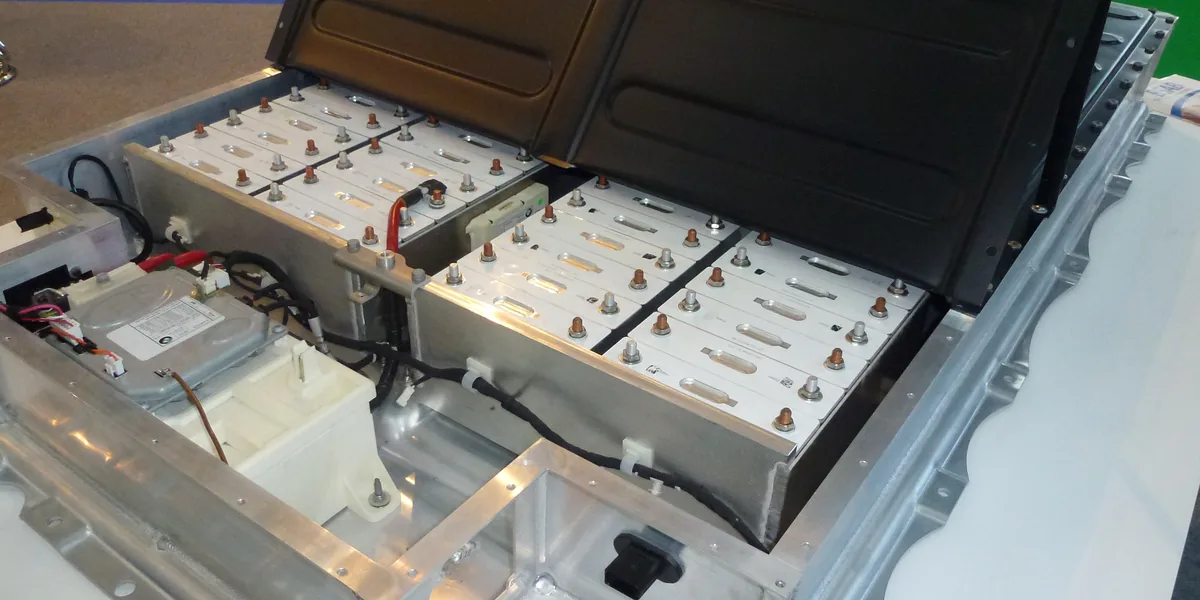
Not as metal. The lithium in a battery is a guest inside other materials — mostly the cathode.
There is no lump of lithium metal in an EV battery (that is the whole point of lithium-ion design). The lithium sits as ions inside compounds: in the cathode material — lithium iron phosphate in an LFP cell, a lithium-nickel oxide in NMC and NCA cells — and, when the battery is charged, much of it has travelled across to lodge inside the graphite anode. Charging and discharging is that shuttle journey, repeated.
Nine-tenths of it is in the cathode
Argonne National Laboratory’s cell bill of materials lets us split the lithium’s hiding places.
The electrolyte does contain a lithium salt (LiPF₆), but the salt is only about 1.3–1.8% of a cell’s mass, and lithium is only 4.6% of that salt. Working through Argonne’s GREET data, the electrolyte therefore holds a few percent of the cell’s lithium at most — roughly nine-tenths or more sits in the cathode. It is also why cathode chemistry, not the liquid in the cell, decides a battery’s lithium content per kWh.
A word on iron, since readers ask
LFP’s cathode is mostly iron phosphate — the iron is real, heavy, and not lithium.
Searchers regularly ask how much iron goes into an EV battery, because the letters are confusing: the “F” story in LFP is iron (Fe). An LFP pack carries tens of kilograms of iron in its cathodes — far more iron than lithium. The two numbers answer different questions; iron sets the pack’s weight, lithium sets its chemistry.
How Does an EV Battery Compare With a Phone or Laptop?
Your car battery holds about as much lithium as several thousand phones — because it is several thousand times bigger.
- Smartphone: roughly 0.3–1 gram of lithium
- Laptop: roughly 4–12 grams
- Lithium AA cell: under 1 gram (a standard alkaline AA contains no lithium at all)
Set against a 75 kWh car pack’s 7–8 kg, one EV battery carries the lithium of approximately 7,000–15,000 smartphones. That ratio is the honest version of the comparison — the per-device figures circulating online (3.3 g for a phone, up to 30 g for a laptop) come from the transport formula described above, not from what is inside the devices.
Where Does EV Lithium Come From?
Australia mines the most; Chile’s salt flats hold the most famous brine; the US imports most of what it uses.
The US Geological Survey’s 2026 edition puts 2025 world lithium production at 290,000 tonnes, up 31% on 2024’s 222,000 tonnes, with batteries taking 88% of all lithium end use. The producer ranking surprises most readers:
- Australia — 92,000 t (hard-rock spodumene mines; the world’s largest producer)
- China — 62,000 t
- Chile — 56,000 t (brine pumped from beneath the Salar de Atacama and evaporated in ponds)
- Zimbabwe — 28,000 t · Argentina — 23,000 t
The United States has real skin in this game but produces little today: USGS lists 4.4 million tonnes of US reserves and about 30 million tonnes of resources, yet domestic output comes from a single Nevada brine operation, and over 2021–24 the US imported 54% of its lithium from Chile and 43% from Argentina. Price tells the recent story on its own: battery-grade lithium carbonate averaged about $63,700 a tonne in 2022 and about $9,000 a tonne in 2025 — the “lithium crisis” pricing has already collapsed. Readers comparing materials can see how lithium fits the wider pack in our guide to what materials are inside an EV battery.

Is There Enough Lithium for All EVs?
On USGS numbers, the resource is not the constraint this decade — mining speed and processing are.
The USGS counts 37 million tonnes of reserves (deposits economic to mine today) and roughly 150 million tonnes of identified resources worldwide. Set against 2025 consumption of about 263,000 tonnes a year, even the conservative reserves figure is large — which is why geologists talk about a build-out problem, not a running-out problem. The “Lithium Triangle” needs correcting while we are here: Chile and Argentina together hold about 37% of world reserves; Bolivia holds large resources (about 23 million tonnes) but no booked reserves, because its brine has not yet proved economic to extract.
Does the Lithium Get Used Up?
No — lithium is carried, not burned, and nearly all of it is still in the pack at end of life.
Unlike petrol, lithium is not consumed by driving. A battery loses capacity over the years because side reactions trap some lithium in place and degrade the materials around it — the lithium itself remains in the pack, which is what makes recycling worthwhile. How much comes back depends entirely on the recycling route:
- Hydrometallurgical plants (chemical leaching) report recovering 85–95% of the lithium under optimised conditions
- Pyrometallurgical smelting recovers under 5% — the lithium is lost into the slag
So the honest recycling answer is a split one: the modern route gets nearly all of it, the old smelting route loses nearly all of it, and the industry is shifting toward the former. What that means for pack economics is covered in our EV battery recycling cost guide.
Frequently Asked Questions
How much lithium is in an EV battery?
About 5–8 kg in a typical 60–75 kWh car battery, worked out from 0.08–0.12 kg of lithium per kWh. Small LFP cars sit near 4–5 kg; the largest packs, around 120 kWh, reach roughly 11–13.5 kg.
What percentage of an EV battery is lithium?
About 1.5% of the pack’s weight. In a ~480 kg Tesla Model Y Long Range pack, the lithium calculates to roughly 6.8–8.3 kg — a small share next to the nickel, graphite, copper and steel that make up most of the mass.
How much lithium is in a Tesla battery?
By model, calculated from pack size and chemistry: Model 3 RWD (57.5 kWh LFP) ≈4.6–5.2 kg; Model Y Long Range (~75 kWh) ≈6.8–8.3 kg; Model S (~100 kWh) ≈9–10.5 kg; Cybertruck (~123 kWh) ≈11–13.5 kg. Tesla does not publish per-model lithium figures, so these are sourced calculations, not Tesla data.
Why do some sites say an EV battery has 50–60 kg of lithium?
They are quoting lithium carbonate equivalent (LCE) as if it were lithium metal. LCE counts the lithium plus the carbonate it would be sold as, and weighs 5.32× more. The widely copied “62.6 kg in a Tesla” figure is this error — the same pack holds about 9–10.5 kg of actual lithium.
Does an LFP battery use more lithium than an NMC battery?
Slightly less, per kWh. The ICCT puts LFP at about 0.08 kg of lithium per kWh against 0.09–0.10 for NMC, and a 2025 peer-reviewed compilation agrees (LFP 0.084; NMC 0.096–0.123). Claims that LFP needs more lithium per kWh are not supported by those sources. Our explainer on what LFP battery chemistry is covers how the chemistry differs.
How much lithium is in a phone battery?
Roughly 0.3–1 gram — about one ten-thousandth of a car battery’s content. The 3.3-gram figure often quoted comes from an air-transport safety formula (0.3 g per amp-hour), not from the phone’s actual contents.
Does the lithium get used up as an EV battery ages?
No. Capacity fades because side reactions gradually trap lithium ions where they cannot shuttle, and other materials degrade — the lithium is still physically in the pack. That is why end-of-life packs are worth recycling rather than treating as spent fuel.
Can the lithium in an EV battery be recycled?
Yes, and the route decides the yield: modern hydrometallurgical plants report 85–95% lithium recovery, while older pyrometallurgical smelting loses almost all of it to slag (under 5% recovered). Most new recycling capacity is being built on the hydrometallurgical route.
Conclusion
A typical EV battery holds about 5–8 kg of lithium — near 1.5% of its weight — and the scarier numbers are a unit conversion wearing a disguise.
Once you know the two honest figures (0.08–0.12 kg per kWh, and 1 kg of lithium = 5.32 kg of LCE), you can check any claim about any car in seconds: multiply the pack size, check the unit, and the myth falls apart on its own. That, more than any single number, is what this page’s title promises — how much lithium is really inside.
