
Do EVs Have a 12V Battery Too?

Built from manufacturer owner’s manuals and service documentation (Tesla, Hyundai, Kia, Ford and GM), NHTSA recall records, GM and Hyundai technical bulletins, and the Which? 2025 owner reliability survey of 63,334 cars.
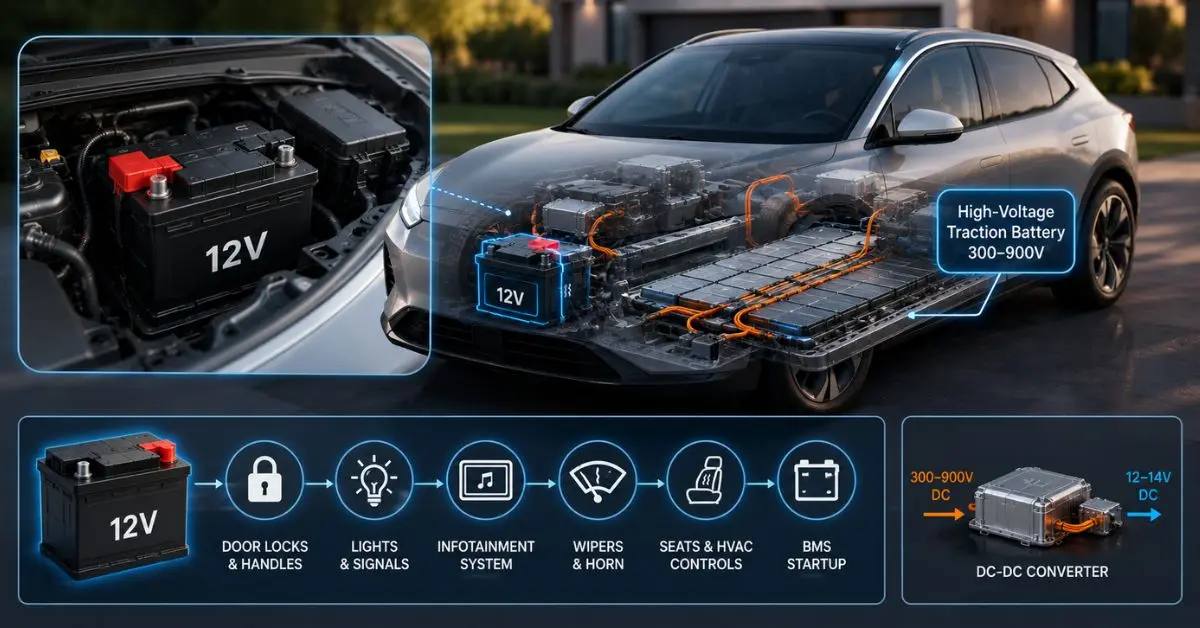
Yes. Almost every electric car on sale runs two batteries: the large high-voltage traction pack under the floor, and a small low-voltage battery — 12 volts on most cars — that wakes the car up and runs its everyday electrical systems. Take the small battery away and the car will not switch on at all, even with a fully charged traction pack, because nothing can close the contactors that connect the big battery to the rest of the car.
Two groups of cars bend the rule, and this guide covers both. Current Teslas replaced the lead-acid 12V battery with a lithium-ion unit that actually runs at about 16 volts, and the Tesla Cybertruck has no 12V battery at all — its low-voltage system runs at 48 volts. Every other EV sold in the United States still uses a conventional lead-acid 12V battery, and everything below — what it powers, how it stays charged, why it is the most common reason an EV ‘dies’, and what replacement involves — is written for that majority first.
Quick answer
Yes — nearly every EV has a small low-voltage battery alongside its traction pack. On most cars it is a conventional 12V lead-acid battery; current Teslas use a lithium-ion unit running at about 16V, and the Cybertruck runs 48V with no 12V battery at all. The small battery powers the car’s computers, locks, lights and safety systems, and it closes the contactors that bring the traction pack online.
Key figures: Typical 12V capacity 35–60 amp-hours on mainstream cars (Tesla’s lithium unit: 6.9 Ah) · Lead-acid lifespan about 3–5 years · Replacement roughly $100–$300 fitted on mainstream cars · Charged by a DC-DC converter from the traction pack — there is no alternator · Covered by the car’s basic warranty, not the 8-year battery warranty
Why Does an EV Need a 12V Battery at All?
A separate low-voltage battery exists because the traction pack is deliberately disconnected whenever the car is off — and something has to power the systems that reconnect it.
Why is the traction pack disconnected when the car is off?
When an EV is parked or switched off, large relays called contactors physically isolate the high-voltage pack from the rest of the car. That isolation is a safety requirement: it keeps 400 to 900 volts away from occupants, technicians and first responders while the car is unattended. The contactors are powered from the low-voltage side, so the small battery has to run the car’s computers and close those relays before the traction pack can supply a single watt.
What runs off the small battery while the car is off?
The same battery also runs everything that has to work while the car is off or in an emergency: door locks and handles, the alarm, lights, the airbag and stability-control electronics, and the computers that perform safety checks before the pack connects. It never drives the wheels — propulsion is entirely the traction pack’s job — but without it the car cannot start the sequence that leads to driving. That is also why the obvious shortcut does not work: accessories cannot simply run off the big pack, because the big pack is switched off precisely when those accessories are needed most.
The most common EV breakdown is a dead small battery. Germany’s ADAC patrol data attributes roughly half of all EV breakdowns to a failed 12V battery — ahead of any fault in the traction pack or motors.
Two Battery Systems in Every EV
The traction pack and the low-voltage battery differ in almost every respect — voltage, size, job and lifespan — and confusing the two causes most misunderstandings about EV batteries.
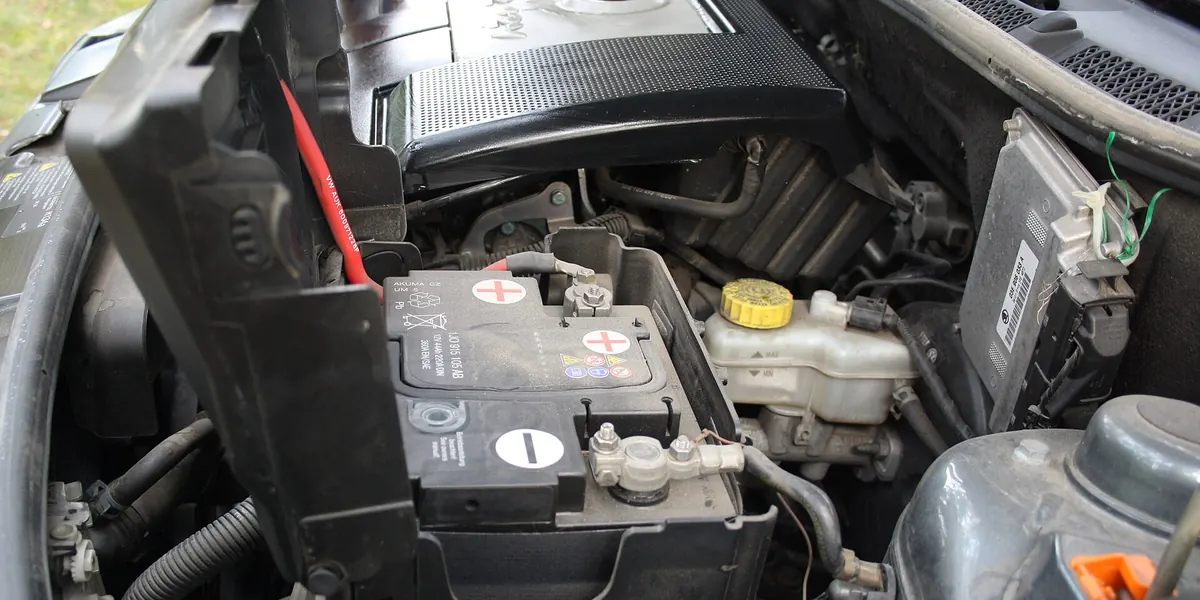
The traction pack is the energy store: hundreds of volts, tens of kilowatt-hours, sealed under the floor and expected to last the life of the car. The low-voltage battery is a service item the size of a shoebox that any auto parts store would recognise. Most EVs carry it under the hood or in the trunk; a few hide it in less obvious places, which matters when it needs replacing.
| Feature | High-voltage traction battery | Low-voltage (12V) battery |
|---|---|---|
| Voltage | 300–900V | 12V (Tesla lithium: ~16V; Cybertruck: 48V) |
| Capacity | 40–120 kWh | About 35–60 Ah lead-acid; Tesla lithium 6.9 Ah; Rivian 18 Ah |
| Job | Drives the motor; powers high-voltage systems | Wakes the car, closes the contactors, runs locks, lights, computers and safety systems |
| Chemistry | Lithium-ion (NMC, NCA or LFP) | Lead-acid on almost every EV; lithium-ion on current Teslas |
| Charged by | Home and public chargers | A DC-DC converter drawing from the traction pack |
| Replacement cost | Five figures if ever replaced out of warranty | Roughly $100–$300 fitted on mainstream cars |
| Service life | Designed for the life of the car | About 3–5 years for lead-acid |
One clarification the table makes necessary: regenerative braking charges the traction pack only. It plays no direct part in charging the 12V battery — the DC-DC converter described next does all of that work, whether the car is driving, charging or, on many models, simply parked.
How the 12V Battery Is Charged
There is no alternator in an EV; a DC-DC converter steps traction-pack voltage down to charge the 12V battery and run the low-voltage systems.
How does the converter charge the 12V battery?
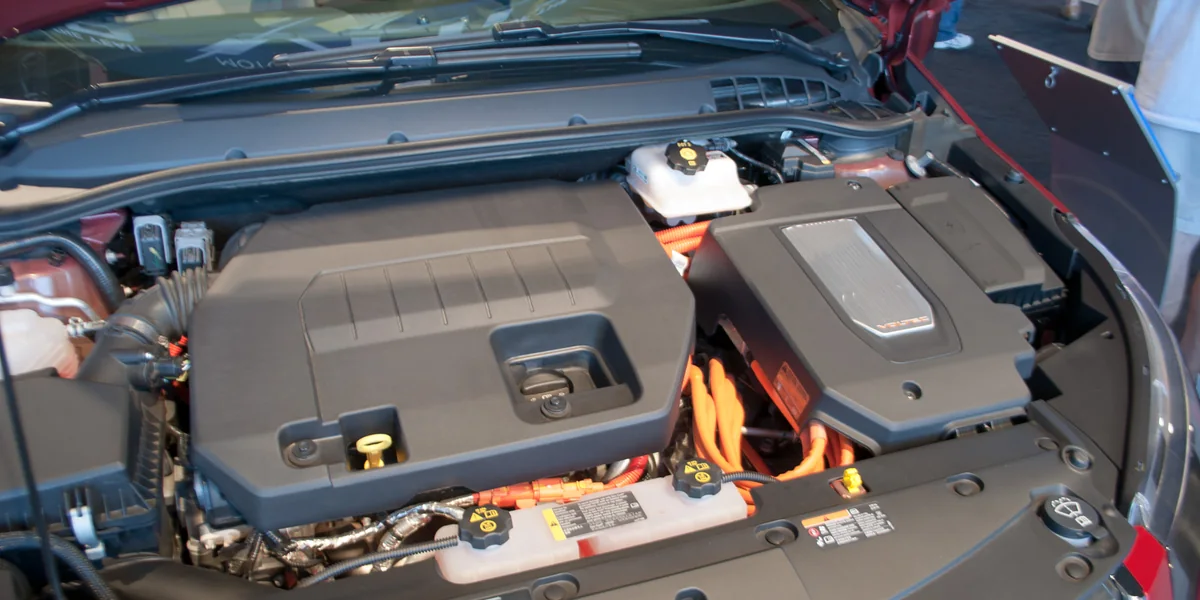
The converter works whenever the car is awake, holding the low-voltage bus at roughly 13 to 14 volts — the same job an alternator does in a gasoline car, done electronically. Kia’s owner’s manual states the arrangement plainly: the auxiliary battery charges automatically whenever the vehicle is in READY mode or the high-voltage battery is being charged. While you drive, the converter can power the 12V systems directly, with the battery acting as a buffer.
Does the 12V battery charge while the car is parked?
Many cars also top the 12V battery up while parked. Hyundai and Kia call it Aux. Battery Saver+, GM builds a similar Battery Maintenance Mode into its EVs, and Rivian wakes its trucks every six to eight hours to check and top up the small battery. It is not universal, though — behaviour varies by brand and model — and a car whose 12V needs constant parked top-ups is usually telling you the battery itself is failing; Hyundai’s system stops after ten consecutive top-ups for exactly that reason.
Which EVs Use Lead-Acid, and Which Use Lithium?
As of late 2026, Tesla is the only maker selling EVs in the United States with a lithium low-voltage battery — everyone else still fits lead-acid.
The census matters because this is the point where most guides, and many dealer pages, go wrong. The Mustang Mach-E is widely described online as using a lithium 12V battery; it does not — Ford fits a 35 Ah AGM lead-acid battery, and its charging system is calibrated for that chemistry. Hyundai and Kia’s electric cars are also often credited with lithium 12V batteries, but that system belongs to their hybrids, whose lithium-polymer unit is built into the hybrid battery pack and can be revived with a dashboard ’12V Batt Reset’ button. Their EVs, including the latest Ioniq 5, use lead-acid.
| Car | Low-voltage battery |
|---|---|
| Tesla Model 3 / Y and refreshed Model S / X (built after late 2021) | Lithium-ion, about 16V, 6.9 Ah |
| Earlier Tesla Model 3 / Y / S / X | Lead-acid (45 Ah flooded on 3/Y; AGM on S/X) |
| Tesla Cybertruck | 48V lithium-ion — no 12V battery |
| Hyundai / Kia / Genesis EVs (Ioniq 5, Ioniq 6, EV6, EV9, GV60) | Lead-acid |
| Ford Mustang Mach-E | AGM lead-acid, 35 Ah |
| Rivian R1T / R1S | Lead-acid, 18 Ah (two units on early trucks, one since 2023) |
| Lucid Air | Two AGM lead-acid batteries |
| GM Ultium EVs (Lyriq, Blazer EV, Equinox EV and others) | AGM lead-acid |
| Volkswagen ID.4 | Lead-acid |
| Nissan Leaf | Conventional flooded lead-acid |
BYD takes the other path outside the United States: many of its cars use a small lithium starter battery instead of lead-acid, which is why owners ask whether BYDs still have a 12V battery — they do have a low-voltage battery, just a lithium one. For US buyers the practical follow-on question is whether they can swap their own lead-acid battery for an aftermarket lithium unit. Sometimes the car allows it, but do not assume: Ford explicitly calibrates the Mach-E for AGM, and a lithium swap can confuse a charging system programmed for lead-acid behaviour. Check the manufacturer’s position for your model first.
When the 12V Battery Dies: Symptoms and Causes
A failing 12V battery is the classic ‘dead EV with a full charge’ — the traction pack is fine, but the car cannot wake up to use it.
What are the symptoms of a failing 12V battery?
The symptoms are consistent across brands: the key fob and door handles stop responding, the screens stay dark or keep restarting, the app shows the car offline, and the car may power on but refuse to shift or charge. Strange fault codes that vanish after a 12V replacement are another classic sign, because low voltage makes healthy control units misreport errors. On the Mustang Mach-E the failure had a sharper edge: a discharged 12V can leave the electronic door latches unpowered and trap occupants inside, which is why Ford recalled the car in 2025 (recall 25V-404) to address it.
What causes a 12V battery to fail?
Age is the commonest cause. Lead-acid batteries sulphate when they sit at low charge, and EV duty is unkind to them — they carry heavy standby loads (telematics, key-fob listening, security systems) and cycle more deeply than a starter battery in a gasoline car. Software can do it too: GM has issued bulletins for Ultium cars whose control modules kept draining the 12V while parked, and Volkswagen recalled 1,042 early ID.4s (22V-956) because the 12V charging cable could chafe, short and disable the car.
The Hyundai and Kia story: when the charger for the 12V fails
The best-documented 12V problem in modern EVs is not a battery problem at all. On Hyundai, Kia and Genesis E-GMP cars (Ioniq 5, Ioniq 6, EV6, EV9, GV60), the ICCU — the unit that houses the low-voltage converter, the car’s effective alternator — can fail internally, blow its fuse and stop charging the 12V battery. The battery then drains while driving, the car loses power in stages, and the driver gets a ‘check electric vehicle system’ warning and, eventually, a dead car on a healthy traction pack.
Hyundai and Kia recalled the cars twice — first in spring 2024 (Hyundai 24V-204, Kia 24V-200), then again that November (24V-868 and 24V-867), with cars repaired in the first round required to return. In April 2026 Hyundai extended ICCU warranty coverage to 15 years or 180,000 miles for the affected US cars; Kia indicated a similar programme was coming but had not published final US terms at the time of writing. The pattern shows in owner data too: in the Which? 2025 survey of 63,334 owners, 12V faults affected 3.8% of EVs aged 0–4 years overall, but 16.1% of Hyundai electrics — the worst brand-and-fuel combination recorded. Full recall details are listed on the NHTSA recalls site.
Can You Jump-Start an EV?
Yes — you jump-start the 12V system, never the traction pack, and a portable booster pack is the method manufacturers design for.
How do you jump-start an EV?
A jump gives the low-voltage battery just enough charge to wake the car and close the contactors; after that, the DC-DC converter takes over and recharges it properly. Hyundai’s manual gives the full procedure — connect a 12V supply at the jumper terminal in the motor compartment, then run the car for at least 30 minutes. Tesla’s guidance assumes a portable jump starter at the car’s jump posts, and the Cybertruck can be woken the same way from an ordinary 12V source despite its 48V system.
Can an EV be used as the donor?
Two cautions are worth stating plainly. An EV is generally not a donor: Tesla states outright that its cars cannot be used to jump-start another vehicle, and a Hyundai or Kia hybrid must never be used as a donor either, because jump-starting can damage its integrated lithium 12V battery. Whether an EV can jump-start another car at all is covered in our guide to whether an EV can jump start another car. And never connect anything to the orange high-voltage cabling — if you cannot identify the 12V jump points from the owner’s manual, call roadside assistance instead.
How Long Does an EV 12V Battery Last, and What Does Replacement Cost?
Plan on three to five years from a lead-acid 12V battery, and treat replacement as ordinary maintenance — it sits outside the 8-year traction-battery warranty.
How long does an EV 12V battery last?
Three to five years is the working life for a lead-acid unit, the same as in a gasoline car, and EV standby loads can pull it toward the shorter end; owners of Tesla’s earlier lead-acid cars commonly report failures at two to three years. Tesla’s lithium unit should last far longer — independent estimates run to 10–15 years — but Tesla publishes no service-life figure, so treat any number as an estimate. Many newer cars soften the surprise by warning you first: Tesla, for example, pushes a proactive alert when its 12V battery needs service. Our guide to how long EV batteries last covers the traction pack’s lifespan separately.
What does a replacement cost?
Costs split by car type. On mainstream lead-acid cars the battery is a standard group-size unit: roughly $100–$250 fitted at an independent shop. Reported figures for specific cars run higher where the design complicates access — Mustang Mach-E replacements are commonly quoted around $180–$260 at dealers, and Rivian owners report $780–$900 for the early twin-battery setup at service centers. Tesla’s 16V lithium unit has no clean published price: replacement runs through Tesla service and includes a software routine that teaches the car the new battery, so budget for a service visit rather than a parts-store swap.
What does the warranty cover?
Warranty is the point owners most often get wrong. The low-voltage battery is covered as part of the car’s basic warranty — four years or 50,000 miles at Tesla, three years or 36,000 miles at Ford — not by the 8-year high-voltage battery warranty, and not by some separate 12-month rule. DIY replacement is realistic on the mainstream lead-acid cars with ordinary tools. It is not realistic everywhere: Tesla’s lithium unit needs the software routine, Rivian uses proprietary terminals, and Lucid buries its two batteries behind a rear wheel liner.
Storing an EV Without Killing Its 12V Battery
Long parking drains the small battery, not the big one — and the fix is to keep the car plugged in or keep the 12V on a tender.
How fast does a parked EV drain its 12V battery?
Left parked, an EV’s standby systems keep sipping from the 12V battery. Cars with parked top-up systems defend it for weeks; cars without them, or with an ageing battery, can be dead in a fortnight. Modern EV 12V batteries are sealed and need no routine maintenance — no watering, no terminal schedule — so storage care is the whole maintenance story.
What does GM recommend for long storage?
GM’s guidance for its EVs is the clearest published version: for long storage, keep the vehicle plugged in and it maintains both batteries automatically; if that is impossible, put an AGM-compatible battery tender on the 12V, do not disconnect it, and store the traction pack at around 30% charge. Makers differ in detail, so follow your own manual — but the shared thread is that a plugged-in EV looks after its 12V battery, and an unplugged one slowly spends it.
From 12V to 48V: What Changes Next
The 12V standard has survived since the 1950s because everything is built for it — but the first production break has now happened, and one major follower is confirmed.
What is the advantage of 48 volts?
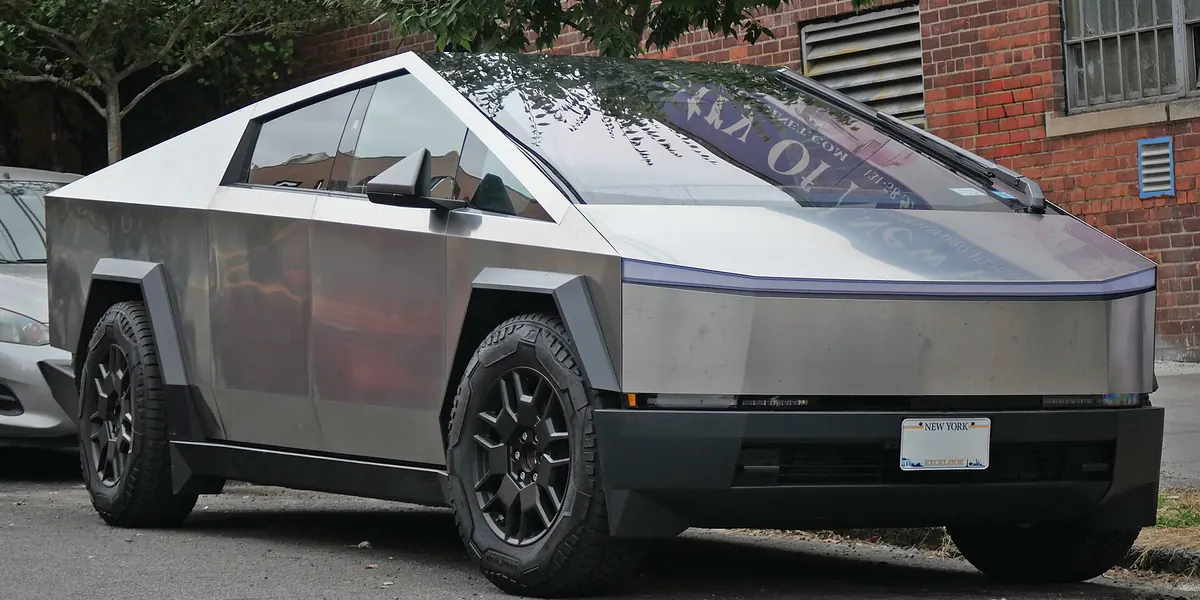
The Cybertruck’s entire low-voltage system runs at 48 volts, fed by a small 48V lithium battery through a converter from its roughly 800V pack. The physics is the attraction: power is volts times amps, so the same power at 48 volts needs a quarter of the current, which means thinner, lighter, cheaper copper wiring throughout the car — and enough headroom for power-hungry systems like steer-by-wire that strain a 12V bus. Tesla even sent rival manufacturers a guide to designing 48V vehicles in December 2023.
Who is following Tesla to 48V?
Ford is the one confirmed follower: its Universal EV Platform, starting with a midsize pickup built from 2027, moves to a 48V low-voltage system, with a harness Ford says is 4,000 feet shorter and 22 pounds lighter than on its first-generation EVs — though even Ford will still step down to 12V locally for some accessories such as lights and audio. No other maker has a confirmed 48V low-voltage EV on sale or formally announced, and 48V mild-hybrid systems on gasoline cars are a different technology that proves nothing about EVs. For now the honest summary is that the shift has begun at the edges — Tesla’s 16V lithium, Cybertruck’s 48V, Ford from 2027 — while 12V lead-acid remains the default everywhere else.
Frequently Asked Questions
Do EVs have a 12V battery?
Almost all of them. Nearly every EV pairs its high-voltage traction pack with a small low-voltage battery — a conventional 12V lead-acid unit on most cars. The exceptions are current Teslas, whose lithium-ion low-voltage battery runs at about 16 volts, and the Cybertruck, which uses a 48V system with no 12V battery at all.
Why can’t the big traction battery run everything?
Because the traction pack is deliberately disconnected when the car is off, for safety, and its contactors need low-voltage power to reconnect it. The 12V battery runs the computers and closes those contactors, and it powers the locks, lights and safety systems that must work while the pack is isolated. Without a healthy 12V battery, a fully charged EV cannot switch on.
What happens when the 12V battery dies in an EV?
The car will not wake up: the fob and handles may not respond, the screens stay dark, the app shows the car offline, and it cannot shift, drive or start charging. Weak batteries also cause flickering screens and spurious fault codes. The traction pack is usually unharmed — replacing or jump-starting the 12V battery brings the car back.
Can you jump-start an electric car?
Yes — you jump-start the 12V battery, never the traction pack. A portable booster pack connected at the manufacturer’s jump points gives the car enough power to wake and close its contactors, after which its DC-DC converter recharges the 12V battery. The Cybertruck can also be woken from a 12V source despite its 48V system.
Can an EV jump-start another car?
Generally, do not. Tesla states its cars cannot be used to jump-start another vehicle, and using a Hyundai or Kia hybrid as a donor can damage its integrated lithium 12V battery. An EV’s low-voltage system is designed to run its own electronics, not to crank another car’s starter motor.
How long does an EV’s 12V battery last?
About three to five years for a lead-acid unit, similar to a gasoline car’s battery, sometimes less because of the standby loads EVs place on it. Tesla’s lithium low-voltage battery should last much longer — estimates run to 10–15 years — but the manufacturer publishes no official figure.
Can I replace my EV’s 12V battery with a lithium one?
Only if your car’s charging system is designed or approved for it. The converter that charges the 12V battery is calibrated for a specific chemistry — Ford’s Mach-E, for example, is calibrated for its AGM lead-acid battery, and an unapproved lithium swap can cause charging problems. Aftermarket lithium units exist for some models; check the manufacturer’s position before fitting one.
Can I replace the 12V battery myself?
On most mainstream EVs, yes: it is a standard group-size battery in an accessible spot, changed with ordinary tools. On some cars, no: Tesla’s lithium unit needs a software ‘learn new battery’ routine at service, Rivian uses proprietary terminals, and Lucid’s batteries sit behind a rear wheel liner. When in doubt, the owner’s manual says which kind of job yours is.
Conclusion
The small battery is the part most likely to strand an EV — and the easiest to plan for.
Every EV you can buy today carries a low-voltage battery, whether that is the familiar 12V lead-acid unit in most cars, Tesla’s 16V lithium pack, or the Cybertruck’s 48V system. It runs the car’s everyday electrics, wakes the traction pack into service, and quietly absorbs the standby loads of a connected car. It is also, by patrol and survey data alike, the single most common cause of EV breakdowns.
The ownership rules are simple: expect three to five years from a lead-acid unit, replace it at the first symptoms rather than after a no-start, keep the car plugged in during long storage, and remember that its warranty is the car’s basic warranty, not the 8-year battery cover. The 12V battery survived the move from gasoline to electric power because the job it does did not change — and the first signs of its eventual replacement, at 16 and 48 volts, are only now reaching the road.
