What Is a Cobalt-Free EV Battery?

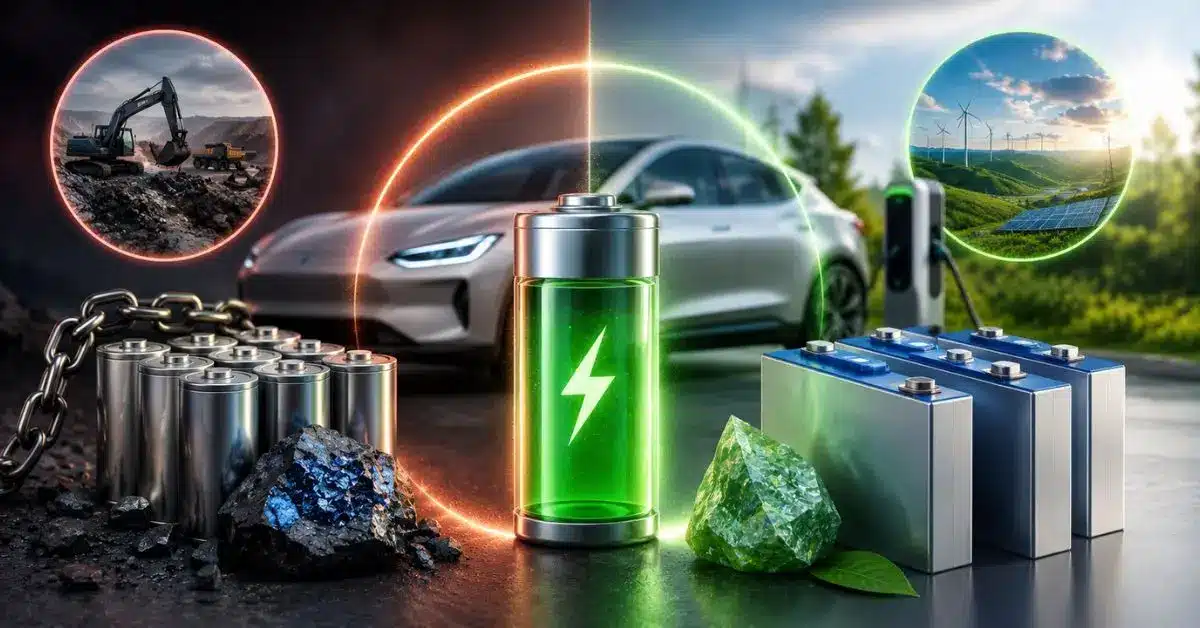
A cobalt-free EV battery is a lithium-ion battery whose cathode contains no cobalt whatsoever. The most commercially successful cobalt-free chemistry is LFP (lithium iron phosphate) — and it already powers nearly half of all new EVs sold globally. By 2024, LFP had captured approximately 50% of the global EV battery market, up from less than 10% in 2020. The shift away from cobalt is one of the most important transitions in EV battery technology today.
Why Was Cobalt Used in EV Batteries in the First Place?
Cobalt became a standard cathode material in lithium-ion batteries because of its unique electrochemical properties:
- Structural stability: Cobalt helps maintain the layered oxide cathode structure during repeated charge/discharge cycles, preventing collapse and capacity fade
- High energy density: Cobalt enables high operating voltages, increasing energy stored per kilogram
- Thermal stability: Cobalt slows cathode decomposition at high temperatures
Early lithium-ion batteries used pure lithium cobalt oxide (LCO) cathodes — the chemistry still used in smartphones. NMC batteries replaced much of the cobalt with nickel and manganese, reducing cobalt content while retaining most of the performance benefits.
Why Is Cobalt Problematic?
Despite its performance advantages, cobalt carries three major problems that are driving the industry toward elimination:
1. Supply Concentration Risk
Approximately 70% of global cobalt comes from the Democratic Republic of Congo (DRC). A single country controlling the majority of the supply for a critical EV material creates massive geopolitical and price volatility risk. Cobalt prices have ranged from $30,000 to over $90,000 per metric ton historically. In 2026, cobalt prices were approximately $30–40/kg — but that can reverse sharply with any supply disruption.
2. Human Rights Concerns
DRC cobalt mining — particularly artisanal small-scale mining — has been linked to hazardous child labor, dangerous working conditions, and environmental destruction. Multiple major EV and battery manufacturers have faced scrutiny over their cobalt supply chains. Eliminating cobalt removes this ethical liability entirely.
3. Cost
Cobalt is the most expensive active cathode material per kilogram in an EV battery. At $30–40/kg, the cobalt content alone in an NMC battery can account for a meaningful portion of cathode cost. Eliminating cobalt directly lowers battery pack cost per kWh — a key enabler of affordable EVs.
Cobalt-Free EV Battery Technologies
LFP — Lithium Iron Phosphate (Most Widely Adopted)
LFP (LiFePO₄) uses iron and phosphate in an olivine crystal structure as the cathode material — zero cobalt, zero nickel. It is the dominant cobalt-free chemistry and the fastest-growing battery type in the EV market.
- Energy density: ~90–170 Wh/kg (cell level) — lower than NMC but improving
- Cycle life: 2,000–5,000+ cycles to 80% capacity — 2–5x better than NMC
- Thermal runaway onset: ~270°C vs ~210°C for NMC — significantly safer
- Cost: ~$81/kWh pack average (BloombergNEF 2026) — ~37% cheaper than NMC
- Cobalt and nickel content: Zero
EVs using LFP: Tesla Model 3/Y Standard Range, all BYD models (blade battery), Chevy Equinox EV (base), MG4 Standard Range, Dacia Spring, Volvo EX30 Standard, and many more.
Learn: how LFP and NMC compare across range, safety, and cost
LMFP — Lithium Manganese Iron Phosphate (Next Generation)
LMFP adds manganese to the LFP olivine structure. The manganese increases the cathode’s operating voltage from ~3.2V (LFP) to ~3.7V — boosting energy density by approximately 14–20% while keeping zero cobalt and zero nickel. LMFP retains LFP’s excellent thermal stability and long cycle life.
Cobalt-Free vs Cobalt-Containing: Performance Comparison
| Feature | LFP (Cobalt-Free) | LMFP (Cobalt-Free) | NMC 811 (Low Cobalt) |
|---|---|---|---|
| Cobalt content | Zero | Zero | ~10% of the cathode |
| Nickel content | Zero | Zero | ~80% of cathode |
| Cell energy density | ~90–170 Wh/kg | ~160–200 Wh/kg | ~220–260 Wh/kg |
| Cycle life (to 80%) | 2,000–5,000+ | 2,000–5,000+ | 1,000–2,000 |
| Thermal runaway onset | ~270°C | ~270°C | ~210°C |
| Pack cost (2026 avg.) | ~$81/kWh | ~$85–95/kWh (est.) | ~$128/kWh |
| Daily 100% charging | Yes — recommended | Yes | Not recommended (80%) |
| Cold weather performance | Weaker | Better than LFP | Better |
Which EVs Already Use Cobalt-Free Batteries?
| Automaker / Model | Chemistry | Cobalt-Free? |
|---|---|---|
| BYD — all pure EV models (Atto 3, Seal, Han, Tang, Dolphin, Seagull) | LFP (Blade) | ✅ Yes |
| Tesla Model 3 Standard Range | LFP | ✅ Yes |
| Tesla Model Y Standard Range | LFP | ✅ Yes |
| Chevy Equinox EV (base trim) | LFP | ✅ Yes |
| MG4 Standard Range | LFP | ✅ Yes |
| Dacia Spring | LFP | ✅ Yes |
| Volvo EX30 Standard Range | LFP | ✅ Yes |
| Toyota bZ3 (China) | LFP (BYD-supplied) | ✅ Yes |
The Market Shift: How Fast Is Cobalt Disappearing From EVs?
- 2020: LFP (cobalt-free) = <10% of global EV battery market
- 2024: LFP = ~50% of global EV battery market (IEA data)
- In China: LFP accounts for approximately 75% of domestic EV batteries
- IEA forecast: Continues growing, with cobalt demand revised downward from previous projections
Conclusion
Cobalt-free EV batteries are not the future — they are the present. LFP already powers nearly half the world’s new electric vehicles, eliminating cobalt from the cathode along with its ethical, supply chain, and cost burdens. LMFP is the next step, adding energy density without adding cobalt. As Cell-to-Pack design and silicon-carbon anodes improve LFP’s range competitiveness, cobalt-free batteries will move from mainstream to dominant across all EV segments. For buyers who want a safe, long-lasting, ethically straightforward battery today, cobalt-free options from BYD, Tesla Standard Range, and a growing list of other automakers already deliver excellent real-world performance.
Frequently Asked Questions
What is a cobalt-free EV battery?
A cobalt-free EV battery uses a cathode material that contains no cobalt. The most common commercial option is LFP (lithium iron phosphate), which replaces cobalt and nickel with abundant iron and phosphate. LMFP (adding manganese to LFP) is the next evolution, offering higher energy density while remaining completely cobalt-free.
Is LFP really better than NMC without cobalt?
For most everyday drivers, yes. LFP offers lower cost (~37% cheaper per kWh), longer cycle life (2–5x more cycles), better safety (higher thermal runaway threshold), and zero ethical/supply concerns. The tradeoff is lower energy density — meaning more battery weight for equivalent range. For long-range premium EVs, NMC still holds an advantage in range-per-kg, but that gap is narrowing with LMFP.
What is LMFP and how is it better than LFP?
LMFP (lithium manganese iron phosphate) adds manganese to the standard LFP olivine structure. The manganese raises the cathode’s operating voltage from ~3.2V to ~3.7V, boosting energy density by approximately 14–20% compared to LFP. It remains completely cobalt-free and nickel-free while offering better cold-weather performance than LFP.
Can a cobalt-free battery match the range of NMC?
Not yet at the cell level — standard LFP has ~90–170 Wh/kg vs ~220–260 Wh/kg for NMC 811. However, Cell-to-Pack design (like BYD’s blade battery) closes the pack-level gap significantly by eliminating module housings and using space more efficiently. LMFP with silicon-carbon anodes is expected to further close the range gap while remaining cobalt-free.