
Cylindrical vs Prismatic vs Pouch Cells: Which Is Better?

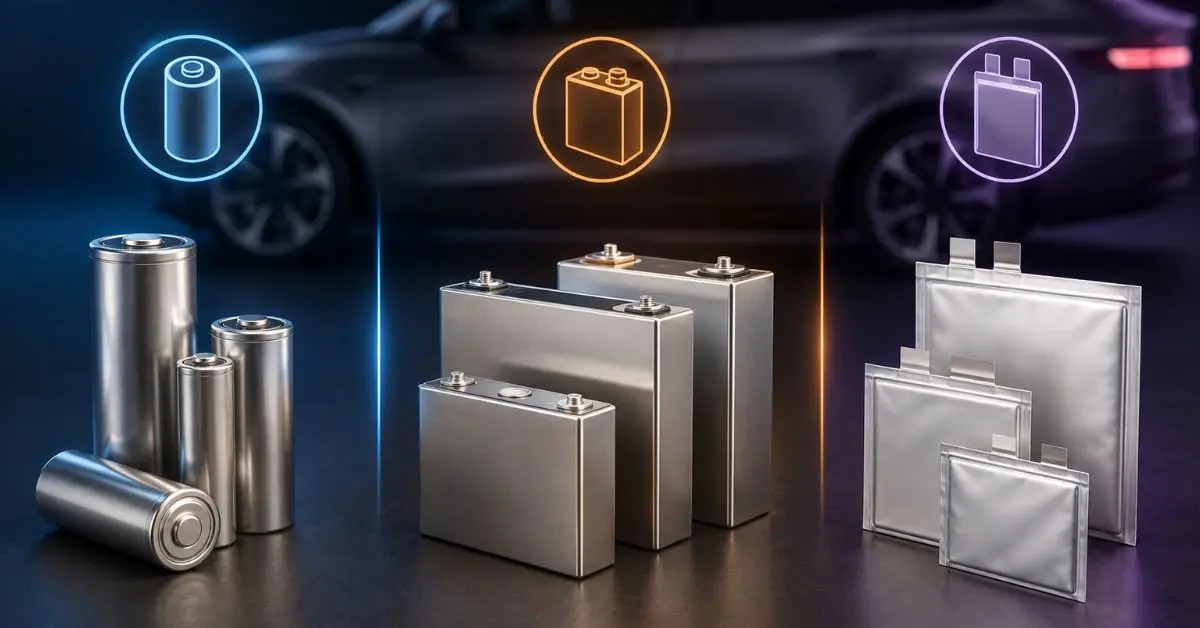
Every EV battery is built from one of three cell formats: cylindrical, prismatic, or pouch. Tesla uses cylindrical cells. BYD uses prismatic. Nissan uses pouch. Each format has real tradeoffs in energy density, cost, thermal management, and safety. There is no single best answer — but knowing the differences helps you understand why your EV was built the way it was.
What Are the Three EV Battery Cell Formats?
All three formats use the same lithium-ion chemistry. The difference is in the physical shape and packaging of each cell — and that shape affects nearly every aspect of battery pack design.
- Cylindrical cells: Round, tube-shaped, like an oversized AA battery. Common sizes: 18650, 21700, and Tesla’s new 4680.
- Prismatic cells: Flat, rectangular, enclosed in a rigid aluminum or steel case. Often large-format (50Ah–300Ah per cell).
- Pouch cells: Flat, flexible, sealed in a soft aluminum-plastic foil bag. Custom-shapeable and lightweight.
Cylindrical vs Prismatic vs Pouch Cells: Full Comparison
| Feature | Cylindrical | Prismatic | Pouch |
|---|---|---|---|
| Shape | Round tube | Rectangle (rigid case) | Flat, flexible bag |
| Energy density (gravimetric) | Moderate | Good (160–255 Wh/kg) | Highest |
| Volumetric efficiency | ~60–65% | ~72% | Highest |
| Manufacturing cost | Lowest | Higher | Moderate |
| Thermal management | Excellent (radial dissipation) | Moderate (needs active cooling) | Poor (needs external compression) |
| Mechanical durability | Excellent (rigid metal case) | Good (rigid case) | Lowest (flexible pouch) |
| Swelling risk | Very low | Low | High |
| Cycle life | 800–1,200 cycles (NMC) | 2,000+ cycles (LFP) | ~1,000 cycles |
| Pack complexity | High (many cells, connections) | Low (fewer, larger cells) | Moderate |
| Key EV users | Tesla, Rivian, BMW i3 | BYD, CATL, Chevy Bolt, VW | Nissan Leaf, Hyundai, Audi |
Cylindrical Cells: The Proven Workhorse
Cylindrical cells are the oldest and most standardized lithium-ion cell format. The electrodes are wound into a tight “jelly roll” and inserted into a rigid metal cylinder. Their round shape naturally distributes internal pressure evenly, which reduces the risk of deformation or electrolyte leakage.
Pros of Cylindrical Cells
- Lowest cost per kWh — High-volume automated manufacturing keeps prices down. Tesla leveraged this for years with 18650 and 21700 cells.
- Excellent thermal management — Cylindrical shape dissipates heat radially, reducing cooling loads by roughly 14% compared to prismatic cells.
- High consistency — Tight manufacturing tolerances mean cells perform predictably.
- Strong fault tolerance — A single failed cell in a pack of 7,000 has minimal impact on total performance.
- Proven reliability — Decades of use in laptops, power tools, and EVs give cylindrical cells the longest track record.
Cons of Cylindrical Cells
- High cell count — Thousands of small cells mean thousands of connections, increasing BMS complexity and assembly labor.
- Lower volumetric efficiency — Round cells leave gap spaces when packed together, wasting usable volume inside the battery pack.
- Heavier pack structure — More cells require more housing, wiring, and support components.
Who uses them: Tesla (18650, 21700, 4680), Panasonic supplies most cylindrical cells. BMW i3 and early Rivian models also use cylindrical cells.
Prismatic Cells: Space-Efficient and Scalable
Prismatic cells are rectangular and housed in a rigid aluminum or steel case. Their flat sides stack neatly together, like building blocks, maximizing space inside a battery pack. A single large prismatic cell can store 50Ah to over 300Ah — replacing dozens of cylindrical cells.
Pros of Prismatic Cells
- Superior space utilization — ~72% volumetric efficiency, more than cylindrical cells.
- Fewer connections — Fewer cells mean simpler wiring, fewer failure points, and lower BMS complexity.
- High energy density — NMC prismatic cells reach up to 255 Wh/kg. LFP prismatic cells offer 160–210 Wh/kg with excellent cycle life.
- Long cycle life (LFP) — Lithium iron phosphate (LFP) prismatic cells can deliver 2,000+ charge cycles, making them ideal for commercial EVs and taxis.
- Easier to integrate cooling plates — Flat surfaces accept thermal management hardware more efficiently.
Cons of Prismatic Cells
- Higher manufacturing cost — Precision stacking and welding adds expense compared to cylindrical production.
- Less natural thermal dissipation — Flat sides don’t dissipate heat as naturally as round cylindrical cells. Active cooling is usually required.
- One cell failure is more impactful — With fewer, larger cells, a single bad cell represents a larger share of total pack energy.
Who uses them: BYD (blade battery), CATL, Chevrolet Bolt EV, Volkswagen ID series, BMW (newer models), most Chinese EV manufacturers. Samsung SDI is expanding prismatic supply for Volkswagen.
Pouch Cells: Lightweight and Flexible
Pouch cells replace the rigid metal case with a thin, sealed aluminum-plastic foil bag. This minimalist packaging maximizes the proportion of active battery material, giving pouch cells the highest gravimetric energy density of the three formats.
Pros of Pouch Cells
- Highest energy density by weight — Removing the heavy metal case means more energy per kilogram — critical for range.
- Design flexibility — Custom shapes allow engineers to fit batteries into unusual spaces within a vehicle’s chassis.
- Lower weight — Lighter than prismatic or cylindrical cells of equivalent capacity.
- Good power delivery — Pouch cells handle high discharge rates well, making them suitable for performance EVs.
Cons of Pouch Cells
- Swelling risk — Gas buildup inside the flexible casing causes swelling over charge cycles. Engineers must design compression into the module structure.
- Lowest mechanical durability — The soft casing is vulnerable to punctures, deformation, and impact damage.
- More complex thermal management — Uneven heat distribution can create hotspots that accelerate degradation.
- Lower cycle life — Typically around 1,000 cycles at 80% depth of discharge.
Who uses them: Nissan Leaf (AESC supplier), Hyundai Ioniq 5 and 6, Kia EV6, LG Energy Solution supplies pouch cells to several automakers. Audi Q8 e-tron uses pouch cells from SK Innovation.
Which Cell Format Is Winning in EVs Right Now?
The market is shifting. Cylindrical cells dominated early EV development — largely because of Tesla. But prismatic cells are gaining rapidly, particularly LFP prismatic cells from CATL and BYD, due to their lower cost, longer cycle life, and simpler pack assembly.
Key industry moves as of 2025–2026:
- Tesla is transitioning to larger 4680 cylindrical cells to gain the efficiency benefits of size while keeping the thermal advantages of the cylindrical format.
- BYD’s blade battery — a long, thin prismatic cell — has become a global benchmark for LFP safety and thermal performance.
- CATL, the world’s largest battery maker, produces both prismatic and cylindrical cells and supplies dozens of automakers globally.
- Volkswagen has standardized on a unified prismatic cell format for its EV lineup, supplied by Samsung SDI and others.
- Solid-state batteries (expected post-2027) may eventually challenge all three formats — but lithium-ion cells in these three shapes will dominate the 2020s.
Which Cell Type Is Best for an EV?
The honest answer: it depends on what the automaker is optimizing for.
- Best for low cost + proven reliability: Cylindrical (especially 21700 and 4680 formats)
- Best for long life + pack simplicity: Prismatic LFP (BYD blade, CATL)
- Best for lightweight + high range per kg: Pouch (Hyundai, Kia)
- Best for commercial/fleet EVs: Prismatic LFP (2,000+ cycle life)
- Best for performance EVs: Cylindrical or high-density pouch
Conclusion
Cylindrical, prismatic, and pouch cells each represent a different engineering philosophy for EV battery design. Cylindrical cells win on cost and thermal performance. Prismatic cells excel at space efficiency and long cycle life. Pouch cells deliver the highest energy density by weight. As the EV industry matures, prismatic LFP cells are gaining ground — but all three formats will coexist throughout the 2020s, with each serving different vehicle classes, performance targets, and price points.
Want to understand how battery chemistry affects performance and lifespan? Read our detailed guide on LFP vs NMC batteries