
What Is High-Nickel Cathode Battery Chemistry?

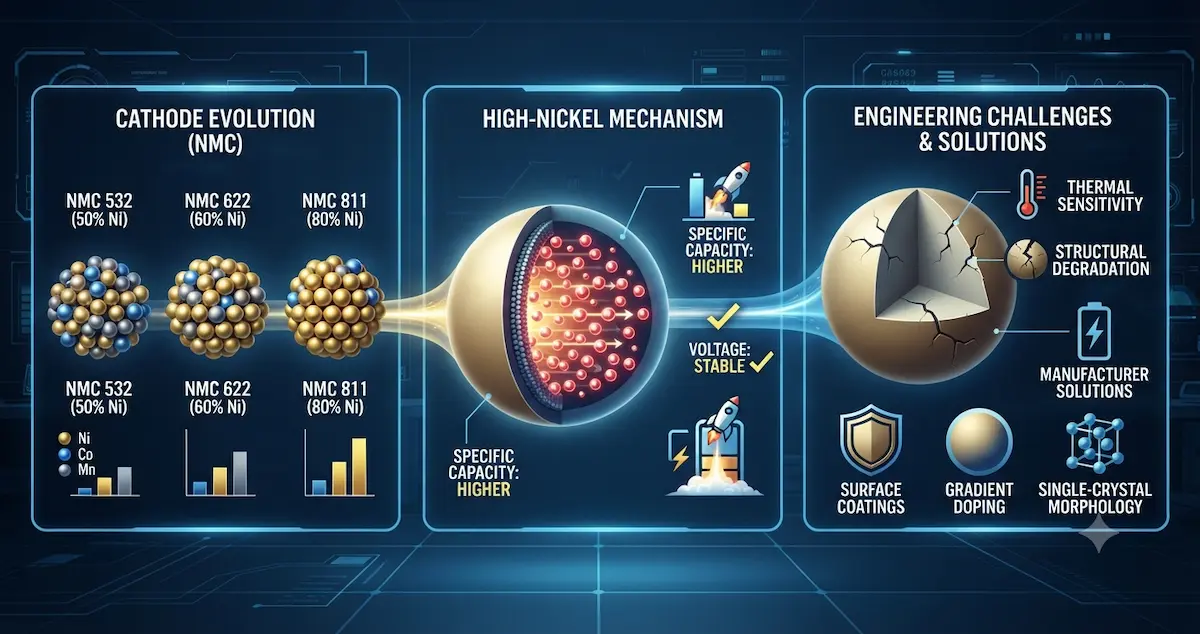
High-nickel cathode battery chemistry refers to lithium-ion batteries where nickel accounts for 80% or more of the cathode’s transition metal content — primarily NMC 811, NCMA, and ultra-high-nickel variants targeting 90%+. High nickel is the current direction of premium EV battery development because more nickel = more energy per kilogram = more range. Every major battery manufacturer — CATL, LG Energy Solution, Panasonic, Samsung SDI, SK On — is developing or producing high-nickel cathode cells for long-range EV applications.
See the full breakdown of the NMC side of this progression in our comparison of NMC 532 vs NMC 622 vs NMC 811.
What Makes a Cathode “High-Nickel”?
In the battery industry, “high-nickel” typically means nickel content of ≥80% of the transition metal fraction in the cathode. The progression:
- NMC 532: 50% Ni — low nickel
- NMC 622: 60% Ni — mid nickel
- NMC 811: 80% Ni — high nickel threshold
- NCMA (~89/5/5/1): 89% Ni — ultra-high nickel
- Panasonic next-gen NCA: targeting 91% Ni
Why Higher Nickel = More Range
Nickel provides electrochemical capacity in lithium-ion cells — the more nickel, the more lithium can be stored and released per gram of cathode material. The progression from NMC 532 to NMC 811 increased cell capacity from ~155 mAh/g to ~195 mAh/g — a 26% improvement. Higher capacity at the same cell voltage means more energy stored per gram, which directly translates to more miles per charge from the same pack weight.
High-Nickel Cathode Specifications
| Chemistry | Nickel Content | Energy Density | Key Challenge |
|---|---|---|---|
| NMC 811 | 80% | ~220–260 Wh/kg | Thermal management, cobalt reduction |
| NCMA (~89% Ni) | 89% | ~250–280 Wh/kg | Structural stability, manufacturing |
| NCA (Panasonic) | ~82–85% | ~300–322 Wh/kg | Higher cobalt, thermal sensitivity |
| Ultra-high nickel (90%+) | 90–95% | ~300–350+ Wh/kg (target) | Severe structural instability, surface reactions |
Challenges of High-Nickel Chemistry
- Cation mixing: Ni²⁺ (similar size to Li⁺) migrates into lithium sites, blocking movement. More nickel = more mixing risk
- Particle cracking: Volume changes during cycling cause mechanical fracture of cathode particles — worse at higher nickel content
- Lower thermal stability: Thermal runaway onset temperature decreases as nickel content rises — from ~220°C at NMC 622 to ~200°C at NMC 811 to potentially ~180°C at 90% Ni
- Surface reactivity: High-nickel cathodes react aggressively with moisture and CO₂ during manufacturing, requiring ultra-dry production environments
- Electrolyte compatibility: High-nickel cathodes decompose standard electrolytes faster — requiring advanced electrolyte additive packages
Solutions: How Manufacturers Handle High-Nickel Challenges
- Surface coatings: Thin layers of Al₂O₃, ZrO₂, or other oxides deposited on cathode particles reduce surface reactivity and slow electrolyte decomposition
- Gradient doping: Nickel-rich core with manganese/cobalt-rich shell — protecting the reactive core while maximizing capacity
- Aluminum addition (NCMA): Small Al doses stabilize the lattice and slow cation mixing
- Single-crystal morphology: CATL and others use single-crystal NMC 811 particles that resist cracking better than polycrystalline particles
- Advanced electrolyte additives: Proprietary additive packages that stabilize the cathode-electrolyte interface (CEI)
- See our full explainer on the fracture mechanism these coatings and single-crystal designs address: what cathode cracking is in high-nickel EV batteries
Frequently Asked Questions
What is high-nickel cathode battery chemistry?
High-nickel cathode chemistry refers to lithium-ion batteries where nickel accounts for ≥80% of the cathode’s transition metal content — primarily NMC 811, NCMA, and NCA. Higher nickel content increases energy storage capacity per gram, enabling more range per kilogram of battery. The tradeoffs are lower thermal stability, higher manufacturing complexity, and greater structural degradation challenges vs lower-nickel formulations.
Is high-nickel battery chemistry safe?
High-nickel batteries are safe with proper thermal management — but they have a lower thermal runaway onset temperature (~200–210°C) than lower-nickel NMC variants or LFP (~270°C). Modern EVs using high-nickel cells include advanced liquid cooling, BMS protection, and cell-level fusing to manage this. The statistical fire rate for high-nickel EV cells is still dramatically lower than gasoline vehicles when operated within their designed parameters.
Why don’t manufacturers use 100% nickel cathodes?
100% nickel (LiNiO₂) cathodes are highly reactive, structurally unstable, and extremely difficult to manufacture. They undergo severe cation mixing, particle cracking, and surface reactions that cause rapid capacity fade. Small amounts of manganese, cobalt, and/or aluminum are essential to stabilize the crystal structure, maintain conductivity, and enable practical cycle life. Even 90%+ Ni formulations face significant engineering challenges — which is why most production cells remain at 80–89% Ni.
Conclusion
High-nickel cathode chemistry — NMC 811, NCMA, and ultra-high-nickel variants — is the current frontier of EV range technology. More nickel means more energy stored per gram, directly enabling longer-range EVs without heavier packs. The engineering challenges — cation mixing, particle cracking, thermal sensitivity — are being managed through surface coatings, gradient doping, single-crystal morphology, and advanced electrolytes. As nickel content pushes toward 90%+ in next-generation cells, the balance between maximum energy density and structural stability will remain the defining engineering challenge of premium EV battery development.
NCMA’s aluminum doping is one of the leading answers to this exact tradeoff — see our explainer on what NCMA battery chemistry is and who uses it.
