
What Are Iron-Air Batteries? Are They for EVs?

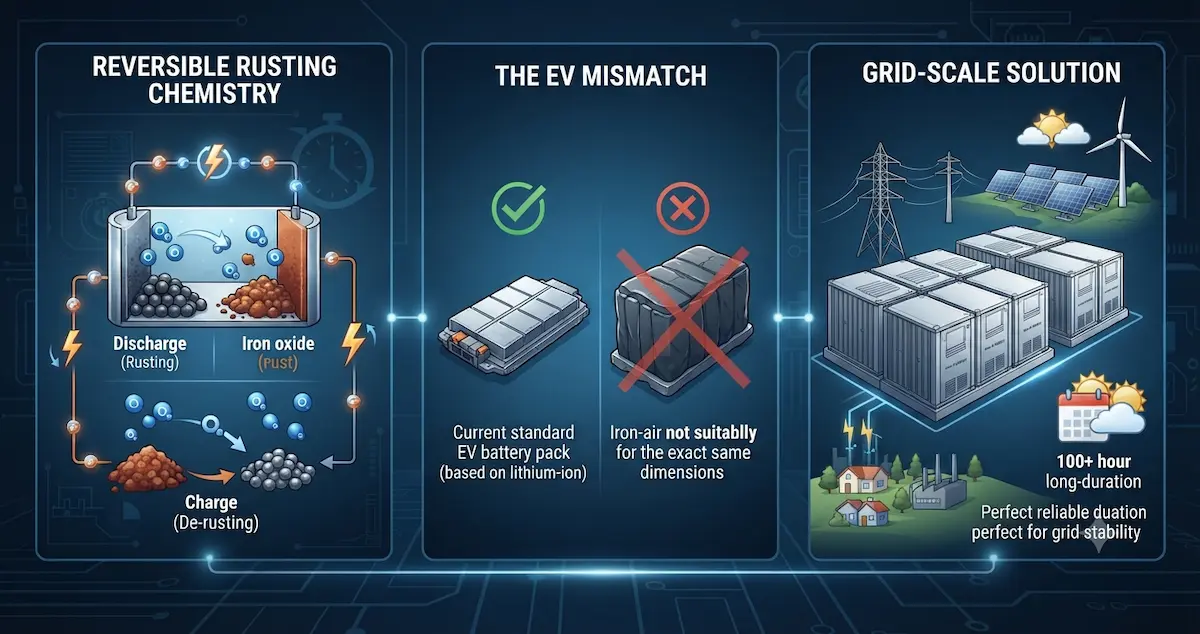
Iron-air batteries are a commercially advancing energy storage technology that uses reversible rusting — iron oxidizes (rusts) during discharge to release energy, and electricity converts the rust back to metallic iron during charging. Iron is the most abundant metal on Earth, and iron-air batteries use a non-flammable water-based electrolyte — making them the cheapest, safest energy storage chemistry under commercial development. Form Energy, the leading iron-air company, is shipping commercial systems from its Weirton, West Virginia gigafactory to major U.S. utilities in 2025–2026, targeting system-level costs below $20/kWh — a fraction of lithium-ion’s $81–128/kWh. However, iron-air batteries are too heavy and have too low energy density to power electric vehicles. They are strictly a grid-scale stationary energy storage technology — but an extraordinarily important one for making renewable energy reliable.
Another safe, low-cost aqueous chemistry with EV-relevant niches (unlike iron-air) is explored in our guide on what zinc-ion batteries are and whether they can power EVs.
How Iron-Air Batteries Work
Iron-air batteries use an elegantly simple electrochemical process based on a reaction that happens naturally everywhere: iron rusting. The key innovation is making this rusting process reversible and controllable:
- Discharge (rusting — releasing energy): Iron pellets at the anode react with oxygen drawn from ambient air, forming iron oxide (rust): 4Fe + 3O₂ → 2Fe₂O₃. This reaction releases electrons that flow through the external circuit — generating electricity. The water-based electrolyte conducts hydroxide ions to complete the circuit.
- Charging (de-rusting — storing energy): Electrical current reverses the reaction — iron oxide is electrochemically reduced back to metallic iron, and oxygen is released back to the air: 2Fe₂O₃ + electrical energy → 4Fe + 3O₂. The iron pellets are regenerated, ready for another discharge cycle.
- Cell voltage: ~1.3V per cell — modest compared to lithium-ion’s 3.2–4.2V per cell, contributing to low energy density but also to low cost (no expensive high-voltage electrolyte formulations required)
- Electrolyte: Aqueous alkaline solution — essentially a modified saltwater bath. Non-flammable, non-toxic, inexpensive.
The simplicity of this chemistry — iron, air, and water — explains both iron-air’s extraordinary cost potential and its fundamental limitation. Iron is ~$0.02/kg. Air is free. The electrolyte costs pennies. The result: Form Energy targets system-level costs below $20/kWh, compared to utility-scale lithium-ion at $80–150/kWh. But iron’s weight and the low cell voltage create an energy density of approximately 20–50 Wh/kg — far too low for anything that moves.
Iron-Air Commercial Status: Form Energy and Ore Energy
Iron-air batteries have achieved remarkable commercial momentum in 2025–2026:
- Form Energy (Weirton, West Virginia): Opened its commercial-scale iron-air battery gigafactory on the site of a former steel mill in Weirton, WV — a powerful symbol of industrial reinvention. The facility is shipping commercial systems to major U.S. utilities. Contracts include Xcel Energy, Georgia Power, a 10 MW system for FuturEnergy Ireland, and a 12 GWh deal with AI infrastructure company Crusoe beginning in 2027. Form Energy raised over $400 million to bring the technology to commercial scale. Its largest announced project — 30 GWh announced by CEO Mateo Jaramillo — was described as “the largest battery system by energy capacity ever announced globally.” Form Energy’s iron-air batteries have received UL9540A certification, confirming compliance with safety standards for commercial deployment.
- Ore Energy (Netherlands): Connected the world’s first iron-air battery to a public grid at Delft University in July 2025. While smaller in scale than Form Energy’s commercial projects, this European milestone demonstrated that iron-air can meet real-time grid standards and be safely integrated into dense urban environments.
- Fraunhofer Institute (Germany): Developing next-generation iron-air cells targeting 250 Wh/kg energy density and 60% round-trip efficiency — a substantial improvement over current commercial designs (40–50% efficiency). These performance targets remain R&D goals rather than commercial products. See our full explainer on a much higher-density (but still lab-stage) air-cathode chemistry: what a lithium-air battery is.
Why Iron-Air Is Perfect for Grid Storage (But Not EVs)
Iron-air batteries are purpose-designed for a specific application: long-duration stationary energy storage — storing energy for 10–100+ hours to balance multi-day renewable energy droughts (when neither solar nor wind generation is available for extended periods). This is a fundamentally different application from EVs, and iron-air’s properties are perfectly matched to this use case:
| Property | Iron-Air Battery | EV Battery Requirement | Mismatch? |
|---|---|---|---|
| Energy density (Wh/kg) | ~20–50 Wh/kg (very low) | 150–260+ Wh/kg needed | Severe — 3–10x too heavy for EVs |
| Power density | Very low (designed for slow discharge) | High power output needed for acceleration | Severe — unsuitable for traction |
| Cost per kWh | Target <$20/kWh (exceptional) | ~$81–128/kWh currently | Iron-air wins massively on cost |
| Discharge duration | 100+ hours (perfect for grid) | 3–6 hours needed for daily EV use | Iron-air over-engineered for EVs |
| Safety (fire risk) | Zero — non-flammable aqueous | Important but secondary to energy density | Iron-air wins on safety |
| Round-trip efficiency | ~40–50% (low) | >90% efficiency required for EVs | Severe — EV loses 50–60% of energy to charging losses |
| Weight/volume | Very heavy — irrelevant for grid | Weight directly reduces vehicle efficiency | Severe — iron-air too heavy for vehicles |
The most critical numbers are energy density and round-trip efficiency. At 20–50 Wh/kg energy density, a 75 kWh EV battery using iron-air technology would weigh 1,500–3,750 kg — equivalent to 3–8 times the weight of a current EV battery. The entire vehicle concept would collapse under the weight. Additionally, iron-air’s 40–50% round-trip efficiency means 50–60% of charging energy is lost as heat and chemical process losses — completely unacceptable for a vehicle application where energy efficiency directly translates to range and charging cost.
The Grid Storage Opportunity Iron-Air Addresses
The problem iron-air batteries are designed to solve is one of the most critical challenges in the clean energy transition: long-duration energy storage. As renewable energy (solar and wind) provides a growing fraction of global electricity — over 35% in the U.S. in 2025 — grid operators increasingly face multi-day periods where neither solar nor wind generation is adequate. Winter “dark doldrums” in northern climates can last 3–7 days with minimal renewable generation. A New England winter can mean 5 days of overcast skies and low winds — no solar, minimal wind. Storing enough energy to bridge these renewable droughts requires batteries that can hold 50–100 hours of backup power economically.
Lithium-ion LFP batteries at $81/kWh pack cost are reasonable for 4-hour storage applications — the most common grid storage deployment. But scaling to 100-hour storage with LFP costs approximately $8,100/kWh-per-hour-of-discharge (very rough) — economically prohibitive. Iron-air at $20/kWh system cost makes 100-hour storage economically viable for the first time. This is why Form Energy’s demand is “outpacing internal forecasts” according to April 2026 reporting — utilities desperately need affordable long-duration storage that iron-air uniquely provides.
The IEA View: Iron-Air as Complementary Technology
The IEA’s Global EV Outlook 2025 specifically categorized iron-air alongside redox-flow batteries as technologies that “target different applications to established lithium-ion technologies, such as longer-duration storage for grid applications” — distinguishing them explicitly from technologies like solid-state and lithium-sulfur that could eventually replace lithium-ion in EVs. This framing is accurate: iron-air is not a competitor to EV batteries but a complementary technology addressing an application that lithium-ion cannot cost-effectively serve. The clean energy system needs both — lithium-ion (and eventually solid-state) for mobile traction applications, and iron-air for multi-day grid storage — working together to enable 100% renewable electricity grids.
Frequently Asked Questions
What are iron-air batteries and are they for EVs?
Iron-air batteries use reversible rusting (iron + oxygen → iron oxide during discharge; electrical current restores iron during charging) with a non-flammable water-based electrolyte. They are NOT for EVs — their energy density of 20–50 Wh/kg is far too low (EV batteries need 150–260+ Wh/kg) and their 40–50% round-trip efficiency is incompatible with vehicle applications. Iron-air batteries are designed exclusively for stationary grid-scale long-duration energy storage (10–100+ hours).
How cheap are iron-air batteries?
Form Energy targets system-level costs below $20/kWh for iron-air storage — compared to $81–128/kWh for lithium-ion battery packs. The raw materials are extraordinarily inexpensive: iron (~$0.02/kg), air (free), and an alkaline aqueous electrolyte (cents per liter). This cost advantage makes iron-air uniquely economical for long-duration grid storage where it provides 100+ hours of backup at a fraction of lithium-ion’s cost for equivalent stored energy.
Is Form Energy’s iron-air battery commercially available?
Yes — Form Energy’s commercial-scale factory in Weirton, West Virginia began shipping commercial iron-air battery systems to major U.S. utilities in 2025–2026, with contracts including Xcel Energy and Georgia Power. Ore Energy connected the world’s first grid-connected iron-air battery in Delft, Netherlands in July 2025. Iron-air is transitioning from R&D to commercial utility-scale deployment faster than most battery technologies in recent memory.
Conclusion
Iron-air batteries are not for EVs — they are for the power grid. At 20–50 Wh/kg energy density and 40–50% round-trip efficiency, they cannot power moving vehicles. But for the specific problem of affordable long-duration grid energy storage (50–100+ hours), iron-air is potentially transformative — offering system costs below $20/kWh using iron, air, and water. Form Energy’s commercial production and utility contracts in 2025–2026 prove the technology is real and economically viable. Iron-air and EV batteries are not competitors — they are partners in the clean energy system. EVs reduce petroleum demand; iron-air enables the renewable grid that charges those EVs through extended weather events. Understanding the right technology for each application is as important as the technologies themselves.
CATL is also pursuing next-generation storage concepts on the battery side — see our explainer on what CATL’s condensed battery technology is.
