
What Is a Semi-Solid-State Battery?

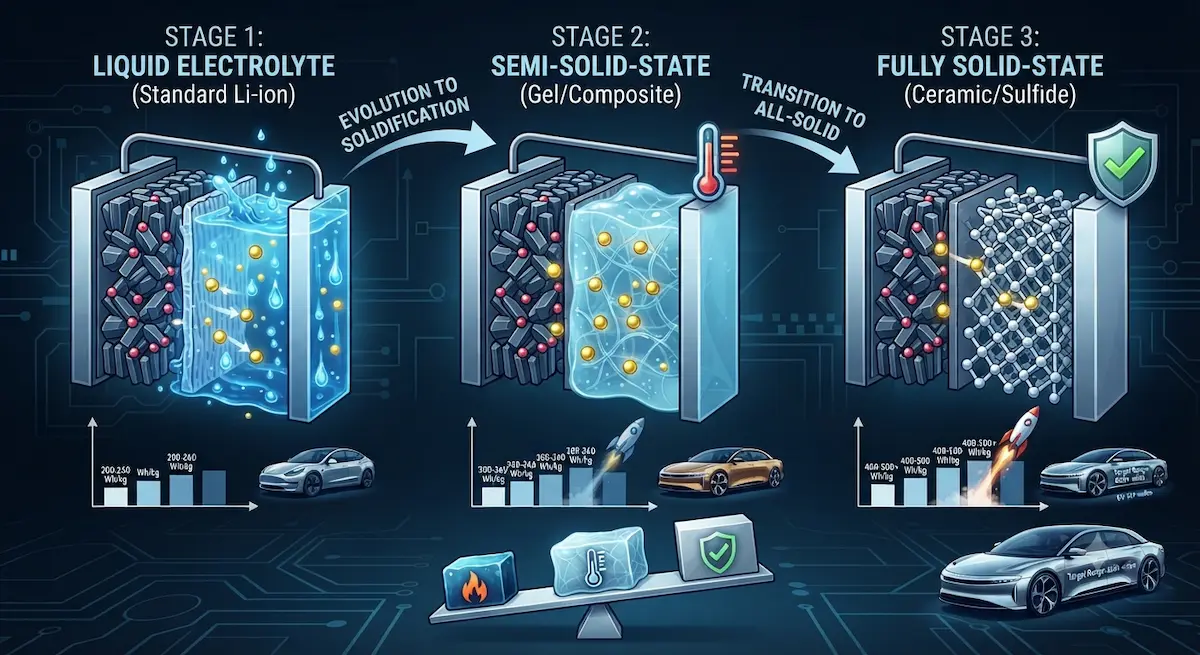
A semi-solid-state battery is a hybrid technology that sits between conventional liquid electrolyte lithium-ion batteries and fully solid-state batteries. Instead of using a completely liquid or completely solid electrolyte, it uses a gel, paste, or composite electrolyte—a mixture of solid particles and a small amount of liquid or polymer—that provides improved safety and energy density over standard liquid-electrolyte cells while being significantly more manufacturable than pure ceramic solid electrolytes. Semi-solid-state batteries are not a theoretical technology: they are already in limited commercial EV production in China, with NIO’s WeLion-supplied 150 kWh pack achieving 360 Wh/kg at the cell level and enabling over 1,000 km (621 miles) of CLTC range in testing.
CATL is pursuing a related but distinct approach — see our explainer on what CATL’s condensed battery technology is.
What Is a Semi-Solid-State Battery?
The term “semi-solid-state” covers a range of electrolyte designs, but all share the same fundamental concept: replacing 100% of the conventional liquid electrolyte with a material that is partly or mostly solid. Different manufacturers define “semi-solid” differently, but the common thread is a gel or composite electrolyte that:
- Contains significantly less free flammable organic liquid than standard liquid electrolyte cells — improving safety
- Provides better mechanical stability than pure liquid — enabling thinner cells and higher volumetric energy density
- Maintains higher ionic conductivity than fully solid ceramic electrolytes at room temperature — preserving fast-charging capability
- Can be manufactured using modified versions of existing lithium-ion production equipment — unlike ceramic solid electrolytes, which require entirely new processes
WeLion’s design for NIO uses a gel-like polymer electrolyte system — a solid electrolyte that has been partially plasticized to maintain adequate ionic conductivity at room temperature while eliminating the bulk of the flammable organic solvent present in standard liquid electrolyte cells. The cells also pair this semi-solid electrolyte with a silicon/graphite composite anode and an ultra-high-nickel cathode — combining three performance improvements simultaneously to achieve the 360 Wh/kg cell-level energy density.
How Semi-Solid Differs From Liquid and Fully Solid Electrolyte
| Property | Liquid Electrolyte (standard) | Semi-Solid Electrolyte | Fully Solid (ceramic) |
|---|---|---|---|
| Electrolyte state | 100% liquid organic solvent | Gel/composite — partial solid | 100% solid ceramic or sulfide |
| Flammability | Yes — flammable organic solvents | Significantly reduced | None — inorganic, non-flammable |
| Room-temp ionic conductivity | ~10–15 mS/cm (excellent) | ~1–10 mS/cm (good) | ~0.1–25 mS/cm (varies by type) |
| Energy density (cell level) | ~200–260 Wh/kg (NMC 811) | ~300–360 Wh/kg (NIO/WeLion) | ~400–500+ Wh/kg (target) |
| Manufacturing compatibility | Fully compatible with existing lines | Modified existing equipment | Requires entirely new equipment |
| Electrode contact | Excellent — self-wetting liquid | Good — gel conforms | Challenging — brittle ceramics |
| Lithium dendrite suppression | Poor — liquid allows growth | Better — gel slows dendrites | Best — dense solid blocks dendrites |
| Commercial EV status (2026) | Universal — all current EVs | Limited commercial (NIO, MG) | Pre-commercial (Toyota 2027–2028) |
NIO and WeLion: The First Commercial Semi-Solid EV Battery
The most commercially advanced semi-solid EV battery implementation is NIO’s 150 kWh pack, supplied by Beijing-based WeLion New Energy Technology, which has been producing semi-solid-state battery cells since December 2022. WeLion delivered its first batch of 360 Wh/kg semi-solid cells to NIO in June 2023, with series production beginning in April 2024. The cells feature:
- Cell-level energy density: 360 Wh/kg — one of the highest of any commercial automotive-grade battery cell globally
- Pack-level energy density: 260 Wh/kg (after modules, BMS, and casing weight)
- Pack capacity: 150 kWh
- Range: 1,044 km (648 miles) CLTC range in NIO ET7 sedan during real-world testing across Shanghai, Chengdu, and other Chinese cities
- Anode: Silicon-graphite composite — combining silicon-carbon’s higher capacity with graphite’s stability
- Cathode: Ultra-high-nickel NMC (specific composition undisclosed)
- Weight addition: Only 20 kg more than the previous-generation 100 kWh pack — extraordinary energy-per-kilogram improvement
The 360 Wh/kg cell energy density achieved by WeLion’s semi-solid cells is approximately 40–60% better than current commercial NMC 811 cells (~220–260 Wh/kg) — a remarkable improvement without the full manufacturing complexity of ceramic solid electrolytes. This makes semi-solid technology the most commercially advanced intermediate step between today’s liquid lithium-ion and tomorrow’s fully solid-state batteries.
However, the technology’s commercial trajectory has been complicated. NIO CEO William Li disclosed in November 2025 that production of the 150 kWh semi-solid pack had been discontinued after only a few hundred units due to lack of demand. The primary reason: the battery’s cost was too high for the market at that time, making the pack uncompetitive against NIO’s standard 100 kWh liquid electrolyte option. This commercial setback illustrates an important reality — technology readiness and economic readiness are different things. WeLion’s cells achieved impressive performance, but manufacturing semi-solid cells at cost-competitive prices against mature liquid electrolyte production remains a work in progress.
Other Semi-Solid Battery Programs
NIO and WeLion are not alone in the semi-solid battery space. Several other companies have announced or deployed semi-solid technology:
- Gotion Hi-Tech (China): Developed the G-Dome semi-solid cell, passing stringent nail penetration safety tests. Gotion planned a 12 GWh semi-solid production line by 2025. Its semi-solid cells are targeted at both EVs and energy storage applications, with the improved safety profile of the gel electrolyte being the key commercial advantage.
- MG (SAIC): Announced the MG Solidcore semi-solid battery — a commercialization step between liquid electrolyte and full solid-state. MG’s implementation uses a solid electrolyte mixed with gel components, explicitly described as “a step on the path to full solid-state” that provides improved safety and higher energy density than standard LFP while being manufacturable with modified existing equipment.
- CATL (semi-solid research): CATL has published research on composite solid-liquid electrolyte systems consistent with semi-solid approaches. While CATL’s primary solid-state roadmap targets full solid electrolytes, intermediate semi-solid designs are likely to appear in commercial products before full solid-state is ready.
- WeLion (independent): Beyond NIO supply, WeLion has announced plans to work with “leading international automakers” and is preparing for an IPO on China’s ChiNext market — suggesting the company sees broader market opportunities beyond the NIO partnership.
Why Semi-Solid Is Important for the EV Battery Transition
Semi-solid batteries occupy a strategically important position in the EV battery technology roadmap because they offer meaningful improvements over liquid electrolyte cells now, rather than in 2027–2030 when full solid-state commercializes. The technology hierarchy is:
- Stage 1 (now): Liquid electrolyte NMC/LFP — 200–260 Wh/kg, flammable, mass-market production
- Stage 2 (2024–2026): Semi-solid electrolyte with silicon-composite anode — 300–360 Wh/kg, reduced flammability, limited commercial production (NIO/WeLion)
- Stage 3 (2027–2030): Full solid-state with lithium metal anode — 400–500+ Wh/kg, non-flammable, initial commercial production (Toyota, QuantumScape)
- Stage 4 (2030s): Mature solid-state at scale — mainstream EV deployment at competitive costs
Semi-solid batteries in Stage 2 demonstrate that the performance benefits of electrolyte solidification are real and achievable before full solid-state manufacturing is ready. Every semi-solid EV that goes into production builds manufacturing experience, electrolyte optimization knowledge, and supply chain infrastructure that reduces the barriers for full solid-state deployment in Stage 3 and beyond. WeLion’s learning from the NIO 150 kWh pack — even the commercial disappointment of high costs — provides invaluable data on what semi-solid manufacturing must achieve to be economically viable, directing R&D toward cost reduction rather than performance improvement alone.
A solid electrolyte is also one of the leading proposed fixes for a much more exotic chemistry — see our explainer on what a lithium-sulfur battery for EVs is.
Semi-Solid Safety: The Reduced Fire Risk Advantage
One of semi-solid batteries’ most commercially compelling claims is significantly reduced fire risk compared to standard liquid electrolyte cells. By reducing or eliminating free organic solvent in the electrolyte, the amount of flammable material available for combustion in a thermal event is dramatically reduced. MG noted that liquid electrolyte accounts for approximately 20% of standard battery pack volume — and that volume is entirely composed of flammable organic solvents. Replacing that liquid volume with a gel or solid material reduces fire risk proportionally.
WeLion’s cells passed aggressive safety tests including nail penetration — a test where a nail is driven through a fully charged cell. Standard NMC cells fail this test catastrophically, catching fire or exploding. WeLion’s semi-solid cells reportedly produced no fire or explosion in nail penetration testing — a safety profile that normally only LFP or fully solid-state cells achieve. This safety advantage makes semi-solid technology particularly attractive for commercial fleet applications (taxis, buses, delivery vehicles) where thermal events have public safety implications, and for battery swapping applications where packs are regularly handled in relatively unsecured environments.
Frequently Asked Questions
What is a semi-solid-state battery?
A semi-solid-state battery uses a gel, paste, or composite electrolyte — partly solid, partly liquid or polymer — rather than a fully liquid or fully solid electrolyte. This provides improved safety (less flammable material) and higher energy density (300–360 Wh/kg cell-level, vs liquid electrolyte’s 200–260 Wh/kg) while remaining more manufacturable than ceramic solid electrolytes. NIO’s 150 kWh WeLion semi-solid pack is the most commercially advanced EV implementation, achieving 360 Wh/kg and 1,044 km CLTC range.
Is semi-solid-state the same as solid-state?
No — semi-solid and fully solid-state are distinct technologies at different maturity levels. Semi-solid retains some liquid or polymer component, achieving 300–360 Wh/kg but not fully eliminating flammability. Fully solid-state (Toyota, QuantumScape) uses zero liquid, enabling lithium metal anodes and 400–500+ Wh/kg — but requires entirely new manufacturing processes and is not yet commercially available. Semi-solid is the bridge technology between today’s liquid cells and tomorrow’s full solid-state.
Why did NIO stop producing semi-solid battery packs?
NIO CEO William Li disclosed in November 2025 that the 150 kWh WeLion semi-solid pack was discontinued after only a few hundred units due to lack of customer demand. The semi-solid pack’s high cost compared to NIO’s standard liquid electrolyte options made it economically uncompetitive for most buyers, despite its superior range and energy density. This highlights that semi-solid technology’s manufacturing cost must fall significantly — through production scale and process optimization — before it can achieve mainstream commercial deployment even in the premium EV segment.
Conclusion
Semi-solid-state batteries represent the most commercially advanced intermediate step between today’s liquid electrolyte lithium-ion batteries and tomorrow’s full solid-state batteries. WeLion’s 360 Wh/kg cells in NIO’s 150 kWh pack demonstrated that semi-solid technology can achieve energy densities 40–60% above current NMC 811 production cells — while providing improved safety through reduced flammable electrolyte content. The technology’s commercial challenge — manufacturing cost competitiveness — is the same challenge that every next-generation battery faces. As production scales at WeLion, Gotion, MG, and other semi-solid producers through 2026–2028, cost reduction will determine whether semi-solid emerges as the dominant intermediate technology or is leapfrogged by fully solid-state production arriving at competitive prices from Toyota, Samsung SDI, and QuantumScape in 2027–2030.
Curious about another emerging cell architecture entirely? See our explainer on what a dual-ion battery chemistry is.
