
What Is a Lithium-Air Battery? Could It Power EVs?

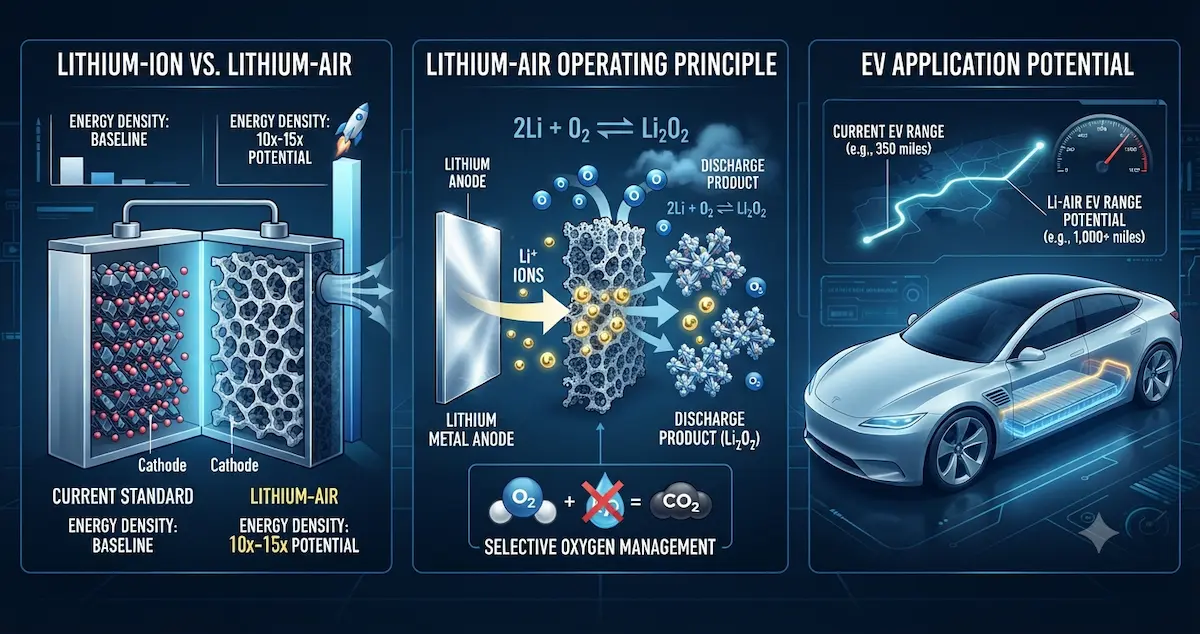
A lithium-air (Li-Air) battery uses oxygen from the ambient air as the cathode reactant — rather than a solid cathode material — giving it a theoretical energy density of approximately 3,500 Wh/kg, comparable to gasoline on a mass basis and roughly 10–15x higher than current lithium-ion batteries. If commercialized, a lithium-air battery could power an EV for 1,000+ miles on a single charge. Despite this extraordinary potential, lithium-air remains one of the most technically challenging battery chemistries in existence — with fundamental scientific problems in electrolyte stability, reaction products, and electrode management that have kept it in laboratory research stages for decades. As of 2026, no lithium-air EV battery is close to commercial deployment.
A nearer-term exotic conversion chemistry chasing similar goals is explored in our guide on what a lithium-sulfur battery for EVs is.
How Lithium-Air Batteries Work
A lithium-air battery operates on a fundamentally different principle from lithium-ion. Instead of a solid cathode storing lithium in a crystalline structure, lithium-air uses the oxygen in air as the cathode reactant:
- Anode: Lithium metal (Li⁰) — same as solid-state batteries
- Cathode: Porous carbon or other material that serves as a reaction site for oxygen from air
- Discharge reaction: Lithium oxidizes at the anode (Li → Li⁺ + e⁻), and oxygen from air is reduced at the cathode (O₂ + 2e⁻ → O₂²⁻). These react to form lithium peroxide (Li₂O₂) or lithium oxide (Li₂O) deposits in the cathode pores.
- Charging reaction: The discharge products are electrochemically decomposed back to lithium metal and oxygen gas
The theoretical energy density advantage comes from the fact that the cathode material (oxygen) doesn’t need to be stored in the battery — it’s drawn from ambient air during discharge. The battery only needs to store the anode (lithium metal) and the porous cathode structure — dramatically reducing weight per unit of energy compared to any battery that must carry both electrodes.
The Staggering Energy Density Potential
Lithium-air’s theoretical gravimetric energy density of ~3,500 Wh/kg (based on lithium weight only, excluding cathode and packaging) approaches that of gasoline (~12,000 Wh/kg combustion energy, ~3,000 Wh/kg practical drivetrain energy). For EV context:
- Current NMC 811 cells: ~220–260 Wh/kg → 300–360 miles in a typical EV
- Lithium-air theoretical: ~3,500 Wh/kg → potentially 4,000–5,000 miles from the same pack weight
- Practical lithium-air (if commercialized): likely 600–1,500 Wh/kg practical → 800–2,000+ miles from a standard EV pack
Even at 10% of theoretical efficiency — 350 Wh/kg practical — lithium-air would match NMC 811. At 30% efficiency (~1,000 Wh/kg practical), it would enable 1,000+ mile EVs. These numbers explain why lithium-air receives substantial research funding despite its current technical immaturity — the potential payoff is transformative.
The Core Technical Challenges
1. Li₂O₂ Accumulation Clogs the Cathode
The discharge product, lithium peroxide (Li₂O₂), is a solid that precipitates within the porous cathode as the battery discharges. As discharge continues, Li₂O₂ accumulates, filling the cathode pores and eventually blocking further oxygen access — limiting the practical capacity to a fraction of theoretical. For full capacity realization, all Li₂O₂ must be decomposed back to lithium and oxygen during charging — but Li₂O₂ is electrically insulating and chemically stable, making its complete electrochemical decomposition difficult, slow, and energy-intensive.
2. Electrolyte Instability
The highly reactive intermediates generated during lithium-air discharge — superoxide radicals (O₂⁻), peroxide ions — attack virtually all organic liquid electrolytes, rapidly degrading them. This is why standard lithium-ion electrolytes (LiPF₆ in organic carbonates) are completely incompatible with lithium-air chemistry. Research has explored ionic liquid electrolytes, DMSO-based electrolytes, and various other solvents — but none has yet demonstrated adequate stability for thousands of cycles at practical rates. Solid electrolytes offer a potential solution by replacing the reactive organic liquid entirely, but this compounds the manufacturing challenge of solid-state batteries with lithium-air’s already severe cathode challenges.
3. Oxygen Management
Real ambient air contains water vapor and CO₂ alongside oxygen — both of which react destructively with lithium metal and lithium peroxide discharge products. Water produces lithium hydroxide (LiOH) that is difficult to reverse electrochemically; CO₂ produces lithium carbonate (Li₂CO₃) that is even harder to decompose during charging. Practical lithium-air EVs would require either an oxygen purification system (adding weight, cost, and complexity) or electrode/electrolyte designs that selectively allow oxygen while blocking water and CO₂ — a materials challenge without an adequate solution as of 2026.
4. Lithium Metal Anode Challenges
Like solid-state batteries, lithium-air requires a lithium metal anode — with all the associated dendrite formation and reactive surface challenges. In lithium-air cells, the problem is compounded by the highly oxidizing environment created by oxygen intermediates during discharge — creating additional parasitic reactions at the lithium surface beyond those seen in conventional liquid electrolyte cells.
Solid electrolytes are one proposed path around this reactivity — see our explainer on what a semi-solid-state battery is.
Current Status: Research Stage Only
As of mid-2026, all lithium-air battery development is at laboratory research stage. Key milestones from recent research:
- IBM Research: Demonstrated lithium-air cells reaching 700 Wh/kg practical in lab conditions with a water-based electrolyte — addressing the carbonate formation problem by using lithium iodide as a redox mediator
- MIT research: Identified solid lithium superoxide (LiO₂) as an alternative discharge product that is easier to reverse electrochemically — potentially a path to better cyclability
- Cambridge and Oxford research: Demonstrated improved cycle life (50–100 cycles) using reduced graphene oxide cathodes and DMSO electrolytes — progress but far from commercial requirements
- No commercial EV deployment: No automaker has announced a timeline for lithium-air EV deployment. The technology is generally considered a 2035+ possibility at the earliest for commercial deployment, pending fundamental breakthroughs in electrolyte stability and cathode management.
Lithium-Air vs Other Next-Generation Chemistries
| Chemistry | Theoretical Energy Density | Practical Target | Commercial EV Timeline | Maturity |
|---|---|---|---|---|
| Lithium-Air | ~3,500 Wh/kg | 600–1,500 Wh/kg (if solved) | 2035+ (speculative) | Lab research only |
| Lithium-Sulfur | ~2,500 Wh/kg | 350–500 Wh/kg | 2028–2030 (targeted) | Advanced research/pilot |
| Solid-State (Li metal) | ~400–500 Wh/kg | 400–500 Wh/kg | 2027–2028 (Toyota target) | Pilot production |
| NMC 811 (current) | ~260 Wh/kg | 220–260 Wh/kg | Commercial now | Fully commercial |
Frequently Asked Questions
What is a lithium-air battery and could it power EVs?
A lithium-air battery uses ambient oxygen as the cathode reactant — achieving theoretical energy density of ~3,500 Wh/kg, roughly 10–15x current lithium-ion. If commercialized, it could power EVs for 1,000+ miles per charge. As of 2026, lithium-air remains at laboratory research stage due to fundamental challenges with electrolyte instability, discharge product accumulation, and oxygen management. No commercial EV deployment timeline exists — 2035+ is speculative for practical applications.
Why can’t lithium-air batteries be used in EVs today?
Four unresolved problems: discharge product (Li₂O₂) clogs the cathode pores and is difficult to reverse electrochemically; all practical electrolytes are attacked by reactive oxygen intermediates during discharge; ambient air’s CO₂ and water vapor react destructively with lithium and discharge products; and the lithium metal anode forms dendrites. None of these has an adequate solution at practical cycle counts and energy densities for EV applications as of 2026.
Is lithium-air better than solid-state for EVs?
Lithium-air has dramatically higher theoretical energy density (~3,500 Wh/kg vs solid-state’s ~400–500 Wh/kg practical). However, solid-state batteries are vastly more commercially mature — Toyota is targeting 2027–2028 commercial deployment, while lithium-air has no realistic commercial EV timeline before 2035 at the earliest. For EV buyers, solid-state is the relevant next-generation technology; lithium-air remains a long-term research goal.
Conclusion
Lithium-air batteries represent the ultimate long-term vision for EV energy storage — theoretical energy densities comparable to gasoline, using oxygen from air as the cathode with no heavy cathode material to carry. The potential is transformative: EVs with 1,000+ mile range from standard-size packs. The reality in 2026 is that fundamental scientific challenges — electrolyte instability, discharge product management, and oxygen selectivity — remain unsolved for practical, long-cycle-life EV applications. Lithium-air is the battery chemistry that could one day make lithium-sulfur look low-energy. But it is also the chemistry that requires the most scientific progress before becoming practically relevant for electric vehicles. Research continues, progress is real, but commercial EV deployment remains firmly in the post-2030 realm.
For a much cheaper (if lower-density) alternative already reaching grid and early EV use, see our guide on what iron-air batteries are and whether they’re for EVs.
