
What Is the Range of a Sodium-Ion EV Battery?

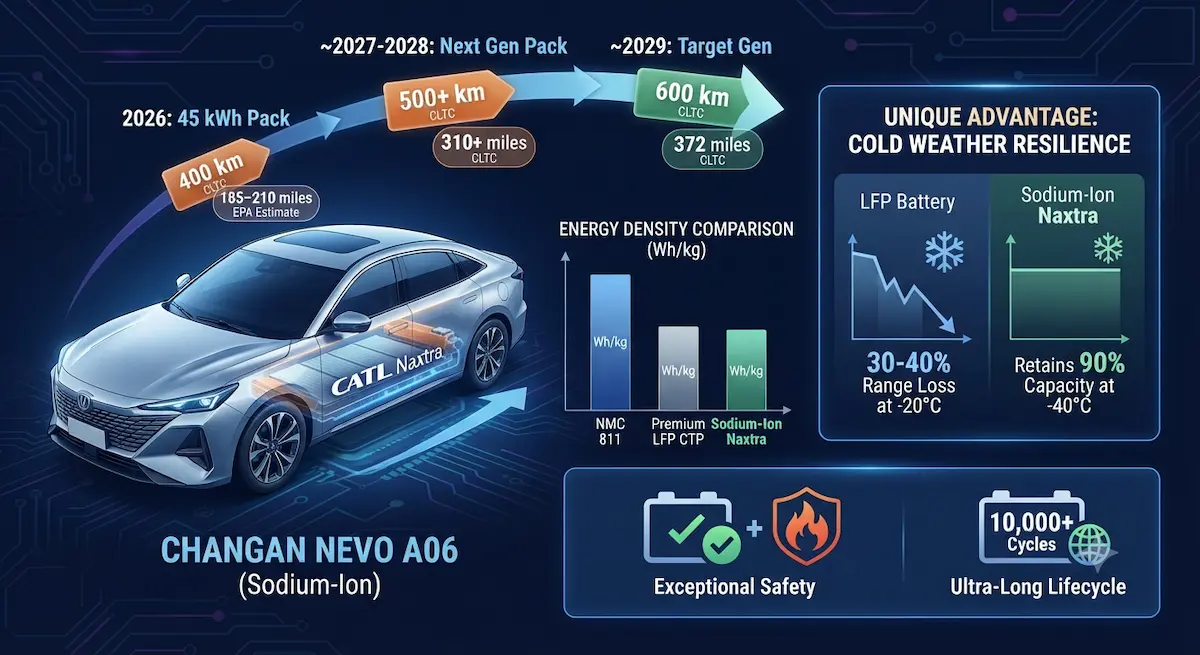
The first mass-produced sodium-ion EV — the Changan Nevo A06 — delivers approximately 248 miles (400 km) on China’s CLTC test cycle using CATL’s Naxtra 45 kWh sodium-ion battery pack. CATL’s next-generation sodium-ion supports over 500 km (310 miles) of CLTC range, with a target of 600 km (372 miles) as energy density improves toward LFP-equivalent levels. For U.S. drivers, sodium-ion range is currently competitive with entry-level EVs — and improving rapidly with each generation.
New to sodium-ion itself? Start with our full explainer on what a sodium-ion battery for electric cars is.
Current Sodium-Ion EV Range: Real Numbers
| Vehicle / Battery | Pack Size | Range (CLTC) | Approx. US EPA Equivalent |
|---|---|---|---|
| Changan Nevo A06 (Naxtra) | 45 kWh | ~400 km (248 mi) | ~185–210 miles |
| CATL Naxtra Gen 2 (announced) | Not disclosed | 500+ km (310+ mi) | ~235–260 miles |
| CATL sodium-ion target (2029) | Not disclosed | 600 km (372 mi) | ~280–310 miles |
| BAIC sodium-ion EV (2026) | Not disclosed | 450 km (280 mi) | ~210–235 miles |
Note: CLTC (China Light-Duty Vehicle Test Cycle) typically reads 10–20% higher than EPA-equivalent real-world range. U.S. EPA equivalents are estimated conversions.
Why Sodium-Ion Has Lower Range Than LFP or NMC
Sodium-ion’s current range limitation is purely a function of energy density — and energy density is constrained by fundamental electrochemistry. Sodium ions are larger (ionic radius 1.02 Å vs 0.76 Å for lithium) and heavier (sodium is 23 g/mol vs lithium’s 6.9 g/mol). These physical differences mean sodium-ion cathode materials store less energy per gram than equivalent lithium-ion cathodes at the same mass.
CATL’s Naxtra achieves 175 Wh/kg at the cell level — the highest achieved in mass production for sodium chemistry. This places it at approximately the same level as entry-grade LFP cells, though below premium LFP Cell-to-Pack designs (140–165 Wh/kg at pack level using CTP) and far below NMC 811 (~220–260 Wh/kg). The energy density gap is real and rooted in physics — but it is not as large as commonly assumed, and it continues to narrow as cathode and anode materials improve.
How CATL Is Increasing Sodium-Ion Range
CATL’s chief scientist Wu Kai confirmed in April 2026 that the company targets LFP-equivalent energy density — enabling 600 km CLTC range — within approximately three years. The technical roadmap involves:
- Improved cathode materials: Moving from early layered sodium transition metal oxides toward optimized compositions with higher sodium storage capacity per gram. CATL has been exploring manganese-rich, copper-doped, and other cathode configurations that push sodium-ion cell capacity closer to LFP’s ~160–170 mAh/g
- Hard carbon anode optimization: Hard carbon’s sodium storage capacity and first-cycle efficiency are both improving with pore structure engineering and surface coating technologies — contributing to cell-level energy density improvements
- Cell-to-Pack design: Just as BYD’s blade battery used CTP to close LFP’s energy density gap with NMC at the pack level, CATL can apply similar pack architecture optimization to sodium-ion — extracting more range from cells at the system level without improving cell chemistry at all
- Larger pack sizes: Simply increasing pack size from 45 kWh to 60–70 kWh would bring sodium-ion range to 310–372 miles CLTC (230–280 miles EPA equivalent) without any cell-level improvement
What Sodium-Ion Range Covers in Real U.S. Driving
Current sodium-ion vehicles (~185–210 miles EPA equivalent) comfortably cover the vast majority of American daily driving needs. The Federal Highway Administration’s National Household Travel Survey found that 95% of U.S. car trips are under 30 miles, and the average American drives approximately 37 miles per day. At 185–210 miles EPA range, a sodium-ion EV provides more than five days of average American driving on a single charge — far exceeding the practical daily requirement for most households.
Where sodium-ion range becomes a practical limitation is long-distance road trip driving. A 185-mile EPA range EV would need to stop to charge every 140–160 miles on an interstate highway trip (using 80% of rated range for a comfortable buffer). For a 600-mile journey, that means three charging stops instead of two for a 250-mile NMC EV. For daily drivers who charge at home, this limitation is essentially invisible. For frequent road-trippers, it remains a relevant consideration — though the next generation of sodium-ion targeting 250+ miles EPA equivalent closes this gap significantly.
Sodium-Ion’s Unique Range Advantage: Cold Weather
Sodium-ion’s range story has an important twist in cold climates. While LFP and NMC EVs lose 15–35% of their rated range in cold weather, CATL’s Naxtra sodium-ion battery retains approximately 90% capacity at -40°C. At -30°C, CATL claims Naxtra delivers nearly triple the discharge power of a comparable LFP pack. This cold weather resilience means that in cold climates — Scandinavia, northern Canada, Alaska, Minnesota, Michigan — the effective real-world range of a sodium-ion EV in winter is significantly better than an LFP EV, even if the nominal (room temperature) range is slightly lower on paper.
See the full data behind this cold-weather advantage in our guide on whether sodium-ion battery works better in cold weather.
For a driver in Minneapolis who experiences -20°F winters regularly, a sodium-ion EV retaining 90%+ capacity at that temperature delivers meaningfully better winter range than an LFP EV losing 30–40% of its rated capacity. This cold-weather range resilience is one of sodium-ion’s most compelling real-world advantages — and it makes comparing nominal EPA ranges between sodium-ion and LFP misleading for cold-climate buyers specifically.
Safety and Range: The Combined Benefit
CATL’s Naxtra sodium-ion battery passed China’s new national safety standard (GB 38031-2025) in September 2025 — the first sodium-ion battery to meet this certification. In crush, puncture, and saw tests, the Naxtra produced no smoke or flames — matching and in some cases exceeding LFP’s already excellent safety profile. This means sodium-ion delivers its 248-mile range with the same fundamental fire-safety advantage as LFP — no oxygen release from the cathode, non-flammable electrode materials, and extremely stable chemistry under mechanical stress. For applications where both range and safety matter — urban taxis, ride-share fleets, family vehicles — sodium-ion’s combination of adequate range, cold weather resilience, and excellent safety is a genuinely compelling package.
The 10,000-Cycle Lifecycle Advantage
BYD’s third-generation sodium-ion platform achieves over 10,000 charge cycles — the highest cycle life of any mass-produced EV battery chemistry. At 248 miles per full charge, 10,000 cycles represents 2.48 million miles of theoretical range before reaching 80% capacity — making sodium-ion’s cycle life extraordinary even at its current range per cycle. For commercial fleet use where vehicles accumulate high mileage rapidly, sodium-ion’s combination of adequate range and exceptional cycle life creates a total cost of ownership argument that may exceed LFP’s already strong fleet economics.
Frequently Asked Questions
What is the range of a sodium-ion EV battery?
Current sodium-ion EVs (2026) deliver approximately 248 miles (400 km CLTC) from a 45 kWh pack in the Changan Nevo A06. CATL’s next-generation Naxtra targets 500+ km CLTC (310+ miles) with 600 km (372 miles) achievable as energy density approaches LFP levels — CATL’s stated target within three years.
Can a sodium-ion EV handle a road trip?
Yes — with slightly more charging stops than a comparable NMC EV. At 185–210 miles EPA equivalent range (current generation), a sodium-ion EV handles road trips with one additional charging stop per 600-mile journey compared to a 300-mile NMC EV. The next generation targeting 250+ miles EPA equivalent narrows this gap further. In very cold weather, sodium-ion’s superior cold performance means real-world road trip range may actually exceed an LFP alternative of similar nominal spec.
Is sodium-ion range good enough for the U.S. market?
For daily driving, yes — comfortably. 95% of U.S. car trips are under 30 miles; 185–210 miles covers average American driving for five-plus days on one charge. For frequent road-trippers who regularly drive 300+ miles between charging stops, current sodium-ion range is somewhat limiting. The next generation at 250+ miles EPA equivalent addresses this for most road trip scenarios.
Conclusion
The range of a sodium-ion EV battery is approximately 248 miles CLTC (185–210 miles EPA equivalent) in first-generation commercial vehicles — adequate for the vast majority of daily American driving needs. CATL is targeting 600 km CLTC (370+ miles) within three years as cell energy density approaches LFP levels. The cold-weather range story is sodium-ion’s most underrated advantage: retaining 90% capacity at -40°C means sodium-ion’s winter real-world range outperforms LFP significantly in cold climates, even at lower nominal ratings. Combined with BYD’s 10,000-cycle life and exceptional safety, sodium-ion’s range proposition will only strengthen as the chemistry matures through the late 2020s.
Curious which specific EVs deliver this range today? See our list of which EVs use sodium-ion batteries.
