
What Is a Graphite Anode in an EV Battery?

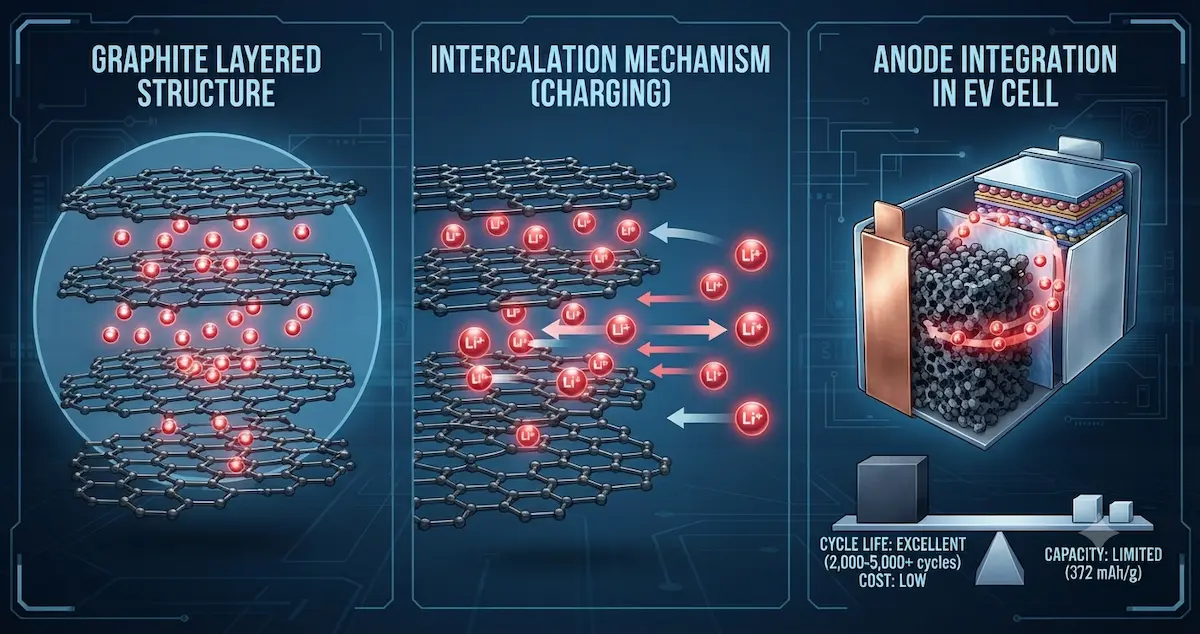
Graphite is the anode material in virtually every commercial EV battery today. When you charge your electric vehicle, lithium ions travel from the cathode, through the electrolyte, and intercalate into the layered carbon structure of the graphite anode — storing energy like books being slid between tightly stacked shelves. When you drive, those lithium ions slide back out, generating the electron flow that powers the motor. Graphite has been the dominant anode material in lithium-ion batteries since their commercialisation in 1991 — not because it is the highest-performing option, but because it offers an exceptional combination of stability, affordability, and cycle durability that no alternative has yet matched at commercial scale for mainstream EV applications.
Curious about the higher-capacity alternative entering production now? See our full explainer on what a silicon anode battery is.
What Is Graphite and Why Is It Used in EV Anodes?
Graphite is a crystalline form of carbon with a distinctive layered structure — sheets of carbon atoms (graphene layers) arranged in a hexagonal lattice and stacked in parallel planes. The spaces between these graphene layers — called the interlayer spacing (approximately 3.35 Ångstroms) — are where lithium ions reside during charging. This process of lithium ions inserting between the graphene layers is called intercalation, and the reverse process when they exit during discharge is called de-intercalation. Both processes are highly reversible — graphite can accept and release lithium ions thousands of times with minimal structural damage, which is the fundamental reason it enables such excellent battery cycle life.
The theoretical maximum lithium storage in graphite is one lithium atom per six carbon atoms — written as LiC₆. This gives graphite a theoretical specific capacity of 372 mAh/g. In commercial EV cells, actual usable capacity is typically 340–360 mAh/g — very close to the theoretical limit, indicating that graphite is well-optimised as a material. The layered carbon structure provides flat voltage profile during charging (near 0V vs Li/Li⁺), high electronic conductivity, excellent chemical stability against the electrolyte (once the SEI forms), and mechanical robustness — all properties that proved impossible to match simultaneously in alternative anode materials until silicon-carbon composites began reaching commercial maturity in the mid-2020s.
Natural vs Synthetic Graphite: Two Types in EV Batteries
There are two forms of graphite used in EV battery anodes — natural and synthetic — and both are widely used in commercial production. They differ in source, processing, performance, and cost:
Natural Graphite
Mined from geological deposits and purified to battery grade (typically >99.9% carbon purity). The largest natural graphite deposits are in China (~65% of global supply), Mozambique, Madagascar, and Tanzania. China controls approximately 65% of natural graphite supply and approximately 80% of battery-grade graphite processing capacity globally. Natural graphite has a highly ordered crystal structure ideal for lithium intercalation — excellent capacity and rate performance. It is generally cheaper per kilogram than synthetic graphite. The supply chain concentration in China is a significant geopolitical risk for Western EV manufacturers — a factor driving U.S. and European investment in domestic graphite processing and synthetic graphite alternatives.
Synthetic Graphite
Manufactured from petroleum coke or coal tar pitch through a high-temperature graphitisation process (above 2,800°C). Synthetic graphite can be engineered with precisely controlled particle size, porosity, and crystal structure — enabling optimisation for specific cell chemistries and performance targets. It is purer and more consistent than natural graphite but costs approximately 2–3x more per kilogram. Tesla uses synthetic graphite from Panasonic’s Nevada Gigafactory production. Premium fast-charging cells increasingly use synthetic graphite because its engineered structure allows more controlled lithium intercalation at high charge rates — reducing lithium plating risk during fast charging.
How Much Graphite Is in an EV Battery?
A typical 75 kWh EV battery contains approximately 70 kilograms of graphite in the anode — more by weight than any other single active material in the cell. To put this in perspective:
- 70 kg graphite per 75 kWh vehicle
- ~12 kg lithium (in cathode and electrolyte combined)
- ~50 kg nickel (for NMC 811 cathode)
- ~4.5 kg cobalt (NMC 811)
Graphite’s dominance by weight reflects the cathode-anode capacity balance required in cell design. The anode must have sufficient capacity to store all the lithium from the charged cathode — and since graphite’s theoretical capacity (372 mAh/g) is somewhat lower than high-nickel NMC cathodes’ practical capacity, a larger mass of graphite is needed. This ratio — called the N/P ratio (negative to positive electrode capacity ratio) — is typically 1.05–1.15 in commercial EV cells, meaning there’s always slightly more anode capacity than cathode capacity to prevent lithium plating on the anode surface.
Graphite’s Key Advantages as an Anode Material
- Excellent cycle life: The intercalation mechanism causes minimal graphite structural change per cycle — enabling 2,000–5,000+ cycles before significant capacity loss. The layered structure accommodates lithium without the catastrophic volume expansion that plagues alternative materials like silicon
- Low operating voltage vs Li/Li⁺: Graphite operates at ~0.05–0.3V vs Li/Li⁺ — very close to metallic lithium’s potential. This maximises the cell voltage difference between cathode and anode, maximising energy density
- Good rate capability: Lithium ions diffuse quickly between graphene layers in properly oriented graphite — enabling fast charge acceptance. Engineered synthetic graphite with optimised particle size and porosity can accept even higher charge rates
- Low cost and mature supply chain: At approximately $6–10/kg for battery-grade graphite, it is far cheaper than cathode materials. Decades of production experience have optimised processing, purification, and electrode coating
- Chemical stability: Once the protective SEI layer forms on the first charge, graphite is highly stable against electrolyte attack — maintaining performance over thousands of cycles
Graphite’s Limitations
Despite its dominance, graphite has three meaningful limitations that are driving research into alternatives:
- Limited theoretical capacity (372 mAh/g): This is already close to the practical maximum for graphite — meaning further improvements in energy density must come from the cathode or from replacing graphite with a higher-capacity anode material. Silicon’s theoretical capacity of 4,200 mAh/g (11x higher) makes it the most pursued alternative
- Lithium plating at high charge rates: At very high charge currents or below 0°C, lithium deposits on the graphite surface as metallic lithium (lithium plating) rather than intercalating between the layers. This plating is irreversible — it permanently reduces capacity and in severe cases creates lithium dendrites that can cause cell failure. This is why BMS systems limit charging speed in cold weather and why ultra-fast charging (beyond ~4C rate) is difficult with graphite anodes. See our full explainer on what causes lithium plating in EV batteries
- Supply chain concentration: China controls ~65% of natural graphite supply and ~80% of processing capacity. The U.S. Department of Energy listed graphite as a critical mineral in 2022. New U.S. graphite processing facilities are planned or under construction, but domestic self-sufficiency is years away
Graphite vs Emerging Anode Alternatives
| Property | Graphite | Silicon (pure) | Silicon-Carbon Composite | Lithium Metal |
|---|---|---|---|---|
| Theoretical capacity | 372 mAh/g | 4,200 mAh/g (11x) | 400–1,000+ mAh/g | 3,860 mAh/g (10x) |
| Volume expansion | ~10% per cycle | ~400% per cycle | ~50–150% (managed) | 100% (dendrite risk) |
| Cycle life | Excellent (2,000–5,000+) | Poor (rapid cracking) | Good (improving) | Moderate (dendrite failure) |
| Commercial status (2026) | Universal in all EVs | Not commercially viable alone | Commercial (BYD Gen 2, Panasonic) | Solid-state batteries only |
| Cost | ~$6–10/kg | Higher | Higher ($15–30/kg) | Much higher |
Frequently Asked Questions
What is a graphite anode in an EV battery?
The graphite anode is the negative electrode in an EV battery — the material where lithium ions are stored during charging. When you plug in your EV, lithium ions intercalate (slot between) graphite’s layered carbon structure. When you drive, they de-intercalate and return to the cathode, releasing electrons that power the motor. Graphite is used because it provides an excellent balance of cycle life, capacity, cost, and chemical stability — making it the universal anode choice for all commercial EV batteries today.
How many cycles can a graphite anode withstand?
Commercial EV graphite anodes typically support 1,000–5,000+ cycles before significant capacity degradation, depending on the cathode chemistry paired with it. LFP cathodes (with their lower operating voltage) allow the graphite anode to remain at lower stress states — contributing to LFP’s superior cycle life vs NMC. The graphite anode itself is rarely the limiting factor for cycle life — cathode degradation and electrolyte decomposition at the anode surface (SEI growth) typically limit cycle life before the graphite structure fails.
Will graphite anodes be replaced by silicon?
Not replaced — but supplemented. Pure silicon anodes are commercially unviable due to 400% volume expansion that causes rapid structural failure. Silicon-carbon composite anodes (blending silicon nanoparticles into graphite) are entering commercial production — BYD’s Gen 2 Blade Battery (2026) and Panasonic’s next-gen 4680 cells use silicon-carbon composites to boost energy density. These composites add 5–20% silicon content to gain 15–50% energy density improvement while retaining graphite’s structural stability. Graphite will remain the dominant anode material through the rest of this decade.
Conclusion
Graphite’s role as the universal EV battery anode material reflects its unique combination of properties: reversible lithium intercalation over thousands of cycles, low cost, good rate capability, and a mature supply chain. Its 372 mAh/g theoretical capacity limit and vulnerability to lithium plating at high charge rates are the key limitations driving silicon-carbon composite development. As silicon content in composite anodes rises from 5% toward 20%+ over the next generation of cells, graphite will gradually cede ground as the sole anode component — but will remain a critical component of composite anodes for the foreseeable future. The graphite supply chain’s concentration in China represents the most significant non-technical risk to this otherwise well-established technology.
See the full head-to-head breakdown of these two anode materials in our guide on silicon vs graphite anode: which is better for EVs.
