
What Causes Lithium Plating in EV Batteries?

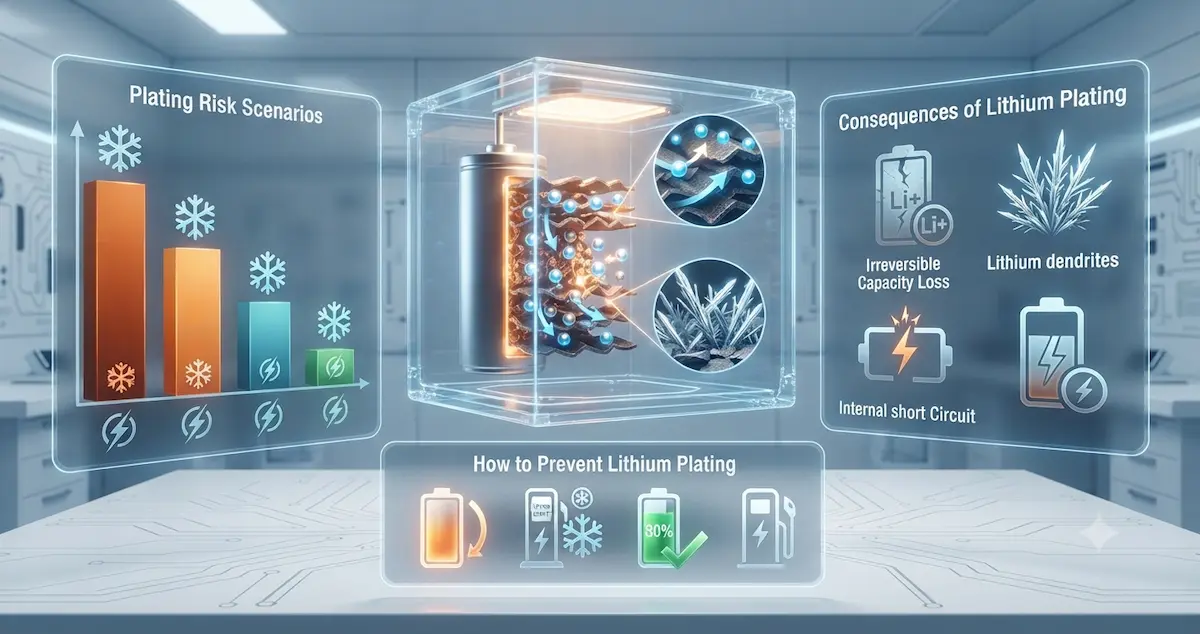
Fast-charge a stone-cold battery and something quiet goes wrong inside it: lithium that should have slipped into the graphite instead piles up on its surface as metal. That coating is lithium plating — one of the fastest ways to age an EV battery, and one your car spends a surprising amount of effort preventing.
Lithium plating happens when charging pushes lithium ions at the graphite anode faster than it can absorb them, so they deposit as metallic lithium on the surface instead of intercalating into it. The three triggers are charging a cold pack (the risk rises sharply below about 5°C / 41°F, and charging below freezing should not happen at all), charging at high current, and charging into a nearly full battery. Some plated lithium re-enters the anode as the pack warms; the rest is permanent loss. Your EV’s battery management system fights it constantly — slowing cold charging, capping voltage and warming the pack before a fast charge.
Plated lithium also disrupts the anode’s protective coating — see our explainer on what SEI layer formation is in EV batteries.
The Fundamental Mechanism: When Intercalation Fails
During normal charging, lithium ions (Li⁺) travel from the cathode through the electrolyte and intercalate into the graphite anode — slotting between graphene layers in an ordered, reversible process. The graphite anode operates at a very low electrochemical potential (~0.05–0.3V vs Li/Li⁺) — close to but above the potential at which metallic lithium (Li⁰) deposits (0V vs Li/Li⁺). As long as lithium ions can intercalate into graphite faster than they arrive, the anode potential stays above 0V and no metallic lithium forms.
Lithium plating occurs when this balance tips: lithium ions arrive at the anode surface faster than they can intercalate between graphene layers. The excess Li⁺ ions cannot wait indefinitely — at some point, the anode potential drops toward 0V vs Li/Li⁺, and lithium ions begin depositing as metallic lithium metal (Li⁰) on the graphite surface instead of intercalating into it. This metallic lithium deposit is the plated layer — “plating” because the lithium metal coats the graphite like an electroplated metal film.
The intercalation rate is determined by two kinetic processes: (1) lithium ion diffusion through the electrolyte to the anode surface, and (2) solid-state diffusion of lithium ions through the graphite particle from the surface to the interior. Both processes slow dramatically at low temperatures and become overwhelmed at very high charge currents. When either bottleneck is severe enough, plating begins.
The tripwire is electrical. Plating starts when the anode’s potential is pushed down to the potential of metallic lithium itself — 0 volts against a lithium reference (Ossila’s explainer states the threshold plainly). Graphite makes this easy to trip: fully charged graphite sits within about 100 millivolts of that line (Yang et al., 2018), so cold, speed or a nearly full pack only has to push it a short distance.
What Causes Lithium Plating in EV Batteries
1. Cold Temperature Charging
Cold temperatures are the most common cause of lithium plating in real-world EV use. Below approximately 15°C (59°F), lithium ion diffusion through both the liquid electrolyte and graphite particles slows significantly. The rate of intercalation decreases exponentially with temperature — at -10°C, intercalation kinetics may be 10–20x slower than at 25°C. This means that a charge rate that is perfectly safe at 25°C can cause lithium plating at -10°C because the graphite simply cannot absorb lithium ions fast enough.
This is why EV battery management systems (BMS) automatically reduce maximum charging current at cold temperatures — preventing the charge rate from exceeding what the anode can safely intercalate. An EV that accepts 250 kW at 25°C may limit to 50–100 kW at -5°C to prevent plating. The same charge current that is completely safe in summer becomes plating-inducing in winter. Battery preconditioning — warming the battery to 25–35°C before starting a DC fast charge — restores full charge rate capability by eliminating the cold-induced kinetic bottleneck.
Battery University’s charging limits put the safe charge range at 0–45°C (32–113°F), fast charging at 5–45°C, reduced current below 5°C — and no charging below freezing at all, because that is where plating sets in. For best results it narrows the band further, to 10–30°C.
How fast the safe rate collapses is the part owners never see. Yang and colleagues (PNAS, 2018) put it in one line: a cell that happily takes a 4C charge at 25°C can only be allowed 1.5C at 10°C — and barely C/1.5 at 0°C — if plating is to be avoided. Same battery, same charger; the cold alone removes most of the speed.
2. Excessive Charge Rate (High C-Rate Charging)
At charging rates above approximately 1C (charging the full battery in one hour), lithium ion delivery to the anode surface exceeds graphite’s intercalation capacity. Even at room temperature, very high charge currents overwhelm the solid-state diffusion limitation in graphite particles. Standard 150–350 kW DC fast chargers operate at approximately 1–3C for a typical 75 kWh EV — already approaching the threshold where electrode design and electrolyte formulation must be carefully optimized to prevent plating. Ultra-fast chargers above 350 kW (4C and higher) make lithium plating management the critical limiting factor — explaining why such extreme charging speeds require advanced electrode designs (silicon-carbon anodes, optimized graphite microstructure, high-conductivity electrolytes) rather than just higher power electronics. Cold is the classic trigger, but it is not the only one: at moderate temperatures, an excessive current alone can push the anode to the plating threshold.
3. High State of Charge Charging
As the graphite anode approaches full charge (near 100% SoC), available intercalation sites become scarce. Li⁺ ions find it increasingly difficult to locate empty sites between graphene layers — the “vacant parking spots” for lithium are almost full. This increased difficulty of intercalation as the anode fills means the effective intercalation rate decreases near full charge, even at constant charging current. This is why fast charging above 80% SoC is slower and more plating-prone — the BMS reduces charging current in the upper 20% of SoC not just to protect the cathode but to prevent anode plating as well. The combination of high SoC + cold temperature + high charging rate creates the maximum plating risk scenario. Near 100%, the graphite’s open sites effectively run out, so arriving ions have nowhere to go but the surface.
4. Anode Electrode Inhomogeneity
Research from Queen Mary University of London (published in Nature Communications) identified anode microstructure inhomogeneity as a key contributor to lithium plating. The graphite anode is composed of randomly distributed particles of varying size and orientation. In a homogeneous ideal electrode, lithium would distribute evenly across all particles simultaneously. In real electrodes, some regions of the electrode reach full intercalation capacity before others — causing local anode potential to drop to 0V in those regions while the overall SoC is still well below 100%. These locally saturated regions experience lithium plating while adjacent regions still have available intercalation capacity. Optimizing graphite particle size distribution, orientation, and porosity to minimize this inhomogeneity is one of the primary routes to enabling faster charging without plating.
As the SEI layer degrades and re-forms over the battery’s life, fresh surfaces and uneven current distribution create new plating sites in places that were once uniform. There is also a high-temperature cousin to this problem: at high temperatures, fast SEI growth can itself produce the uneven surface that favours plating.
Consequences of Lithium Plating
| Consequence | Mechanism | Severity |
|---|---|---|
| Irreversible capacity loss | Plated Li⁰ reacts with electrolyte → forms “dead lithium” unavailable for cycling | High — permanent and accumulates with each plating event |
| Increased impedance | Dead lithium and SEI growth on plated surface increases resistance | Moderate — worsens charging and performance |
| Reduced fast charging capability | Progressive anode damage limits safe high-rate charging | Significant over time |
| Dendrite formation | Uneven lithium deposits grow into needle-like dendrites | Severe if dendrites penetrate separator |
| Internal short circuit | Dendrites bridge anode-cathode gap | Potentially catastrophic — fire/thermal runaway risk |
Capacity loss from plating is much larger than the loss from normal cycling aging, and the resistance it leaves behind means slower charging and reduced performance.
Accumulated plating products are one of the routes to the ‘knee point’ — the stage, usually near the planned end of first life at around 70–80% remaining capacity, where a cell’s aging suddenly accelerates.
In a modern EV this worst case is very rare, because the management system intervenes long before plating gets that far.
Reversible vs Irreversible Lithium Plating
Not all plating is equally harmful. Two forms exist:
- Reversible plating: Some metallic lithium deposited during charging can re-intercalate into graphite during subsequent discharge, or slowly diffuse back into the graphite as the battery warms. This reversible plating causes temporary capacity reduction but limited permanent damage. Modern BMS algorithms can detect and manage mild reversible plating — some advanced charging protocols deliberately allow slight plating in the final SoC stages to maximize charging speed while monitoring for irreversible accumulation.
- Irreversible plating: Plated lithium that reacts with the electrolyte, forms dendrites, or becomes electrically isolated from the anode surface permanently. This “dead lithium” is removed from the active cycling pool — permanently reducing capacity and contributing to long-term capacity fade. Irreversible plating damage accumulates with each event and cannot be recovered through any reconditioning process.
In short: the reversible part strips and re-intercalates as the pack warms or rests, while the irreversible part reacts with the electrolyte, thickens the SEI and becomes “dead lithium” — electrically cut off and permanently lost.
The dead lithium and byproducts from plating also accelerate a related degradation pathway — see our explainer on what causes electrolyte breakdown in EV batteries.
How to Prevent Lithium Plating: Practical EV Owner Actions
Modern BMS systems protect against plating through automated current limiting — but EV owners can take additional steps to minimize plating risk and extend battery life:
- Enable battery preconditioning: Most modern EVs (Tesla, Hyundai, Kia, BMW) offer battery preconditioning before DC fast charging — automatically warming the battery to 25–35°C before the charge begins. This eliminates cold-induced kinetic bottlenecks and restores full charge rate capability. Always navigate to a fast charger via the car’s navigation system (not a third-party app) to trigger preconditioning automatically. Tesla’s manual advises setting the Supercharger as the destination 30–45 minutes ahead so the pack arrives warm — and a pack that arrives warm can accept current a cold pack cannot.
- Cold-morning rule: If the car cold-soaked overnight, drive first or charge slowly at home — the worst single act is demanding full DC speed from a freezing pack.
- Make AC (Level 2) your daily charging: Charge at home or work on AC day to day and save DC fast charging for trips, instead of fast-charging routinely.
- Don’t leave the car pinned at 100%: Charge to full for a trip, not as a parking state.
- Avoid DC fast charging in extreme cold: Below -10°C (-14°F), even preconditioning may not fully prevent plating risk at very high charge rates. If you must charge in extreme cold without preconditioning, accept the BMS-reduced charge rate rather than driving to a fast charger with a cold battery and expecting full speed.
- Don’t DC fast charge routinely above 80% SoC: Most BMS systems already handle this automatically (tapering speed above 80%), but stopping at 80% rather than 100% reduces high-SoC plating risk and significantly reduces charge time per kWh of energy added.
- Avoid extreme fast charging as your only regular charging option: DCFC 1–3 times per week for genuine need is fine for most modern EVs. Using DCFC daily as a primary charging source rather than home Level 2 charging increases cumulative plating exposure over the battery lifetime.
Modern battery management systems are very effective and prevent most situations that could lead to severe plating — the owner’s habits are the second line of defence, not the only one.
How Manufacturers Prevent Lithium Plating
Battery manufacturers address lithium plating through multiple engineering approaches — making it increasingly manageable even at very high charge rates:
- Graphite electrode microstructure optimization: Controlling graphite particle size distribution, shape (platelet vs spherical), and orientation minimizes local inhomogeneity that causes premature local saturation. Smaller, more uniform particles with better tortuosity control distribute lithium more evenly during fast charging.
- Electrolyte formulation: Localized high-concentration electrolytes (LHCE) and specific additive packages (vinylene carbonate, LiPO₂F₂) improve lithium ion transport kinetics at the anode surface — raising the rate at which graphite can safely accept lithium before plating begins.
- Silicon-carbon anode adoption: Silicon’s faster lithium acceptance kinetics vs graphite reduce the intercalation bottleneck — enabling higher charge rates for a given plating risk. This is one reason silicon-carbon anodes enable both higher energy density AND faster charging simultaneously.
- Adaptive charging algorithms: Advanced BMS algorithms monitor real-time cell impedance, temperature, and voltage signatures to detect early plating onset and adjust current proactively — enabling faster average charging by pushing safely up to the plating threshold without crossing it.
Throttling, cut-offs and warming
The battery management system restricts charging speed until the pack warms, caps voltage, applies low-temperature charge cut-offs and adapts current to the pack’s temperature and state of charge — throttling first, and only then relying on detection.
The honest limit: detection usually comes after the fact
Most detection reads the evidence after plating has happened — the stripping plateau on the next discharge, the voltage-relaxation signature. Pack temperature is sensed at system level, not per cell, so one cold corner can plate unseen, and voltage is the most reliable indicator engineers have. This is why prevention — throttling — matters more than detection.
The research fix: heat the cell from inside
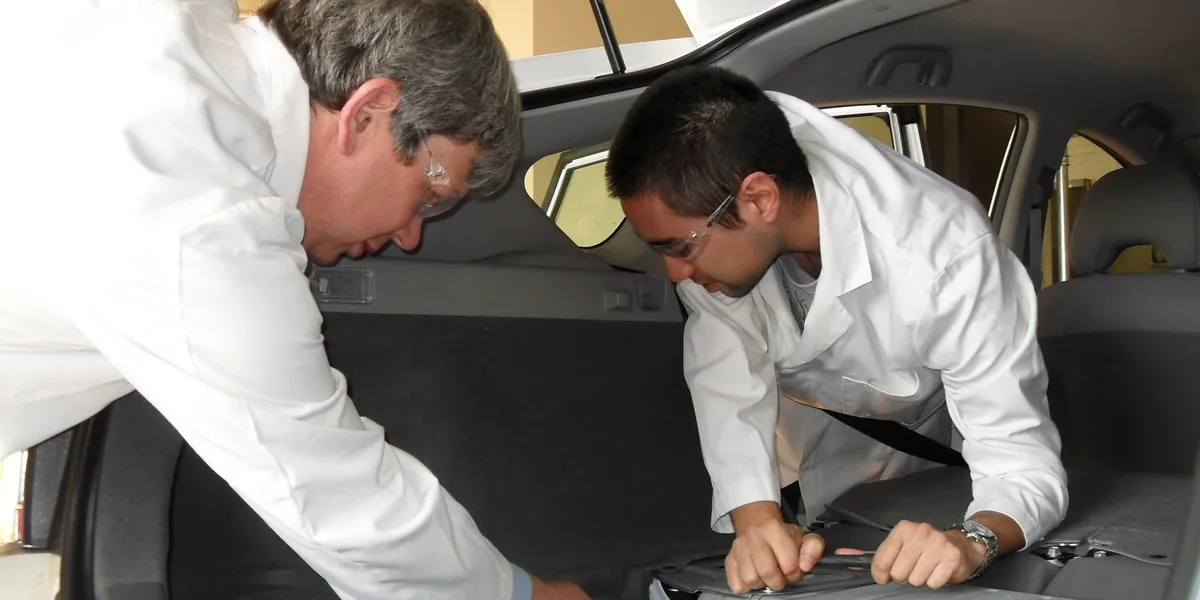
Yang et al. (2018, PNAS) embedded thin nickel foils inside cells so the cell heats itself at about 1°C per second before charging. The heated cell charged to 80% in about 15 minutes even at −50°C, and at 0°C survived 4,500 fast-charge cycles with no plating detected, where the unheated cell lost 20% of its capacity in 50 cycles. It is a demonstrated research approach — asymmetric temperature modulation — not a feature in today’s production cars.
Frequently Asked Questions
What causes lithium plating in EV batteries?
Lithium plating is caused by conditions where lithium ions arrive at the graphite anode faster than they can intercalate between graphene layers: cold temperatures (below 15°C), excessive charge rate (above the anode’s safe intercalation rate), high state of charge (near 100%), and anode microstructure inhomogeneity. These conditions reduce lithium intercalation kinetics below the rate of lithium ion delivery — forcing Li⁰ deposition on the anode surface instead.
Is lithium plating reversible?
Partially. Some plated lithium (reversible plating) can re-intercalate into graphite during subsequent discharge or battery warming. Irreversible plating — where plated lithium reacts with electrolyte to form “dead lithium,” becomes electrically isolated, or forms dendrites — permanently reduces capacity. Irreversible plating cannot be recovered by any charging or reconditioning process. Prevention is far more effective than any recovery approach.
How do I prevent lithium plating in my EV?
Enable battery preconditioning before DC fast charging — the single most impactful action in cold weather. Avoid DC fast charging at temperatures below -10°C without preconditioning. Don’t fast charge above 80% SoC as a regular practice. Use Level 2 home charging as your primary charging method and DC fast charging for road trips. Your BMS automatically limits charging speed to prevent plating — trust its current-reduction decisions rather than trying to override them through third-party software.
How cold is too cold to charge an EV battery?
Below 5°C (41°F) charging should slow down; below 0°C (32°F) it should not happen at all until the pack warms — which is why your car warms the battery and charges slowly when cold.
What is the 40–80 rule for EV batteries?
The habit of keeping daily charge between roughly 40% and 80%: it keeps the battery out of the nearly-full zone where plating risk rises, and out of deep discharge. It is a gentle-life guideline, not a hard law — charging to 100% for a trip is fine.
What is the difference between lithium plating and dendrites?
Plating is the coating of metallic lithium on the anode surface; dendrites are the needle-like growths that can sprout from heavy plating. Plating is the cause, dendrites are its most dangerous shape — the ones that can pierce the separator.
Conclusion
Lithium plating is one of the most consequential degradation mechanisms in EV batteries — occurring when lithium ions cannot intercalate into graphite fast enough and instead deposit as metallic lithium on the anode surface. Cold temperature and excessive charge rate are the primary triggers. The consequences range from temporary capacity reduction (reversible plating) to permanent capacity loss and dendrite formation (irreversible plating) — making prevention far more important than any attempted recovery. Modern BMS systems automatically limit charging current to prevent plating, and enabling battery preconditioning before DC fast charging in cold weather is the most impactful action EV owners can take to protect their battery. The shift to silicon-carbon composite anodes and localized high-concentration electrolytes in next-generation cells will further push the plating threshold — enabling faster charging at lower temperatures without the battery health consequences current graphite anodes face.
Cold temperature also slows the reactions behind cathode-side aging — see our explainer on how electrolyte oxidation degrades EV batteries.
