
How Does Electrolyte Oxidation Degrade EV Batteries?

Every time an EV battery charges, its cathode climbs to a voltage the liquid inside it was never quite built to survive. The slow chemical burn that follows, electrolyte oxidation, is one of the quietest and most persistent ways a pack loses capacity.
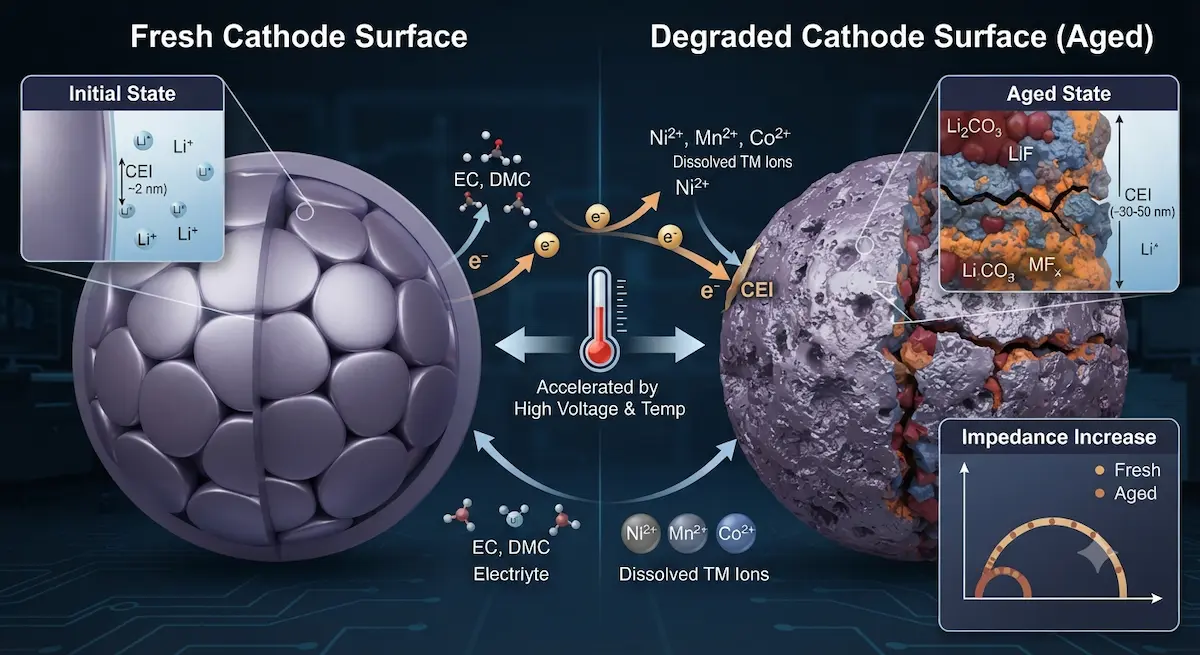
Electrolyte oxidation is the breakdown of the battery’s liquid at the cathode once the cell voltage pushes past about 4.3 volts. The oxidised liquid leaves behind a resistive surface film called the CEI, releases gases such as carbon dioxide and carbon monoxide, and helps form hydrofluoric acid from the LiPF6 salt, which dissolves nickel, cobalt and manganese out of the cathode. Together, those effects consume electrolyte, raise resistance and permanently remove capacity, fastest in high-nickel packs held at a full charge in the heat.
Key figures: carbonate electrolyte ceiling ≈ 4.3V · CEI film growth measured at 10 nm → 100 nm over one year of storage · oxidation gases: CO2, CO, O2, CH4, H2
What Is Electrolyte Oxidation?
Electrolyte oxidation is what happens when the charged cathode pulls electrons out of the electrolyte itself, breaking its molecules apart instead of just storing lithium.
Every liquid electrolyte has a stability window, a voltage range inside which it survives contact with both electrodes. Below the window it gets reduced at the anode, above it, it gets oxidised at the cathode. A widely cited review of high-voltage electrolyte chemistry puts the practical ceiling for today’s carbonate electrolytes at about 4.3 volts: they are considered unable to circulate for long above it.
That ceiling matters because an EV cell lives close to it. A fully charged nickel-rich cell sits around 4.2 volts, just under the line, so oxidation never runs wild, but it never fully stops either. It simmers at the cathode surface for the whole life of the pack, and everything in this article follows from that simmer.
Two Ways the Electrolyte Gets Oxidised
The electrolyte is attacked twice over: directly by the voltage, and chemically by the cathode material itself, and researchers now believe the chemical attack does more of the damage.
Direct electrochemical oxidation
At a high enough voltage, the cathode surface simply strips electrons from the solvent molecules touching it.
The carbonate solvents in a normal electrolyte, ethylene carbonate and its relatives, are the victims. Push the cathode high enough and they oxidise electrochemically, with ethylene carbonate’s own oxidation placed above roughly 4.5 volts in the degradation literature. The fragments left behind become gas, acid precursors and the raw material of the surface film covered next.
Chemical oxidation by the cathode itself
A deeply charged cathode does not wait for electrochemistry; it leaks reactive oxygen that burns the electrolyte chemically.
Work by Rinkel and colleagues showed that oxidation at the cathode is more chemical than electrochemical, driven mainly by singlet oxygen released from the cathode lattice at high states of charge. Nickel-rich cathodes also pass through a structural transition at around 80% charge that frees lattice oxygen, and their charged nickel ions, Ni4+, are strong oxidisers that react with electrolyte on contact. The cathode’s surface oxygen even attacks solvent molecules directly, and that attack strengthens in the order manganese, cobalt, nickel, which is the first clue to why high-nickel chemistries suffer most.
The CEI: A Protective Film That Never Quite Seals
Oxidation leaves a film on the cathode called the CEI, and unlike its famous anode cousin, it never forms a complete seal, so the attack underneath it continues.
Most owners who read about degradation meet the SEI first, the film that grows on the anode and genuinely does protect it once formed (I covered how the SEI layer forms in its own guide). The cathode electrolyte interphase, the CEI, is the mirror structure on the positive side, built from the debris of oxidised electrolyte. Its typical ingredients include:
- Lithium fluoride (LiF), lithium carbonate and lithium oxide
- Metal fluorides formed from dissolved cathode metals
- Lithium phosphate compounds where the electrolyte provides them
- Organic fragments, including polycarbonates and alkyl carbonates from broken solvent molecules
A perfect CEI would pass lithium ions while blocking electrons completely, starving further oxidation. Real CEI layers are thinner, patchier and more fragile than the SEI, and parts of them dissolve back into the electrolyte at high temperature or voltage, exposing fresh cathode surface. One measurement found a cathode surface film growing from about 10 nanometres to 100 nanometres over a single year of storage, which tells you the reaction underneath never stopped. Every rebuild consumes more electrolyte and adds more resistance, because the film is a worse conductor than the bare surface it covers.
What Oxidation Produces: Gas, Acid and Dissolved Metals
The film is only part of the bill. Oxidation also fills the cell with gas, breeds a corrosive acid and strips valuable metals out of the cathode.
Gas that swells cells and blocks surfaces
Oxidised electrolyte turns partly into gas: carbon dioxide, carbon monoxide, oxygen, methane and hydrogen have all been measured coming off charged cathodes.
Inside a sealed cell that gas has nowhere to go. It raises internal pressure, which is why swelling shows up most obviously in flat pouch cells, and bubbles clinging to electrode surfaces block lithium ions and force the current into uneven paths. Uneven current means uneven ageing, so gassing quietly accelerates the very degradation that produced it.
Hydrofluoric acid, the chain reaction
The standard lithium salt, LiPF6, breaks down into PF5, and PF5 meeting any trace of water produces hydrofluoric acid, HF.
The chain runs LiPF6 to LiF plus PF5, then PF5 plus water to POF3 plus two HF. Worse, the cell can manufacture its own water: singlet oxygen oxidising carbonate solvent produces water as a by-product, so HF forms even in cells filled almost dry, and the salt’s breakdown accelerates as voltage rises. HF is destructive out of all proportion to its quantity: it attacks the anode’s protective film, corrodes current collectors and, above all, dissolves transition metals out of the cathode. I covered the wider electrolyte breakdown picture, salts included, in a companion guide.
Dissolved metals that poison the other electrode
Acid and oxidation together leach nickel, cobalt and especially manganese out of the cathode, and those ions migrate across the cell and land on the anode.
Measurements on NCM523 cells found metal dissolution rising sharply at higher voltages, with manganese dissolving more readily than nickel or cobalt. Once dissolved metals deposit on the graphite anode, they thicken its SEI film, raise its resistance and trap lithium that can never cycle again. One widely cited analysis concluded that this single crossover explains much of the capacity loss, impedance growth and metal contamination seen in aged cells, which makes cathode-side oxidation an anode problem too.
The Hydrogen Twist Researchers Found in 2024
In 2024, a team led from Stanford, SLAC and the University of Colorado showed that hydrogen from the electrolyte invades the cathode and steals the parking spots meant for lithium.
The study, published in Science, found that hydrogen atoms leave the electrolyte and settle into the cathode, with protons occupying sites lithium ions normally bind to. The more lithium is pulled out during charging, the more openings appear and the more hydrogen accumulates, driving self-discharge, the slow loss of charge in a parked car. The same invasion stresses the cathode mechanically, feeding the micro-cracking I described in the cathode cracking guide. It is the clearest proof yet that electrolyte oxidation is not just a surface story; its products work their way inside the cathode itself.
Which Cathodes Suffer Most From Oxidation?
Risk follows voltage and nickel content: the higher a cathode charges and the more nickel it carries, the harder oxidation bites.
High-nickel NMC and NCA sit at the top of the risk list. Their charged surfaces carry the most Ni4+, their lattice gives up oxygen most readily, and their surface oxygen attacks solvent most strongly. Lithium cobalt oxide, the older chemistry of phones and laptops, is also vulnerable once charged past about 4.2 volts, where cobalt ions oxidise, dissolve and catalyse electrolyte decomposition.
LFP is the exception that proves the rule. An LFP cathode operates around 3.4 to 3.6 volts even when fully charged, comfortably below the carbonate ceiling, so oxidation there is a minor ageing route rather than a leading one; that voltage gap is a large part of the LFP versus NMC durability story. At the far extreme, high-voltage spinel cathodes designed to charge near 4.7 volts exist precisely in the zone ordinary electrolytes cannot survive, which is why they remain niche.
How Manufacturers Fight Electrolyte Oxidation
Nobody has eliminated oxidation, but cell makers slow it with surface armour, sacrificial additives and plain voltage discipline.
Coatings and engineered surface layers
A thin, stable coating keeps the electrolyte from ever touching the reactive cathode surface directly.
Reviews of degradation mechanisms note that protective films and coatings have been shown to influence every positive-electrode degradation route, including electrolyte decomposition and film growth. Phosphate-rich surface chemistry earns a special mention: lithium phosphate within the surface film conducts lithium ions quickly and helps suppress metal dissolution.
Additives that sacrifice themselves first
A small dose of additive can be designed to oxidise before the main solvents do, building a better film, or to hunt down HF before it reaches the cathode.
Borate additives such as LiDFOB are valued high-voltage film formers, and some double as lithium salts in their own right. Silane additives work the other flank by scavenging hydrofluoric acid; in one study, a silane additive lifted an NCM523 cell’s capacity retention after 100 cycles at a 4.5-volt cutoff from 38% to 73%, an improvement credited to removing HF’s attack. Flame-retardant phosphorus additives show similar film benefits in laboratory cells.
Salt choices and voltage discipline
Replacing the salt and capping the voltage are the bluntest, most reliable tools of all.
LiTFSI has been proposed as a more water-stable alternative to LiPF6, which would cut the HF chain at its first link. And every EV already uses the simplest defence: the battery management system holds the pack inside a voltage window chosen by the maker, trading a little usable capacity for a much slower oxidation rate. The difference between a pack that lives at 4.2 volts per cell and one allowed to sit higher is measured in years, not weeks.
What Electrolyte Oxidation Means for Your EV
For an owner, oxidation reduces to one habit: the less time your pack spends sitting at a full charge, especially in heat, the slower this whole chain runs.
A car parked at 100% holds every cathode at its most oxidising state for hours or days at a time, and heat multiplies the reaction rate on top. That is the chemistry underneath the familiar 80% daily-charging advice; it is not superstition, it is keeping the cathode out of its most aggressive zone for the 95% of life when you do not need the range. Cold weather has its own anode-side hazard, lithium plating, but heat plus full charge is the cathode’s enemy. There is nothing to service or top up; oxidation is managed by the cell design, the BMS and your charging routine, in that order.
Frequently Asked Questions
Does charging to 100% cause electrolyte oxidation?
Charging to 100% puts the cathode at its highest voltage, where oxidation runs fastest, and parking there keeps it running. Occasional full charges for a trip do negligible harm; living at 100% in a hot climate is what measurably shortens pack life.
Is the CEI the same thing as the SEI?
No. The SEI forms on the anode, mainly by reduction, and passivates well. The CEI forms on the cathode by oxidation, is thinner and less stable, and keeps dissolving and reforming, which is why cathode-side oxidation continues for the life of the cell.
Can electrolyte oxidation damage be reversed?
No. Lost electrolyte, dissolved cathode metals and lithium trapped by crossover deposits are permanent losses. Good design and charging habits slow the rate; nothing restores what oxidation has already consumed.
Why do high-nickel batteries suffer more from oxidation?
Charged nickel ions (Ni4+) are the strongest oxidisers among the common cathode metals, high-nickel lattices release reactive oxygen most readily at high charge, and their surface oxygen attacks solvent molecules more aggressively than cobalt or manganese surfaces do.
Conclusion
Electrolyte oxidation is the slow price a lithium-ion cell pays for operating near the top of its electrolyte’s stability window.
Past roughly 4.3 volts the carbonate liquid breaks down at the cathode, directly and through oxygen the cathode itself releases. The products, a never-quite-sealed CEI film, gas, hydrofluoric acid, dissolved metals and even invading hydrogen, each remove a little capacity and add a little resistance. High-nickel packs pay the highest rate, LFP largely escapes it, and the defences, coatings, additives, better salts and voltage discipline, are all ways of negotiating with the same chemistry. Respect the top of the charge gauge, and the negotiation goes your way.
