
Lexus RZ Battery: Complete Guide


The Lexus RZ battery is a lithium-ion pack under the floor of Lexus’s electric SUV, and it comes in three sizes depending on the year: 71.4 kWh in the 2023–2025 RZ 450e, 72.8 kWh in the 2024–2025 RZ 300e, and 74.69 or 76.96 kWh in the refreshed 2026 lineup. The best EPA range is 301 miles, from the 2026 RZ 350e, DC fast charging peaks at 150 kW, and the battery warranty runs 8 years or 100,000 miles with a 70% capacity floor.
Two things catch RZ owners out. Much of what dealer websites say about this battery is wrong — including a 10-year, 150,000-mile warranty figure that actually belongs to Lexus hybrid cars, not the RZ. And the RZ has two batteries: alongside the high-voltage pack sits a conventional 12-volt battery with a well-documented drain problem that can leave owners locked out of a car whose main battery is full. This guide covers both batteries, year by year, using Lexus’s own documents and EPA ratings.
The RZ shares its e-TNGA platform with the Toyota bZ4X and Subaru Solterra, but its packs, warranty paperwork and charging hardware differ in the details that matter — and several of those details changed for 2026.
Updated November 2026 · Figures from Lexus’s own specifications and warranty booklet, EPA ratings and NHTSA filings
Quick answer
The Lexus RZ uses a 71.4–76.96 kWh lithium-ion battery depending on the model year, with up to 301 miles of EPA range (2026 RZ 350e) and 150 kW DC fast charging. Lexus covers the pack for 8 years or 100,000 miles, down to 70% of its original capacity.
Key figures: 71.4 kWh (450e, 2023–2025) · 72.8 kWh (300e, 2024–2025) · 74.69 kWh (350e/450e, 2026) · 76.96 kWh (550e, 2026) · 150 kW peak DC · 8 yr / 100,000 mi warranty
Lexus RZ Battery: Specs by Generation (2023–2026)
Three packs cover the RZ’s first four model years — and the front-wheel-drive cars, not the AWD flagships, go furthest on a charge.
Every US-market RZ is in the table below. Note the pattern: the most efficient versions are the single-motor front-wheel-drive cars, and every RZ charges at the same 150 kW DC peak regardless of pack or price.
| Model years / Variant | Battery (gross) | EPA range | Drivetrain | Peak DC rate |
|---|---|---|---|---|
| 2023–2025 RZ 450e | 71.4 kWh | 220 mi (18-in wheels) / 196 mi (20-in) | AWD | 150 kW |
| 2024–2025 RZ 300e | 72.8 kWh | 266 mi (18-in) / 224 mi (20-in) | FWD | 150 kW |
| 2026 RZ 350e | 74.69 kWh | 301 mi (18-in) / 284 mi (20-in) | FWD | 150 kW |
| 2026 RZ 450e | 74.69 kWh | 264 mi (18-in) / 257 mi (20-in) | AWD | 150 kW |
| 2026 RZ 550e F SPORT | 76.96 kWh | 229 mi | AWD | 150 kW |
One column is missing on purpose: usable capacity. Lexus does not publish a usable figure for any RZ pack, so the usable numbers quoted on other websites are third-party estimates, not Lexus data. The gross capacities above are Lexus’s own figures — for the 2026 cars, measured under the IEC 62660-1 standard.
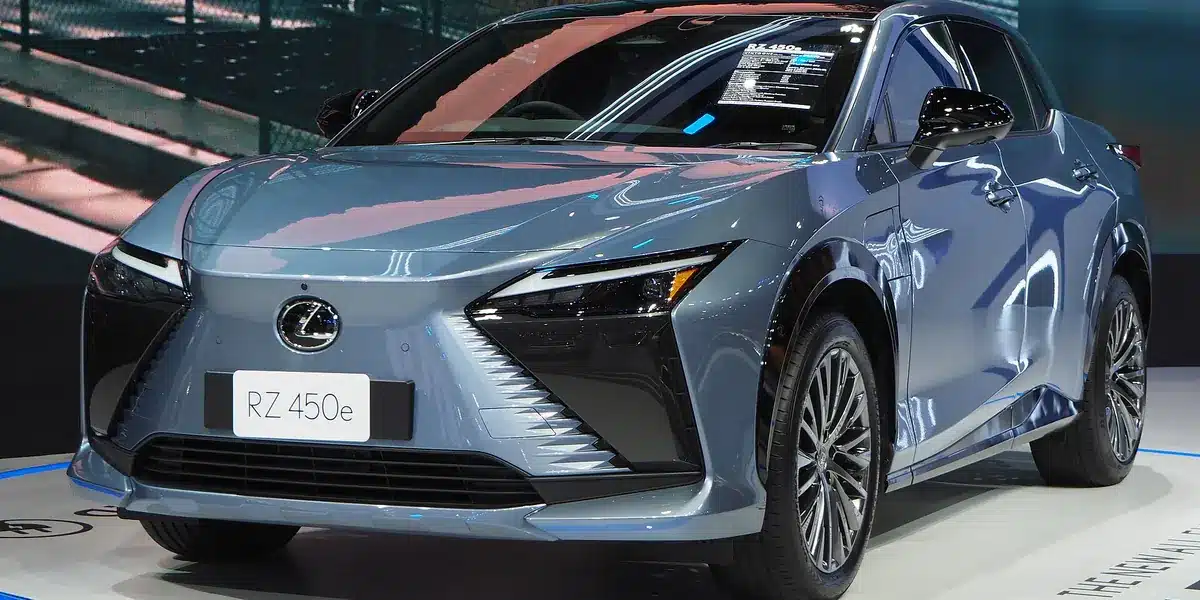
The 2026 Battery Upgrade: What Actually Changed
The 2026 refresh brought bigger packs, a first front-wheel-drive RZ, faster home charging and a native Tesla-style port — not a new kind of cooling.
The battery itself grew: 71.4 kWh became 74.69 kWh on the 350e and 450e, and the new RZ 550e F SPORT flagship gets 76.96 kWh. A new entry model, the front-wheel-drive RZ 350e, took over as the range leader at 301 miles EPA. Home charging improved the most: the onboard AC charger jumped from 6.6 kW to 11 kW, cutting a full overnight charge by roughly a third.
2026 also added proper battery preconditioning — set it manually on the multimedia screen, or let the car do it automatically when a charger is your navigation destination — and a native NACS charge port with Plug & Charge (covered in the Charging section below).
One claim needs correcting, because older versions of this guide and other websites repeat it: the RZ did not “gain” liquid cooling in 2026. The pack has been water-cooled and water-heated since the car’s 2023 launch. What 2026 brought is a new water-cooling system, which Lexus says helps maximise output and suppress cell deterioration — an improvement to an existing system, not a first for the car.
Inside the Lexus RZ Battery: Conservative Buffer Strategy
Toyota builds the RZ’s packs to last rather than to headline: prismatic cells, a conservative charge buffer, and liquid cooling from day one.
The cells differ by pack. The 71.4 kWh battery in the 450e comes from Prime Planet Energy & Solutions (PPES), the Toyota–Panasonic joint venture, while the 72.8 kWh battery in the 300e is built by CATL. Lexus has not published the supplier for each 2026 trim; PPES announced in 2025 that a new, higher-capacity prismatic battery it builds is installed in the new Toyota bZ4X and Lexus RZ. The RZ shares its e-TNGA platform with the Toyota bZ4X.
Lexus describes the chemistry only as lithium-ion and does not publish the cathode type, so treat any site that confidently names one (usually “NMC”) as guessing. What is documented is the cell format — prismatic — and the pack’s liquid cooling and heating, which hold the cells near their ideal temperature in summer heat and winter cold alike.
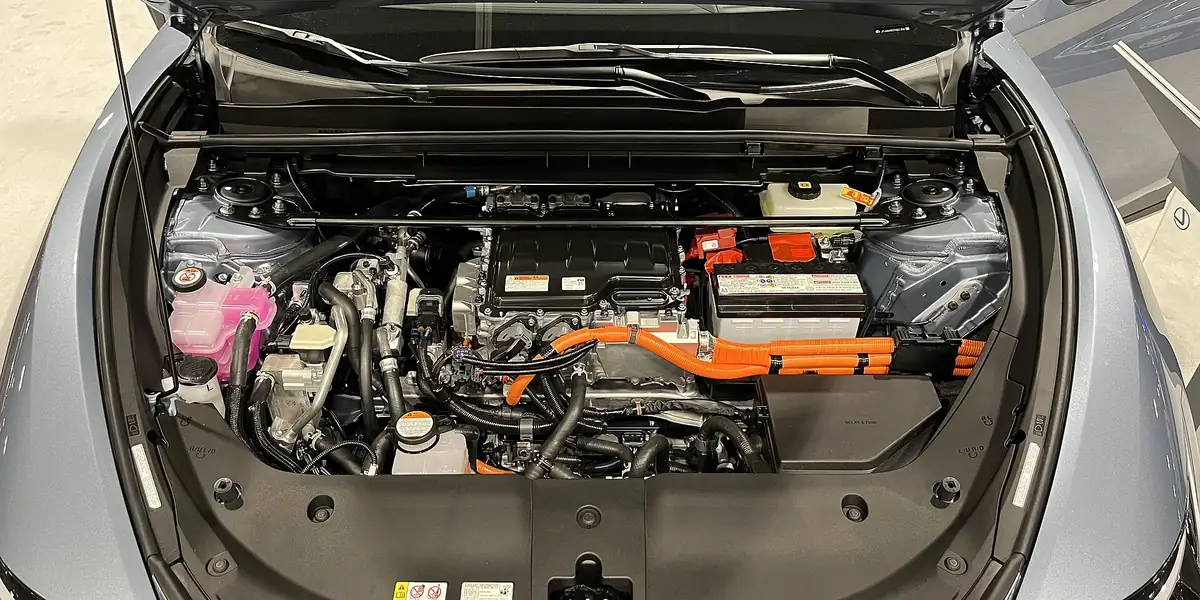
Toyota also protects the pack with a conservative buffer: the car holds back part of the battery at the top and bottom of the charge range, so the cells rarely sit at the voltage extremes that age lithium-ion fastest. Lexus does not publish the usable capacity that this leaves, but the strategy trades a little accessible range for slower, more predictable ageing — the opposite approach to rivals that advertise every last kilowatt-hour.
The pack works at roughly 400-volt-class architecture, which is why DC charging tops out at 150 kW. The 800-volt rivals in the comparison table below can charge far faster; the RZ answers with efficiency and price rather than peak speed.
Lexus RZ Charging Speeds and Times
Every RZ fast-charges at up to 150 kW and needs about 30 minutes for a 10–80% top-up; the real generational gap is home charging — a weak 6.6 kW before 2026, a proper 11 kW after.
| Charging method | 2023–2025 RZ | 2026 RZ |
|---|---|---|
| Level 1 (120V outlet) | ~1.4 kW — emergency use only | ~1.4 kW — emergency use only |
| Level 2 (240V) | 6.6 kW — about 9.5 hours from the low-battery warning | 11 kW — a full charge in roughly 7–9 hours |
| DC fast charging | 150 kW peak — 0–80% in about 30 minutes | 150 kW peak — 10–80% in about 30 minutes |
The 2026 cars also changed where you can plug in. They carry a native NACS port — the Tesla-style connector — with Plug & Charge support and access to more than 25,000 Tesla Supercharger plugs, and Lexus includes J1772 and CCS adapters in the box. Owners of 2023–2025 cars are not left out: since November 2025, Lexus dealers have offered a complimentary NACS adapter for earlier cars, with owners contacted by letter.
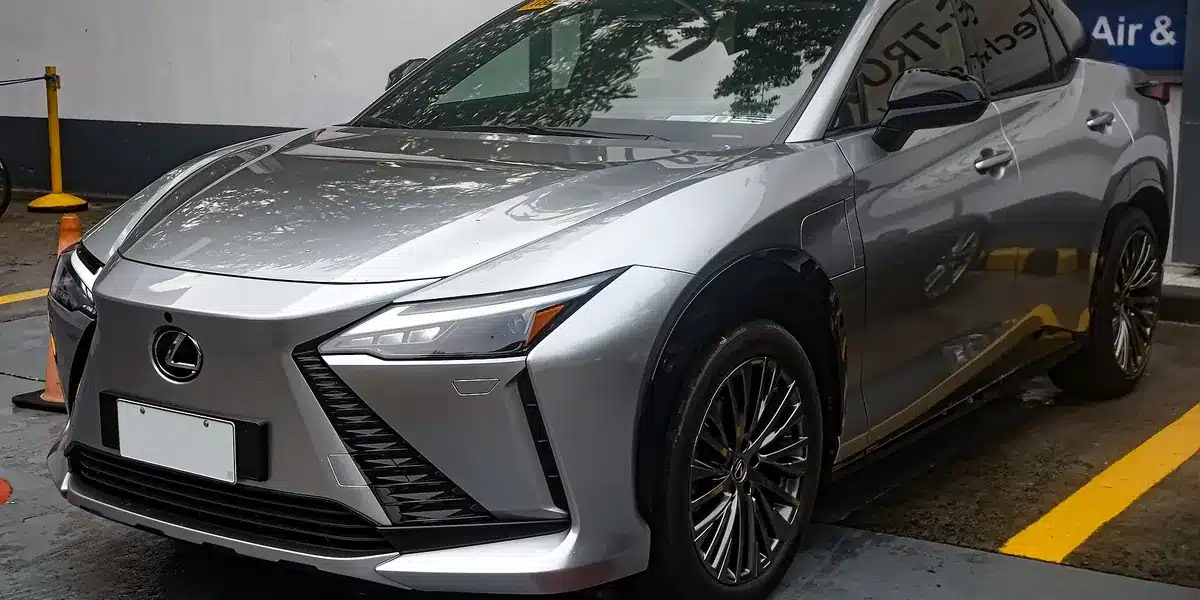
Preconditioning arrived with the 2026 refresh: warm or cool the pack manually from the multimedia screen, or set a charger as the navigation destination and the car prepares the battery on the way. A conditioned pack is what lets the RZ actually reach its 150 kW peak in winter. Earlier cars manage battery temperature with their cooling and heating systems but offer no driver-controlled preconditioning routine.
Real-World Range: What Owners Actually Get
EPA figures span 196 to 301 miles by year, trim and wheel size — and the wheel choice alone can cost more range than the 2026 battery upgrade added.
Start with the honest ladder from the specs table: a 2023 RZ 450e on 20-inch wheels is a 196-mile car, while a 2026 RZ 350e on 18s is a 301-mile car. Independent testing flatters the RZ more than most EVs: Edmunds ran the 229-mile-rated RZ 550e to 255 miles in its range test, beating its EPA figure by 26 miles. A standard heat pump on every RZ also protects winter range better than resistive heating would.
Wheel penalty: the RZ 300e drops from 266 miles on 18-inch wheels to 224 miles on the 20-inch option — 42 miles of range given up for looks, almost as much as the entire 2026 battery upgrade added to the AWD car (+44 miles).
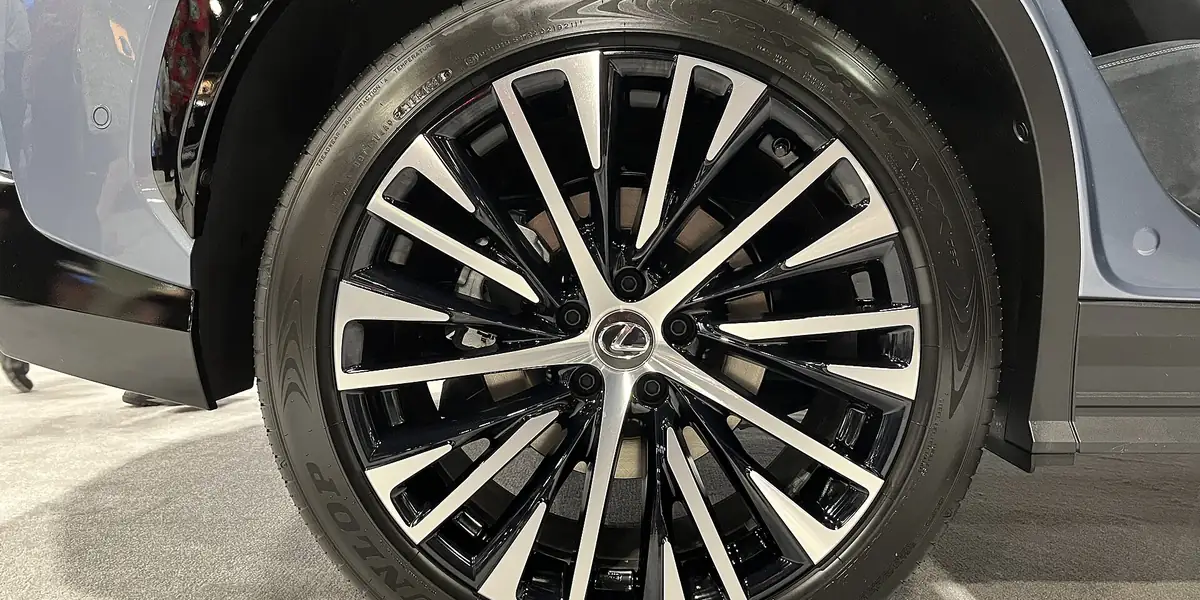
Cold weather still bites, as it does on every EV: expect the usual winter drop on short trips, when the pack and cabin start cold. The RZ’s heat pump and — on 2026 cars — preconditioning narrow the gap, but no RZ matches its EPA figure in freezing weather at highway speed.
Lexus RZ Battery Lifespan and Degradation
No RZ-specific degradation dataset exists yet — anyone quoting you an exact RZ percentage is guessing. The honest evidence is fleet data, plus Toyota’s buffer strategy.
Neither Recurrent nor Geotab publishes a battery-health figure for the RZ itself; the car is too new and too low-volume. What exists is fleet context: Geotab’s latest study of more than 22,700 EVs found average degradation of about 2.3% per year across all models, with modern liquid-cooled packs at the durable end of that spread. Treat that as the landscape the RZ lives in, not as an RZ measurement.
Two things argue for the RZ ageing well inside that landscape. The conservative buffer means the cells avoid the charge extremes that drive most wear, and the pack is liquid-cooled and heated — the setup that consistently outlasts air-cooled designs in fleet data. Lexus’s own warranty wording underlines the point: capacity loss of up to 30% over the warranty period is considered normal (the Warranty section below explains what that means in practice).
Signs an RZ pack is genuinely unwell, rather than normally aged:
- A sudden, step-change drop in displayed range, not a gradual drift
- DC fast charging that slows dramatically even on a warm battery
- Hybrid-system or EV-system warning messages on the dashboard
Lexus RZ Battery Warranty
The US RZ battery warranty is 8 years or 100,000 miles with a 70% capacity floor — the 10-year, 150,000-mile figure repeated across the web belongs to Lexus’s hybrid cars, not the RZ.
The terms come from Lexus’s own Warranty and Services Guide. The Electrical Drive Component Warranty runs for 8 years or 100,000 miles from the car’s in-service date and covers the traction battery if it falls below 70% of its original capacity, alongside the transaxle and the inverter with converter. Read the small print the other way round, too: a capacity reduction of 30% or less is considered normal and is not covered — the warranty pays out only once the battery drops under that 70% line.
Why do so many websites — including Lexus dealer pages — say 10 years and 150,000 miles? That is the Lexus Hybrid Battery Warranty, written for cars like the RX Hybrid. It does not apply to the fully electric RZ, and the RZ’s own booklet is unambiguous: 8 years, 100,000 miles, 70% floor. The same terms cover every US model year so far. The RZ’s basic vehicle warranty is the usual Lexus 4 years or 50,000 miles.
Lexus RZ Battery Replacement Cost
Lexus does not publish a price for a complete RZ traction battery, and no verified fitted cost exists — be suspicious of any website that gives you one neat number.
Search this topic and you will find confident figures; the most repeated traces back to a trade article whose own sourcing cannot be checked and which is no longer online. No Lexus parts catalogue lists a complete RZ pack price, and no repair network publishes a fitted cost — the cars are simply too new, and almost every pack problem so far has landed inside the 8-year warranty.
What is real: individual components around the pack are priced (a traction-battery bus-bar block lists at about $998, for example), module-level work is possible in principle, and used packs from written-off cars exist. If you face an out-of-warranty failure, get the diagnosis in writing and price all three routes — warranty goodwill, module repair, used pack — before agreeing to anything.
Read more: our complete guide to EV battery replacement cost across every major brand.
Lexus RZ Battery Recalls
One recall touches the RZ’s high-voltage battery system directly: a 2026 software fault in the battery control unit that can cut drive power.
In June 2026, Toyota recalled certain 2026 Lexus RZ models (alongside the Toyota bZ and Subaru Solterra) because the electronic control unit that manages the high-voltage battery can fault and cause a loss of drive power. The fix is a free software update at a Lexus dealer, and owner letters went out in August 2026. About 16,200 vehicles are covered across the three nameplates; Lexus has not published an RZ-only count. (NHTSA campaign 26V-393.)
A second recall, covering 2023–2025 cars, concerns the defroster and HVAC system, including its electrical compressor — electrical, but not a traction-battery fault. And to close a rumour: the widely shared 2026 “battery overcharge” recall covers the Toyota C-HR only, not the RZ. Check any RZ by VIN at nhtsa.gov/recalls.
Lexus RZ 12-Volt Battery: The Drain Problem
The RZ’s most common battery problem is not the big battery at all — it is the small 12-volt battery going flat in a car that still shows a full main battery.
The 12-volt battery wakes the car up: it runs the locks, screens and computers that then connect the traction battery. When it dies, the car will not start, open or respond — even with 80% charge showing for the main pack. Owner communities for the RZ and its bZ4X and Solterra sisters document the pattern widely: the car’s connectivity module and other computers fail to drop into a full sleep state, and third-party apps that repeatedly poll the car for status are a major trigger for waking it.
A note on the search that brings many owners here: Lexus does not publish a specific 12-volt fitment for the RZ, and there is no special RZ-only battery to hunt down — despite the “TrueStart” branding on Lexus’s general battery line. Any reputable battery shop can match the correct conventional 12-volt unit by specification. Expect roughly $250–$450 fitted at an independent shop; Lexus dealers have advertised RZ 12-volt replacement specials from about $238–$250.
To avoid the drain: limit third-party apps that keep querying the car, let the car sleep undisturbed when parked for long stretches, and treat a first flat 12-volt battery as a warning — have the replacement tested rather than simply jump-started and ignored. (There is no verified Lexus service bulletin for this issue; be wary of bulletin numbers quoted by AI summaries online.)
RZ vs Competitors: Luxury Compact EV Battery Comparison
The RZ is not the fastest-charging luxury crossover — it answers bigger, pricier packs with efficiency and a lower starting price.
| Model | Battery | EPA range | Peak DC rate | Architecture |
|---|---|---|---|---|
| Lexus RZ 350e (2026) | 74.69 kWh | 301 mi | 150 kW | 400V-class |
| Cadillac Lyriq RWD | 102 kWh | 326 mi | 190 kW | 400V-class |
| BMW iX3 50 xDrive (2027) | 108.7 kWh usable | 383–434 mi | 400 kW | 800V |
| Audi Q8 e-tron 55 | 106 kWh usable | 285 mi | 170 kW | 400V-class |
The honest read: if you road-trip weekly, the 800-volt BMW’s charging speed is in another class. If your life is home charging and commuting, the RZ’s smaller pack is cheaper to buy, cheaper to fill and — on the 350e — nearly as far-ranging as cars carrying 30 kWh more battery.
Charging Tips for Lexus RZ Owners
Small habits protect the pack — and they differ slightly between the early cars and the 2026 refresh.
- Set the daily charge limit to 80%: even with Toyota’s conservative buffer, a daily 80% limit adds longevity — and 80% of an RZ pack still covers most drivers’ daily miles several times over.
- Precondition before fast charging (2026 cars): set the charger as your navigation destination, or switch preconditioning on manually, so the pack arrives at the plug at its ideal temperature.
- On 2023–2025 cars, fast-charge after driving, not from cold: a pack warmed by a drive charges noticeably faster than one that sat overnight in the cold — these cars have no manual preconditioning control.
- If shopping used, weigh the 2026 updates: the bigger pack, the 11 kW home charger, preconditioning and the native NACS port make the refreshed car the one to have for road trips — the early cars counter with much lower prices.
Frequently Asked Questions
How long does the Lexus RZ battery last?
There is no RZ-specific degradation dataset yet, because the car is too new. Fleet studies of modern liquid-cooled EVs average about 2.3% capacity loss per year, and the RZ’s conservative charge buffer is designed to land it at the durable end of that range. Lexus guarantees the pack stays above 70% of original capacity for 8 years or 100,000 miles.
What is the warranty on a Lexus RZ battery?
In the US, 8 years or 100,000 miles, with replacement covered if capacity falls below 70% of original. The 10-year, 150,000-mile figure quoted on many dealer websites is Lexus’s hybrid battery warranty — it does not apply to the fully electric RZ.
How much does it cost to replace a Lexus RZ battery?
Lexus does not publish a price for a complete RZ pack, and no verified fitted cost exists yet — most failures so far fall inside the warranty. Be wary of precise figures quoted elsewhere; they trace back to unverifiable sources. Module-level repairs and used packs are the realistic out-of-warranty routes.
What is the battery size of the Lexus RZ?
It depends on the year: 71.4 kWh in the 2023–2025 RZ 450e, 72.8 kWh in the 2024–2025 RZ 300e, and 74.69 kWh (350e and 450e) or 76.96 kWh (550e) in the 2026 lineup. Lexus does not publish usable capacities.
What is the 12V battery in a Lexus RZ, and why does it keep going flat?
A conventional 12-volt battery that runs the locks, screens and computers. RZ owners report it draining because the car’s electronics do not always fully sleep — third-party apps that repeatedly poll the car are a known trigger. Replacement is a standard battery-shop job, roughly $250–$450 fitted.
Can you charge a Lexus RZ at a Tesla Supercharger?
Yes. The 2026 RZ has a native NACS (Tesla-style) port with Plug & Charge, and Lexus ships J1772 and CCS adapters with the car. Owners of 2023–2025 models can get a complimentary NACS adapter from a Lexus dealer, a programme that began in November 2025.
Conclusion
The RZ’s battery story is one of steady correction: the 2026 car fixes the early model’s real weaknesses — pack size, home charging speed and Tesla-station access.
The early RZ asked buyers to accept a small pack, a weak 6.6 kW home charger and 196 miles on the wrong wheels, in exchange for Toyota-grade longevity engineering. The 2026 refresh kept the longevity strategy and fixed the spec sheet. What did not change is the paperwork: an 8-year, 100,000-mile warranty with a 70% floor, whatever the internet says about ten years.
Judge the RZ as what it is — an efficiency-and-durability play, not a charging-speed one — and mind the little battery as much as the big one: the 12-volt drain is this car’s best-documented battery headache, and it is also the cheapest to solve.
