
BYD Han Battery: Complete Guide

Researched from BYD’s European launch materials and January 2026 warranty announcement, EV Database and EVKX model data, and CnEVPost and CarNewsChina launch coverage — November 2026.
The BYD Han EV holds a genuine place in electric car history: launched in China in July 2020, it was the first mass-produced car in the world with BYD’s Blade Battery. The Han most readers outside China could actually buy was the European version of 2023–24 — a dual-motor luxury saloon with an 85.4 kWh battery. In April 2026 the Han name made headlines again when a new Chinese edition arrived with the second-generation Blade Battery and megawatt flash charging.
Those three cars share a name and a battery family, but they are not the same car, and much of the confusion around the Han comes from mixing them up. This guide keeps them separate: the European car first, then the 2020 original, then the 2026 flash-charging edition — with the plug-in hybrid Hans and the larger Han L and Da Han fenced off at the end. The Han was never sold in the United States, the UK or Australia.
Key figures: 380 kW and 3.9 seconds to 100 km/h (European car) · 120 kW DC charging peak · battery warranty now 8 years / 250,000 km in Europe.
BYD Han Battery Sizes and Specifications
Three generations of Han, three different battery stories — the test cycle matters as much as the size.
The table below puts the main versions side by side, with each range figure labelled by the cycle it was measured on. NEDC figures from the 2020 car read far more generously than WLTP, and China’s CLTC sits between the two — none of them can be compared directly with each other.
| Version | Battery | Range (cycle) | Power | 0–100 km/h | DC peak |
|---|---|---|---|---|---|
| Han EV — Europe (2023–24) | 85.4 kWh LFP Blade | 521 km (WLTP) | 380 kW AWD | 3.9 s | 120 kW |
| Han EV — China (2020) FWD | 64.8 / 76.9 kWh LFP Blade | 506 / 605 km (NEDC) | 163 kW | — | ~120 kW |
| Han EV — China (2020) AWD | 76.9 kWh LFP Blade | 550 km (NEDC) | 363 kW | 3.9 s | ~120 kW |
| Han EV Flash Charging Edition — China (2026) | 69.07 kWh Blade Battery 2.0 | 705 km (CLTC) | 240 kW FWD | 6.5 s | Flash charging (see below) |
What did the Chinese facelift change?
China’s range later moved to the CLTC cycle: the facelifted Chinese car from 2022 offered packs of 60.48, 72 and 85.44 kWh, with CLTC ratings up to 715 km in front-wheel drive and 610 km in all-wheel drive. The 85.44 kWh pack is effectively the same battery the European car carries as its 85.4 kWh unit.
Is there an official gross-versus-usable split?
BYD publishes one capacity figure per pack and no official split between gross and usable capacity. EV Database treats the European car’s 85.4 kWh as its usable figure — that is the database’s treatment, labelled as such, not a BYD-published split. BYD has never published a cell count for any Han pack.
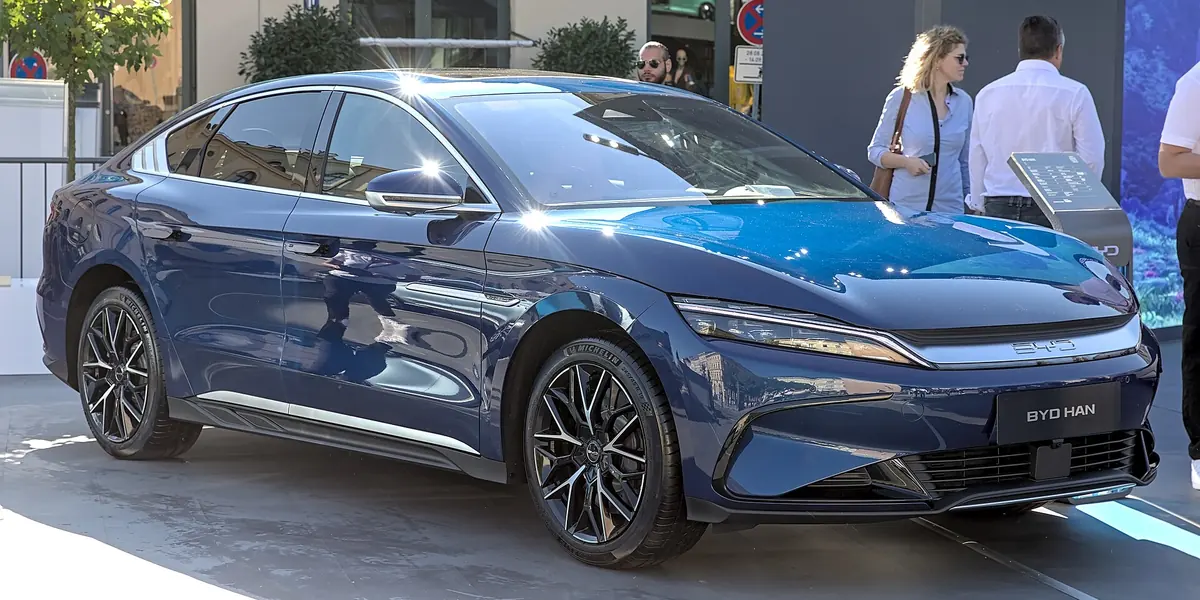
The European Han (2023–2024)
Europe got one version — the big-battery all-wheel-drive car — at a German flagship price.
BYD opened German pre-sales in September 2022 at €72,000 and showed the car at the Paris Motor Show the following month, with deliveries running through 2023. French prices ran from €70,800 to €74,400. There was a single drivetrain: two motors, 380 kW, 700 Nm, and the 85.4 kWh battery, with a heat pump fitted as standard.
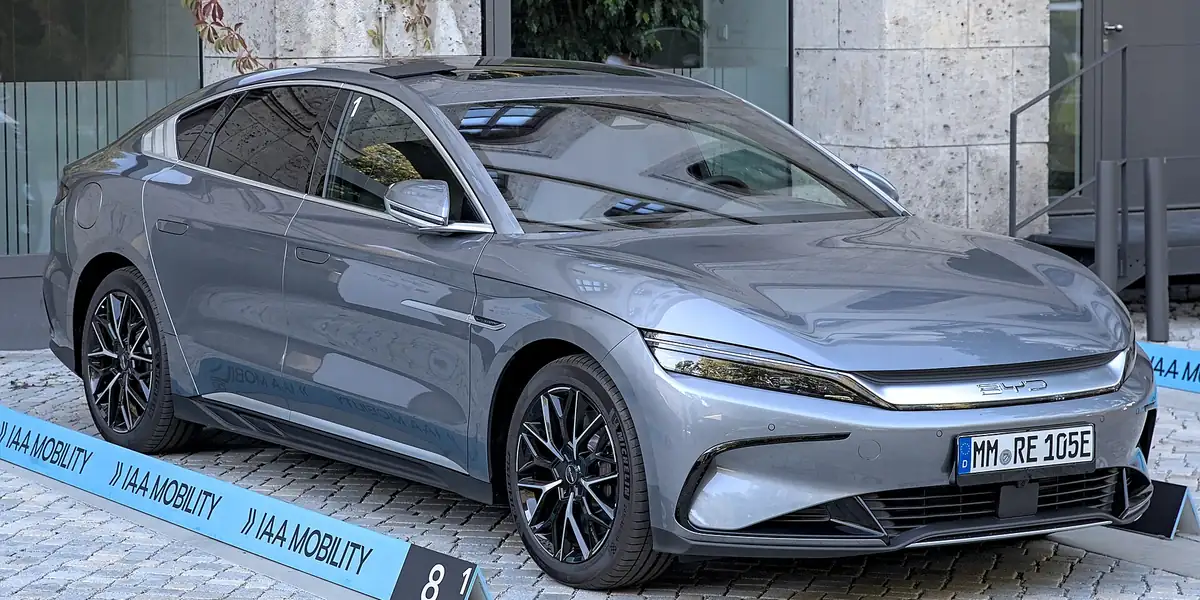
Sales were slow, and the Han quietly left European price lists market by market from 2024 onward; BYD published no single end date. In Europe the Han is now a used-car and servicing story rather than a new-car one. It was never launched in the UK, and Australia never received it at all — the platform was never engineered for right-hand drive.
The Blade Battery and Cell-to-Pack Design
The Han’s real claim to fame is that it proved an LFP battery could power a flagship saloon.
How does the Blade Battery work?
When the Han launched in 2020, lithium iron phosphate was considered not energy-dense enough for a long-range luxury car. BYD’s answer was the Blade Battery: very long, thin LFP cells arranged directly into the pack, skipping the module stage entirely — a design called Cell-to-Pack. Fitting more cell material into the same space closed much of the gap to nickel-based packs. The technology is explained in full in our guide to what a Blade Battery is in electric cars.
What is the difference between Cell-to-Pack and Cell-to-Body?
Cell-to-Pack should not be confused with Cell-to-Body, where the pack becomes part of the car’s structure — that step arrived two years later, on the BYD Seal.
What was the nail-penetration demonstration?
BYD introduced the Blade Battery in March 2020 with a nail-penetration demonstration, in which a pierced cell produced no fire or smoke and only modest surface heat. That was a launch demonstration by the manufacturer, not a certification test — but it set the safety terms on which LFP batteries have been marketed ever since.
Real-World Range
The honest answer is that no major independent range test of the Han exists — the WLTP figure is the anchor.
The European car’s official rating is 521 km (324 miles) WLTP, at a rated consumption of 16.4 kWh per 100 km. Unlike the Seal or the Atto 3, the Han was never put through a published ADAC or What Car? range test, and EV Database’s modelled real-range estimate could not be verified for this guide, so no substitute figure is printed here.
What can be said is structural: a large, heavy all-wheel-drive saloon on a 521 km WLTP rating will travel noticeably less on a cold motorway run, as every car of its class does. EVKX’s 1,000 km challenge model for the car assumes 25 kWh per 100 km at 120 km/h — a modelling assumption, not a measurement, and it points to roughly 340 km of high-speed range on that basis.
Charging the Han
The European car peaks at 120 kW — respectable for 2020, ordinary now — and its claimed times depend on which brochure you read.
How fast does the European Han charge?
BYD’s launch claim for the Chinese car was 30–80% in 25 minutes; the European leaflet quotes 34 minutes for the same window. EVKX’s modelled curve for the European car lands between the two in spirit: a 10–80% charge takes about 36 minutes at an average of roughly 100 kW. That is the figure to plan journeys around.
What is the home-charging conflict?
Home charging carries a genuine documentation conflict. EVKX lists a 7 kW onboard charger as standard, good for a full charge in about twelve hours, while some BYD export leaflets list 11 kW. Until BYD publishes a single settled figure, treat the 7 kW specification as the safe assumption for the European car. All export cars use a CCS2 (Type 2) connector, and vehicle-to-load output of up to 3.3 kW is fitted.
Does the Han precondition its battery?
One gap to know about: cabin preconditioning through the app is documented, but battery preconditioning for fast charging is not documented for this car in any source we could check — a cold pack will charge more slowly until it warms. As an LFP car, the Han follows BYD’s standard guidance of charging to 100% regularly, which also keeps the range estimate calibrated.
The 2026 Flash Charging Edition (China Only)
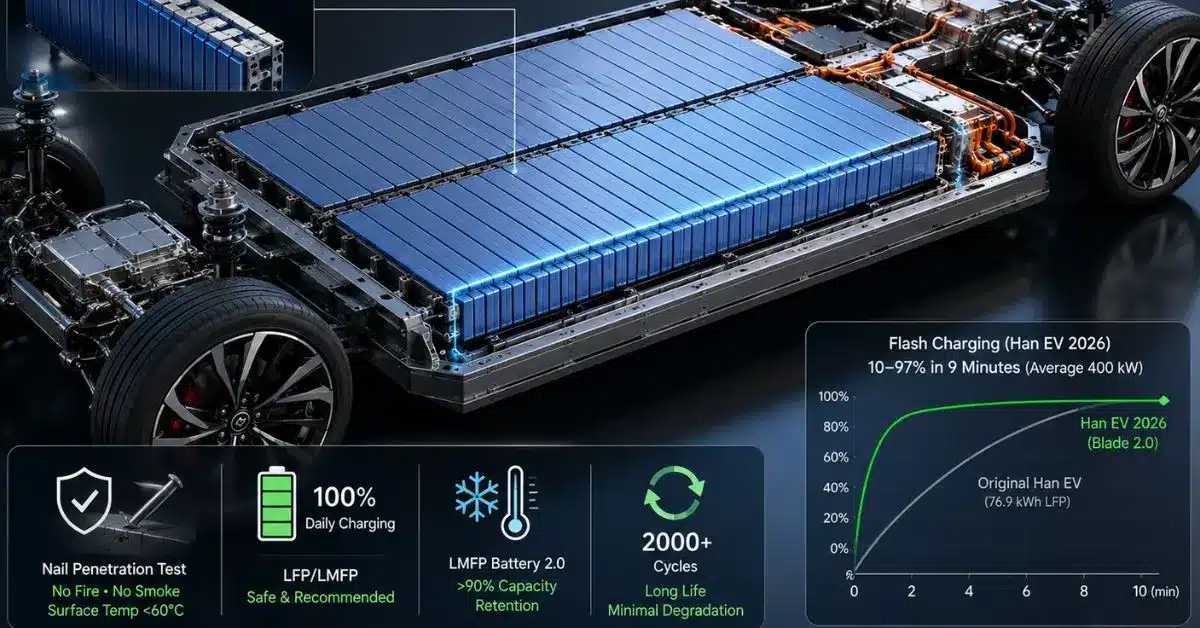
The “Blade Battery 2.0 Han” is real — but it is a Chinese-market edition of the existing car, and its battery is LFP, not LMFP.
What is the Flash Charging Edition?
On 28 April 2026 BYD launched the Han EV Flash Charging Edition in China, in two trims at ¥179,800 and ¥187,800. It keeps the current Han body and pairs it with a 69.07 kWh second-generation Blade Battery, a 240 kW front motor and a claimed consumption of just 10.8 kWh per 100 km, for a CLTC range of 705 km. The pack is about 19% smaller than the 85.4 kWh battery — the extra range comes from efficiency, not from storing more energy.
Is the Flash Charging Edition’s battery LMFP?
Some launch coverage described the new battery’s chemistry as LMFP. That label does not hold for this car: CarNewsChina’s database lists the flash edition’s pack as LFP, and China’s MIIT filings describe the first large Blade Battery 2.0 pack (in the Yangwang U7) as LFP as well. LMFP remains, at most, contested reporting about the technology generally.
How fast does the Flash Charging Edition charge?
The charging claims are BYD’s own and were not independently tested at launch: on BYD’s 1,500 kW flash chargers, the company claims 10–70% in 5 minutes and 10–97% in 9 minutes, with the same charge taking about three minutes longer at −30 °C. Those times need BYD’s flash-charging network, which exists in China. Coverage that also promised standard “God’s Eye C” driver assistance was wrong — the LiDAR-based God’s Eye B system is a ¥12,000 option on this edition.
BYD Han Prices
The Han was priced like a German flagship in Europe and like a domestic premium car in China — there is no US price, because it was never sold there.
China’s 2020 launch prices ran from ¥229,800 to ¥279,500 after subsidies. Germany’s pre-sales opened at €72,000 in September 2022, and French prices ran from €70,800 to €74,400 — squarely at Mercedes and BMW money, which is part of why European sales stayed small. The 2026 Flash Charging Edition sells in China from ¥179,800.
In Europe the Han is now a used-car purchase. Prices vary by market and mileage, and any car bought there carries the current European warranty position described below, including the extended battery cover that applies to existing owners.
Replacement Cost: No Official Price Exists
BYD has never published a replacement price for a Han battery pack, in any market.
The figures that circulate are aggregator-class: Chinese Q&A sites quote ¥70,000–80,000 for a full pack without sourcing it to any dealer document, one owner-reported figure sits near ¥52,000, and a US content site prints $12,000–22,000 with no sourcing at all. None of these is a price an owner has been officially quoted.
For owners, the practical protection is the warranty below rather than a published parts price. Our EV battery replacement cost guide explains how replacement pricing works across brands.
Lifespan and Degradation
BYD’s own claim is that the Blade Battery exceeds 3,000 charge cycles — and no Han-specific degradation study exists.
The 3,000-cycle figure comes from BYD’s January 2026 warranty announcement, where the company states the Blade Battery has been proven to exceed 3,000 charge cycles in its testing. At the European car’s range, that equates on paper to well over a million kilometres of full cycles — a design-life claim about the cells, not a measured result for this model.
No fleet operator or research firm has published a degradation dataset for the Han, so the “1% to 1.5% per year” figures sometimes quoted for this car have no identifiable source and are not repeated here. What owners can control is the standard LFP routine: charge to 100% regularly, and let the occasional deep discharge recalibrate the battery management system.
Warranty and Recalls
European Han batteries are now covered for 8 years or 250,000 km — and the extension covers cars already sold.
What does the extended battery warranty cover?
On 15 January 2026 BYD extended its Blade Battery warranty across the EEA, Switzerland and the UK to 8 years or 250,000 km, with a guaranteed minimum of 70% state of health, applying retroactively to existing owners. The Han is covered — it is a European-sold Blade Battery car, and the only model excluded from the extension is a commercial van. The vehicle warranty is 6 years or 150,000 km, and the drive unit is covered for 8 years or 150,000 km.
How does the warranty differ in China?
That replaces the launch-era position of 8 years or 150,000 km that older coverage still quotes. In China, the car’s home market, the vehicle warranty is 6 years or 150,000 km and the battery, motor and controller — the “three electrics” — are reported to carry a lifetime warranty for the first owner.
Was the Han recalled?
No recall specific to the Han was found in the records checked for this guide. BYD’s large Chinese recalls of recent years covered other models — the Dolphin and Yuan Plus in 2024, the Tang and Yuan Pro in 2025 — and should not be folded into this car’s record.
The Han DM-i Plug-in Hybrids
Not every Han is electric — and the first hybrid Han did not use an LFP battery at all.
The original Han DM of 2020 paired its petrol engine with a roughly 15.2 kWh pack of the ternary (nickel-based) type, rated at 81 km of electric range on the NEDC cycle. The Blade Battery story belongs to the electric Han and to the later hybrids.
The 2022 Han DM-i moved to LFP packs of 18.3 kWh (121 km NEDC electric range) and 37.5 kWh (242 km), with the all-wheel-drive DM-p using the larger pack for a 202 km rating and a 3.7-second sprint. The fifth-generation DM-i of 2025 uses an 18.31 kWh pack rated at 125 km on the CLTC cycle and supports 40 kW DC fast charging — unusual for a plug-in hybrid.
The Other Cars Called Han
Han L and Da Han are separate, newer cars — their headline figures do not belong to the Han EV.
The Han L, launched in China in April 2025, is a larger saloon on BYD’s 1,000-volt Super e-Platform, with an 83.2 kWh battery, CLTC ratings of 701 km (rear-wheel drive) and 601 km (all-wheel drive), and BYD-claimed charging of 10–70% in 6 minutes. The Da Han — “Great Han” — followed in October 2026 as a 5.26-metre flagship with a 102.3 kWh Blade Battery 2.0 pack and CLTC ratings up to 1,008 km; a Chinese highway test measured 566.4 km from that car, about 56% of its claim, which says more about the CLTC cycle than about the car.
A further all-new Han appeared in a Chinese regulatory filing in October 2026, at 5,156 mm long, with its battery size not disclosed. It had not gone on sale when this guide was prepared.
Frequently Asked Questions
What battery does the BYD Han have?
It depends on the version. The European Han (2023–24) has an 85.4 kWh LFP Blade Battery. The 2020 Chinese original used 64.8 or 76.9 kWh LFP Blade packs, and the April 2026 Chinese Flash Charging Edition uses a 69.07 kWh second-generation Blade pack.
Is the BYD Han battery LFP or NMC?
The electric Han is LFP in every version, including the 2026 Blade Battery 2.0 edition — reports calling that pack LMFP are contradicted by BYD’s own listings and Chinese regulatory filings. The exception in the family is the original 2020 Han DM plug-in hybrid, which used a nickel-based pack.
Does the BYD Han have Blade Battery 2.0?
Only one version does: the Flash Charging Edition launched in China in April 2026. The European car and all earlier Hans use the first-generation Blade Battery. Blade Battery 2.0 also brings BYD’s Flash Charging system, with claimed charges as fast as 10–97% in 9 minutes on 1,500 kW chargers in China.
What is the BYD Han’s real range?
The European car’s official rating is 521 km (324 miles) WLTP. No major independent range test of the Han has been published, so there is no verified real-world figure to set against it; expect noticeably less on cold, fast motorway driving, as with any large electric saloon.
How fast does the BYD Han charge?
The European car peaks at 120 kW DC. BYD’s claims for a 30–80% charge range from 25 minutes (Chinese launch material) to 34 minutes (European leaflet), and modelled data puts a 10–80% charge at about 36 minutes. The 2026 Chinese flash edition claims far faster times, but only on BYD’s own megawatt chargers in China.
How much does a BYD Han replacement battery cost?
There is no official price. BYD does not publish pack prices for the Han, and the figures quoted online — roughly ¥70,000–80,000 on Chinese aggregator sites, or $12,000–22,000 on one US site — are unsourced estimates, not dealer prices.
Can I buy a BYD Han in the USA, UK or Australia?
No. The Han was sold in China and, briefly, in parts of continental Europe. It was never launched in the UK, never sold in the United States, and was ruled out for Australia because the platform was never engineered for right-hand drive.
What is the difference between the BYD Han and the Han L?
The Han L is a separate, larger car launched in China in 2025 — not a version of the Han EV. It uses a 1,000-volt platform, an 83.2 kWh battery and much faster claimed charging. The Han EV is the smaller, older car, and the only one of the two sold in Europe.
What warranty covers the BYD Han’s battery?
In Europe, 8 years or 250,000 km with at least 70% capacity guaranteed, following BYD’s January 2026 extension, which also covers cars already sold. In China, the battery and drive system are reported to carry a lifetime warranty for the first owner.
Conclusion
The Han’s battery legacy is outsized for a car few Western buyers ever saw: it proved the Blade Battery in 2020, carried it to Europe in 85.4 kWh form, and now lends its name to China’s flash-charging flagship.
For European owners, the practical news is the warranty: 8 years and 250,000 km of battery cover, applied retroactively. For readers comparing BYD’s seven-seat SUV on the same Blade Battery foundation, our BYD Tang battery guide covers its packs and markets.
