
BYD Seal Battery: Complete Guide

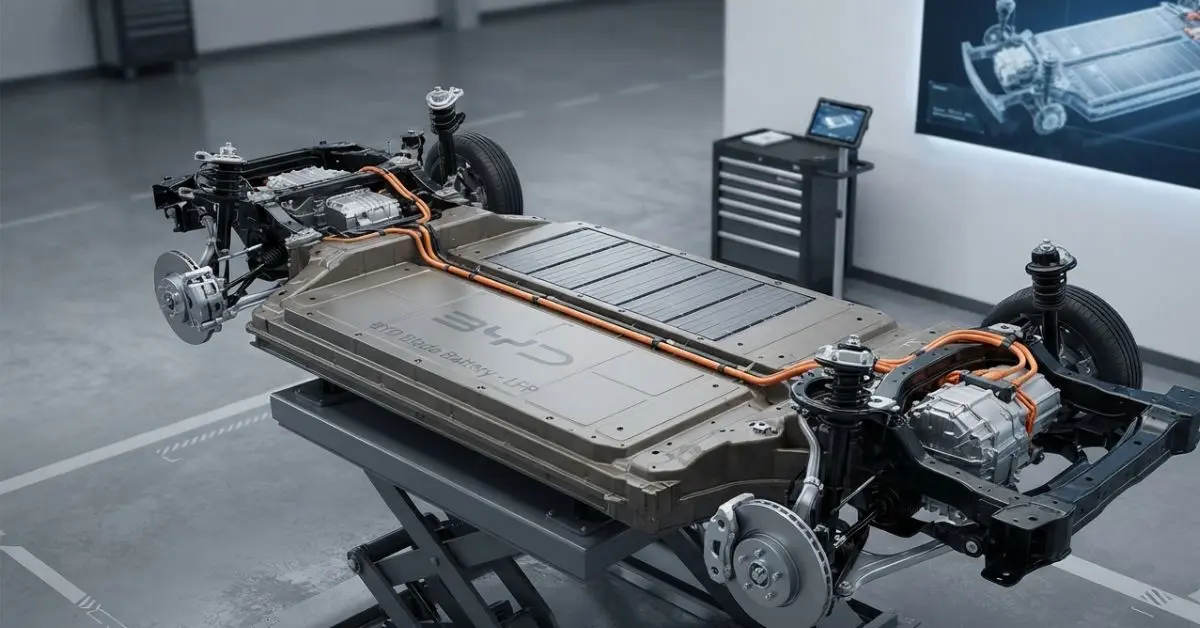
The BYD Seal features BYD’s unique Blade Battery technology, which uses LFP (Lithium Iron Phosphate) chemistry. You can choose between a 61.4 kWh Standard Range or an 82.5 kWh Long Range model. Unlike many other electric sedans that use different battery chemistries, the Seal uses LFP chemistry across all versions, including the powerful 390 kW dual-motor model.
The 82.5 kWh battery provides up to 354 miles of range. It supports 150 kW DC charging and can power external devices with its Vehicle-to-Load feature. BYD uses Cell-to-Body technology to build the battery directly into the car frame. This design makes the car very stiff—rating 40,500 Nm/degree—which improves handling and safety. This structural design is also found in the BYD Sealion 7 SUV.
BYD Seal Battery: Full Specs by Variant
| Variant | Battery | Chemistry | Voltage | WLTP Range | Peak DC Rate | Power | 0–100 km/h |
|---|---|---|---|---|---|---|---|
| Seal Standard Range (Dynamic) | 61.4 kWh | LFP Blade | 400V | ~420 km (~261 mi) | 110 kW | 150 kW (201 hp) | 7.5 sec |
| Seal Long Range (Design / Premium) | 82.5 kWh | LFP Blade | 550V | 570 km (~354 mi) | 150 kW | 230 kW (308 hp) | 5.9 sec |
| Seal Performance (Excellence / AWD) | 82.5 kWh | LFP Blade | 550V | 520 km (~323 mi) | 150 kW | 390 kW (523 hp) | 3.8 sec |
Why an LFP Blade Battery in a Sports Sedan?
Most performance electric sedans — Tesla Model 3 (NCA/NMC), Hyundai Ioniq 6 (NMC), Polestar 2 (NMC) — use nickel-based chemistry for maximum energy density. BYD chose LFP Blade Battery for the Seal’s entire lineup, including the 390 kW AWD performance variant. This is a deliberate engineering statement: LFP can now deliver competitive performance while offering structural and safety advantages NMC cannot match.
The Seal’s 82.5 kWh LFP pack delivers its energy content through BYD’s Cell-to-Body design — long, blade-shaped cells slot directly into the body structure, eliminating module housings and maximizing usable volume for active cell material. This design also means the cells contribute directly to the car’s structural rigidity, not just energy storage — achieving that remarkable 40,500 Nm/degree torsional stiffness figure.
For owners, LFP offers three key practical benefits over NMC: daily charging to 100% without degradation concerns, a longer rated cycle life (2,000–5,000+ cycles), and better thermal stability in hot climates. BYD explicitly recommends charging the Seal to 100% regularly — unlike the 80% daily limit advisories typical of NMC rivals.
Cell-to-Body: BYD’s Structural Battery Innovation
The Seal takes BYD’s Blade Battery further than the Atto 3 by implementing Cell-to-Body (CTB) integration, in which the battery cells become part of the vehicle’s structural floor assembly. In traditional EVs, the battery pack is a separate module bolted to the chassis. In CTB, the cells are bonded into the floor structure itself, with the car body above and an underbody guard below completing a structural sandwich.
This integration achieves four benefits simultaneously: higher structural rigidity (40,500 Nm/deg), lower floor height (improving headroom), lower center of gravity (improving handling), and more volume available for energy storage per unit of vehicle space. BYD’s CTB approach is among the most advanced structural battery integration designs in any production vehicle as of 2026.
BYD Seal Charging Speeds
Charging Method | Power | 61.4 kWh (Standard) | 82.5 kWh (Long Range / Performance) |
|---|---|---|---|
Level 1 (120V) | ~1.4 kW | ~45 hours full | ~60 hours full |
Level 2 (240V, 7 kW) | 7 kW | ~10 hours full | ~14 hours full |
Level 2 (240V, 11 kW) | 11 kW | ~7 hours full | ~9 hours full |
DC Fast (Standard) | 110 kW | ~35 min (10–80%) | — |
DC Fast (Long Range / AWD) | 150 kW | — | ~26 min (30–80%) |
The BYD Seal’s 150 kW peak DC charging speed is its main weakness compared to 800-volt rivals. Independent tests show the car often peaks at only 123 kW for a short time, which is lower than BYD’s official claim. This speed difference rarely affects daily local driving when you use a Level 2 home charger.
For road trips, the car takes 26 minutes to charge from 30% to 80%. This is functional, though it is slower than the Ioniq 6 at 18 minutes or the Model 3 at about 20 minutes. BYD includes Vehicle-to-Load (V2L) technology on Long Range and Performance trims. This feature lets you power camping gear, tools, or emergency devices through a standard outlet adapter.
BYD Seal Battery Longevity
LFP Blade Battery longevity is one of the Seal’s strongest selling points. BYD’s LFP cells are rated for 2,000–5,000+ charge cycles to 80% capacity — versus NMC’s typical 1,000–2,500 cycles. For a sedan averaging 15,000 miles per year with approximately 60 full-equivalent cycles annually, even a 2,000-cycle LFP pack is projected to last over 30 years of cycling before reaching 80% capacity. Calendar aging from heat and high SoC exposure is the practical limiting factor.
- Charge to 100% daily: BYD specifically recommends this for LFP chemistry — unlike NMC competitors that advise 80% daily limits
- Annual degradation rate: Approximately 1–1.5% per year under normal LFP conditions — among the lowest in any electric sedan
- Hot climate advantage: LFP’s higher thermal runaway onset temperature (~270°C vs NMC’s ~195–210°C) makes the Seal’s battery safer and less prone to heat-accelerated degradation in warm climates
BYD Seal vs Competitors: Battery Comparison
| Model | Battery | Chemistry | WLTP / EPA Range | Peak DC Rate | Daily Charge Limit |
|---|---|---|---|---|---|
| BYD Seal Long Range RWD | 82.5 kWh | LFP Blade | 354 miles WLTP | 150 kW | 100% (recommended) |
| Tesla Model 3 Long Range RWD | ~82 kWh NCA | NCA | 358 miles EPA | 250 kW (V4) | 80% recommended |
| Hyundai Ioniq 6 LR RWD | 77.4 kWh NMC (800V) | NMC | 361 miles EPA | 233 kW | 80% recommended |
| Polestar 2 LR RWD | 82 kWh NMC | NMC | 320 miles EPA | 205 kW | 90% recommended |
Charging Tips for BYD Seal Owners
- Charge to 100% regularly: LFP chemistry actually benefits from regular full charges — it helps the battery management system recalibrate accurate state-of-charge readings
- Precondition for faster DC charging: Route to DC fast chargers via the Seal’s navigation for best charging speeds — especially in cold weather, where LFP performance can drop significantly below 10°C
- Cold-weather awareness: LFP’s main weakness is cold-weather range — below 0°C, available range can drop by 25–40%. Precondition the battery while plugged in before cold-weather departures
- Use V2L for camping/events: The 82.5 kWh pack makes an excellent mobile power source — V2L allows powering appliances up to approximately 3.3 kW through the charge port adapter
BYD Seal Battery Warranty
BYD covers the Seal battery with an 8-year / 150,000 km (93,000 miles) warranty in most markets against capacity loss of less than 70% of the original capacity. This 150,000 km coverage limit is higher than many European and American competitors’ 100,000-mile (160,000 km) limits — reflecting BYD’s confidence in the Blade Battery’s durability under higher-mileage use.
Conclusion
The BYD Seal shows that LFP battery technology works well in a high-performance electric car. It’s 82.5 kWh “Blade Battery” uses a design called Cell-to-Body, where the battery is built directly into the car’s frame. This setup gives the car a range of 354 miles and makes the vehicle very strong. You can charge this battery to 100% every day without worrying about it wearing out quickly. It also lasts longer than NMC batteries, a common rival battery type.
If you want an SUV with this same battery technology, you should look at the BYD Sealion 7 or the cheaper BYD Atto 2. The main weakness of the Seal is its 150 kW peak DC charging speed, which is slower than that of some competitors that use 800V systems. Even so, if you mostly charge at home, the Seal is a great choice. Its battery is simple, lasts a long time, and stays stable even in hot weather.
