
BYD Dolphin Battery: Complete Guide

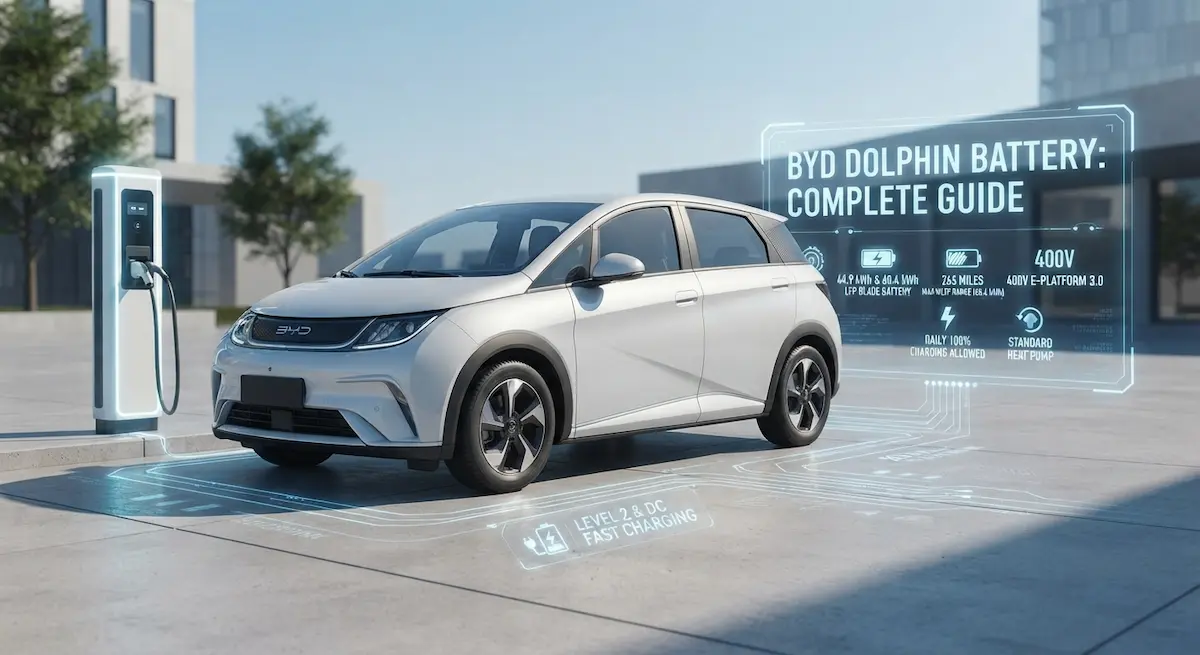
The BYD Dolphin uses BYD’s Blade Battery in two sizes: 44.9 kWh and 60.4 kWh, both lithium iron phosphate (LFP). The smaller pack is rated at 340 km (211 miles) of WLTP range and the larger at 427 km (265 miles), and the car is sold across Europe, the UK, Australia and New Zealand — but not in the United States, so it has no EPA rating and every range figure in this guide is WLTP.
The BYD Dolphin has a Blade Battery (LFP) in two sizes: 44.9 kWh usable (46.0 kWh gross) and 60.4 kWh usable (about 62 kWh gross). WLTP range is 340 km for the small pack and 427 km for the large one; expect roughly 350 km of real range from the 60.4 kWh car. DC fast charging peaks at 65 kW (44.9 kWh), 88 kW on launch 60.4 kWh cars and 110 kW on updated European cars from 2025; Australian cars peak lower, at 60 and 80 kW.
Key figures: 44.9 / 60.4 kWh · LFP Blade · WLTP 340 / 427 km · DC 65–110 kW by market · from £25,490 at UK launch · battery warranty 8 years / 250,000 km in Europe, 160,000 km in Australia.
That one fact explains most of the confusion around this car online. The same 60.4 kWh pack also appears as 60.5 and even 62.0 kWh in different databases, Australian cars charge more slowly than European ones, and the warranty changed in January 2026. This guide separates the markets and model years so each figure means what it says.
BYD Dolphin Battery Specifications
Two packs, one chemistry: every Dolphin carries an LFP Blade Battery, sized 44.9 or 60.4 kWh. The table below lists the European launch range, which is also the basis for UK cars; Australian cars follow underneath it because their motors and charging speeds differ.
| Trim | Battery (usable) | Motor | WLTP range | 0–100 km/h | DC peak |
|---|---|---|---|---|---|
| Active | 44.9 kWh | 70 kW | 340 km (211 mi) | 12.3 s | 65 kW |
| Boost | 44.9 kWh | 130 kW | 315 km (196 mi) | 7.3 s | 65 kW |
| Comfort | 60.4 kWh | 150 kW | 427 km (265 mi) | 7.0 s | 88 kW (110 kW from the 2025 update) |
| Design | 60.4 kWh | 150 kW | 427 km (265 mi) | 7.0 s | 88 kW (110 kW from the 2025 update) |
The figures BYD quotes are usable capacity. The 44.9 kWh pack holds 46.0 kWh in total, and the 60.4 kWh pack is estimated at about 62.0 kWh gross, which is why some databases list the same battery as 60.5 kWh usable or 62.0 kWh nominal. All three numbers describe one battery; this guide uses BYD’s 44.9 and 60.4 kWh figures throughout.
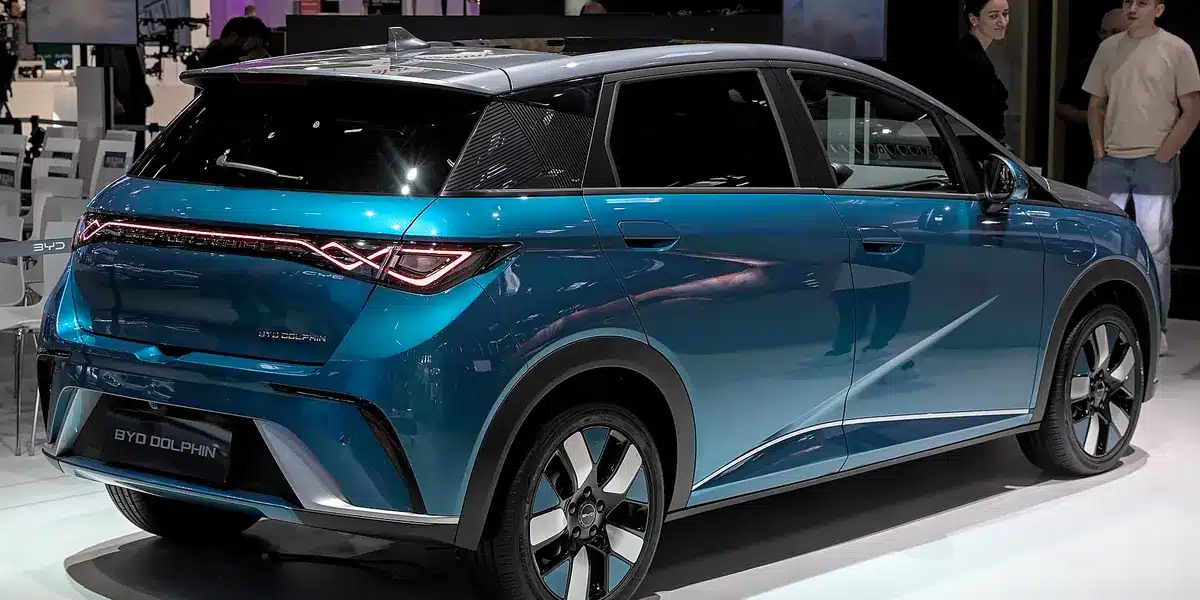
Nominal voltage confirms the Dolphin’s 400-volt-class design: about 333 volts for the 44.9 kWh pack and 403 volts for the 60.4 kWh pack, so there is no 800-volt version of this car in any market. Kerb weight is 1,506 kg with the small pack and 1,658 kg with the large one, and BYD does not publish a separate pack weight. Australian cars are the Dynamic (44.9 kWh, 70 kW, 340 km) and the Premium (60.4 kWh, 150 kW, 427 km), later renamed Essential and Premium; their DC charging peaks are 60 and 80 kW, lower than Europe’s, and Australian AC charging is 7 kW single-phase only.
Inside the Blade Battery and e-Platform 3.0
The Dolphin’s battery is the structure: long LFP cells laid directly into the pack floor, with no modules in between. That cell-to-pack layout is what BYD calls the Blade Battery, and it sits at the centre of the e-Platform 3.0 architecture the Dolphin shares with the Atto 3 and Seal. Because the cells are LFP, the pack contains no cobalt or nickel, which keeps cost down and suits the frequent full charging described later in this guide. Readers who want the technology on its own can read our guide to what a Blade Battery is.
The platform’s eight-in-one electric powertrain combines the vehicle control unit, battery management system, power distribution unit, drive motor, motor controller, transmission, DC-DC converter and onboard charger in one assembly. Thermal management matters more to daily range: a heat pump is standard on European and UK Dolphins, and the updated cars from 2025 use an optimised version of it. BYD Australia does not publish a heat-pump specification for its cars, so this guide does not claim one there. Vehicle-to-load is fitted on European cars, with BYD UK quoting a 3.3 kW external discharge through its power strip while some databases list 2.2 kW, so the usable output depends on the market and the adapter supplied.
Dolphin or Dolphin Surf? Two Different Cars
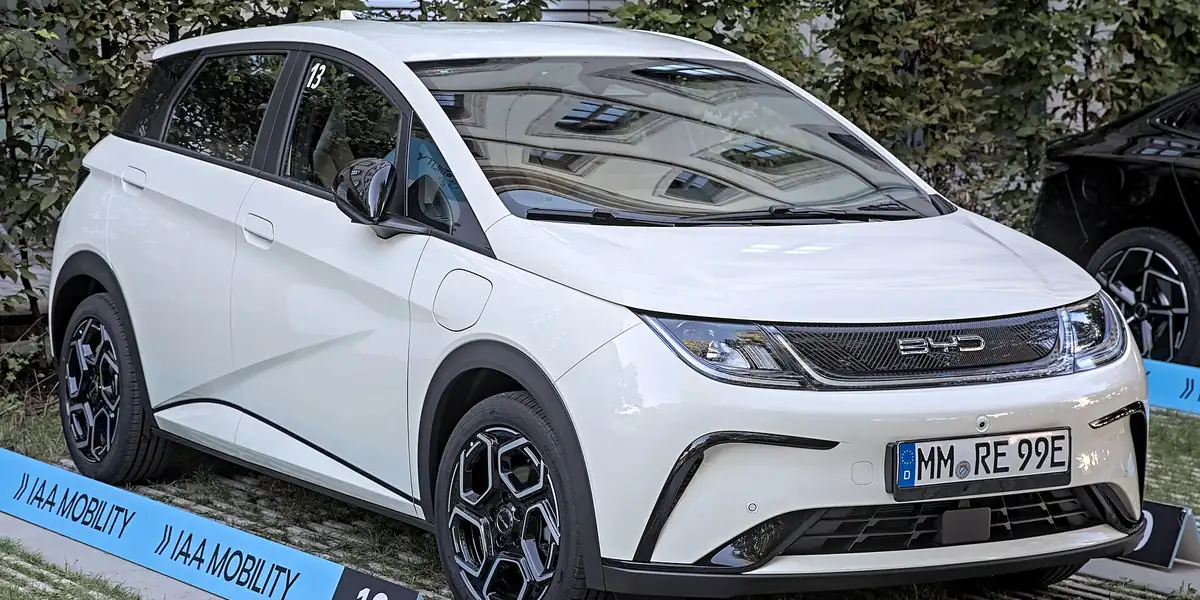
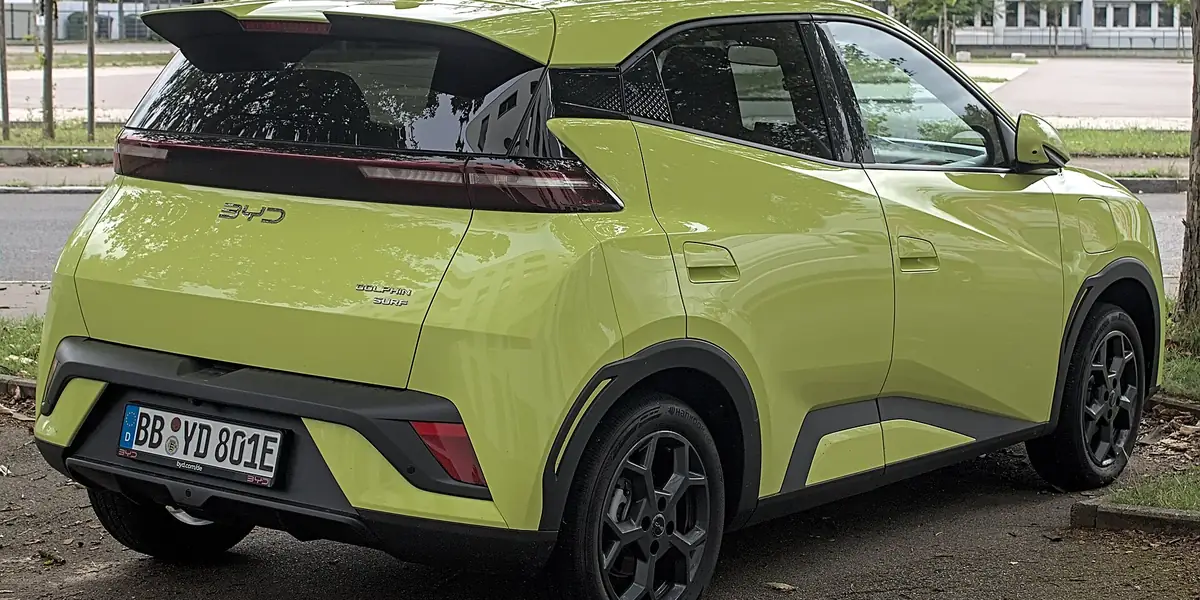
The Dolphin Surf is not a Dolphin trim — it is the smaller Seagull city car under a European name, with 30 or 43.2 kWh batteries. Search results mix the two constantly, and BYD’s own naming invites it: the Surf is the Seagull from China and the Dolphin Mini from Latin America, relaunched in Europe in May 2025 from £18,675 in the UK. It is about 40 cm shorter than the Dolphin, seats its driver in a car a class smaller, and charges at 65 or 85 kW DC depending on version.
The clean split is this: Dolphin means 44.9 or 60.4 kWh and 4.29 metres of family hatchback; Dolphin Surf means 30 or 43.2 kWh and a city car. Our separate Dolphin Surf battery guide covers the smaller car on its own. A third name is now appearing in European listings — the Dolphin G, a plug-in hybrid with a much smaller battery — and its figures belong to neither of these electric cars.
BYD Dolphin Real-World Range
Independent estimates put the 60.4 kWh Dolphin at about 350 km (215 miles) of mixed real-world range, against its 427 km WLTP rating. EV Database’s breakdown shows where the official figure goes: about 400 km in mild combined driving, 295 km in cold weather, 315 km at highway speeds and up to 520 km in mild city use. For the 44.9 kWh car, the same source family estimates roughly 280–290 km in mixed use against 340 km WLTP.
Measured testing agrees with the estimates. Germany’s ADAC Ecotest recorded the Dolphin Comfort at 19.1 kWh per 100 km, which works out at roughly 350 km from the large pack — thirstier than the WLTP cycle suggests, and a useful reality check for motorway drivers. Cold weather costs the usual LFP share of range, and the heat pump fitted to European cars is there to claw some of it back; there is no honest single “winter range” number, because EV Database’s cold-combined estimate of 295 km for the large pack already assumes a mix of driving.
BYD Dolphin Charging Times and Speeds
Charging speed is where the Dolphin’s markets and model years genuinely differ, so each figure below names its car. All Dolphins use a Type 2 socket for AC and CCS2 for DC in Europe and Australia. BYD quotes its fast-charge times from 30 to 80 percent, while independent databases quote 10 to 80 percent; the basis is labelled on every figure here so the two are never mixed.
| Car | DC peak | Quoted / measured time |
|---|---|---|
| 44.9 kWh, Europe | 65 kW | 10–80% in about 38 min (measured average 50 kW) |
| 60.4 kWh, Europe (2023–24) | 88 kW | 30–80% in 29 min (BYD); 10–80% in about 40 min |
| 60.4 kWh, Europe (2025 update) | 110 kW | 30–80% in 26 min (BYD); 10–80% in 36 min |
| 44.9 kWh, Australia (Dynamic) | 60 kW | — |
| 60.4 kWh, Australia (Premium) | 80 kW | — |
Home and workplace charging is AC. In Europe the Active charges at 7 kW single-phase (a full charge in about six and a half hours), while the Boost, Comfort and Design take 11 kW three-phase, filling the 44.9 kWh pack in about four hours and the 60.4 kWh pack in about five and a half. Australian cars of both sizes charge at 7 kW single-phase, and charging from an ordinary household socket in the car’s own markets means 230 volts at roughly 2.3 kW — an overnight top-up, not a full charge.
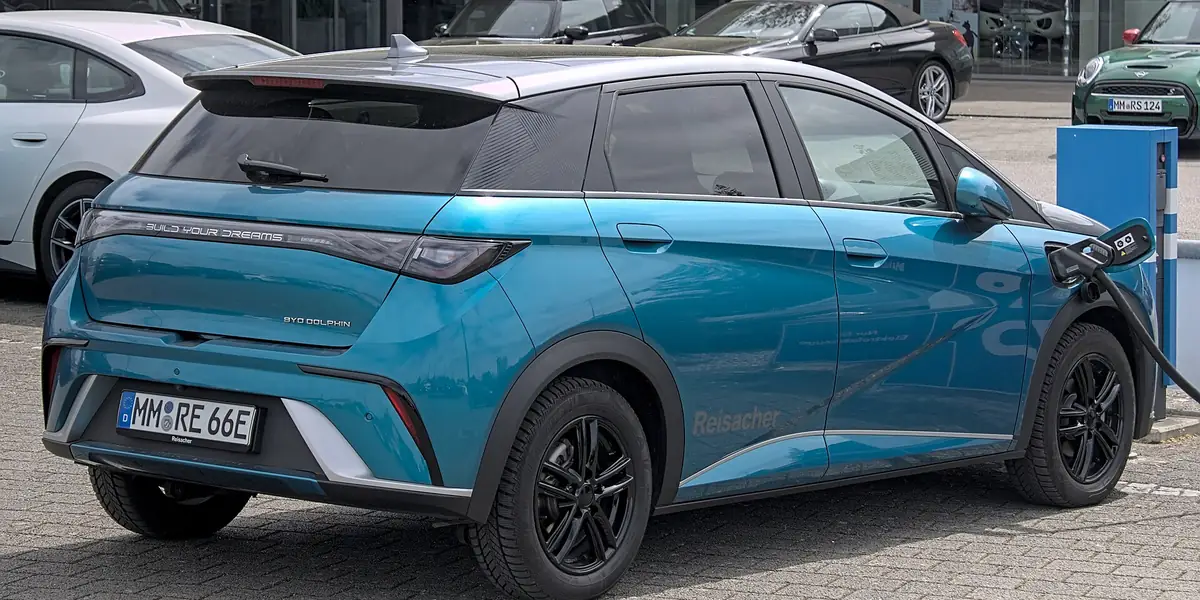
LFP chemistry changes the charging advice. BYD’s owner guidance for its Blade Battery cars is to charge to 100 percent regularly rather than stopping at 80, because a full charge is how the battery management system keeps its state-of-charge reading accurate on an LFP pack. The same guidance asks owners to run the battery below 10 percent every three to six months, then charge fully, so the system can recalibrate across the whole range. Occasional DC fast charging does the pack no harm, but the daily habit BYD designs for is a full AC charge.
BYD Dolphin Prices
The Dolphin launched as one of Europe’s cheapest electric family cars, and prices have since split by market. In the UK it started at £25,490 for the 44.9 kWh Active in 2023, with the 60.4 kWh Comfort at £29,490; by late 2026 UK prices run from about £26,195, with the large-battery car at £30,230. Mainland European launch prices ran from €29,990, and German pricing in late 2026 starts at €33,990 after earlier discounting ended.
Australia has seen the sharpest falls. The Dynamic launched at A$38,890 plus on-road costs and the Premium at A$44,890, but the renamed Essential now starts at A$29,990 and the Premium at A$36,990, with driveaway promotions dipping below that in 2026. Every price in this section is dated because BYD adjusts them often; treat them as the position at the time shown, not a live quote.
BYD Dolphin Battery Replacement Cost
No official replacement price for a Dolphin battery pack exists in any market — BYD does not publish one, and no verifiable dealer quote for this car has surfaced. That is less alarming than it sounds. The oldest Dolphins anywhere are the 2021 Chinese cars, European and Australian cars date from 2023, and every one of them is still inside its eight-year battery warranty, so out-of-warranty pack replacements barely exist yet; accident damage is normally an insurance matter, and repairs are handled module by module where possible.
Treat any precise figure you meet elsewhere with suspicion unless it names this car and this market: the Australian dollar figures that circulate most widely are prices quoted for the Atto 3, and the most-shared Brazilian quote concerns the smaller Dolphin Mini. What an owner does have, beyond the warranty, is consumer law: in Australia, the Australian Consumer Law’s guarantees cannot be excluded by a manufacturer warranty and can still cover a major battery failure after the warranty ends, which for a major failure means a repair, replacement or refund. For the general picture across brands, our EV battery replacement cost guide explains what full pack replacements cost on the cars where prices are known.
How Long Does the BYD Dolphin Battery Last?
BYD’s own claim for the first-generation Blade Battery in this car is more than 3,000 charge cycles, which BYD equates to roughly 1.2 million kilometres of driving. BYD’s current Blade Battery marketing cites over 5,000 cycles, but that figure belongs to the newer generation of the technology, so the 3,000-cycle claim is the one that describes the Dolphin’s pack. LFP chemistry supports a long service life: it fades more slowly than the nickel-based chemistries and tolerates the regular 100 percent charging BYD recommends.
Honesty requires a limit here: there is no published fleet study or instrumented long-term test of Dolphin degradation, because the oldest European and Australian cars are only about three years old. Anything online presenting precise Dolphin state-of-health percentages at set mileages is unsourced. The hardest longevity fact available is the warranty floor below — BYD contractually guarantees at least 70 percent capacity for eight years, which tells you the degradation BYD itself is prepared to stand behind.
BYD Dolphin Battery Warranty
European and UK Dolphins now carry an eight-year, 250,000 km battery warranty with a guaranteed 70 percent state of health — and it applies to cars already sold. BYD raised the distance limit from 200,000 km in January 2026 and applied the change retroactively across the UK and Europe; if the measured state of health falls below 70 percent inside the term, BYD must repair, replace or otherwise rectify the battery. The car’s vehicle warranty is six years or 150,000 km, and the drive unit is covered for eight years or 150,000 km.
Australia’s terms are different and were not part of the European extension. The BYD Australia warranty handbook covers the battery and drive unit together for eight years or 160,000 km, with a capacity-retention guarantee of at least 70 percent, and the vehicle itself for six years or 150,000 km. Australian owners also keep their Australian Consumer Law rights on top of those terms, as the replacement section above explains.
One recall belongs in any honest ownership picture. In September 2024 BYD recalled 96,714 Dolphins and Yuan Plus cars in China for a defect in the electric steering column controller — a capacitor that could interfere with the controller and, in the worst case, overheat; dealers fit an insulation gasket free of charge. It was not a battery defect, and no equivalent battery recall affects European or Australian Dolphins.
BYD Dolphin vs Other Affordable Electric Hatchbacks
Against its European rivals, the Dolphin’s edge is battery size for the money — and its rivals’ figures are often misquoted, so this table uses manufacturer numbers. The MG4 Extended Range’s 77 kWh battery is a nickel-based (NMC) pack, not LFP; the Renault 4’s official range is lower than many roundups claim.
| Car | Battery | WLTP range | DC peak |
|---|---|---|---|
| BYD Dolphin | 60.4 kWh LFP | 427 km (265 mi) | 88–110 kW |
| MG4 Extended Range | 77 kWh NMC | 520 km (323 mi) | 144 kW |
| Renault 4 E-Tech | 52 kWh | 400 km (248 mi) | 100 kW |
| Peugeot e-208 | 54 kWh (51 usable) | 433 km (269 mi) | 100 kW |
| Nissan Leaf | 40 kWh | 270 km (168 mi) | 50 kW |
Should You Buy a BYD Dolphin?
For a European or Australian buyer who charges at home, the Dolphin remains one of the easiest electric hatchbacks to justify: a big LFP battery, a long warranty, and a price the rivals struggle to match. The 44.9 kWh car suits urban and suburban use, where its 340 km rating is more than enough, while the 60.4 kWh car’s extra range and (in Europe) faster charging make it the better motorway tool. Its weaknesses are the modest DC charging speeds by 2026 standards, Australian cars being slower still, and real-world range that lands well short of the WLTP figure.
Frequently Asked Questions
What size battery does the BYD Dolphin have?
Two sizes: 44.9 kWh usable (46.0 kWh gross) and 60.4 kWh usable (about 62 kWh gross), both BYD Blade Batteries using LFP chemistry. The small pack is rated at 340 km WLTP and the large one at 427 km.
Is the BYD Dolphin battery LFP or NMC?
It is LFP — lithium iron phosphate — in every market and every trim. That cobalt-free chemistry is what BYD’s Blade Battery is built on, and it is why the car can be charged to 100 percent regularly.
How far does a BYD Dolphin really go on a charge?
About 350 km (215 miles) of mixed driving for the 60.4 kWh car on EV Database’s estimates, and roughly 280–290 km for the 44.9 kWh car. Cold weather brings the large pack down to about 295 km, and ADAC’s measured consumption test also works out at roughly 350 km.
How long does a BYD Dolphin take to charge?
On a DC fast charger, a European 44.9 kWh car needs about 38 minutes from 10 to 80 percent at its 65 kW peak; the 60.4 kWh car takes 29 minutes from 30 to 80 percent at 88 kW, or 26 minutes in updated 2025 cars at 110 kW. Australian cars peak at 60 and 80 kW, so they take longer. At home on AC, allow about four to six and a half hours for a full charge depending on the version.
Is the BYD Dolphin sold in the United States?
No. BYD does not sell passenger cars in the United States, so the Dolphin has no US price and no EPA range rating. The figures in this guide are European, UK and Australian specifications, and all ranges are WLTP.
What is the difference between the Dolphin and the Dolphin Surf?
They are different cars. The Dolphin is a 4.29-metre family hatchback with 44.9 or 60.4 kWh batteries; the Dolphin Surf is the smaller Seagull city car sold under that name in Europe, with 30 or 43.2 kWh batteries and prices from £18,675 in the UK.
How much does a BYD Dolphin battery replacement cost?
There is no published price: BYD does not list one, and all European and Australian cars remain inside their eight-year battery warranty, so out-of-warranty replacements are not yet a market. Figures quoted online for other BYD models, including the Atto 3 and the Dolphin Mini, are not Dolphin prices.
How long is the BYD Dolphin battery warranty?
Eight years in both regions, with a 70 percent capacity guarantee: up to 250,000 km in Europe and the UK (extended from 200,000 km in January 2026 and applied to existing owners), and 160,000 km in Australia.
Conclusion
The Dolphin’s battery story is simple once the markets are separated: two LFP Blade packs, honest mid-pack charging speeds, and one of the longest battery warranties in its class. The 44.9 kWh car covers city and suburban life at the lowest price, the 60.4 kWh car adds real touring range, and the January 2026 warranty extension strengthened the case for both. Judge the car on the figures for your own market — not the merged numbers that circulate online — and it remains the benchmark affordable electric hatchback in the markets where it is sold.
