
Honda e Battery: Complete Guide

Researched from Honda’s own warranty and launch material, EV Database and Fastned charging data, and the instrumented tests of Bjørn Nyland and Carwow, November 2026.
Quick answer
The Honda e has one battery: 35.5 kWh in total, of which about 28.5 kWh is usable — Honda holds back roughly a fifth of the pack to protect it. The Panasonic cells give a WLTP range of up to 137 miles and a realistic 105 miles. Charging peaks at a claimed 50 kW but measures 46 kW. The battery warranty is 8 years or 100,000 miles at 70% capacity — and no, the battery cannot be upgraded: no bigger pack exists for this car.
Honda e Battery Specs at a Glance
One car, one battery — every Honda e ever built carries the same 35.5 kWh pack.
| Item | Honda e |
|---|---|
| Battery (total) | 35.5 kWh |
| Battery (usable) | ~28.5 kWh (estimate — Honda never published it) |
| Cells | Panasonic, prismatic, 192 cells (96s2p), liquid-cooled |
| Nominal voltage | 355 V (400 V class) |
| Motor | Rear, 136 hp (base) / 154 hp (Advance), 315 Nm |
| WLTP range | Up to 137 miles (131 on 17-inch wheels) |
| Real-world range (EV Database) | ~105 miles |
| DC charging | 50 kW claimed / 46 kW measured peak |
| AC charging | 6.6 kW single-phase |
| Battery warranty | 8 years / 100,000 miles, 70% floor |
Two clarifications before the detail, because Honda’s naming causes real confusion. This page is about the Honda e city car — not the Honda e:Ny1, which is a much larger SUV with a 68.8 kWh battery, and not any scooter. And the e was only ever sold with this single battery size: claims found on some manuals sites of a larger 50.5 kWh option are simply wrong. The car was sold in Europe, the UK and Japan from 2020, never in the US, and production ended in January 2024 — so every figure here is a European/UK figure, and every Honda e you can buy in 2026 is a used one.
The Battery: Panasonic Cells Behind a Very Large Buffer
The pack is 192 Panasonic prismatic cells in a 96s2p layout — and the interesting engineering is not the cells, it is how little of them Honda lets you use.
Honda’s own launch material confirms Panasonic as the cell supplier and a liquid-cooled pack mounted under the floor. Database listings describe NMC chemistry; one specialist source (PushEVs) identifies the cells more precisely as Panasonic’s prismatic PHEV2 family — the same cell family it identifies in the Mazda MX-30, another deliberately small-battery Japanese car of the same era. Treat that finer identification as one specialist’s work rather than a Honda-published spec, because Honda never published the chemistry in detail.
Honda never published a usable-capacity figure either. The 28.5 kWh used throughout this page is EV Database’s flagged estimate, echoed by other databases; the only instrumented check, from Bjørn Nyland’s range testing, delivered 27.2 kWh from a full charge. So read 28.5 as “about 28” — close enough for every decision in this guide, and labelled honestly because the exact number is not Honda’s.
Where did the other 7 kWh go?
Nowhere — it is held in reserve. The gap between 35.5 and ~28.5 kWh is a buffer of about 19.7% of the pack, which EVKX describes as held back “for battery protection”. Most EVs of the car’s era hold back roughly 5–10%. Honda never published a sentence saying the buffer exists for longevity, so that part is reasoning rather than a quote — but it is sound reasoning: cells that are never truly full and never truly empty age more slowly, and the pattern shows up again in this car’s charging curve and in what owners report about its health.
So can you charge it to 100% every day?
This is where the buffer pays out in daily life. Honda never set an 80% rule for this car: the owner’s manual gives storage guidance (recharge at least every three months, avoid heat and full discharge) but no daily charge limit, although the car does offer a driver-set charging limit in its EV menu for owners who want one.
Honda UK’s general EV advice counsels against habitually charging any EV to maximum — but on a car where “100%” on the dashboard is roughly 80% of the cells’ true capacity, owners charging to full every night are doing far less harm than the same habit would do in a car with a thin buffer. That is the design working as intended, not an accident.
Range: 137 Miles on Paper, About 105 on the Road
The WLTP figure belongs to the lightest car on the smallest wheels — the honest planning number is EV Database’s ~105 miles, and winter takes a real bite.
The type-approval figures are 222 km (137 miles) for the lightest configuration and 210 km (131 miles) on 17-inch wheels. EV Database’s real-range estimate is 170 km (about 105 miles) combined, spanning 120 km on a cold motorway run to 255 km of gentle city driving in mild weather. The instrumented evidence supports that spread rather than the brochure.
What did instrumented tests record?
Bjørn Nyland’s summer test is the most encouraging data point: at a steady 90 km/h in 26 °C weather the car covered 189 km — 85% of its WLTP figure, a proportion few small EVs match; at 120 km/h it managed 121 km. Carwow’s run-it-until-it-stops test recorded 113 miles, mostly motorway. Parkers, after six months living with one, reported struggling to go much beyond 100 miles on a charge. A Finnish owner logging a full year recorded about 180 km in summer, 120 km in ordinary winter, and 100 km at −25 °C. There is no instrumented winter test from Nyland for this car — the winter picture here is estimates and owner logs, labelled as such.
85% — of its WLTP range achieved at a steady 90 km/h in instrumented testing; the Honda e’s problem was never honesty, it was the size of the pack.
Charging: the Claim Is 50 kW, the Measurement Is 46
Honda’s “80% in about 30 minutes” was measured from the low-charge warning light, not from 10% — a real 10–80% charge takes about 41 minutes.
Honda’s claim, from its own launch material, is up to 50 kW with a charge to 80% in roughly 30 minutes on a 50 kW-class rapid charger. Fastned’s measured curve, published via EV Database, is the reality: a 46 kW peak, a 31 kW average across 10–80%, and 41 minutes for that charge.
A minority of spec databases print 56 kW for this car; no Honda document and no measured session supports it, so it does not appear in this guide’s tables. What the measured curve does show, unusually, is the buffer at work: the car holds roughly 20 kW from about 70% charge to beyond 95%, where most small EVs have tapered to a trickle — charging to full at a rapid is less wasteful here than in rivals.
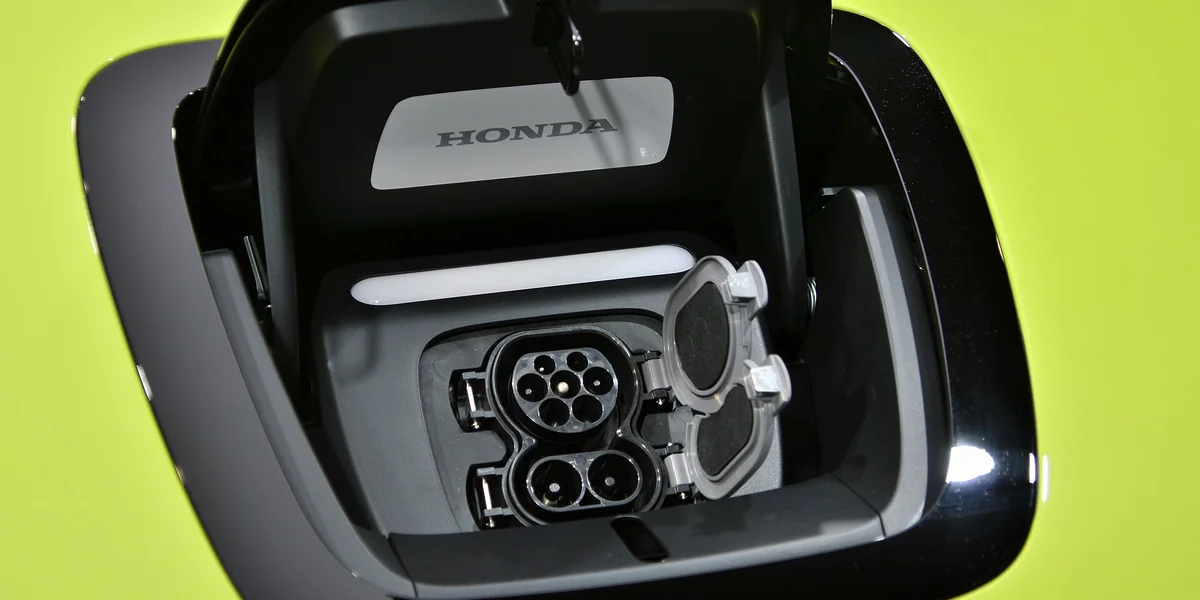
At home, the onboard charger is 6.6 kW single-phase — settled across EV Database, EVKX and EVspecs. The 7.4 kW figure repeated by many reviews is the rating of the wallbox, not the car; a full charge takes about 5 hours 15 minutes either way. European and UK cars use Type 2 for AC and CCS2 for DC; Japanese cars use CHAdeMO for DC instead. Two absences shape winter ownership: there is no heat pump (cabin heat is resistive) and no battery preconditioning, which is the mechanical reason the winter range figures above fall as far as they do.
Can You Upgrade the Honda e’s Battery?
No — and this is the answer the search results for this question have been missing: there is no upgrade, from Honda or anyone else.
Honda never offered, priced or documented a capacity upgrade for the e: no programme, no dealer option, no parts-catalogue path. No company sells an aftermarket kit, and no completed bigger-battery conversion of a Honda e is documented anywhere — no build thread, no specialist listing, nothing. (It has been done by a manufacturer elsewhere: Renault once sold a 22→41 kWh upgrade for the Zoe. Honda did nothing equivalent.)
The obvious candidate does not fit either. The Honda e:Ny1’s 68.8 kWh pack belongs to a larger front-wheel-drive crossover on Honda’s e:N Architecture F platform; the e is a bespoke rear-drive small car with its pack inside the wheelbase. The packs are not interchangeable parts — our Honda e:Ny1 guide covers that car separately. If you need more range than a healthy Honda e gives, the honest options are a state-of-health check on the car in front of you, or a different car. The e’s range limit is its concept, not a worn-out battery.
Warranty and Battery Health: a Strong Warranty, a Thin Dataset
Honda’s own European warranty conditions guarantee the pack for 8 years or 160,000 km (100,000 miles in UK materials) at no less than 70% of original capacity.
Put that floor in this car’s terms: 70% of ~28.5 usable kWh is about 20 kWh — under 100 miles of range. A car approaching the floor would be obviously limited long before it qualified for a claim, which makes the warranty a backstop rather than a description of normal ageing. What does normal ageing look like? Honestly: the dataset does not exist.
No instrumented state-of-health study and no fleet dataset for the Honda e has been published. The best single data point is an owner’s report on the Honda e forum: a July-2020 Advance, at over 150,000 km with most of its charging done on rapid chargers, still reading 90% state of health. One car, one readout — consistent with the big-buffer design, and printed here as exactly what it is.
If a pack ever did fail outside warranty, there is no Honda list price; UK third-party estimators put a replacement at roughly £3,000 (Bumper) to about £3,900 (BookMyGarage’s per-kWh model) — estimates, not quotes. Two ownership notes complete the picture: no recall touching this car’s high-voltage battery or charging system appears in EU, UK or Japanese records; and some cars suffered public-charging failures (owners call it the “red light of doom”), fixed by a software update in mid-2024 — a buyer should confirm that update has been applied.
Buying a Used Honda e in 2026
Asking prices in the UK in November 2026 run from about £11,400 to £22,500, with a median around £15,400 — for a car that cost up to £37,395 new.
Production ended in January 2024, so the newest cars are approaching three years old, and the warranty maths is favourable: a 2020 car’s battery is covered to 2028, a 2023 car’s to 2031, mileage permitting. The PistonHeads used buying guide and owner forums point to the same short check list:
- The 12V battery. It can go flat if the car stands for more than a few days (a software update reportedly eased this). Ask its age, and make sure the car starts cleanly after standing.
- The charging software. Confirm the mid-2024 update is applied, and test a public rapid charge before money changes hands.
- The bonnet charge port. Its exposed position collects debris — check around it for water ingress.
- The ordinary stuff. Some cars are rattly, and sat-nav/GPS antenna faults occur; neither is a battery issue, both are bargaining points.
Honda e vs the Used City-EV Alternatives
The e is the charmer of this set; on the battery numbers alone it is also, frankly, the weakest — every rival below goes further, and most charge faster.
| Car | Usable battery | Real range (EV Database) | DC peak |
|---|---|---|---|
| Honda e | ~28.5 kWh | ~105 miles | 46 kW measured (50 claimed) |
| Fiat 500e (42 kWh) | 37.3 kWh | ~145 miles | 85 kW |
| MINI Electric (2020–23) | 28.9 kWh | ~110 miles | 50 kW |
| MINI Cooper E (current) | 36.6 kWh | ~155 miles | 70 kW |
| Peugeot e-208 (50 kWh) | 46.3 kWh | ~180 miles | 100 kW |
| Renault Zoe ZE50 | 52.0 kWh | ~195 miles | 46 kW measured |
Two warnings belong with this table. The Zoe’s DC charging was a cost option when new (about £750 in the UK) — many used Zoes have no rapid charging at all, though all have excellent 22 kW AC. And the Honda e’s 6.6 kW AC is the slowest home charging in this set. The original MINI Electric is the e’s true contemporary: near-identical usable capacity and real range, from the same years, usually cheaper. What the e returns for its compromises is the design, the interior, the turning circle — and a battery that was engineered, unusually, to be under-stressed for its whole life.
Frequently Asked Questions
What size battery does the Honda e have?
35.5 kWh in total, with about 28.5 kWh usable — the usable figure is EV Database’s estimate, because Honda never published one. It was the only battery ever fitted to the car; there is no larger option, factory or otherwise.
Why is so much of the Honda e’s battery unusable?
About 7 kWh (19.7%) is held back as a protective buffer — EVKX describes it as held “for battery protection”, and it is roughly double the proportion most EVs reserve. The cells are never truly full or truly empty, which is gentle on them; Honda never published its reasoning in those exact words, but the design’s effects are measurable in the charging curve and in owner-reported health.
Can you upgrade the Honda e battery to a bigger one?
No. Honda never offered an upgrade, no aftermarket kit exists, and no completed swap is documented. The e:Ny1’s larger pack does not fit — that car sits on a different platform with a different drive layout. A healthy Honda e already delivers everything the car was designed to give.
How far does a Honda e really go in winter?
EV Database estimates 140 km (about 87 miles) combined in cold weather and 120 km on a cold motorway run. A Finnish owner logging a full year recorded about 120 km in ordinary winter and 100 km at −25 °C. With no heat pump and no battery preconditioning, winter is this car’s hardest season.
How fast does the Honda e actually charge?
Faster than its size suggests, slower than its brochure claims. Measured: a 46 kW peak and 31 kW average, taking about 41 minutes for 10–80%. At home, the 6.6 kW onboard charger fills it in about 5 hours 15 minutes. Honda’s “80% in 30 minutes” was measured from the low-charge warning, not from 10%.
Should you charge a Honda e to 100%?
Honda never set an 80% rule for this car, and the large buffer means a displayed 100% is roughly 80% of the cells’ true capacity — the habit that ages other packs is largely disarmed here. The car does have a driver-set charge limit in its EV menu if you prefer one.
How much warranty is left on a used Honda e?
The battery warranty runs 8 years or 100,000 miles (160,000 km) from first registration, at a 70% capacity floor: a 2020 car is covered to 2028, a 2023 car to 2031, whichever limit comes first. Check the car’s registration date and mileage, and confirm the mid-2024 charging software update has been applied.
What does a Honda e battery replacement cost?
Honda publishes no list price. UK third-party estimators put a replacement pack at roughly £3,000 (Bumper) to about £3,900 (BookMyGarage’s per-kWh model) — treat those as estimates, not quotes. The battery owners actually replace is the 12V auxiliary unit, a small lead-acid battery costing from about €48.
Conclusion
The Honda e is a small-battery car that was engineered like a big-battery one — liquid cooling, Panasonic cells, and a fifth of the pack kept in reserve from day one.
Everything about this car’s used proposition follows from those choices: a range of about 105 real miles that no upgrade will ever extend, charging that is honest rather than fast, and early health evidence — thin, but consistent — that the packs are ageing gracefully. It was discontinued because most buyers wanted more range for the money, and the rivals above still make that argument today. What they cannot offer is this car’s particular combination of design and under-stressed engineering. Buy one with the range maths done honestly, the software update confirmed and some battery warranty in hand, and the e is exactly the car Honda intended it to be.
