
Kia EV3 Battery: Complete Guide

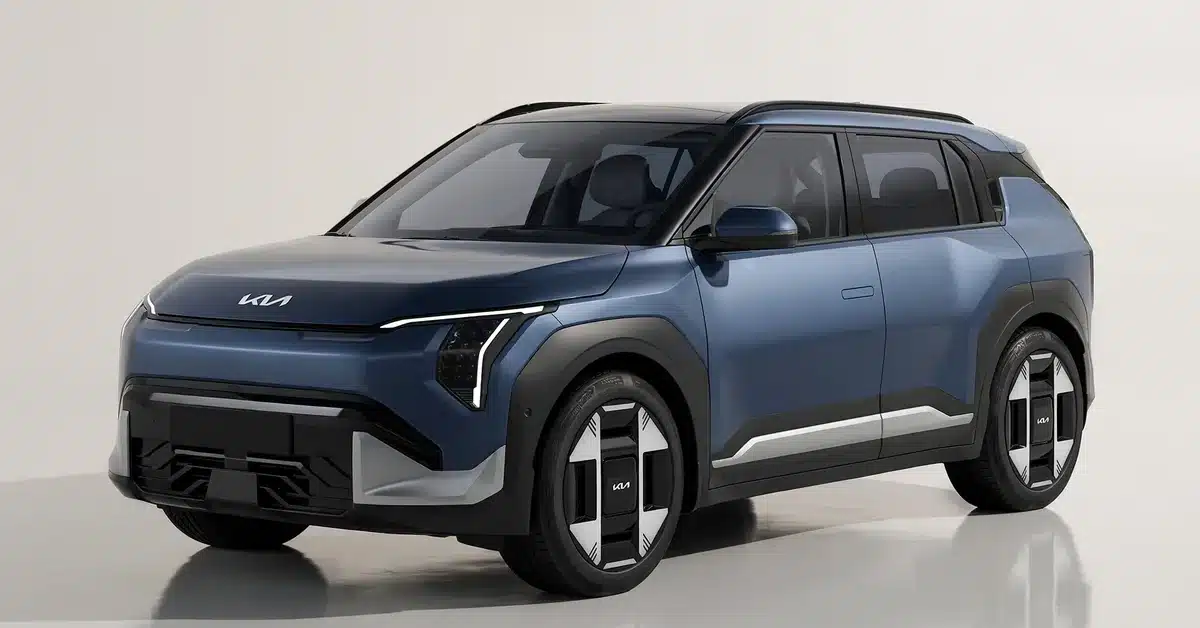
The Kia EV3 battery comes in two sizes, 58.3 kWh in the Light trim and 81.4 kWh in everything else, and both use nickel manganese cobalt chemistry on a 400-volt system. The bigger battery gives the front-wheel-drive car an EPA range of 321 miles, the smaller one 221 miles, and the EV3 is one of the cheapest new electric cars in America that charges natively on Tesla’s NACS plug. The car is a 2027 model year vehicle, built for the US in Pesquería, Mexico, and it reached American showrooms in October 2026.
Kia sold 1,496 EV3s in the US through the end of October 2026, so this is no longer a preview of a car that might come here. It also won the 2025 World Car of the Year award, a year earlier than some coverage suggests. This guide covers the US car as it is actually sold: both batteries and what separates them, real-world range from American road tests, charging at home and on the road, the 10-year battery warranty, lifespan, the 12-volt battery, and what a replacement pack would cost, insofar as anyone can honestly say today.
Sources: Kia America specifications and press releases, fueleconomy.gov (EPA), the Kia EV3 owner’s manual, NHTSA, and the Edmunds, Car and Driver and MotorTrend road tests.
The US Kia EV3 offers two NMC lithium-ion batteries: a 58.3 kWh pack in the Light (EPA 221 miles) and an 81.4 kWh pack in the Wind, Land, GT-Line and GT (EPA 321 miles front-wheel drive, 280 miles all-wheel drive). Fast charging runs 10 to 80% in 29 minutes (58.3) or 31 minutes (81.4), and the battery warranty is 10 years or 100,000 miles with a 70% capacity floor.
Key figures: 58.3 / 81.4 kWh · NMC, 400V · EPA 221–321 miles · Native NACS · From $29,890 · Warranty 10 years / 100,000 miles
Kia EV3 Battery Specs and Prices (US Models)
Two batteries, five trim names, seven versions — and the battery is decided by the trim, not picked from an options list.
The Light is the only EV3 with the 58.3 kWh battery. Every other version carries the 81.4 kWh pack, and the choice that remains is front-wheel drive or all-wheel drive. Prices below are before the $1,495 destination charge; add it and the Light starts at $31,385 delivered.
| Version | Battery | Power | EPA range | Price from |
|---|---|---|---|---|
| Light FWD | 58.3 kWh | 201 hp | 221 miles | $29,890 |
| Wind FWD | 81.4 kWh | 201 hp | 321 miles | $34,990 |
| Land FWD | 81.4 kWh | 201 hp | 321 miles | $38,490 |
| Wind AWD | 81.4 kWh | 261 hp | 280 miles | $38,690 |
| Land AWD | 81.4 kWh | 261 hp | 280 miles | $41,690 |
| GT-Line AWD | 81.4 kWh | 261 hp | 280 miles | $43,490 |
| GT AWD | 81.4 kWh | 288 hp | 280 miles | $45,890 |
What voltages and efficiency do the EV3 packs deliver?
The packs run at different nominal voltages, 369 volts for the 58.3 kWh battery and 343 volts for the 81.4 kWh battery, both on Kia’s 400-volt-class E-GMP platform. Efficiency is strong across the range: the big-battery front-wheel-drive cars are EPA-rated at 117 MPGe combined, the Light at 115 MPGe, and the all-wheel-drive cars at 103 MPGe. The GT loses no range to the other all-wheel-drive versions despite its extra power.
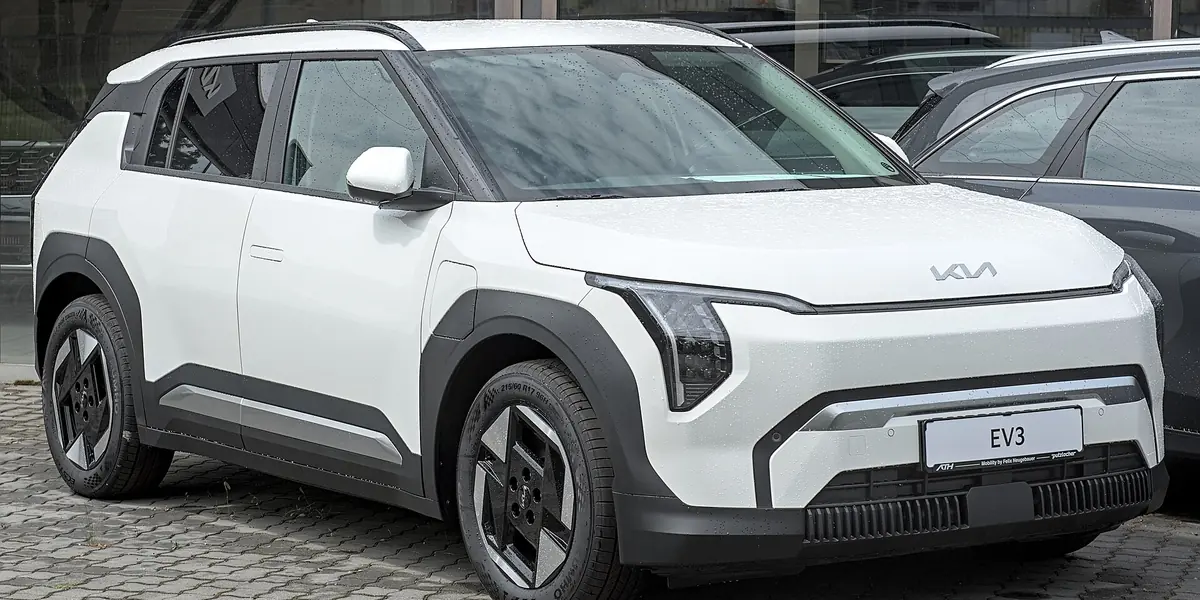
2025 World Car of the Year: Why the EV3 Won
The EV3 won the 2025 World Car of the Year award, announced at the New York Auto Show in April 2025 — not 2026, as some early coverage (including this page) had it.
Why did the EV3 win the award?
A jury of 96 motoring journalists from 30 countries picked the EV3 ahead of the BMW X3 and Hyundai’s Inster, making it Kia’s second consecutive win after the EV9 took the same award in 2024. The judges praised the same things American buyers are now discovering: proper electric range from a compact, affordable car, a bold design that does not look like a budget compromise, and value that undercuts most rivals. For a battery guide the relevant point is simpler: the award was won on the strength of the two packs this page is about, in a car sized and priced for ordinary families.
What does the award mean for buyers?
None of that guarantees the car will suit you, and awards do not charge batteries. What it does mean is that the EV3’s battery sizes, range and charging were benchmarked against the best electric cars on sale anywhere and came out on top of the judging. The sections below test those claims against US figures and US road tests.
Inside the Kia EV3 Battery: NMC, Not LFP
Both EV3 batteries use nickel manganese cobalt (NMC) pouch cells — the EV3 is not an LFP car, and it does not use BYD’s Blade battery.
What chemistry do the EV3 batteries use?
Search data shows real confusion on this point, so it is worth answering plainly. The pack assembler for the EV3, Webasto, states that both versions use NMC811 chemistry, which means a cathode rich in nickel with smaller shares of manganese and cobalt, in pouch-format cells. Kia’s own US material calls the battery only ‘lithium-ion’, so the NMC811 detail comes from the company that builds the packs. What Kia has not published is a usable-capacity figure: the 58.3 and 81.4 kWh numbers are the packs’ full sizes, and third-party estimates of roughly 55 and 78 kWh usable should be treated as estimates, not Kia data.
What is not yet known about the US-built cars?
One more honesty point matters for American buyers. Webasto’s statement covers the packs it assembles in South Korea for Korean-built cars, and Kia has not named the cell supplier for the Mexico-built cars sold in the US. The chemistry type is not in doubt, but any source naming a specific cell maker for US cars, including claims about CATL, is ahead of the evidence: CATL cells are the story of the Kia Niro EV, a different car. This page will name the US supplier when Kia or the supplier does.
Which EV3 Battery Should You Choose?
The step from the small battery to the big one costs $5,100 and buys 100 extra EPA miles — for most buyers that is the decision that defines the car.
Is the small battery enough?
The Light at $29,890 is the only way to get the 58.3 kWh battery, and its 221 miles of EPA range is honest transport for a household that charges at home and rarely road-trips. The Wind front-wheel drive at $34,990 brings the 81.4 kWh pack and its 321-mile rating, the longest range of any EV3 and the figure that makes the car a genuine only-car. Drivers whose days are mostly short trips will not miss the bigger battery; anyone who regularly drives more than about 150 miles between charges will feel the difference every single time.
What does all-wheel drive cost in range?
All-wheel drive is the other fork in the road, and it is a range decision as much as a traction one: it drops the big-battery car from 321 to 280 EPA miles, while adding power and, in the US range, the available heat pump that protects winter range. The GT at $45,890 adds performance flavour without losing range against the other all-wheel-drive cars. There is no wrong answer here, but there is a permanent one: the battery cannot be changed later, so buy for the longest journey you actually make, not the average one.
Kia EV3 Charging: Native NACS and 29-Minute Fast Charges
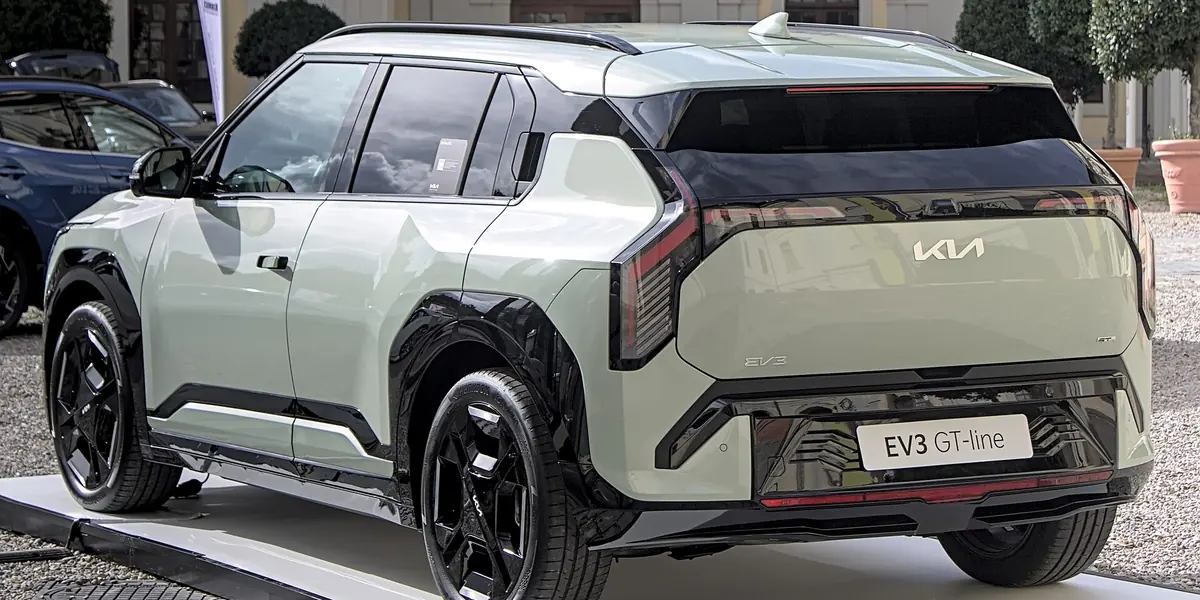
The EV3 charges natively on the Tesla-style NACS plug with Plug & Charge, so Supercharger sessions need no adapter and no separate app dance.
How fast does the EV3 charge on DC?
That is a headline feature at this price, and it sits alongside a CCS-era spec sheet underneath: the car’s system is 400-volt class, so it cannot match the 800-volt charging speeds of the EV6 or EV9. Kia’s own tested DC fast-charge times are 10 to 80% in 29 minutes for the 58.3 kWh battery and 31 minutes for the 81.4 kWh battery, and on a 50 kW charger the same charge takes about 55 and 79 minutes respectively.
Kia America does not publish a peak DC figure; Kia’s claimed figures globally are about 101 kW for the small pack and 128 kW for the large one, and Car and Driver measured a 129 kW peak in its US test, so treat those as the working numbers.
| Charging method | 58.3 kWh (Light) | 81.4 kWh |
|---|---|---|
| Home AC (11.5 kW, Level 2) | About 5.2 hours, full | About 7.9 hours, full (AWD window-sticker figure) |
| DC fast charge, 10–80% | 29 minutes | 31 minutes |
| DC at 50 kW, 10–80% | About 55 minutes | About 79 minutes |
What about the battery heater, heat pump and V2L?
A battery heater is fitted, and the car can precondition its battery on the way to a charger when a charging stop is planned in the navigation, which is how the tested times are achieved in cold weather. The available heat pump, tied to the all-wheel-drive versions in the US, protects cabin-heating range rather than charging speed. Vehicle-to-Load is available with separately sold equipment and can run down to a 20% state of charge, turning the big battery into a very large power bank for tools, camping kit or a fridge during an outage.
Kia EV3 Real-World Range: US Road Tests
In Edmunds’ EV Range Test the EV3 GT-Line AWD covered 309 miles on a charge — 29 miles beyond its own EPA rating.
What did Edmunds’ range test find?
That test matters because every instrumented US result so far is for the same version, the all-wheel-drive GT-Line with the 81.4 kWh battery, EPA-rated at 280 miles. Edmunds also recorded efficiency of 28.7 kWh per 100 miles against the EPA’s 33, a 13% improvement on the official figure. Until the front-wheel-drive cars are tested in the US, their 321-mile label has no equivalent American test behind it, and this page will say so rather than borrow European numbers.
What do the highway tests show?
Highway tests tell the colder half of the story, as they always do. Car and Driver measured 250 miles at a steady 75 mph in the same GT-Line, and MotorTrend’s 70-mph road-trip test, run from full down to 5%, returned 236 miles. Winter will take a further slice, as owners in colder markets are already reporting, which is why the all-wheel-drive car’s available heat pump is a range feature and not a luxury.
How Long Does the Kia EV3 Battery Last?
The EV3 is too new for its own degradation data, but it starts with two advantages: modern NMC chemistry under liquid cooling, and a 10-year warranty standing behind it.
What does fleet data say about degradation?
No honest page can quote a yearly percentage for this car yet, and older versions of this one did — that figure had no EV3 source and is gone. The evidence that does exist is fleet-scale: Geotab’s study of more than 22,000 electric vehicles found average degradation of about 2.3% per year across modern EVs, with cars charged mostly on AC ageing slowest. Our guide to how long EV batteries last explains what moves those numbers, and the EV3’s own manual agrees with the research, as the care section below shows.
What can owners expect so far?
Early owner reports from markets where the car has been on sale longer are being watched rather than quoted: a new model’s first-year anecdotes are not data. What can be said today is that the warranty (next section) guarantees the outcome owners actually care about — at least 70% of original capacity for a decade — and that a battery which starts at 321 EPA miles has a great deal of margin before degradation changes how the car is used.
Kia EV3 Battery Warranty: 10 Years, 70% Floor
Kia covers the EV3’s high-voltage battery for 10 years or 100,000 miles, including capacity loss below 70% of the original figure.
What does the battery warranty cover?
The cover is part of Kia America’s EV System Warranty, which also includes the electric motor and on-board charger, and the capacity term is a separate, explicit promise: if the battery falls below 70% of its original capacity inside the term, Kia repairs or replaces it to restore at least that level. That is among the strongest battery warranties sold in the US at any price, and it is remarkable at this one. Earlier drafts of this page quoted an 8-year US term and mixed in British warranty terms; neither applies to the American car.
Does the battery warranty transfer to used buyers?
For used buyers later on, the battery warranty transfers to subsequent owners, which is more than can be said for Kia’s 10-year powertrain warranty, whose full term is limited to the original or certified pre-owned purchaser. On an EV3, the battery cover is therefore likely to be the longest-lasting promise on the car. It is also the practical answer to the lifespan question above: whatever the degradation curve turns out to be, Kia is contractually standing behind the first decade of it.
Kia EV3 Battery Replacement Cost
Kia does not publish a US price for an EV3 battery pack, and no credible fitted cost exists for a car that has been on sale for a month — any exact figure is invented.
What happens if the battery needs replacing?
That answer is less alarming than it looks. Every US EV3 is inside its 10-year, 100,000-mile battery warranty, which covers defects and capacity below 70%, so a replacement pack in the car’s first decade is Kia’s bill, not the owner’s. The realistic out-of-warranty scenario for years to come is accident damage, which is assessed by a dealer and handled through insurance rather than a price list.
Where can I find general replacement pricing?
For the wider picture of what EV battery replacement costs across brands and why the numbers vary so much, see our EV battery replacement cost guide. When a verifiable EV3 parts price does appear, this section will print it with its source. Until then, treat any website quoting a precise EV3 pack price with suspicion: without a published parts price or a dealer quote behind it, the number is a guess dressed as a fact.
Kia EV3 Recalls: None So Far — and No ICCU Problem
As of November 2026 there are no NHTSA safety recalls for the 2027 Kia EV3, and the car is not part of the ICCU recalls that affected its bigger brother.
The ICCU question deserves a direct answer, because Kia shoppers know the story: the integrated charging control unit recalls (24V-200 and 24V-867) covered 2022–2024 EV6 cars, and a 2026 battery-cell fire recall (26V-431) covered certain EV6 and EV9 cars. The EV3 appears in none of those campaigns; it is a different car on a cost-optimised 400-volt platform that arrived two years later. A car one month into its US life has had little time to accumulate recalls of any kind, so the honest phrasing is ‘none so far’ — and any EV3 can be checked by VIN on the NHTSA recalls site at any time.
The Kia EV3’s 12-Volt Battery
Yes, the EV3 has two batteries: the big pack under the floor, and a small 12-volt auxiliary battery that runs everything else.
How does the EV3’s 12-volt battery work?
Kia’s owner’s manual describes the arrangement plainly: the 12-volt battery drives all the car’s 12-volt systems, while the high-voltage battery handles the motor and air conditioning. The auxiliary battery is charged automatically whenever the car is in Ready mode or the main battery is being charged, and the system tops it up even while the car is switched off to protect it. The manual also includes a jump-start procedure using a 12-volt booster if the auxiliary battery ever does run flat.
What size is the 12-volt battery?
What Kia does not publish for the EV3 is the 12-volt battery’s group size or amp-hour figure, so this page does not print one; aftermarket listings for this car are generic fitments, not Kia data. In practice the 12-volt battery is a dealer-service item on a car this new, and any 12-volt warning should be read as a service visit rather than a parts-store trip. If Kia publishes the specification, this section will carry it with its source.
Kia EV3 vs Its US Rivals
The EV3’s battery story only makes sense against the two cars it undercuts and out-ranges at the same money: the new Chevrolet Bolt and Nissan Leaf.
How do the Bolt, Leaf and Kona Electric compare?
All three are fresh, affordable, front-wheel-drive electric cars with native NACS charging, and they divide on battery philosophy. The Bolt uses a cheaper LFP pack, the Leaf offers the middle ground, and the EV3 brings the biggest battery and the longest EPA range of the three in front-wheel-drive form. Our Hyundai Kona Electric battery guide covers the closest Korean relative, an older design whose 64.8 kWh battery and 261-mile rating show how far this segment moved in one generation.
| Model | Battery | EPA range (up to) | DC fast charging | Price from |
|---|---|---|---|---|
| Kia EV3 (2027) | 81.4 kWh NMC | 321 miles | 10–80% in 31 min | $29,890 (58.3 kWh Light) |
| Chevrolet Bolt (2027) | 65 kWh LFP | 262 miles | Up to 150 kW | $28,995 |
| Nissan Leaf (2026) | 75 kWh NMC | 303 miles | Up to 150 kW | $29,990 |
| Hyundai Kona Electric | 64.8 kWh NMC | 261 miles | About 100 kW | — (outgoing model) |
Why does the warranty strengthen the EV3’s case?
Read the table with the warranties in mind and the EV3’s case strengthens: its 10-year, 100,000-mile battery cover with a 70% floor is the longest promise in this group. The Bolt fights back on price and charging peak, and the Leaf on its middle-ground range. None of the three is a bad buy; the EV3 is the one to pick when range per dollar is the deciding factor.
Looking After the EV3 Battery
Kia’s own manual gives the recipe in one sentence: charge on AC, treat 80% as the healthy everyday level, and keep DC fast charging occasional.
What does the manual say about charging?
The manual’s actual wording is that if the high-voltage battery is only charged to 80% and the number of DC fast charges is minimised, the battery stays in optimal condition, and Kia America’s launch material repeats the warning that frequent DC fast charging can hurt performance and durability. That is guidance for best health, not a hard limit the car enforces, and charging to 100% before a long journey is exactly what the feature is for. The same manual adds two quiet habits: charge the car at least once every three months if it sits unused, and do not leave the gauge sitting at empty for long periods.
What about cold weather?
Cold weather deserves the same calm treatment. Use the battery preconditioning before a fast-charge stop, prefer the heat pump where fitted, and expect winter range to fall short of the label figure in any electric car, this one included. None of these habits is difficult, and together they are the difference between a battery that merely survives its warranty and one that sails through it.
Kia EV3 Battery FAQs
What type of battery does the Kia EV3 have — NMC or LFP?
Both EV3 batteries are nickel manganese cobalt (NMC) lithium-ion packs, using NMC811 pouch cells according to the pack assembler, Webasto. The EV3 is not an LFP car, and no LFP version has been announced. Kia itself describes the battery simply as lithium-ion in its US material.
How big is the Kia EV3 battery?
There are two sizes: 58.3 kWh in the Light trim, EPA-rated at 221 miles, and 81.4 kWh in the Wind, Land, GT-Line and GT, rated at 321 miles in front-wheel drive and 280 miles with all-wheel drive. Kia does not publish a usable-capacity figure; third-party estimates of about 55 and 78 kWh usable are estimates only.
Can the Kia EV3 charge at Tesla Superchargers?
Yes, and it needs no adapter. The US EV3 has a native NACS charge port on the front passenger side, with Plug & Charge through Kia Charge Pass, so compatible Tesla Superchargers work like they do for a Tesla. It is one of the cheapest new EVs in America with that feature.
How long will the Kia EV3 battery last?
The car is too new for EV3-specific degradation data, and any exact yearly figure would be a guess. Large fleet studies of modern EVs average about 2.3% degradation per year, and Kia’s warranty guarantees at least 70% of original capacity for 10 years or 100,000 miles. Gentle charging habits, set out in the care section above, give the best long-term result.
Will Kia replace the EV3 battery for free?
Inside the warranty, yes. Kia’s EV System Warranty runs for 10 years or 100,000 miles and covers defects plus capacity loss below 70% of the original figure, with repair or replacement restoring at least 70%. The battery warranty also transfers to later owners, unlike the full term of Kia’s powertrain warranty.
Should I charge my EV3 to 100%?
For daily driving, Kia’s manual points to 80% plus minimal DC fast charging as the pattern that keeps the battery in optimal condition. Charging to 100% is fine when you need the full range for a journey; it is living at 100%, or fast charging every day, that the guidance is aimed at. Set the car’s charge limit for your routine and lift it for road trips.
Conclusion
The Kia EV3 gives American buyers something the market has promised for years: a proper electric family car under $30,000 whose battery does not feel like the budget part. The 81.4 kWh version’s 321 EPA miles, 31-minute fast charges and native NACS plug are specifications that cost far more money a class up, and the 10-year battery warranty is the longest reassurance in its segment. Even the cheaper 58.3 kWh Light is an honest 221-mile car rather than a compliance special.
If your budget stretches further up Kia’s own range, our Kia EV6 battery guide covers the bigger, faster-charging 800-volt car the EV3 borrows its looks from. But for most buyers the EV3 is the one that makes the spreadsheet work, and its battery — chemistry, range, charging and warranty — is the reason why.
