
Peugeot E-3008 Battery: Complete Guide

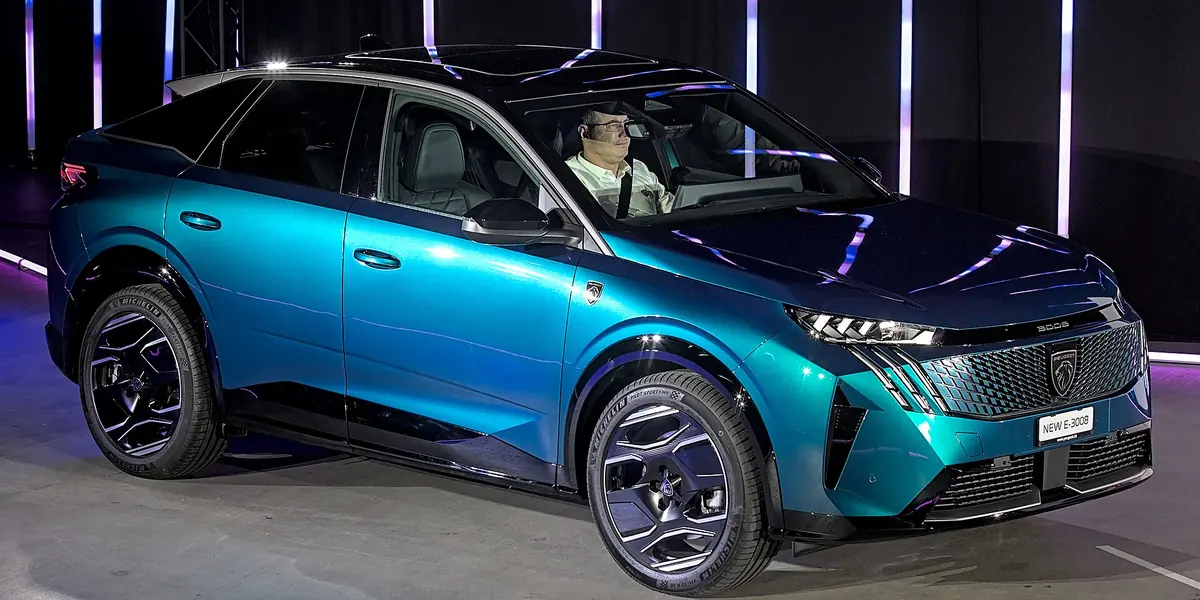
The Peugeot e-3008 is the electric version of the third-generation 3008, and the first car built on Stellantis’s STLA Medium platform — the architecture that now sits under a whole family of European electric SUVs. It was revealed in September 2023, went on sale in early 2024, and is built at Sochaux in France. Peugeot sells it across Europe and the UK; it has never been sold in the United States, and a planned Australian launch never happened.
Every e-3008 uses a nickel-manganese-cobalt (NMC) battery in one of two sizes — 73 kWh usable, or 96.9 kWh usable in the Long Range — driving one front motor, or two motors in the Dual Motor version. This guide covers the verified battery specifications, how far the car really travels, how fast it really charges, what changed on cars built from late 2025, what it costs, and what its battery warranty actually promises.
Battery and specification figures are Peugeot’s and Stellantis’s published data and UK price and specification brochures, cross-checked against EV Database; measured range and charging figures are ADAC’s and NAF’s; the safety rating is Euro NCAP’s.
Quick answer
The e-3008 offers two NMC batteries: 73 kWh usable with up to 527 km (326 miles) WLTP range, and 96.9 kWh usable in the Long Range with up to 700 km (435 miles). All versions charge at up to 160 kW DC and 11 kW AC. The battery warranty is 8 years or 160,000 km with at least 70% capacity guaranteed.
Key figures: 73 / 96.9 kWh usable · 527–700 km WLTP · DC 160 kW · AC 11 kW · heat pump a £700 UK option · warranty 8 yr / 160,000 km.
Battery Sizes and Specifications
The e-3008 has two batteries, both NMC: 73 kWh usable in the standard car, and 96.9 kWh usable in the Long Range, which Peugeot markets as “98 kWh”.
| Version | Battery (usable) | WLTP range | Motor | 0–100 km/h | Top speed | DC charging |
|---|---|---|---|---|---|---|
| Electric 210 | 73 kWh | 527 km (326 mi) | 157 kW (210 hp), FWD | 8.8 s | 170 km/h | 160 kW |
| Electric 230 Long Range | 96.9 kWh | 700 km (435 mi) | 170 kW (230 hp), FWD | 8.7 s | 170 km/h | 160 kW |
| Dual Motor 325 | 73 kWh | up to 306 mi (about 490 km) | 239 kW (325 PS), AWD | 6.0 s | 180 km/h | 160 kW |
Peugeot’s headline figures are usable capacities, and for the Long Range its own UK material states the usable figure precisely as 96.9 kWh. Gross capacities are not published cleanly: the Long Range pack’s total is around 104 kWh by attributed Peugeot France data, while the 73 kWh pack’s total is put at roughly 77–78 kWh by EVKX and by Opel’s figures for the same platform pack in the Grandland. Range varies with trim and wheels — the Long Range GT on larger wheels is rated at 425 miles rather than 435 — so every range figure here is an “up to” for the version named.
The 73 kWh pack is built from 102 cells in a single series string (102s1p) at about 377 V nominal, and weighs 520 kg — the Long Range pack weighs 562 kg and is 15 mm thicker (EVKX; Peugeot Ireland specification).
The STLA Medium Platform
The e-3008’s battery sits in a single flat layer low between the wheels of a platform designed for electric cars first.
STLA Medium is what Peugeot calls a “BEV by design” platform: the 2,739 mm wheelbase and flat floor exist to package the pack, which is why a family SUV of 4,542 mm in length can carry up to 96.9 kWh and still offer a 520-litre boot (470 litres in the Dual Motor). The electric car gets independent multi-link rear suspension; the petrol Hybrid version of the 3008 uses a simpler torsion beam instead. The same platform and the same two battery packs also serve the larger, seven-seat Peugeot e-5008 — a related car whose range figures (500 km and 668 km WLTP) are its own and should never be read across to this one.
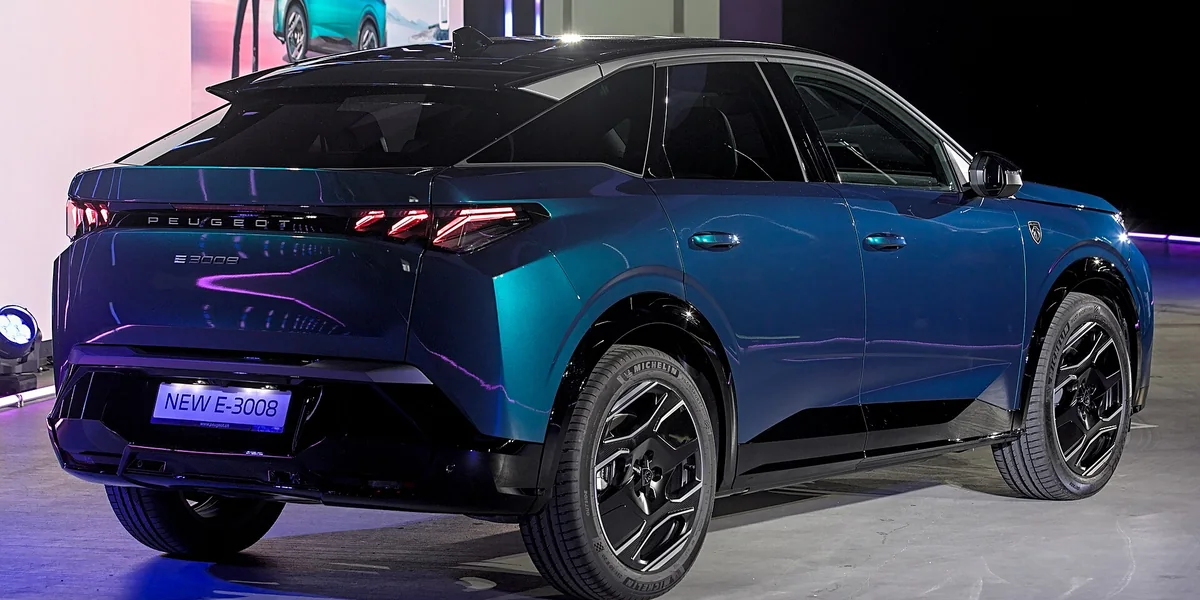
Real-World Range: Measured, Not Claimed
Expect roughly 440 km from the 73 kWh car in mixed driving, about 364 km in a Norwegian winter test, and around 500 km from the Long Range on independent estimates.
What do the independent tests of the 73 kWh car show?
Every independent test located for this guide is of the 73 kWh car. ADAC’s Ecotest measured consumption of 20.1 kWh per 100 km including charging losses — against a 16.9 WLTP rating — which works out to about 440 km against roughly 524 km WLTP for that specification. Norway’s NAF drove the car 448 km in its summer test and 364 km in winter at temperatures between −6 and +8 °C. The UK’s Electrifying found around 180–200 miles in cold-weather motorway use and about 250 miles in warmer, moderate driving.
What about the Long Range?
For the Long Range there is no measured test to quote: EV Database estimates about 500 km (roughly 310 miles) of real-world range, and that estimate is what this page prints, labelled as one. Claims that the Long Range has been “tested” at 350–380 miles are not supported by any test — and the car’s own WLTP consumption figures (17.1–18.1 kWh/100 km against the standard car’s 16.7–17.4) show the Long Range is slightly less efficient per kilometre. Its extra range comes from its bigger battery, not from better efficiency.
Charging: The Claim and the Measurement
Peugeot claims 20–80% in 30 minutes (27 for the Long Range); ADAC measured 40 minutes for 10–80%, and an honest guide carries both numbers.
How fast does it charge on DC?
All three versions peak at 160 kW DC. Peugeot’s published claims are for a 20–80% charge — 30 minutes for the 73 kWh car and 27 minutes for the Long Range. ADAC’s Autotest measured a 10–80% charge at 40 minutes on the standard car, with a curve that falls steeply after its early peak; independent charging guides report the same shape, strong to about 50% and much slower beyond it.
What about AC charging and the heat pump?
At home, the standard 11 kW three-phase onboard charger fills the 73 kWh battery in about 8 hours and the Long Range in about 10 hours 30 minutes (EV Database); on a single-phase home supply the same charger delivers about 7.4 kW. There is no 22 kW charger option on the e-3008 — that option exists on the platform’s Opel Grandland, not on this car.
The heat pump that helps winter efficiency is a paid option in the UK at £700, orderable on any trim; it is standard on the Dual Motor Launch Edition. In other European markets the specification varies, so check the local price list before assuming a car has one.
September 2025: What Actually Changed
Battery preconditioning and vehicle-to-load became standard on newly built cars — this was a production change, not a software update, and earlier cars do not receive it.
How does the new preconditioning work?
On 22 September 2025 Peugeot announced that battery preconditioning would be standard on the e-3008 and e-5008, applying to cars ordered from around October 2025. The system raises the battery’s temperature by about 10 °C in 20 minutes and switches on three ways: automatically when route guidance is heading for a planned charging stop, manually from the touchscreen, or alongside a scheduled cabin preconditioning from the MyPeugeot app. Before this change, the car had no battery preconditioning at all — only cabin preconditioning through the app — and nothing in Peugeot’s announcement offers the feature to cars already built.
What about vehicle-to-load?
The same announcement brought vehicle-to-load (V2L) as standard on new cars by the end of 2025: up to about 3 kW of power for external devices, delivered through a dedicated Type 2 adapter from Peugeot’s accessories catalogue. The practical consequence matters most to used buyers: if preconditioning or V2L matters to you, check the car’s order or build date — a car built before autumn 2025 will not have them, and no update will add them.
Prices in the UK and Europe
The e-3008 launched at £45,850 in the UK and has been discounted heavily since; always check the date on any price you read.
UK orders opened in November 2023 at £45,850 for the Electric 210 Allure and £49,650 for the GT, with German prices from €48,650 and French list prices from €44,990. The Long Range followed from £48,650 in the UK (orders from November 2024, deliveries in early 2025), and the Dual Motor arrived in July 2025. By late 2026 UK list prices had fallen a long way — carwow’s listings put the range at roughly £37,065 to £45,615 — while French list prices started at €45,090 and German prices at €48,090. There is no single European price, and no US price at all: the car is not sold there.
Battery Replacement Cost: No Official Price Exists
Peugeot does not publish a replacement-pack price for the e-3008, and no verified dealer price for either pack has surfaced — any specific figure quoted for this car is invented.
The only numbers in circulation come from generic content sites, and the most repeated of them — a range of €18,000–€24,000 — turns out on inspection to concern the old 3008 Hybrid4, a different car from a previous generation. With the battery under an 8-year warranty and the oldest e-3008s barely two years old, almost no owner has had to price a pack, which is exactly why no real price exists yet. For how replacement pricing works across EVs in general, see our EV battery replacement cost guide.
Lifespan and Degradation: Too New to Measure
No degradation dataset exists for the e-3008, because the car has only been on sale since early 2024.
What can be said rests on the warranty rather than on fleet data: Peugeot guarantees at least 70% of capacity for 8 years or 160,000 km, a floor the company would not offer if typical packs approached it early. General figures for NMC chemistry that circulate online — a percentage of capacity lost per year — are not measurements of this car, and this guide will not present them as if they were. The honest summary is that the pack is a current-generation NMC design under a long warranty, and its real degradation curve will only be known when high-mileage cars have been measured.
Warranty and Recalls
The battery warranty is 8 years with at least 70% capacity guaranteed — 160,000 km in Europe, 100,000 miles in the UK — and a servicing programme extends cover on the rest of the powertrain.
What does Peugeot Care add?
The standard UK vehicle warranty is 3 years or 60,000 miles. On top of it sits Peugeot Care, a programme first introduced on this car: keep the car serviced in the Peugeot network and cover for the electric motor, charger, transmission and main electrical components renews in two-year steps, up to a total of 8 years or 160,000 km (100,000 miles in the UK). It sits alongside, not instead of, the separate 8-year battery warranty.
Are there any battery recalls?
On recalls, there is no battery or charging recall for the e-3008 in any market. The model’s one large campaign — covering roughly 96,000 new-generation 3008 and 5008 cars built between July 2023 and February 2025, including this one — concerns front suspension ball-joint bolts that may fracture; it is a suspension recall, not a battery one, and it is labelled as such here because recall headlines rarely make the distinction.
Safety Rating
The e-3008 scored four stars in Euro NCAP’s 2025 test programme.
Its category scores were 82% for adult occupant protection, 85% for child occupants, 79% for vulnerable road users and 62% for safety assist. Four stars is a respectable result in the tougher modern protocol, but it is four — any source calling this a five-star car is wrong.
The Other 3008s: Hybrids With the Same Name
Two petrol-based 3008s share this car’s body and name, and their batteries are not smaller versions of the e-3008’s — they are different machines entirely.
The 3008 Hybrid 136 pairs a 1.2-litre petrol engine with a 48-volt battery of just 0.88 kWh — a mild hybrid that cannot be plugged in at all. The 3008 Plug-in Hybrid 195 carries a 21 kWh battery (about 17.8 kWh usable) for 85–87 km of WLTP electric range; that is the car behind the “up to 50 miles of electric range” figure that even Peugeot’s own web pages sometimes place next to the e-3008’s 326 miles. The previous-generation 3008’s plug-in hybrids used a 13.2 kWh pack. If a “3008 battery” figure is under 22 kWh, it belongs to one of these cars, not to the e-3008.
Frequently Asked Questions
What battery sizes does the Peugeot e-3008 have?
Two. The standard battery is 73 kWh usable with up to 527 km (326 miles) of WLTP range; the Long Range battery is 96.9 kWh usable — marketed as “98 kWh” — with up to 700 km (435 miles). Both are NMC lithium-ion packs.
What is the real range of the Peugeot e-3008?
ADAC’s measured test of the 73 kWh car works out to about 440 km, and Norway’s NAF recorded 448 km in summer and 364 km in winter. For the Long Range, no independent test exists yet; EV Database estimates about 500 km of real-world range.
How long does the e-3008 take to charge?
Peugeot claims 20–80% in 30 minutes at up to 160 kW DC (27 minutes for the Long Range). ADAC measured 40 minutes for a 10–80% charge on the standard car. At home on the 11 kW onboard charger, a full charge takes about 8 hours (73 kWh) or 10 hours 30 minutes (Long Range).
Is the heat pump standard on the e-3008?
In the UK it is a £700 option that can be ordered on any trim; it is standard on the Dual Motor Launch Edition. Specification varies in other European markets, so check the local price list.
Does my e-3008 have battery preconditioning?
Only if it was ordered from around October 2025. Peugeot made preconditioning standard on newly built cars in its September 2025 announcement; it is a production change, not a software update, so earlier cars do not have it and cannot be updated to get it. The build or order date is the test.
Does the e-3008 have vehicle-to-load (V2L)?
Cars built from late 2025 offer V2L as standard equipment: up to about 3 kW through a dedicated Type 2 adapter sold as a Peugeot accessory. Earlier cars do not have it.
What does a replacement e-3008 battery cost?
There is no official price. Peugeot publishes no pack price and no verified dealer price exists for either battery; the car is covered by an 8-year battery warranty in any case. Figures circulating online trace to the old 3008 Hybrid4, a different car.
How long is the e-3008 battery warranty?
Eight years or 160,000 km in Europe (100,000 miles in the UK), with at least 70% of the battery’s capacity guaranteed. Peugeot Care can also extend cover on the motor, charger and powertrain to the same 8-year span if the car is serviced in the Peugeot network.
Is the e-3008 sold in the United States?
No. Peugeot sells no cars in the US, and the e-3008 is a Europe-and-UK car. A planned Australian launch also never happened.
Is the plug-in hybrid 3008’s battery the same as the e-3008’s?
No. The Plug-in Hybrid 195 has a 21 kWh battery (about 17.8 kWh usable) and 85–87 km of electric range; the Hybrid 136 has a 0.88 kWh 48-volt battery and cannot be plugged in. The e-3008 is fully electric with 73 or 96.9 kWh usable.
Conclusion
The e-3008’s battery story rewards precision: two NMC packs whose usable figures are often misquoted, a headline 700 km range that no independent test has yet been able to check, charging that is respectable in claim and slower in measurement, and a late-2025 production change that quietly split the fleet into cars with preconditioning and V2L and cars without. Get those facts right, and it is one of Europe’s most complete family EVs. If you are working down Peugeot’s electric range, our Peugeot e-208 battery guide covers the smaller car next.
