
Hyundai Santa Fe PHEV Battery: Complete Guide

Researched from Hyundai Motor Europe and Hyundai UK’s own documents, fueleconomy.gov data via InsideEVs, Kia UK and Car and Driver’s instrumented test, checked November 2026.
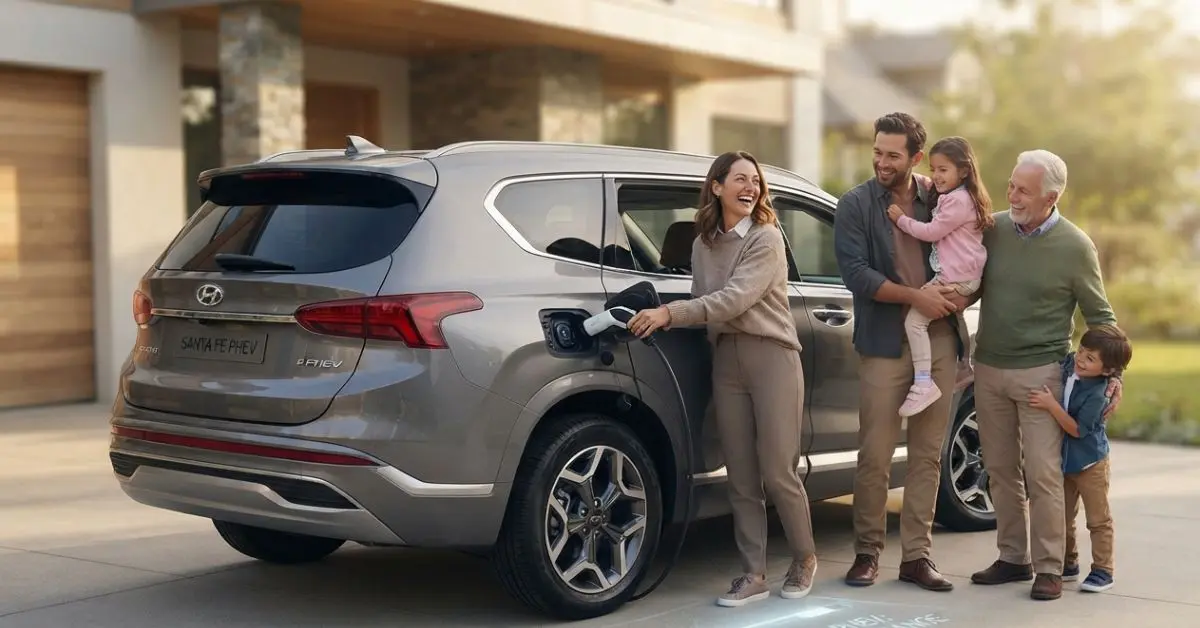
The Hyundai Santa Fe Plug-in Hybrid’s battery holds 13.8 kWh in both generations — the current UK/European car (on sale since 2024) and the US car sold for 2022–2023. Official electric range is 34 miles WLTP for the current car (Hyundai’s own European figure: 58 km) and 30–31 miles EPA for the US car. The onboard charger is just 3.3 kW, so a full charge takes about 3.5 hours — there is no DC fast charging.
• Battery: 13.8 kWh (usable: ~11.6 kWh current car per EV Database; 12.4 kWh US car)
• Electric range: 34 miles WLTP (current) · 30–31 miles EPA (US 2022–2023)
• Charging: 3.3 kW AC only, ~3.5 hours full · no DC
• Seats / towing (UK): 7 seats standard · 1,010 kg at launch, 1,700 kg from September 2025
Hyundai Santa Fe PHEV Battery: Full Specs
Both generations of the Santa Fe Plug-in Hybrid use a 13.8 kWh battery — what changed around it is the power, the towing rating and the price, not the pack.
Is the battery really 13.8 kWh in both generations?
Yes. Hyundai Motor Europe lists 13.8 kWh for the current car, and the US car’s 13.8 kWh pack is confirmed by InsideEVs and Green Car Reports. It is a lithium-ion polymer pack in the US car; current-car sources describe it simply as lithium-ion.
Usable capacity needs an honest label. For the US car, Green Car Reports and Car and Driver put usable capacity at 12.4 kWh. For the current car, EV Database-derived data gives ~11.6 kWh usable — Hyundai itself publishes no usable figure for this generation, so treat 11.6 as a database estimate, not a factory number.
Which Santa Fe PHEV are you looking at?
That question matters more than the battery size, because Hyundai changed this car’s output and towing rating mid-life in September 2025 — and most spec tables online mix the two versions together.
| Current car, launch spec (2024 – Aug 2025) | Current car, updated (Sep 2025 on) | US car (2022–2023) | |
|---|---|---|---|
| Battery | 13.8 kWh | 13.8 kWh | 13.8 kWh (12.4 usable) |
| Official EV range | 34 miles WLTP | 33.6 miles WLTP | 30–31 miles EPA |
| System power | 252 PS | 288 PS | 261 hp |
| 0–62 mph | 9.3 seconds | 8.0 seconds | 0–60 mph 7.5 s (tested) |
| Towing (braked) | 1,010 kg | 1,700 kg | — |
| Onboard charger | 3.3 kW | 3.3 kW | 3.3 kW |
What powers it?
The electric motor is where old articles go wrong. The US car’s motor is 66.9 kW (90 hp), and the system total is 261 hp with the 1.6-litre turbo petrol engine. UK test sources list the current car’s motor at 72 kW (98 hp); one major database still carries the older 67 kW figure, which is likely how wrong numbers keep spreading.
System output for the current car is 252 PS at launch and 288 PS after the September 2025 update. If a listing or article quotes 284 hp and an 8.0-second 0–62 time, it is describing the updated car — check the build date before you rely on it. The current pack runs at a nominal 360 volts (database figure), and nobody — Hyundai included — publishes which company supplies its cells.
Where Is the Santa Fe PHEV Sold?
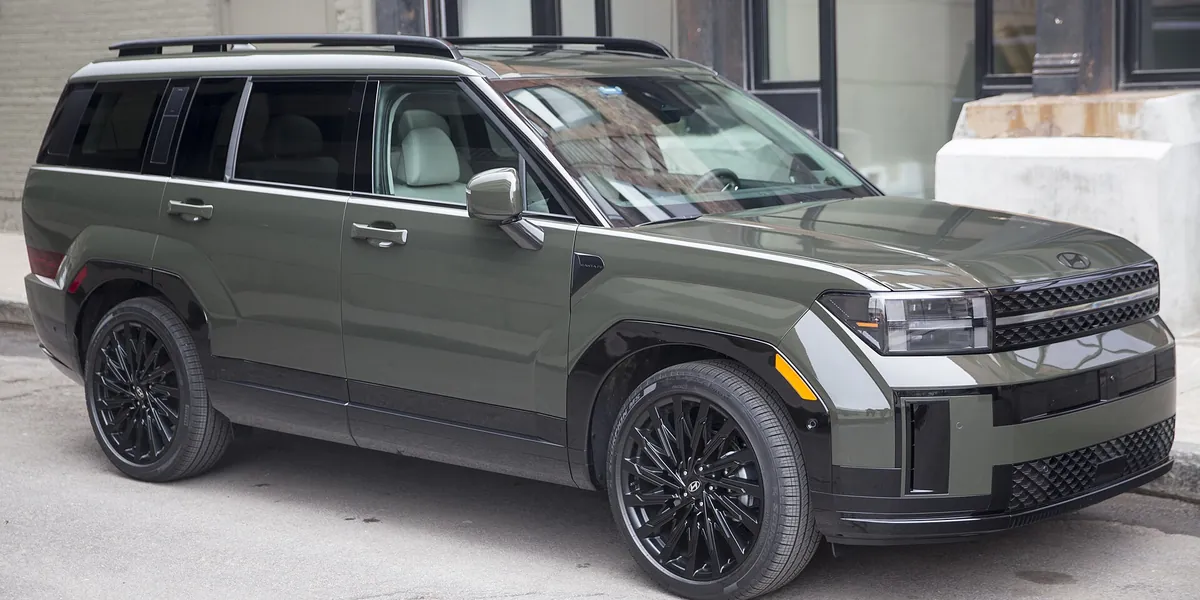
The plug-in Santa Fe is a current car in the UK and Europe, and a used-only car in the United States — the two markets never overlapped on the same generation.
Is there a plug-in hybrid Hyundai Santa Fe in the US?
There was. Hyundai sold the Santa Fe Plug-In Hybrid in the US for model years 2022 and 2023 only, and only in 11 ZEV states (including California, New York and New Jersey). MotorTrend records it as discontinued in the US after 2023; the fifth-generation Santa Fe launched in America as a Hybrid only, with no plug-in version. Hyundai has never published a reason for dropping it.
Can you still buy one new?
In the UK, yes. Hyundai UK’s Model Year 27 price list (effective 1 October 2026) offers the PHEV in Premium (£53,245), Ultimate (£56,745) and Calligraphy (£59,335) trims, on the road. In the US, your only route is a used 2022–2023 car — Kelley Blue Book’s Fair Purchase Price in November 2026 puts a 2022 SEL Convenience at about $20,500 and a Limited at about $23,000, while dealer asking prices for 2023 cars average nearer $27,800.
Real-World EV Range: What to Expect
Officially 34 miles; in measured testing, high-20s on a motorway run — and the car’s honesty problem is that Hyundai’s own documents quote three different figures.
Why do the official figures disagree?
Hyundai Motor Europe’s own pages quote 58 km (36 miles) WLTP. Hyundai UK’s marketing and reviews use 34 miles for the launch car. Hyundai UK’s MY27 document lists 33.6 miles. And EV Database headlines 65 km — higher than anything Hyundai publishes. This page uses Hyundai’s figures and labels each one; if a rival page shows a bigger number without a source, it is probably the EV Database figure wearing no name tag.
What does winter do to it?
No named, instrumented cold-weather test of this car exists — not from ADAC, not from What Car?, not from Electrifying. What exists is EV Database’s modelled estimates (about 47 km at 0 °C) and one owner’s log: 48 km averaged in warm weather against the 58 km WLTP figure, and 35 km in winter. Treat both as indications, not measurements. Anyone quoting you a precise winter figure for this car is estimating.
What happens when the battery is empty?
It becomes a heavy hybrid, and the fuel bills show it. Car and Driver measured 25 mpg in their 75-mph highway test (the EPA rates the car at 33 mpg combined in hybrid mode). A UK road test of the current car, run deliberately with a depleted battery over 615 miles, returned 34 mpg, improving to 48–50 mpg on short local runs. The lesson is the standard PHEV one: this car rewards owners who plug in nightly and punishes owners who never do.
Santa Fe PHEV Charging: The 3.3 kW Truth
The Santa Fe PHEV charges at 3.3 kW — full stop. The internet’s faster figures, including the 11 kW claimed by the top-ranking spec page, are wrong.
How long does a Santa Fe PHEV take to charge?
Hyundai Motor Europe states it plainly: a 3.3 kW onboard charger and 3 hours 30 minutes to charge from 10% to 100% on a 32-amp wallbox. The US car is the same — Green Car Reports and Autoblog both put its charger at 3.3–3.6 kW and a full charge at about four hours, and Hyundai’s own US owner’s manual lists 3 hours 50 minutes from 15% remaining.
| Charging method | Power | Full charge (approx.) |
|---|---|---|
| Home wallbox (UK/EU) | 3.3 kW usable (7.4 kW wallbox) | ~3.5–4 hours |
| US Level 2 (240 V) | 3.3 kW | ~4 hours |
| UK 3-pin socket | ~2.3 kW | ~6 hours |
| US Level 1 (120 V) | ~1.2 kW | ~9–12 hours |
| DC fast charging | Not fitted | — |
Why do so many pages claim faster charging?
Because spec databases copy each other. The highest-ranking page for this car claims an 11 kW charger and a 1.1-hour charge; one leasing site claims 7 kW and 1.7 hours. Neither matches Hyundai’s own published figure for any market. A 7.4 kW home wallbox is still worth having — the car simply takes what it can (3.3 kW) and finishes in about the same time as a bigger-battery PHEV on a faster charger, because the pack is small. Our guide to how PHEV charging works covers the levels and connectors in full.
Does it matter in daily use?
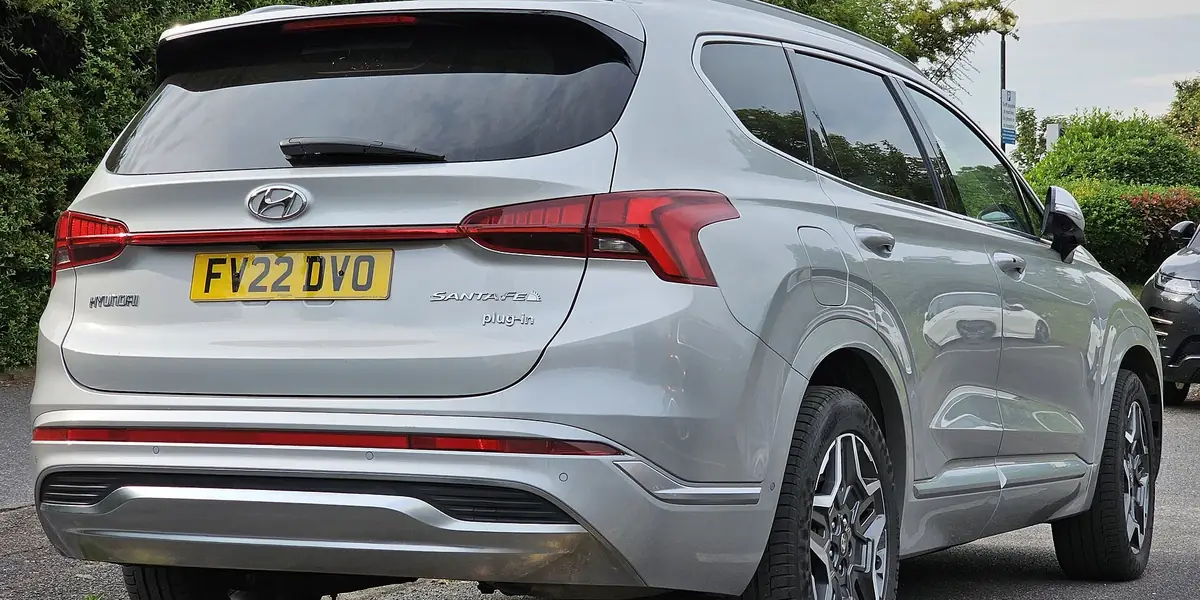
Less than the number suggests. A 3.5-hour charge still fits any overnight window or a workday, and the pack is small enough that even a 3-pin socket covers a typical commute by morning. Where it bites is opportunity charging: an hour plugged in at a supermarket adds only about 3.3 kWh — roughly 8 miles. Plan around full charges, not top-ups.
Looking for the Hybrid’s Battery? It’s a Different Battery
Searches for “Santa Fe hybrid battery size” land on this page, so here is the short answer: the non-plug-in Hybrid’s battery is 1.49 kWh — this page is about the plug-in’s 13.8 kWh pack.
Hyundai’s own specification sheets give the Santa Fe Hybrid a 1.49 kWh lithium-ion polymer battery at 270 volts, driving a 44.2 kW motor. It never plugs in — it charges itself from braking and the engine. If your car has no charge port, that 1.49 kWh figure is yours, and everything else on this page is about your car’s plug-in sibling.
Seven Seats and Towing: Two Reasons People Buy It
Seven seats as standard and — since September 2025 — a 1,700 kg towing rating make the current Santa Fe PHEV a combination few plug-in rivals match.
Are seven seats really standard?
Yes — every UK PHEV trim seats seven, and Hyundai offers a six-seat layout only as a £1,000 option on the Calligraphy. Boot space is 621 litres with the third row folded, just 7 litres less than the Hybrid’s — the battery costs almost no luggage room. That is the quiet engineering win of this car: the plug-in hardware barely dents the family packaging.
How much can it tow?
Read the date, not just the number. Launch cars (2024 to August 2025) are rated at 1,010 kg braked in Hyundai’s material — though Parkers lists 1,110 kg for the same trims, and both figures circulate. From September 2025 the rating rose to 1,700 kg braked (750 kg unbraked), confirmed in Hyundai UK’s MY27 document. The non-plug Hybrid followed the same path, from 1,110 kg at launch to as much as 2,000 kg now.
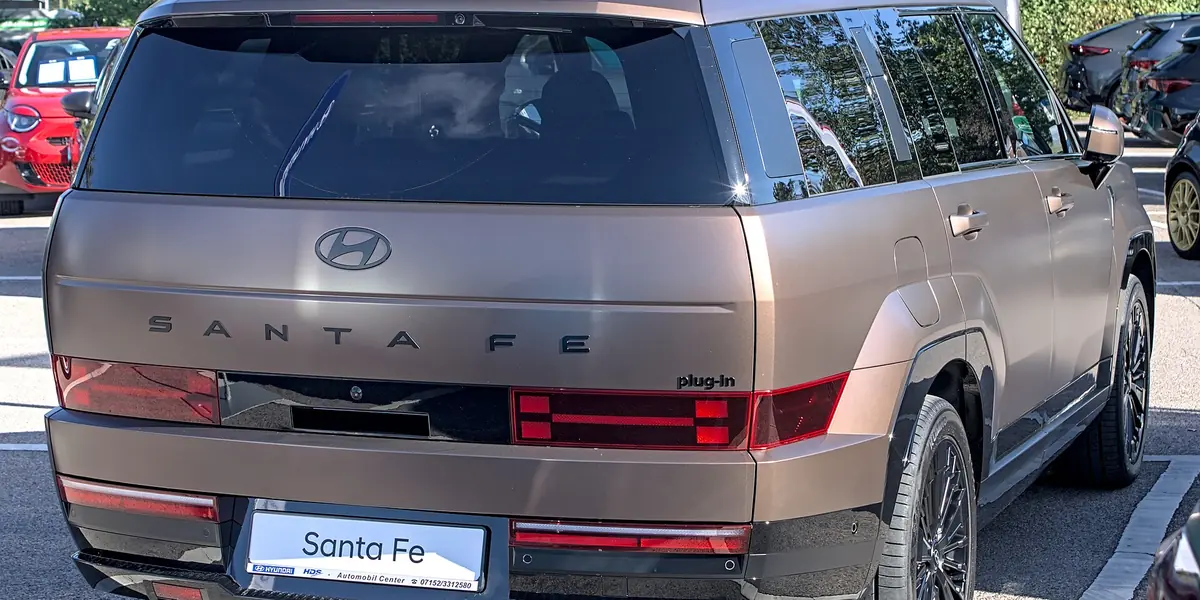
If you tow a caravan, the model-year split is the single most important check on a used current-generation car — a 2024 car and a 2026 car wear the same badge and differ by 690 kg of legal towing capacity.
Battery Life, Warranty and Replacement Cost
The warranty story is better than most articles say — and the degradation story is one nobody can honestly tell you yet, because no measured data for this model exists.
What warranty does the battery carry?
By market — because the terms genuinely differ, and many pages swap them:
| Market | Battery warranty | Capacity floor | Transfers to next owner? |
|---|---|---|---|
| US (2022–2023 cars) | 10 years / 100,000 miles | 70% of original capacity | Yes — full term |
| UK (current car) | 8 years / 100,000 miles | 70% (per CAP data) | Yes |
| Continental EU | 7 years / 150,000 km per EV Database | 70% per same source | — |
Hyundai USA’s terms are unusually clear: the hybrid battery is covered for 10 years or 100,000 miles for the original AND subsequent owners, with capacity warranted not to fall below 70%. The famous first-owner restriction belongs to Hyundai’s separate 10-year powertrain warranty (engine and gearbox) — second owners drop to 5 years/60,000 miles on that one. Articles that tell you the battery warranty dies with the first owner have confused the two warranties. The UK car’s overall vehicle warranty is 5 years with unlimited mileage.
How long will the battery actually last?
Nobody knows — and that is the honest answer. No Santa Fe PHEV degradation dataset exists: no fleet study, no owner state-of-health survey, no measured percentage for this model has been published. Figures floating around (“1.5–2% a year”, “over 80% after ten years”) are generic plug-in estimates with no Santa Fe data behind them.
What can be said from evidence: the pack is small, liquid-cooled, and — per a UK road test — the car holds back roughly 10–15% of its charge in reserve, which is the kind of buffer that protects a pack. And the warranty floor is a hard promise: below 70% capacity inside the term, Hyundai repairs or replaces. If you are buying used, the checks that actually tell you something are a full-charge range test (a healthy current car should show close to its rated range in mild weather), a Hyundai dealer health readout, and confirmation that the tow-hitch recall below has been done.
What does a replacement battery cost?
There is no published Hyundai price, and no dealer quote or owner invoice for this car’s pack exists in the public record. The only figures available are independent guides’ estimates, and they must be read as estimates: $3,800–$4,500 from one replacement-cost guide (its own site says the figure is extrapolated from other Hyundai hybrids, before labour and shipping) and $4,500–$6,500 plus $500–$1,000 labour from another.
One warning that will save somebody money: most dealer pages ranking for “Santa Fe plug-in hybrid battery” are selling the 12-volt auxiliary battery — the small battery that starts the car, at a few hundred dollars. That is not the traction pack, and a cheap quote for “a Santa Fe PHEV battery” is almost always the 12-volt part.
Any battery recalls?
No recall touches this car’s high-voltage battery or charging system. The one recall a US buyer must check is NHTSA 23V-181 (Hyundai recall 244): a trailer tow-hitch wiring harness that could short and, in the worst case, catch fire — 567,912 vehicles including 2022–2023 Santa Fe PHEVs. The fix (a fuse and wiring kit) is free; until it was done, owners were told to park outside. It is a harness recall, not a battery recall — but on a car bought partly for towing, it matters.
The US Car: 2022–2023 (Previous Generation)
The Santa Fe PHEV America got was the previous-generation car — same 13.8 kWh pack size, different body, and a short two-year run.
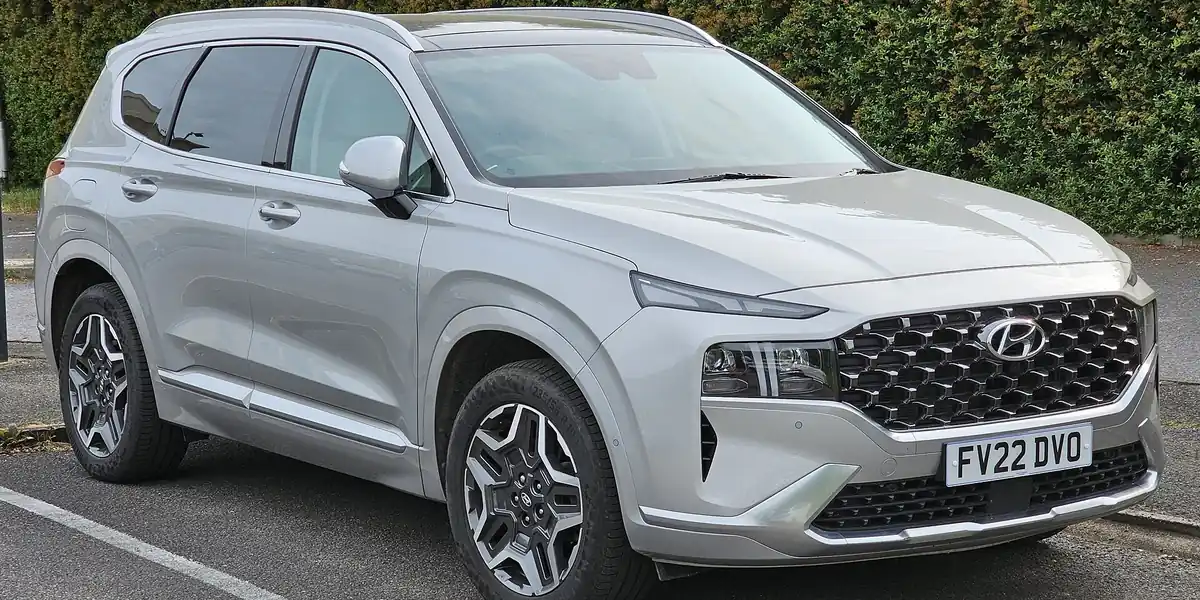
Its figures: 12.4 kWh usable from the 13.8 kWh lithium-ion polymer pack, a 90 hp electric motor, 261 hp in total, and an EPA rating of 30–31 miles of electric range with 33 mpg in hybrid mode and a 440-mile total range. Car and Driver’s instrumented test nearly matched the EPA figure — 29 miles at a steady 75 mph — and recorded 25 mpg on the highway once the battery was spent.
Prices tell the used story. New, a 2022 SEL Convenience cost $40,535 and the Limited $46,545. In November 2026, Kelley Blue Book’s Fair Purchase Price is about $20,500 for that SEL Convenience — these cars have roughly halved, while their battery warranties (10 years/100,000 miles, fully transferable) still have years to run on most examples. For a seven-seat plug-in with warranty left, that is a genuinely interesting used buy — provided the tow-hitch recall is closed and the range test checks out.
Read more: the Pacifica Hybrid takes the same seven-seat plug-in idea in minivan form.
Santa Fe PHEV vs Its Seven-Seat Rivals
Against the other seven-seat plug-ins a UK buyer can order today, the Santa Fe’s battery is the smallest — and its warranty is among the longest.
| Model | Battery | WLTP EV range | Seats | Towing (braked) | UK price from |
|---|---|---|---|---|---|
| Hyundai Santa Fe PHEV | 13.8 kWh | 34 miles | 7 | 1,010–1,700 kg* | £53,245 |
| Kia Sorento PHEV | 13.8 kWh | 34 miles | 7 | 1,010 kg | £46,445 |
| Peugeot 5008 Plug-in Hybrid | 21 kWh (17.8 usable) | 48 miles | 7 | 1,300 kg | £43,350 |
| Toyota RAV4 Plug-in (outgoing) | 18.1 kWh (14.5 usable) | 46 miles | 5 | 1,500 kg | £45,230 |
| Mitsubishi Outlander PHEV | See note | 53 miles | 5+2 / 7 | — | £46,995 |
*Santa Fe towing depends on build date: 1,010 kg before September 2025, 1,700 kg after. Sorento range and towing are from Kia UK’s own specification page — several rival articles quote 40 miles and 1,650 kg, neither of which Kia publishes. The RAV4 row is the outgoing car; an all-new RAV4 Plug-in with a 22.7 kWh battery and up to 102 km (63 miles) of WLTP range is arriving for 2026. Mitsubishi’s own launch material and UK reviewers quote different Outlander battery sizes (27.7 vs 22.7 kWh) and neither states which is gross or usable, so this table prints neither — check the car’s own documents.
Read it plainly: the Peugeot and the new Mitsubishi beat the Santa Fe on electric range, the Kia matches it almost part for part (the two Korean cars share their battery size), and the Santa Fe counters with price positioning at the top of the group, its post-2025 towing rating, and a battery warranty that — in the US — outlasts every rival here.
Frequently Asked Questions
How big is the Hyundai Santa Fe PHEV battery?
13.8 kWh in both generations. Usable capacity is 12.4 kWh in the US car (2022–2023); for the current car, EV Database-derived data suggests about 11.6 kWh, but Hyundai publishes no usable figure for this generation.
How long does a Santa Fe PHEV take to charge?
About 3.5 hours from a home wallbox (10–100%), because the onboard charger is 3.3 kW — Hyundai Motor Europe’s own figure. A UK 3-pin socket takes about 6 hours. Claims of 7 kW or 11 kW charging for this car are wrong; no version has DC fast charging.
What is the Santa Fe PHEV’s real electric range?
Officially 34 miles WLTP for the current car and 30–31 miles EPA for the US car. Car and Driver measured 29 miles at a steady 75 mph in the US car. Expect less in winter — modelled estimates suggest roughly 47 km (29 miles) at 0 °C for the current car — but no instrumented winter test exists.
Is the Santa Fe PHEV sold in the US?
Not since 2023. Hyundai sold it for model years 2022–2023, in 11 ZEV states only, and the current US Santa Fe is a Hybrid with no plug-in version. UK and European buyers can still order the PHEV new.
Does the battery warranty transfer to a second owner?
In the US, yes — Hyundai covers the hybrid battery for 10 years/100,000 miles for original and subsequent owners alike, down to a 70% capacity floor. It is the separate powertrain warranty that shrinks for second owners, a distinction many articles get backwards.
How much does a Santa Fe PHEV battery replacement cost?
Hyundai publishes no price, and no dealer quote exists in the public record. Independent guides estimate $3,800–$4,500 for the pack (extrapolated from other Hyundai hybrids, before labour), with another guide putting a fitted replacement at $4,500–$6,500 plus labour. Beware cheap quotes: most “Santa Fe PHEV battery” prices online are for the 12-volt auxiliary battery.
Is the Santa Fe PHEV being discontinued?
In the US it already has been (after 2023, with no reason published by Hyundai). In the UK and Europe it is a current model — Hyundai UK’s MY27 price list, effective October 2026, still offers all three trims.
Santa Fe PHEV or Hybrid — which battery do I have?
If your car has a charge port, it is the plug-in: 13.8 kWh. If it doesn’t, it’s the Hybrid: 1.49 kWh, self-charging only, and it never needs plugging in. The two cars share a name and a body, not a battery.
Conclusion
The Santa Fe PHEV’s battery is a modest 13.8 kWh pack wrapped in an unusually practical car — and a magnet for wrong numbers.
Corrected, the story is simple: a 3.3 kW charger and a 3.5-hour charge, not the 11 kW of the top-ranking page; a warranty that transfers in full in the US, not one that dies with the first owner; and a towing rating that jumped by 690 kg in September 2025 without the badge changing. Buy the car for what it verifiably is — seven seats, all-wheel drive, honest electric commuting range — and check the build date, the recall record and a full-charge range test before you pay for one.
