
How Much Electricity Does Charging an EV Use Per Month?

Wondering how much your electric bill will increase after buying an EV? The answer depends on your driving habits, EV efficiency, and local electricity rates.
Charging an EV uses approximately 250–400 kWh of electricity per month for a typical American driving 1,000 miles per month. This translates to a monthly electricity cost increase of approximately $40–$75 at the U.S. average residential rate of $0.17–$0.19/kWh. The exact amount depends on your EV’s efficiency, how many miles you drive, and what electricity rate you pay. Here is a complete breakdown of monthly EV electricity consumption for 2026.
How to Calculate Your Monthly EV Electricity Use
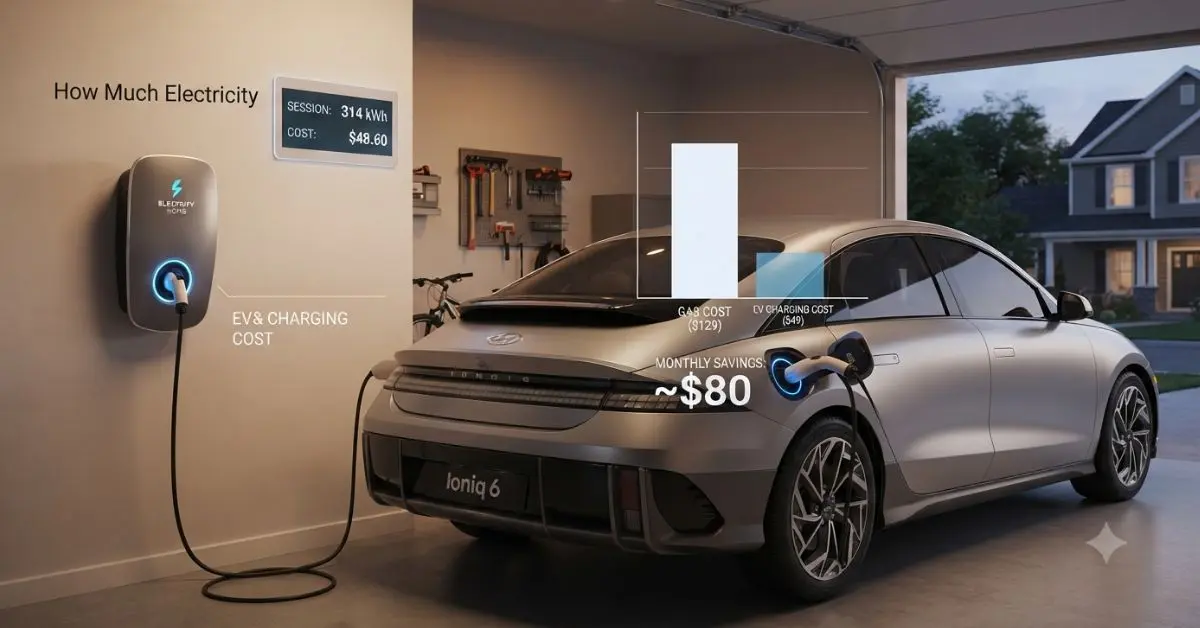
The formula is simple: Monthly kWh = Miles Driven ÷ EV Efficiency (mi/kWh). For example, if you drive 1,000 miles per month and your EV averages 3.5 miles per kWh, you consume approximately 286 kWh monthly. Multiply by your electricity rate: 286 kWh × $0.17/kWh = $48.60 per month. Add 10% for charging losses (Level 2 is about 90% efficient), and your actual kWh drawn from the wall is approximately 314 kWh monthly.
Monthly Electricity Use by EV and Mileage
| EV Model | Efficiency | 500 mi/mo | 1,000 mi/mo | 1,500 mi/mo | Monthly Cost (1,000 mi at $0.17) |
|---|---|---|---|---|---|
| Hyundai Ioniq 6 LR RWD | 4.1 mi/kWh | ~122 kWh | ~244 kWh | ~366 kWh | ~$41 |
| Tesla Model 3 LR RWD | 3.8 mi/kWh | ~132 kWh | ~263 kWh | ~395 kWh | ~$45 |
| Tesla Model Y LR AWD | 3.4 mi/kWh | ~147 kWh | ~294 kWh | ~441 kWh | ~$50 |
| VW ID.4 Pro | 3.0 mi/kWh | ~167 kWh | ~333 kWh | ~500 kWh | ~$57 |
| Ford F-150 Lightning (ER) | 2.1 mi/kWh | ~238 kWh | ~476 kWh | ~714 kWh | ~$81 |
| GMC Hummer EV | 1.6 mi/kWh | ~313 kWh | ~625 kWh | ~938 kWh | ~$106 |
How EV Charging Compares to Total Home Electricity Use
The average U.S. home uses about 900 kWh of electricity each month. Adding a typical electric vehicle (EV) increases home energy use by about 32%. This equals about 286 kWh of extra power every month for 1,000 miles of driving.
This change adds $48–$65 to your monthly electric bill. However, you will save $120–$180 on gas costs. Most drivers save between $70 and $130 each month on total transportation costs.
Factors That Affect Monthly EV Electricity Use
EV Efficiency
EV efficiency (miles per kWh) is the most important factor. Efficient EVs like the Ioniq 6 use about 40% less electricity per mile than large electric trucks.
Weather
Cold weather increases energy consumption by 20–40% because cabin heating uses significant power. Hot weather increases consumption by 5–15% due to increased air conditioning use.
Driving Style
Highway driving uses more energy than city driving. Mixed driving usually results in lower efficiency than city-only driving.
Charging Losses
Level 1 charging loses approximately 15–20% of electricity as heat. Level 2 loses about 8–12%, while DC fast charging loses around 5–8%.
Vehicle Accessories
Heated seats, a heated steering wheel, and climate control in extreme temperatures increase overall electricity consumption.
Seasonal Variation in EV Electricity Use
| Season | Impact on Consumption | Typical Efficiency Change | Monthly kWh Change (1,000 mi) |
|---|---|---|---|
| Spring/Fall (60–70°F) | Optimal — baseline | 100% | ~280–300 kWh |
| Summer (above 90°F) | Higher (AC load) | 85–95% of baseline | ~300–350 kWh |
| Winter (below 32°F) | Highest (heating load) | 65–80% of baseline | ~375–460 kWh |
EV Electricity Use vs Gasoline Costs
A gas car that travels 1,000 miles each month at 30 mpg uses about 33 gallons of gas. At $3.92 per gallon, this costs you about $129 per month.
Driving an electric vehicle (EV) for those same 1,000 miles costs about $49 per month when you charge it at home for $0.17 per kWh. This saves you about $80 each month, totaling $960 annually.
Conclusion
A typical electric vehicle driven 1,000 miles each month uses 250–400 kWh of electricity. This adds $40–$75 to your monthly power bill at average rates. You pay 60–70% less than the cost of gas, on average, for most drivers.
Efficient cars like the Hyundai Ioniq 6 use the least amount of electricity. Large electric trucks like the GMC Hummer EV use the most. Use your smart charger app to track your monthly kWh. This helps you save money by charging during off-peak times or using solar power.
FAQs
How many kWh does an EV use per month?
A typical EV uses about 250–400 kWh of electricity per month if you drive around 1,000 miles.
How much does charging an EV add to your monthly electric bill?
For most U.S. drivers, home charging adds about $40–$75 per month, depending on electricity rates and driving habits.
Does cold weather increase EV electricity use?
Yes. Cold weather can increase electricity consumption by 20–40% because the battery and cabin require additional heating.
