
How Does Public EV Charging Work?

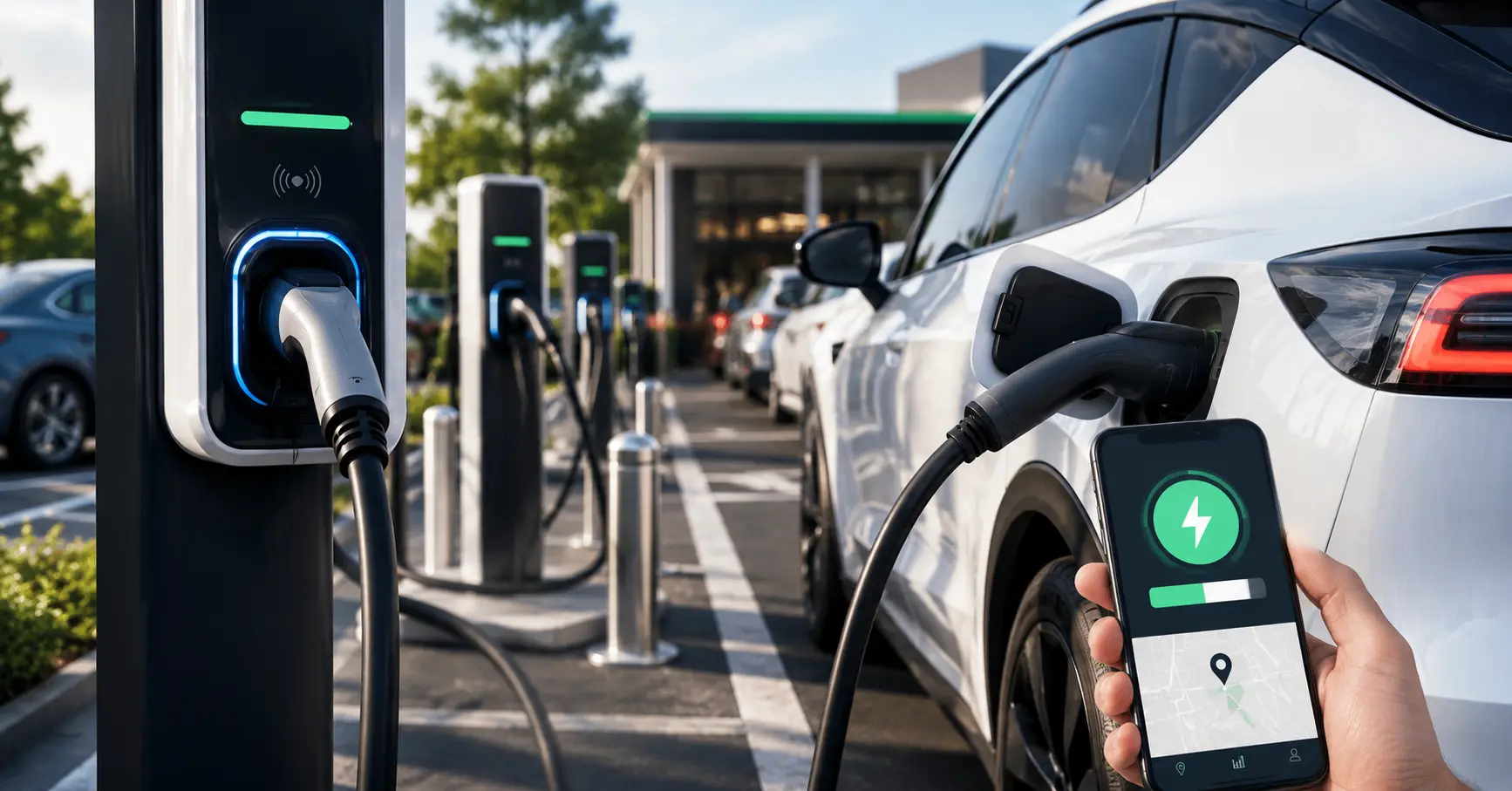
Planning to charge your EV away from home for the first time? Knowing what happens before you arrive can make every charging stop faster, easier, and stress free.
Public EV charging works by connecting your car to a networked charging station, authenticating payment, and delivering electricity to the battery, all in under a minute of setup. Most public chargers use a tap, plug, and charge process: tap a credit card or use the network’s app, plug in the connector, and charging starts automatically.
This guide explains exactly how public EV charging works, what to expect at each type of station, and how to pay at the most common networks in the U.S.
Wondering which connector you’ll actually be plugging in? See our comparison of CCS vs NACS: which charging standard is better.
How Public EV Charging Works
Step 1 — Find the station
Use PlugShare, A Better Routeplanner, your car’s built-in navigation, or the specific network’s app (Electrify America, Tesla, ChargePoint, EVgo) to find a public charger near you. Most apps show real-time availability so you can see which stalls are open before you arrive.
Step 2 — Pull up and plug in
Park next to the charger and open your EV’s charging port. The cable on the station (or in a holster at DC fast stations) connects to your car’s port. For NACS-equipped EVs at Tesla Superchargers, just plug in — the charger recognises your car automatically via Plug & Charge or your Tesla/non-Tesla account.
Step 3 — Authenticate and pay
Most stations allow payment by credit card tap, network RFID card, or the charger’s smartphone app. Plug & Charge (ISO 15118) is supported at an increasing number of modern stations — this automatically identifies your car and bills your registered payment method without any card or app interaction.
Step 4 — Charge and go
Once authenticated, charging starts immediately. Monitor progress on the charger’s screen or your car’s dashboard. For DC fast chargers, plan to stop at 80% — above 80%, charging slows significantly. Unplug when done by pressing the cable release button, hang the cable back on the station, and drive off.
Types of Public Charging Stations
| Type | Speed | Typical Location | Pricing | Time for 100 Miles |
|---|---|---|---|---|
| Level 2 (6–7.7 kW) | 18–25 miles/hr | Shopping, hotels, workplaces | $0–$0.40/kWh or hourly | 4–5 hours |
| Level 2 (11.5 kW) | ~30 miles/hr | Destination chargers, some public | $0–$0.35/kWh | ~3.5 hours |
| DC Fast (50–100 kW) | 100–200 miles in 30–60 min | Highway, urban fast-charge hubs | $0.35–$0.60/kWh | 30–60 min |
| DC Fast (150–350 kW) | 150–300+ miles in 20–45 min | Highway corridors, Tesla Supercharger | $0.32–$0.55/kWh | 15–25 min |
How to Pay at Public EV Chargers
- Credit card tap (contactless): Most modern public chargers — Electrify America, EVgo, ChargePoint, IONNA — accept contactless credit card payment directly at the station with no app or account required
- Network app: Download the specific network’s app (Tesla, Electrify America, EVgo, ChargePoint) for session monitoring, notifications, and often lower per-kWh rates through membership plans
- RFID card: ChargePoint, Blink, and several networks issue RFID cards that tap to activate charging — useful if your phone battery is dead
- Plug & Charge (ISO 15118): Plug & Charge removes the need for a card or app. Your vehicle automatically identifies itself to the charging station, and your registered payment method is billed automatically. It is supported by Electrify America, IONNA, and Tesla Superchargers for compatible vehicles.
What If a Charger Is Broken or Occupied?
Broken or occupied chargers are the most common frustration with public EV charging. Before committing to a specific station, use PlugShare to check recent user check-ins — if multiple drivers report issues in the past 24–48 hours, find an alternative. Most network apps also show real-time stall availability. Plan to have at least two charging options when travelling — a primary destination and a backup within 10–15 miles. As charging infrastructure has expanded to 248,000+ public ports in the U.S. in 2026, the odds of finding an available, working charger have improved significantly.
Understand Idle Fees Before Leaving Your Car
Most public charging networks charge idle fees after your session completes if you leave your car blocking the stall. Tesla Supercharger idle fees start at $0.50/minute when the station is at full capacity. Electrify America charges $0.40/minute for idle time after a session ends. These fees add up quickly — a 30-minute post-charge idle session at Tesla can add $15 to your charging bill. Your car’s app and most network apps send push notifications when charging completes to help you move promptly.
Public EV Charging Network in the United States
The U.S. features over 80,000 public EV charging stations with more than 248,000 charging ports. Tesla operates approximately 3,088 Supercharger stations with over 37,428 ports, making it the largest and most reliable fast-charging network. Other networks like Electrify America, EVgo, ChargePoint, Blink, and IONNA make up the rest of the options.
The federal NEVI (National Electric Vehicle Infrastructure) program adds thousands of new DC fast charging stations along major U.S. highway corridors. This program focuses on placing stations every 50 miles on designated routes to help drivers travel long distances easily.
Heading out on a long trip and want the fastest option? See our guide on what Electrify America is and how it works.
Conclusion
Public EV charging is a simple four-step process. You find a station, plug in your car, pay, and charge. Credit card taps work at most stations so you do not need to download an app.
DC fast chargers add 100 to over 200 miles of range in 20 to 45 minutes at highway stations. Level 2 public chargers fit destination charging during shopping trips, dinners, or hotel stays.
A growing public network with over 248,000 ports makes road trips and away-from-home charging easy. Planning your stops ahead of time remains the smartest habit for stress-free long-distance travel.
Have an older CCS-equipped car? See our guide on whether non-Tesla cars can use Tesla Superchargers.
