
Is It Bad to Always Fast Charge Your EV?

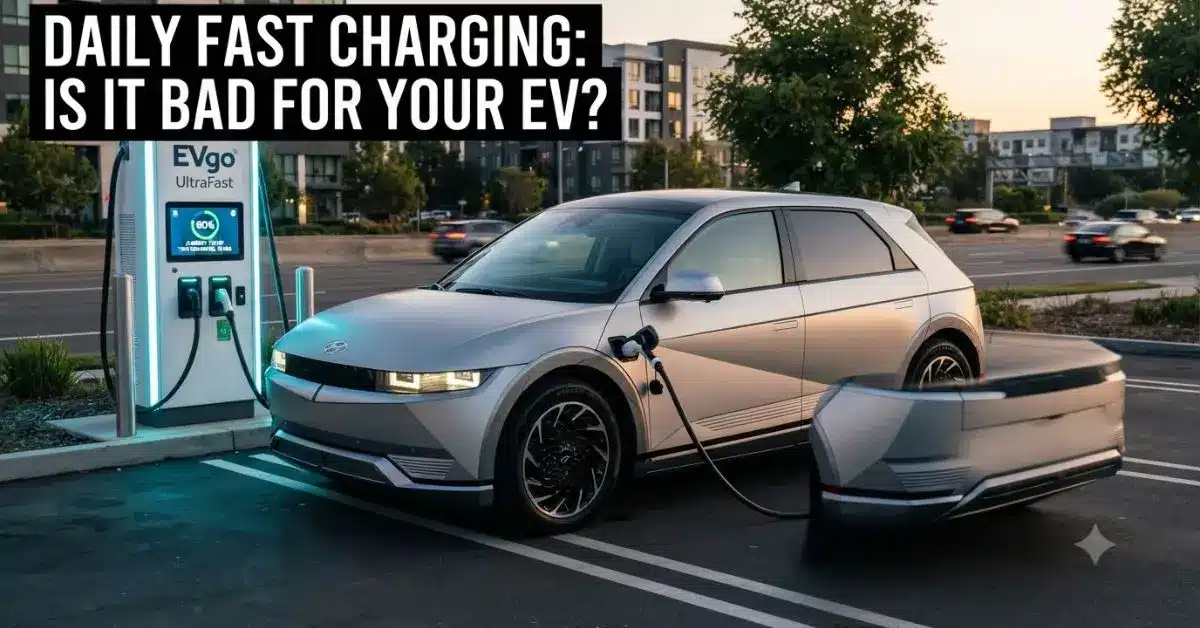
Always fast charging your EV is bad for the battery — but “bad” needs context. Daily DC fast charging causes approximately 2–4% more capacity loss over 5 years compared to predominantly Level 2 home charging. This is meaningful but not catastrophic for modern liquid-cooled EVs. The damage is most severe on air-cooled EVs (older Nissan Leafs), in extreme heat without preconditioning, or when charging above 80% SoC on DC fast chargers. For most EV owners, occasional DC fast charging is fine — daily fast charging is the habit to avoid.
What Research Shows About Frequent DC Fast Charging
A 2019 Idaho National Laboratory study found EVs fast charged daily degraded approximately 3x faster than those using only Level 2 — but this study used older air-cooled technology. Recurrent Auto’s analysis of 15,000+ modern EVs found a more modest 2–4% additional degradation over 5 years for frequent fast-charging users vs predominantly Level 2 users. Battery engineers at Tesla, Hyundai, and other manufacturers have publicly stated that modern thermal management systems significantly reduce the degradation difference between Level 2 and DC fast charging compared to older generations.
The Four Ways Fast Charging Accelerates Battery Degradation
- Heat generation: High current flow at 150–350 kW generates significantly more heat in cells than Level 2 — heat is the primary driver of electrolyte decomposition and capacity loss over time
- Lithium plating: Charging at very high rates without adequate preconditioning causes lithium ions to deposit on the anode surface rather than insert properly — permanently reducing capacity
- Mechanical stress: Rapid charging causes faster expansion and contraction of electrode materials — leading to microscopic cracks over thousands of cycles compared to slower, gentler Level 2 cycles
- High state of charge dwell time: DC fast charging above 80% SoC keeps cells at high voltage longer than Level 2 topped at 80% — chronic high-SoC stress compounds over time
Which EVs Handle Frequent Fast Charging Best?
| EV / Battery Type | Resilience to Frequent DC Fast Charging | Notes |
|---|---|---|
| Hyundai Ioniq 5/6, Kia EV6/EV9 (800V) | Very high | Engineered for frequent high-power charging; excellent thermal management |
| Tesla Model 3/Y (NMC) | High | BMS designed around Supercharger use; robust thermal management |
| Porsche Taycan (800V) | Very high | Designed for frequent track and road-trip fast charging |
| VW ID.4, BMW i4, Ford Mach-E (400V NMC) | Moderate | Good thermal management; limit to 1–2x/week for best results |
| Tesla Model 3 Standard Range (LFP) | High | LFP chemistry tolerates fast charging better than NMC |
| Nissan Leaf (2011–2022, air-cooled) | Very low | No liquid cooling — DC fast charging significantly accelerates degradation |
The Practical Impact: What Actually Happens to Range
Suppose you own a 300-mile-range EV and fast charge daily for 5 years. With 2–4% additional degradation from frequent fast charging (vs Level 2-only), you might retain 85–88% capacity vs 89–93% for a Level 2-primary user. The practical difference: approximately 10–15 miles less range by year 5 — from 300 miles at delivery to approximately 255–265 miles (frequent fast charging) vs 267–279 miles (predominantly Level 2). Both remain well above the 70% warranty threshold. The difference is real but modest for modern thermal-managed EVs.
When Always Fast Charging Becomes a Real Problem
Daily DC fast charging becomes genuinely damaging in specific scenarios. Using a Nissan Leaf (2011–2022) — which lacks liquid cooling — for daily DC fast charging in hot climates like Arizona can reduce battery capacity to 70% in under 3 years. Charging above 80% SoC on a DC fast charger daily stresses cells at two compounding stress points (heat + high voltage). Fast charging without preconditioning in sub-freezing temperatures causes the most severe short-term lithium plating damage. Avoiding these specific combinations is more important than simply reducing fast-charging frequency on modern liquid-cooled EVs.
The Bottom Line: How Often Is Too Often?
- 1–2 DC fast charges per week: Fine for virtually all modern liquid-cooled EVs — this is the recommended maximum from most manufacturers
- Daily DC fast charging (with good habits — precondition, stop at 80%): Approximately 2–4% additional capacity loss over 5 years vs Level 2 — real but modest
- Daily DC fast charging (no preconditioning, charging above 80%): More significant damage — particularly in cold climates or hot climates without effective cooling
- Daily DC fast charging on air-cooled Nissan Leaf: Significant accelerated degradation — genuinely harmful and to be avoided
Conclusion
Always fast charging your EV is bad for the battery — but the degree of harm depends heavily on your specific EV, climate, and charging habits. For modern liquid-cooled EVs, daily DC fast charging with preconditioning and stopping at 80% causes approximately 2–4% more degradation over 5 years than Level 2 home charging — real but manageable. For air-cooled EVs, it is genuinely harmful and should be minimised. The best overall strategy remains unchanged: home Level 2 charging for daily use, DC fast charging for road trips and genuine necessities, always with preconditioning, always stopping at 80%.
